The Politics of Plunder
Trump’s domestic and foreign policies have one consistent theme.


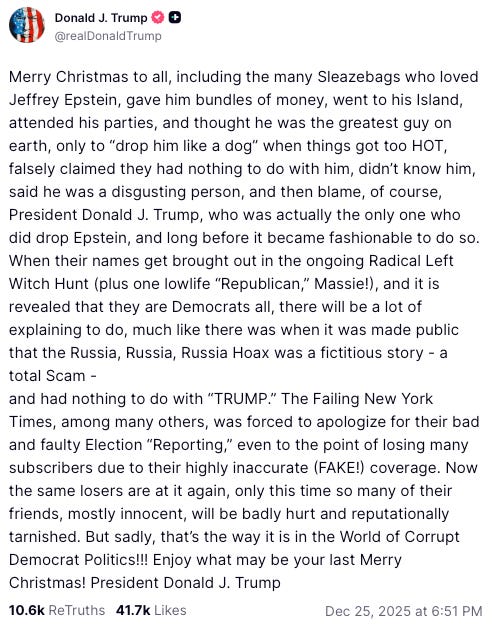
MAGA Christmas was a choose-your-own-adventure affair this year. Did you want to hear Donald Trump wax eloquent, in what is definitely his own writing, about “the graces of Christ’s life, death, and resurrection” that “pour out on all who believe”? Just head over to his “Presidential Message on Christmas,” posted to the White House website. Are you the sort who found all that a little pious and drab? You might find Trump’s Truth Social message a little more your speed:
Joy to the World! Happy Friday.
The President Is a Pirate
by Will Saletan
Donald Trump calls himself the “Peace President.” But this week, as he outlined his plans to capture Greenland and hijack Venezuelan oil, his real agenda became obvious. It’s not peace. It’s extortion, conquest, and theft.
Trump spent his life pursuing wealth, not public service. As president, he reduces every question to money. He arm-twists companies into giving the government a chunk of their stock. He withholds food stamps as a bargaining chip. He calls low-income housing an offense against rich people. He muses about awarding himself $1 billion from the Treasury.
He treats international relations the same way. He slaps our allies with heavy tariffs, insisting that they “pay for the privilege of access to our market.” He bails out Argentina, meddles in its election, and then brags that his candidate’s victory “made a lot of money for the United States.” He bars immigrants from “third world countries” and sells visas to multimillionaires instead.
He also exploits war. Two months ago, in a speech to American troops in Japan, he fondly recalled the days when “they used to say, ‘To the victor belong the spoils.’” In more recent wars, he complained, “We’d win, and then we’d leave.” He made it clear that he would restore the doctrine of spoils. “Unlike past administrations, we will not be politically correct,” he told the troops.
In some parts of the world, Trump has cashed in on the use of force by other countries. In February, after Israel had leveled much of Gaza, he announced a plan to seize the territory, “own it,” and develop it into “the Riviera of the Middle East.” A reporter asked the president whether he truly meant permanent occupation. “I do see a long-term ownership position,” Trump replied.
In Ukraine, Trump has taken advantage of Russia’s invasion. By choking off Ukraine’s access to military aid and intelligence, he extracted Kiev’s agreement to give much of its mineral wealth to the United States. “I made a deal to take rare earth,” he boasted. “That’s the equivalent of much more” than the aid Joe Biden had sent to Ukraine, he said.
Trump also found a second revenue stream from the war: selling weapons to NATO—at “full price”—which NATO would then deliver to Ukraine. “We’re making money,” he told reporters. “We have the hottest company,” he added a minute later. Then, catching his slip, he corrected the last word to “country.”
Like Vladimir Putin, Trump has concocted grievances to justify aggression against other nations. In his inaugural address, he vowed to seize the Panama Canal, claiming that Panama had violated its 1977 agreement to keep the canal neutral. Then, in a bid to annex Canada, he threatened to choke off that country’s foreign trade. To rationalize his coercion, he alleged that Canada “stole” its auto industry from the United States.
Now Trump has deployed the Navy, the Coast Guard, and other forces to harass and intimidate Venezuela. Last week, he issued an ultimatum, warning that the military buildup would continue until Venezuelans “return to the United States of America all of the Oil, Land, and other Assets that they previously stole from us.”
Trump’s tales of oil and land theft apparently date to 1976, when Venezuela nationalized its oil industry. As usual, he’s wrong—American companies didn’t own any of Venezuela’s land or oil—but he’s plotting to capitalize on his propaganda. On Monday he said he had spoken to “all the big” U.S. oil companies about returning to Venezuela once the current government, under American pressure, is ousted.
And oil companies aren’t the only ones who stand to profit. Last week, Sen. Mike Lee of Utah, a Trump ally, introduced legislation authorizing “private American citizens and their businesses” to confiscate boats and other alleged property of drug cartels.
Meanwhile, after months of hectoring Greenland to separate from Denmark and join the United States—under threats of tariffs and military force—Trump announced on Monday that he had appointed a special envoy whose self-described assignment was to “make Greenland a part of the U.S.” Trump dismissed Denmark’s sovereignty over Greenland, scoffing, “They say that Denmark was there 300 years ago or something with a boat. Well, we were there with boats, too, I’m sure.”
This isn’t the foreign policy many of Trump’s voters wanted. They thought “America First” meant staying home. Instead, Trump has gone abroad to seize land and treasure. He’s a pirate. And being a pirate is all fun and games until somebody loses an island.
Donald and Vlad Want Elections . . . in Ukraine
by Cathy Young
There’s a lot that Moscow found not to like in the twenty-point U.S.–Ukraine draft peace plan unveiled on Wednesday. It offers Ukraine strong security guarantees, doesn’t restrict the size of the Ukrainian military as much Russia would like, doesn’t guarantee official status for the Russian language, doesn’t rule out further eastward NATO expansion, and doesn’t resolve the issue of Russia’s frozen assets.
But one element that is mentioned obliquely—and on which Donald Trump and Vladimir Putin appear to agree—is the push for new elections in Ukraine. The proposal, reports the New York Times, calls for elections in Ukraine “as soon as possible after a peace deal is signed.” Without adequate safeguards, that could easily become a trap.
The Kremlin has repeatedly stalled and derailed negotiations by claiming that Volodymyr Zelensky has been illegitimately acting as president of Ukraine since the expiration of his presidential term last May. This is, of course, utter nonsense: The Ukrainian constitution expressly prohibits wartime elections, and Zelensky’s mandate has been lawfully extended by the parliament.
Trump, though, appears to have bought the Kremlin line. “They haven’t had an election in a long time,” Trump said of Ukraine earlier this month. “You know, they talk about a democracy, but it gets to a point where it’s not a democracy anymore.”
Perhaps responding to the success steering Trump, Putin added another item to his demand for elections in Ukraine: “If elections are held,” he said during his annual press conference on December 18, “we have the right to demand that those organizing them provide Ukrainians currently living in Russia the right to vote on Russian territory.” He mentioned estimates of 5-10 million. That sounds like a lot—until you remember that in Putinspeak, “Russia” includes the Ukrainian territories he annexed.
The current adult population of the annexed territories has been estimated at about 4.5 million. There are also as many as 1.2 million Ukrainians living in Russia proper; it’s hard to tell how many of them voluntarily went to Russia as refugees and how many were essentially kidnapped, or at least coerced, during evacuations from war zones.
What’s behind Putin’s tender concern for their voting rights? One explanation is that he wants to use this captive population to try to sway the election results toward a pro-Russian candidate. Putin may well overestimate the number of Ukrainian citizens under his control—as well as the number of pro-Russian voters in Ukraine. He may well think that together, these two groups will create the winning bloc he needs. In reality, he’d be hard pressed to add to the bloc of six million voters he holds at gunpoint.
Putin’s backup plan may be to produce some Kremlin-controlled Ukrainian voters who will claim their rights were violated and use that to cast doubt on the integrity of the elections, and thereby to further delay negotiations, and so on.
Either way, the potential for mischief is enormous. It was bad enough when Ukraine only had to worry about Putin delegitimizing their government. Now they have to worry about Trump, too.
AROUND THE BULWARK
12 Days of Grift-mas... The new instant classic from Bulwark staff you didn’t know you needed.
Why Santa Lives On... Even skeptical and religion-averse younger Americans see something worth passing on in the jolly avatar of the Christmas holiday, writes DANIEL N. GULLOTTA.
America’s Two Christmases—and Why They’re Both Pretty Great... The double joy of a particularly Christian, and a distinctly American, holiday, by ADDISON DEL MASTRO.
‘Marty Supreme’ Review... Timothée Chalamet shines in Josh Safdie’s weirdo outsider sports movie, writes SONNY BUNCH.
A Perfect Christmas Playlist... Ten songs spanning the decades to help with your holiday mindset, curated by DANIEL LELCHUK.
The Bulwark’s 2025 Predictions Are Put On Trial... “Judge” MONA CHAREN joins SAM STEIN to put our 2025 forecasts under the gavel.
Reading the Hate Mail... SAM and SARAH made a mistake. They decided to take on their haters and read mean comments from the internet about each other. What followed was a mix of roasting, self-reflection, interruptions, hair discourse, Seinfeld heresy, and the comment section doing what it does best.
Quick Hits
GET A LIFE: It wouldn’t be a holiday if the Trump administration weren’t posting AI/animated videos deifying Trump or celebrating the rounding up of immigrants. This Christmas provided a bounty offensive material. There was the Department of Homeland Security posting an AI video depicting Santa as an ICE agent—ho ho horrible! There was another DHS video with the title: “We are blessed to share a nation and a Savior.” That one was probably offensive to the non-Christians in America who don’t share that Savior. It also featured six separate shots of Donald Trump (presumably the Savior), one of Melania Trump, and a call for all to “Celebrate our Homeland.” Subtle stuff!
But, for our money, the most spectacular social media clip was the Department of Interior’s offering. Presented in the Charlie Brown motif and with a Vince Guaraldi soundtrack, the video seems innocuous enough at the start—a park ranger here, a forest fire fighter there. And then you get about half-a-minute in and, what the hell? There’s a guy lighting a Christmas tree on an offshore oil rig? And, wait, are those cartoon brown kids in front of a chalkboard saying Bureau of Indian Education? And, dear lord, those are cops arresting what looks like an immigrant?! Why?
I guess the answer to “why” is that they want to elicit incredulous reactions. Congrats! What holiday cheer.
THE PARDON INDUSTRIAL COMPLEX: For a while now it has been apparent that the president is using his pardon power to solicit donations to his political causes or to generate business for the ventures he and his sons are running. But it was still a bit shocking to see it all put together in this Wall Street Journal report. The article walks through specific pardons, including the one given to Changpeng Zhao, founder of the world’s largest crypto exchange, Binance. But it also outlines how a cottage industry of influence peddling has popped up around the process, in which, the paper reports, “Pardon-seekers have offered some lobbyists close to the president success fees of as much as $6 million if they can close the deal, according to people familiar with the offers.”
And it’s not just well respected lobbyists who are getting in on this act. Real hucksters with criminal records of their own are using this pay-for-pardon scheme to enrich themselves. This paragraph nearly killed us:
Conservative operatives Jacob Wohl and Jack Burkman, who themselves pleaded guilty to felony telecommunications fraud in 2022, were paid $960,000 in the second quarter to lobby for a pardon for a former nursing-home operator who pleaded guilty to defrauding the government of $38 million. Trump pardoned the man, Joseph Schwartz, last month.
“We are so pleased that the President in his wisdom chose to act,” Burkman said in an email.
Read the full thing here.
NONE OF THAT JAZZ: The genre is built around improvisation. But one has to imagine that Chuck Reed never had to do this type of pivot before in his line of work. The jazz musician who has hosted the annual Christmas Eve jazz concert at the John F. Kennedy Center for the Performing Arts since 2006 abruptly cancelled the performance last Friday. He did so because the Trump-appointed board decided—in defiance of the law—that it was renaming the center the Trump-Kennedy Center.
“When I saw the name change on the Kennedy Center website and then hours later on the building, I chose to cancel our concert,” Redd told the Associated Press.
The abrupt nature of the cancellation left the Kennedy Center without one of its holiday season offerings. And unfortunately for Trump, neither Kid Rock nor Ted Nugent appeared to be close enough to the nation’s capital to fill the vacancy. Next year we look forward to a Christmas rendition of Cat Scratch Fever.
Cheap Shots

Thanks, guys, for putting out a 12/26 Morning Shots!
100% Will Saletan