




The company that owns Truth Social, which is itself mostly owned by Donald Trump and his family, is marketing a new, premium service, according to the Financial Times. Pay a fee, and you can get access to posts from Donald Trump and the other “highest ranking” accounts on the network whole “milliseconds” before everyone else.
The whole scheme would be a little more believable if the service, rather than being yet another transparent opportunity for companies and wealthy people to shove money at the president, were something anyone actually wanted to buy. Happy Friday.
The Call Is Coming from Inside the White House
by Sam Stein
When our nation’s intelligence agencies put together a report on the impact foreign governments and actors had on the 2020 elections, they broke down the results into two categories.
There was election interference targeting “the technical aspects of the election, including voter registration, casting and counting ballots, or reporting results.” And there was election influence, defined as efforts “to affect directly or indirectly a US election—including candidates, political parties, voters or their preferences, or political processes.”
The authors of that March 2021 National Intelligence Council report were pretty clear about which category was more consequential. Their first “Key Judgment”—the very first substantive sentence of the assessment—is that “We have no indications that any foreign actor attempted to alter any technical aspect of the voting process in the 2020 US elections, including voter registration, casting ballots, vote tabulation, or reporting results.”
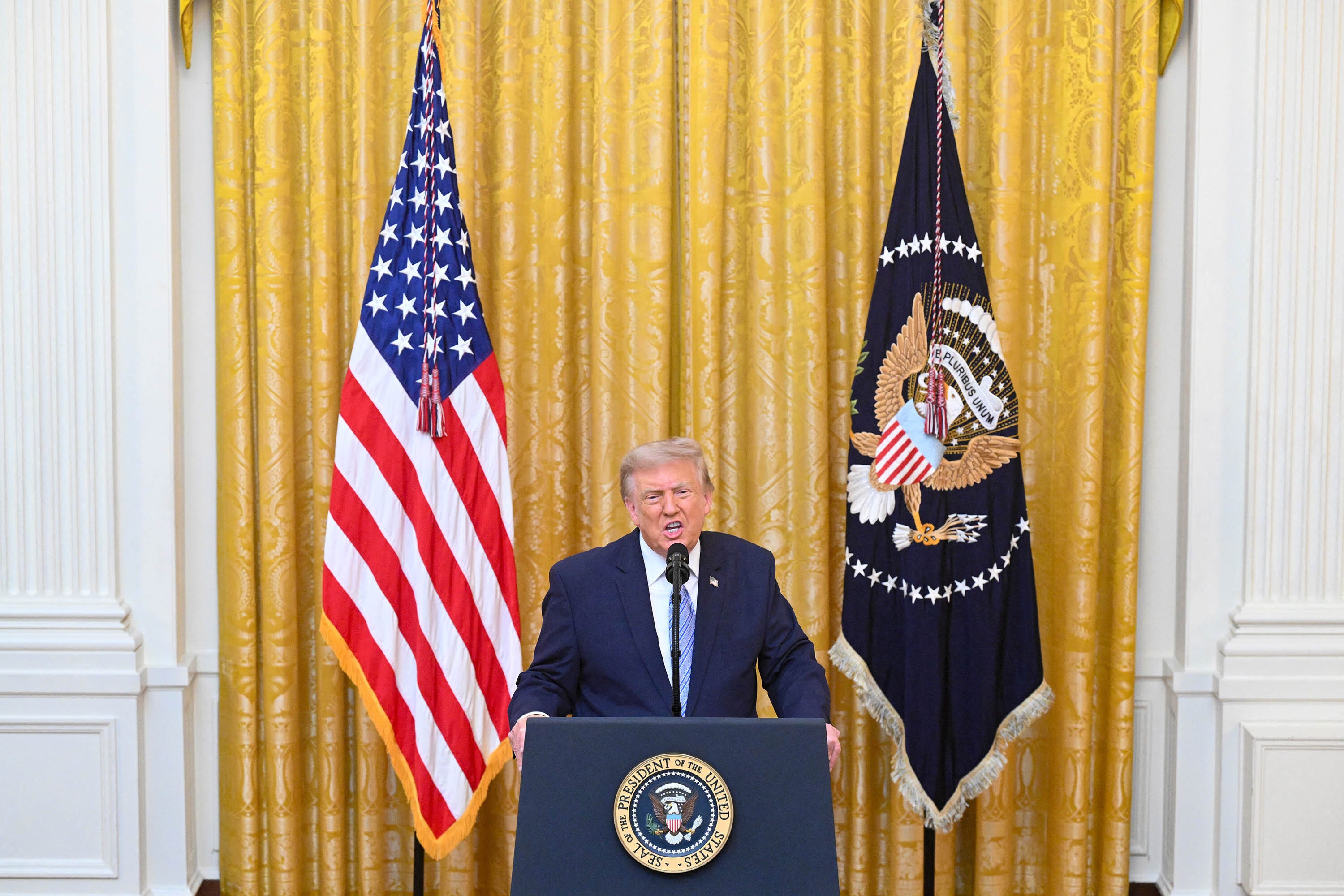
It’s worth considering these lines in light of Donald Trump’s speech last night. Because while the president spent a primetime address rehashing old, unsubstantiated claims of foreign election interference, he was actively engaging in an act of domestic election influence. Put more bluntly, Trump used the bully pulpit to undermine U.S. elections in ways that no other president has—in ways that adversarial governments could only dream of.
To understand how destructive the speech was, go back and read that report, which was started under the first Trump administration. Time and again, the authors underscore the threat posed by outside actors trying to undermine faith in U.S. elections.
“Some foreign actors, such as Iran and Russia, spread false or inflated claims about alleged compromises of voting systems to undermine public confidence in election processes and results,” the intelligence community found.
The concept of “confidence” in elections comes up repeatedly. The report assesses that Russia’s government ran an influence operation denigrating Joe Biden, supporting Trump, and “undermining public confidence in the electoral process.” It notes that Iran attempted both to “undercut former President Trump’s reelection prospects” and “undermine public confidence in the electoral process.” It relays that Moscow has “longstanding goals of undermining confidence in US election processes.” And it says that, “Some foreign actors . . . spread false or inflated claims about alleged compromises of voting systems to try to undermine public confidence in election processes and results.”
That last line, in particular, stood out to me as I watched Trump’s speech. Because if you removed “foreign actors” from it, you would have an apt description of . . . Donald Trump.
The president spread false and inflated claims about China’s covert efforts to undermine his 2020 bid. He bemoaned alleged compromises of our voting systems, specifically Venezuela’s supposed manipulation of electronic voting machines. And he undermined confidence in our election processes by comparing them unfavorably to “any” third-world country.
“Great damage has been done to our country. Our elections were left vulnerable to being rigged and stolen, and the trust of the American people was lost,” Trump proclaimed, surely aware at some psychological level that he is the one who destroyed that trust, and was doing so again as he spoke that line.
Over and over, Trump has sowed doubt in our elections, treating them not as a bedrock of our government but as a grade that could be appealed, forged, or changed through sufficient whining or cheating. After he lost the 2016 Iowa caucus, Trump declared that, “Based on the fraud committed by Senator Ted Cruz . . . either a new election should take place or Cruz results nullified.” I vaguely recall being flabbergasted at the time. I thought it was a bit. I didn’t realize it was an ethos.
And now it’s a doctrine—pushed by Trump but actively embraced by the rest of his party. Hours before Trump spoke last night, Sen. Tommy Tuberville (R-Ala.) claimed four or five of his colleagues in the Senate “didn’t legally win” office. He had no evidence for his claim. Earlier this week, DNI nominee Jay Clayton refused to say that Joe Biden won the 2020 election. He’s considered the sane alternative to the man currently in that post, Bill Pulte.
That these top officials feel free, even compelled, to act like this is a greater problem facing our elections than anything we’ve seen so far from a foreign adversary. Because if one party will not accept results that don’t go its way, then there is nothing to “fix” at all. At that point, the election’s legitimacy is tied strictly to its outcome, not its administration.
The White House released a bevy of documents last night meant to support Trump’s speech. They were underwhelming as far as the president’s claims go. But this statement by the NIC stood out to me, again for how it almost perfectly described what Trump himself is doing:
We assess that adversaries could also make false claims about their ability to manipulate US election infrastructure as part of a broader effort to undermine confidence in US democratic processes. Much of the voting public probably knows little about the process of administering US elections, which could allow false narratives to gain traction. Government efforts to investigate and publicly invalidate such claims could take weeks or months, providing time for concerns about election security to spread.
That was in January 2020. How much time we’ve lost.
Two Options: Lose or Cheat
by William Kristol
Just one footnote to Sam’s piece: A couple of polls that appeared earlier this week are a useful reminder of why Donald Trump is making such frantic efforts to lay the groundwork for his election interference. The reason’s simple: If he doesn’t cheat, he’s going to lose.
Both polls were in the field when gas prices had been coming down and before they started going back up. Nonetheless, in their monthly tracking poll fielded July 9–13, the Republican firm Echelon Insights found only 38 percent of likely voters approving of Trump’s job performance—a new low in their surveys—with 61 percent disapproving. And the Washington Post/Ipsos poll, taken July 8–13, had virtually identical numbers, with 37 percent of the American public approving of Trump, and 61 percent disapproving.
Particularly noteworthy was the contrast in both surveys between the percentage of those who strongly approved and strongly disapproved of Trump. Echelon had 24 percent strongly approving and 51 percent strongly disapproving; the Post had 15 percent strong approval and 47 percent strong disapproval. If you average the two, you get about 20 percent strongly approving and about 50 percent strongly disapproving. These are disastrous numbers going into a midterm election that will be a referendum on Trump, and that will pose a choice between a Congress that will continue to support Trump or one that will try to constrain and check him.
One other striking result from the Post poll: Only 13 percent say they are better off than when Trump returned to office in January 2025, while 39 percent say their situation is about the same, and a new high of 43 percent say they’re not as well off as at the beginning of Trump’s second term. The numbers are a reversal from Trump’s first term, when 28 percent said on the eve of the midterms that they were better off, 58 percent said things were about the same, and only 13 percent felt they weren’t as well off under Trump. Even so, Republicans lost control of the House in November 2018. They may well lose the House and the Senate in 2026.
So Trump faces the prospect of a hostile Congress that will investigate him aggressively over the remainder of this term. And if his numbers don’t improve over the next two years, he faces the prospect of his party’s nominee likely losing in 2028, and being succeeded by an administration that will go about turning over the massive boulders of Trumpian corruption.
Thus the increasingly desperate and widespread effort by Trump and his apparatchiks to tilt the electoral scales in a big way. What we saw last night was only the tip of the election subversion iceberg. The Trump administration can’t afford to lose power. So it will do everything it can over the next two and a half years not to.
AROUND THE BULWARK
In the Grim Darkness of the Far Future, There Is Only Culture War… CHRISTIAN RUTH reports how a forty-year-old satire of fascism became a meme for Trump, a flashpoint over women in sci-fi, and—for some fans—an actual political ideal.
The Slop Doctrine… ALICE E. MARWICK explains why the right has overwhelmingly embraced terrible AI-generated imagery.
Can Subsidies Bring Film Production Back to the USA? On The Bulwark Goes to Hollywood, CHRIS FENTON joins SONNY BUNCH to discuss his new film ‘Bad Counselors’ and the effort to make movies in America.
Quick Hits
$500 ON “TREMENDOUS”: Grift for me, but not for thee. That’s apparently the rule in the White House, where one of President Trump’s longtime teleprompter operators has been put on leave after reportedly amassing more than $100,000 from bets he placed on the Kalshi prediction market about what the president would or would not say. ABC reports:
President Donald Trump’s longtime teleprompter operator is believed to have made tens of thousands of dollars by placing bets on more than a dozen of Trump’s speeches on the prediction market Kalshi, federal investigators with the Commodity Futures Trading Commission found, sources familiar with the matter told ABC News.
Gabriel Perez, a technical assistant to the president who has been operating Trump’s teleprompter since 2016, is in talks with federal regulators to settle allegations he used his inside knowledge of the president’s speeches to win more than $100,000, the sources said. . . .
In addition to February’s State of the Union address, sources said CFTC investigators discovered that Perez placed bets on more than a dozen Trump speeches over a three-month period, including a December primetime address, a January speech at the World Economic Forum in Davos, Switzerland, and Trump’s remarks in March during a Medal of Honor ceremony.
Later in March, the White House issued an internal memo warning staff against using nonpublic information to place bets on prediction markets, sources previously confirmed to ABC News.
Apart from the questions of why an enterprising, tenacious working man like Gabriel Perez should have to play by the rules when no one else in the White House does, or why he was put on administrative leave for a six-figure payday while the president helps himself to billions, there’s another question that seems painfully unresolved here:
How did operating the teleprompter give Perez any indication of what Trump was going to say?
A BRIDGE TOO FAR: The United States has struck targets in Iran for the last six days in a row—though no one seems to know exactly to what end. Perhaps even more ominous than the lack of strategy, though, is the choice of targets. The Wall Street Journal reports that the latest airstrikes have been concentrated on bridges, especially around Bandar Abbas, the largest Iranian city on the Strait of Hormuz.
Are bridges legitimate military targets? Well, yes and no. If the military uses them, then they can become legitimate targets even if civilians also use them. A senior U.S. official told the Journal that the strikes on bridges were part of “an effort to cut off supply routes to a port city and naval base in the Strait of Hormuz that Iran uses to attack ships and project power.” So . . . close enough that the military lawyers who (presumably) approved these strikes probably aren’t sweating too much.
Except that there’s still the question of intent. Trump has been threatening attacks on Iran’s infrastructure—bridges and power plants especially—for months. He has made it clear that these attacks are not to be based on a case-by-case determination of which bridges or electrical stations are being used by the military and which are purely civilian; or at least, that’s the only reasonable interpretation considering that he, at roughly the same time, threatened to wipe out all of Persian civilization.
So did Trump give an order to bomb bridges which the military then found a way to make at least somewhat legal? Or did the military tell him that they could bomb bridges and he immediately trumpeted it as a campaign of war crimes? And which is worse?
HOUSE OF MADNESS: As much as we fume at the president for arrogating to himself power that rightly belongs to Congress—and at the courts for letting him, and thereby encouraging him—we have to lay at least some of the blame with Congress itself. Case in point: Does this seem like a body capable of wresting power back from the other branches and exercising government befitting a superpower?
Speaker Mike Johnson suffered another humiliating political defeat at the hands of his own party on Thursday when he was forced to abandon plans to pass a veterans benefits bill designed to be one of the GOP’s big legislative wins before the midterms.
Just minutes before the bill was slated to come to the floor, Johnson and his team were forced to pull it from the schedule as more than a half-dozen holdouts refused to back the measure. . . .
The defeat for Johnson is the latest in a string of complications for leadership. Only days earlier, Johnson had struck a truce with GOP hardliners to reopen the floor after they’d effectively seized control and prevented the speaker from moving key bills for two weeks.Now, they are leaving Washington on Thursday without a clear path forward on the veteran benefits bill.
Read the whole thing from CNN. Spoiler: The Guy Fawkes of all this legislative insanity is Rep. Anna Paulina Luna (R-Fla.), which really isn’t much of a spoiler at all. But hey, the Republican majority isn’t trying to oust its own speaker—yet—so by recent standards, this counts as effective leadership.
Cheap Shots

"Much of the voting public probably knows little about the process of administering US elections..."
Much of the voting public knows almost nothing about almost everything. That's the real problem.
Hello. You have reached Tim Coffey's "Morning Shots" autoresponder. You are receiving this message because the content in this morning's newsletter has triggered Mr. Coffey's more illiberal and violent inclinations as the preferable method to deal with the MAGAe. As Mr. Coffey wants to spare his fellow Bulwark subscribers from full exposure to his feral id, he will not unsheathe those ideas this morning. There will be no further comment from Mr. Coffey this morning. Thank you, and have a nice day.