

The Return of Communism Chic
A new generation discovers the workers’ paradise.

IT’S NOT EVERY DAY that someone on a Twitch livestream reads at length from an essay by Vladimir Lenin, the father of the Russian Communist revolution. But that’s exactly what Hasan Piker did five months ago, devoting a portion of his stream to Lenin’s 1920 pamphlet “Left-Wing” Communism: An Infantile Disorder, a diatribe against overly uncompromising European Communists who refused to participate in bourgeois parliaments and labor unions. It was, Piker said, an example of a leader of a “successful revolution” advocating “formative work” within existing structures.
It’s par for the course for the controversial streamer, who has also expressed admiration for Mao Zedong; lamented the lack of appreciation for communism in the United States, noting that “this is the country that defeated the USSR, unfortunately”; and most recently declared (echoing Vladimir Putin) that “the fall of the USSR was one of the greatest catastrophes of the twentieth century.” But love for communism—or Soviet-style socialism, which, in practice, amounts to the same thing—is hardly unusual in progressive spaces these days. It has been on the rise since the early 2010s, when apologia like “Why you’re wrong about Communism: 7 huge misconceptions about it (and capitalism)” started showing up in left-wing outlets like Salon (typically relying on sleight-of-hand and other fallacies for a “why communism is fine” argument).1 In 2016, even the New Republic, the former home of Cold War liberal hawks, featured a piece titled “Who’s Afraid of Communism?” Author Malcolm Harris mocked Hillary Clinton for her antiquarian anticommunism, partly because of her praise for NATO, and credited communism’s role in defeating Nazism without mentioning inconvenient details like the Molotov-Ribbentrop pact or the joint German-Soviet invasion of Poland in September 1939.
Long before there was Hasan Piker, far-left podcasts like Chapo Trap House and Pod Damn America offered a similar blend of outrageous provocation, crassness, militant anti-capitalism and unabashed sympathy for far-left or anti-Western regimes—including claims that if Communist regimes did commit crime and atrocities, capitalists made them do it by waging a “holy war” against Communist revolutions. By 2018, even Teen Vogue, then mixing beauty and lifestyle tips with left-wing politics in a true epitome of radical chic, was celebrating Karl Marx’s legacy for his bicentennial and gushing that his work “inspired social movements in Soviet Russia, China, Cuba.” etc. (“Social movements”: What a cute euphemism for gulags and killing fields.) The same year, a YouGov poll for the Victims of Communism Foundation found that while just 15 percent of Americans held a favorable opinion of communism, the figure shot up above 25 percent for younger adults (millennials and Gen Z).
Communism chic is, of course, hardly a new thing for the Western left. In the 1920s and 1930s, plenty of American and European intellectuals flocked to the USSR as “political pilgrims” (to quote the title of Paul Hollander’s 1981 book). But in the decades that followed, the ranks of the disillusioned grew; The God That Failed, a 1951 book by six writers and intellectuals who had broken with communism, received glowing notices and became an international bestseller. Five years later, Nikita Khrushchev’s shocking exposé of Stalin’s monstrous crimes opened many other eyes. Other blows followed: the brutal suppression of anticommunist uprisings in East Germany and Hungary, the Soviet invasion of Czechoslovakia in 1968 to crush the liberal reforms of the “Prague Spring,” the 1973 publication of Alexander Solzhenitsyn’s The Gulag Archipelago (which expanded on earlier revelations about Stalin’s Great Terror and added the human reality of shattered lives). The search for new Communist paradises in China, Vietnam, and Cuba proved equally disillusioning, and Pol Pot’s version of the utopian experiment in Cambodia killed nearly two million people in a country of seven million.
By the 1980s, when Soviet communism entered its terminal stage, it was still considered somewhat gauche in many left-of-center circles to be anticommunist or anti-Soviet, as I found out as a refugee from the Soviet Union. (My mother, who taught piano at Rutgers University in the 1980s and ’90s, was once chided by a fellow faculty member for channeling American “propaganda” when she described the conditions she had experienced and witnessed in Soviet hospitals.) But actual Communists or Communist sympathizers were by that point pretty rare.
Yet today, “tankies” with the hammer and sickle emoji in their profiles are a fairly common sight on social media,2 and memes asserting that victims of Communist terror deserved what they got are not a rare sight.3
Snarky hand-waving of communism’s human tragedy isn’t limited to social media. A 2023 hit piece in the Baffler by Brooklyn journalist and activist Billie Anania about theVictims of Communism Museum (which opened in 2022, nearly thirty years after Congress authorized its construction) sneered at “usual suspects among the victims” such as “kulaks and Cuban plantation owners.” The snide reference to kulaks—peasants accused by the Soviet regime of being rich exploiters—is particularly revolting given the history: In 1930–1933, more than two million farmers branded as kulaks, often simply because they opposed the collectivization of agriculture, were mass-deported to remote regions in grueling conditions; more than half a million died, often during transport. Anania scoffs and nitpicks: The museum doesn’t feature material on the Nazis and on the crimes of Western colonialism; it displays a quote by Solzhenitsyn, “a favorite of Steve Bannon and Jordan Peterson” (and, ya know, the Nobel Committee); a photo of an East German guard fleeing to West Berlin “is credited to the CIA.” The Black Book of Communism, the 1997 volume that is the museum’s source for a global death toll over 100 million, is dismissed as “delegitimized by its own contributors.” (Yes, some contributors questioned overly sweeping claims in the book’s preface and suggested their own estimate of . . . 65 to 93 million.) The museum, Anania concludes, is simply “a relic of Cold War-era propaganda,” as well as “thinly veiled bigotry” and a whitewash of fascism.4
SO WHY THE RETURN of the tankies? There are many reasons. For starters, there’s generational turnover: The Cold War is a thing of the distant past for younger Americans. The Victims of Communism Foundation has often noted that the lack of knowledge about the history of communism has been a “horrible failure of education”: In the foundation’s 2017 survey, only a third of millennials had heard of Lenin. (No wonder they are easily sold on narratives that cover up his homicidal fanaticism.) Meanwhile, the progressive focus on oppressions in liberal Western societies and on the ugly sides of Western history—slavery, colonialism, aggressive wars, the subordination of women—has produced some needed self-exploration, but it has also led to the erasure or whitewashing of the evils of the West’s adversaries, whether in the Global South or in the Communist bloc. In that 2017 survey, about a third of millennials thought George W. Bush was responsible for more deaths than Joseph Stalin.
Add to this the fact that the transition from communism after the fall of the USSR, particularly in Russia, turned out to be a mess of corruption and chaos that, at least temporarily, did leave many people worse off. Defending Piker’s lament for the Soviet downfall, British socialist writer Owen Matthews cited the economic collapse and the drop in life expectancy in Russia in the first years after the dissolution of the Soviet Union in 1991. But the aftermath of communism’s fall is a massively complicated story. The Soviet economy was already running out of steam when Gorbachev embarked on his reforms. Most of the country was immiserated under communism; medicine was in an abysmal state. (Russian life expectancy in the mid-1980s was 67—some seven years lower than in the United States at the time.) It’s not surprising that the health care system fell apart under the pressures of an ill-managed transition.
Other factors in communism’s reputational comeback include capitalism’s tarnished reputation after the 2008 financial crisis. Add, too, the romantic halo of the fight for liberation, often joining the language of class struggle to that of racial justice; witness the comeback of black activist and unrepentant pro-Soviet Communist Angela Davis, who at one point seemed to have sunk into obscurity in the post-Soviet world.

The gang returns to California for two live shows in May. Join Sarah, Tim, and Sam in San Diego on May 20 or in L.A. on May 21 for a night of politics and laughs, and a community built on good faith. Bulwark Live: California is sure to sell out—don’t delay.
WHILE ALL OF THAT IS ON THE LEFT, we shouldn’t forget the role of the right. For one thing, when you keep calling just about every center-left Democrat a Communist and compare Barack Obama to Lenin and Stalin, one possible effect is to take the sting, and the stigma, out of the C-word. You could even say that the effect is to normalize communism in American political life.
Communism chic is also enabled by right-wing attacks on mainstream norms. When the Overton window is busted wide open to allow room for unabashed racists and authoritarians—and the status quo of the liberal order is portrayed as hopelessly corrupt—the far left, including Communists, will see an opportunity too.
Come to think of it, Trump himself has done a pretty good job of legitimizing communism—and not just because he shatters all norms and uses classic Stalinist tropes like “enemy of the people.” He clearly has an affinity for Russia’s Vladimir Putin, who may condemn the Bolsheviks when convenient—for instance, when he needs to blame them for Ukraine’s independence—but clearly wants to build a simulacrum of the Soviet regime. Lately, he’s been bromancing an even more Soviet post-Soviet leader, Alexander Lukashenko, whom he has described as “the highly respected President of Belarus.” And don’t forget his love affair with North Korea’s Kim Jong-un. Add to this Trump’s Kim-like love of extravagant praise and large banners with his face, and you may understand why X influencer Jackson Hinkle is a self-described “MAGA Communist.” Communist chic, MAGA Communists: Whichever way you slice it, it’s tacky, absurd, and borderline sociopathic in its dismissal of human enslavement and suffering.
That purported debunking, by activist Jesse Myerson, countered communism’s confiscatory state violence by pointing out that capitalist societies also rely on the arm of the state to enforce property rights. Myerson also hand-waved communism’s record of mass murder by invoking the crimes of Western colonialism and rebutting the strawman claim that communism’s victims were killed for “resisting dispossession”: in reality, many of those victims were Communists themselves. Checkmate, naysayers!
The term “tankie” originated in 1960s England in internecine disputes on the left, referring to hardline British Communists who supported the incursion of Soviet tanks into Hungary in 1956 and Czechoslovakia in 1968.
Case in point:
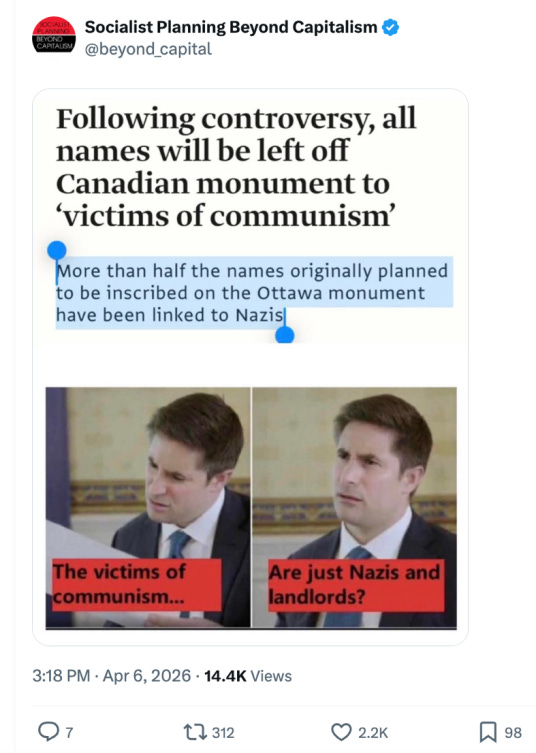
The meme refers to a 2024 controversy over a memorial to victims of communism in Ottawa. Of the 553 names proposed for inscription on the monument, the Department of Canadian Heritage determined that 50 or 60 had affiliations described as Nazi or fascist (mostly with Ukrainian nationalist forces that sometimes collaborated with the Nazis during World War II, a messy history I’ve delved into before). Then the department decided that, “to be on the safe side,” a total of 330 names should be scrapped—mostly people on whom there wasn’t enough information to know for a fact that they didn’t have Nazi or fascist ties. Finally, the decision was made to leave off names altogether. Of course, this hardly proves anything about the millions—variously estimated at 60 million, 94 million, or 110 million—who died in Communist-engineered slaughters and famines over the course of the twentieth century.
This only scratches the surface of Anania’s shockingly malicious piece. She claims that “according to the Victims of Communism team, all Nazis killed by Soviets are victims of communism.” (Her source, the pro-Communist magazine The International, attributes such methodology to Black Book of Communism editor Stephane Courtois, apparently without any basis.) Even more offensively, Anania writes that both the book and the museum “peddle the spurious notion that a ‘double genocide’ took place in the twentieth century: one by fascists and another by so-called ‘Judeo-Bolshevik Communists.’” Neither The Black Book nor the museum uses such language.
The popularity of Communism among the younger set is likely in part due to historical illiteracy, but I think the overwhelming reason is not the 2008 financial crash, but just their current economic status and bleak future prospects under Capitalism. And if capitalism is bad, and Communism is the opposite of Capitalism, then they'll take what is the opposite of Capitalism. College grads can't afford homes, their white collar job prospects are evaporating, and amid all of that they're supposed to pay off tens of thousands in debt for a degree that gets them nowhere. Beyond that, they see that Capitalist greed has destroyed the environment and ensured they're fettered to a warming and dying planet that the Capitalist rich are desperately trying to ditch for Mars. If this is what Capitalism has wrought for them, it's not surprising they're interested in the polar opposite.
I went to Budapest during the 70s. How that happened is a long story except to say that I had a college professor who was a Hungarian refugee who managed to escape with his mother and brother during the 1956 uprising. I also dated a Czech whose family left Czechoslovakia in 1968. My time in Hungary was unforgettable. Depressing doesn’t begin to describe both the city, which is known for its beauty, and feeling of dread one had while being there. Nearly everyone I met would tell me how much they hated communism. An elderly woman started crying when she learned I was American, knowing she could tell me about how terrible communism was. I wish everyone who romanticizes communism could somehow grasp how terribly sad and hopeless communist countries are, and how frightening.