


Hey everybody—it’s Tim sitting in for JVL today.
I want to try to tie together some of the themes that JVL explored last week in his underappreciated (and in some quarters unfairly maligned) newsletters on “enshittification” and Graham Platner, and put more of a campaign lens on them. We’ve been talking a lot about how voters are looking for outsiders and fighters who may not map along the ideological lines expected by social media warriors engaged in factional political fights, so I wanted to hash out that notion a bit. I think there are going to be parts of this thesis for everyone to love and hate, and I’m open to revising and extending—so give it to me in the comments like usual.
On a sad note, I also wanted to offer a tribute to Jason Collins, who died last night. The New Jersey Nets legend came out before his last season in the NBA, making him the first openly gay athlete in professional American team sports. That last year he wore the number 98 to honor Matthew Shepard, who was murdered in 1998. Tragically, doctors found last fall that Collins had an advanced brain tumor, which took his life yesterday at the too-young age of 47. It’s been thirteen years since Collins came out and I think it’s a testimony to his courage that so few have followed his path. Much love to Collins; rest easy queen.
Xx
Tim
1. The Epstein Files Lesson
Last summer the campaign to release the Epstein files seemed dead. Trump’s coverup had worked, with minimal pushback. The Republican party was going along with it. He had moved the conversation onto other absurdities. (Nuuk invasion imminent!) On June 15, 2025, the degenerate Polymarket bettors gave the files an 11.5 percent chance of becoming public.
But then a pair of House gadflies, Reps. Thomas Massie (R-Ky.) and Ro Khanna (D-Calif.), decided they weren’t going to just let the sclerotic establishment brush the files under the rug. They said “eff it” and pressed forward, blowback be damned. Ro’s Democratic colleagues rolled their eyes behind his back. Some thought he was engaging in conspiracy-mongering. The president began actively campaigning against Massie, smearing him in grotesquely personal terms.
You know where this story goes.
It is true that we don’t yet have everything that the victims wanted. But accountability for the perpetrators has begun (abroad, at least), and when the Democrats take the House next year, maybe at long last some accountability will come here at home.
There are a lot of lessons one could take from this about how to “do politics,” but the one I want to focus on today is the importance of having politicians willing to buck conventional wisdom—and endure bullshit attacks, even from their own side—if you actually want to achieve meaningful change in our current system.
This isn’t how politics used to work. For a century, the way to get results was to play the inside game, slowly build relationships, hash out deals with bigwigs—often from the other party—and gain enough power to bring home the bacon.
But that mode of politics has crumbled over the last three decades. The Supreme Court’s Citizens United decision, the weakening of the parties’ gatekeeping power, the internet, John Thune and Mike Johnson castrating themselves for Trump, the unitary executive theory, democratic enshittification, negative partisanship, geographic sorting, and other social contagions have created an extinction-level event for inside-game politics while making voters feel like their representatives are less responsive than ever to their concerns.
I have to say I don’t particularly love this. My natural state is small-c conservatism. In a different universe I’d be the guy with the bullhorn at one of those Incremental Change rallies that Sarah likes to talk about:
What do we want?
Policies that improve people’s lives on the margins without risking catastrophic damage or loss of liberty!
When do we want it?
In the due course of time!
But you may have noticed that we aren’t in a world where incremental positive change is happening. In fact, in many parts of our society it feels totally out of reach.
Just announced! San Diego Mayor Todd Gloria and our own MAGA culture expert, Will Sommer, will join the gang on stage at Bulwark Live: San Diego on May 20 at the Balboa Theatre.
On May 21 at Bulwark Live: LA our friends Jane Coaston, Jon Favreau, Erin Ryan from Crooked Media, the Ringer’s Van Lathan, and progressive commentator Brian Tyler Cohen will join Sarah, Tim, and Sam on stage at the Novo. Grab your seats today!
2. Creative Destruction
As the failures of American politics have become painfully obvious—from Congress’s inability to make policy to the political parties being helmed by octogenarians to the inefficiencies that are driving Californians to move to red states—frustration with government’s lack of ability to do anything might just be the one thing that everyone can agree on, from Mamdani stans to Abundance bros to the MAGA hordes that believed Trump would, if nothing else, be a man of action.
Our government is creaky, literally: As of its convening last year, this Congress has the most members above 70 years old in American history, and the average age of American governors is even higher than that of Congress. Americans made their feelings about the gerontocracy abundantly clear in their rejection of Joe Biden in 2024. And their frustrations are well founded. Think about it: Who is more likely to push for real change and needed reforms? Octogenarians who have been in the machine their whole life or younger outsiders who are incentivized to challenge the entrenched systems?
This is a situation ripe for creative destruction and disruptive innovation, to borrow terms from economics. There are obviously limits to this argument. There are good kinds of creative destruction and bad ones, as we’ve learned over the past decade. (And I find myself getting a little uncomfortable writing sentences that could’ve been penned in Breitbart circa 2015.)
But—to hijack a line from David Frum—if liberal institutionalists insist that only fascists will blow up the status quo, then voters will hire fascists to do the job liberals won’t do.
I’ve had this frame in mind as primary season has become a slog of increasingly personal factional warfare within the pro-democracy coalition. Maybe the logical move is for party voters to turn to candidates who are willing to challenge the stagnant establishment and build up a new bench of anti–status quo candidates even if their ideologies don’t totally cohere.
Not already a Bulwark+ member? Try it out for a two-week trial period at no cost:
3. The Four Amigos
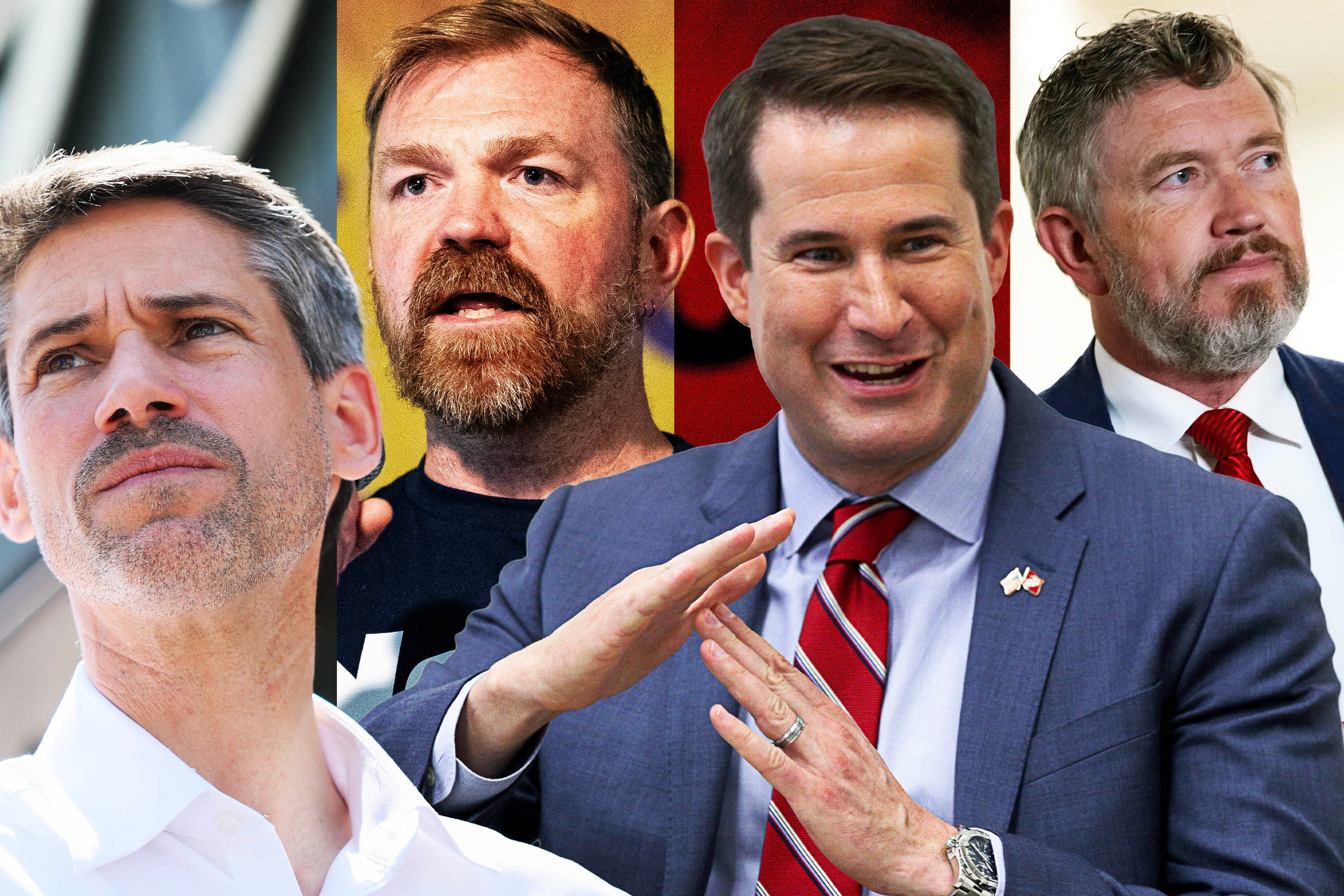
Four of the candidates I have in mind for this frame are Graham Platner (running for the Senate from Maine), Seth Moulton (running for the Senate from Massachusetts), Matt Mahan (gubernatorial candidate in California), and Thomas Massie himself.1
It’s a motley crew, I will admit. But here are the things they have in common:
They’re in campaigns against either older opponents who are protective of the status quo or party apparatchiks.
They have basically zero fucks to give when it comes to appeasing the party bosses.
They’re articulating coherent critiques of the leaders of their respective parties.
They have a fundraising incentive to go against the grain
And the three who are running in federal elections have all earned the ire of AIPAC.
Obviously there are some key differences and caveats here too. Mahan is backed by a lot of Big Tech folks, so while he may be free to buck the entrenched California Democratic Party interests, it’s reasonable to conclude that his policies will be colored by a different set of influences. Platner, meanwhile, is going to be very responsive to some of “the groups” that influence progressive politics—and, to be frank, I’m still a little concerned about what else might come out about his past before November. Although to be fair, that concern could apply to any of these guys, not just the tattooed Mainer. Case in point: As I was writing this newsletter, Axios dropped a story alleging some questionable judgment shown by Massie when dealing with a disgruntled ex who had worked for an ally in Congress.
So, no, these are not the last honest men in politics. But all of them buck the go-along-to-get-along culture set by the establishment in their parties. And that will give them the freedom to propose more dramatic reforms once they’re elected.
The positive case for each goes something like this:
Seth Moulton has pushed age limits for Congress and term limits for committee chairs. He advocates broad electoral reforms like eliminating the filibuster and the Electoral College, and has been doing so since 2019. He’s been a dogged opponent of Trumpian corruption and graft. He’s adept at social media and capable of raising the salience of these issues in the press. Like Platner, he’s a veteran, and despite his more internationalist views he has been a leader in fighting Trump’s Iran war and returned donations from AIPAC. As for his opponent: When was the last time you saw Ed Markey make a meaningful impact on our politics? Does anyone think he would stand up to either the progressive “groups” or the party leadership if the moment called for it? And most critically, when we are at the peak of the Trump crisis in the fall of 2028, Markey will be 82! Forget rallying the troops for democracy—we’ll be lucky if he’s awake to cast votes.
Graham Platner: Plenty of ink has been spilled about Platner’s risks and vulnerabilities, and I myself have stated many times that I wish this control trial were taking place in Kansas and not Maine. But the value prop of a charismatic oyster-farming, shitposting firebrand in this primary was obvious. For starters, he was running against the handpicked choice of the party elite: a governor who served capably but whose reaction was tepid when ICE invaded her state. On the other hand, Platner gave voice to the party base’s frustration that its leaders didn’t share their rage over the Trump administration or the rest of the Epstein class that has bowed to Trump. Whether it be on foreign policy or corporate capture, Platner is going to force a reckoning in a rather staid Senate caucus, which is exactly what Democratic voters want in a senator. At times will it be in service of slopulist nonsense? Absolutely. But if Democrats are going to regain support from the non-college-educated independents who fled during the Trump years, having a champion for fighting corporate capture and stupid Middle East entanglements is an important value-add when it comes to policymaking and rebuilding the party brand.
The case for Thomas Massie is obvious (he’s a Trump critic in a red state), and I want to include him specifically because of the primary coming up next Tuesday. In March, Trump endorsed Massie’s Republican challenger, Ed Gallrein, a former Navy SEAL turned MAGA NPC who lets AI write his social media posts. There’s a lot for me not to like about Massie policywise. He’s been bragging on the trail about agreeing with Trump 90 percent of the time and the campaign took a particularly icky turn this week when a pro-Massie PAC began running a noxious anti-gay, antisemitic ad claiming Gallrein was part of the “LGBTQ Mafia.” As a caporegime of note in said mafia, let me assure you that Eddie is not among our number. But for all Massie’s faults, he’s done two things that are meaningful: 1) Be the first Republican to stand up to Trump directly and then take him head-on in front of the voters rather than tuck tail and retire. 2) Demonstrate the way in which anti-establishment populists can be productive and actually get meaningful results in a divided Congress.
As for Matt Mahan, this probably merits a full article, but I’ll sum it up like this: In the recent CNN debate, the top Democrats besides Mahan summarized Gov. Gavin Newsom’s tenure positively. And whatever you think about Gavin as a politician, the idea that California needs a status quo governor is madness. California is one of the most expensive states to live in and struggles to provide quality services in exchange for the highest tax bill in the country. California has the highest gas tax in the nation and is one of the top-spending states on infrastructure—to the result of a C- infrastructure grade from the American Society of Civil Engineers. Just take as the prime example the stalled and scaled-back high-speed rail project now entering its eighteenth year of construction (I now hear it might be ready by 2041; hopefully the AI overlords or a Trumpian nuclear bomb won’t have killed us by then). Nearly a quarter of the nation’s homeless population lives in California. There’s more YIMBY-NIMBY discourse about whether and how to build housing than actual building of houses. L.A. taxes apartment buildings like mansions. Unsurprisingly, Californians continue to flee to more affordable red states, where it is significantly easier, cheaper, and quicker to build housing. Mahan’s critique of California’s “failing status quo” is simple, to-the-point, and meets voters where they are. To add insult to injury, Texas is even beating California in green energy production. Mahan has a track record of good governance during his tenure as mayor of San Jose, where he has successfully dealt with the top issues plaguing the state by being willing to buck the party pooh-bahs, innovate, and experiment.
If you are skeptical of the Mahan model, I’d point you to what Daniel Lurie has done in San Francisco. He’s nobody’s idea of a populist but he has demonstrated the value of having an independent-minded fighter who is not tied down by entrenched interests. The city has seen real progress, and with a 74 percent approval rating, he might just be the most popular mayor in America. I don’t think it’s a coincidence that the two buzziest Democratic mayors right now are disrupters who have come from different wings of the party and haven’t been afraid to anger the powers that be.
4. The “To Be Sure” Closer
Again, there are some obvious limits to how I’ve framed this. There will be bad outsiders and good institutionalists. There will be ideological disagreements with gaps that are not bridgeable. Platner and Mahan are not going to get along on Big Tech regulation. Moulton and Massie have starkly differing views about America’s role in the world and the size of the federal safety net. Each of these guys will piss me off at times. I caught Platner doing some light China apologia the other day. Mahan seems to have enough juice to take on the Democratic establishment but I doubt he would be aggressive enough for my taste on Trump. With Moulton the porridge will be closer to just right. YMMV.
But the pro-democracy movement can’t keep doing the same thing and expecting better results. By nature it is a group of institutionalists who want to protect our fragile republic. While that’s a good impulse, there are some limits to its appeal.
What we need are laboratories of democratic change to see what works both electorally and legislatively. It’s not all going to be pretty or exactly my cup of tea. But Massie and Khanna show it’s possible to shake things up and get positive results that disillusioned Americans can believe in. We need to have the stomach to give it a try.
All four are currently engaged in primaries—though Platner’s is functionally over since his establishment opponent has already dropped out.
Growing older is interesting. At one moment you are 25 years old and excited about the prospect of Obama running for President because he is running against the status quo. Like I said, you're 25 years old and what did status quo do for you? The economy is on the brink of collapse. You have student loans because your working class parents made too much for decent financial aid, but not enough to help you with college. The war in Iraq is going poorly and Democrats are too scared to say anything. Why do we want another status quo Clinton when this guy representing your adopted home is speaking directly to your concerns?
Then one day you look up and you're 44 years old. One thing that is the same is the status quo is still letting you and everybody else around you down. Bring on some creative destruction. Who looks at the state of the Democratic Party and thinks, "what we need is for them to stay the same." We need to shake up the status quo from time to time. Last time Democrats went 8 years between Clinton and Obama. We are coming up on 20 years between Obama and what’s next. So, I think we are past due.
Thank you for your service, 70+ year old members of Congress, but it's time for you to enjoy retirement.
The inside game of politics — incrementalism, relationship-building, deals with bigwigs — is structurally dead. Tim makes that case persuasively today, and I buy it. So voters should reward a new class of disruptors willing to blow up the status quo from within the system. I don’t have a strong brief for or against his four candidates specifically; others are better positioned to evaluate whether Graham Platner or Matt Mahan are the right vessels for this theory. What I do want to engage with is the implied parallel: if the inside game is dead for elected officials, what does that mean for the *outside* game — the citizen pressure that’s supposed to make elected officials accountable in the first place?
Because I think the outside game is just as broken, for the same underlying reasons, and I haven’t seen the pro-democracy movement fully reckon with that.
I got thinking about this after hearing something Sarah said on the TNL podcast yesterday, lamenting the lack of youth participation in peaceful rallies and protests in the streets, while worrying about increasingly violent rhetoric from center-left young people online. Her prescription: get off the internet and into the streets. Her model: the Civil Rights Movement.¹
I understand the impulse, but I think it misreads both the present and the past.
Start with the present. There’s a genuine debate about protest tactics — should demonstrators stick to city centers and public squares, or is it legitimate to picket outside legislators’ homes? Sarah’s instinct seems to be that neighborhood protests are uncomfortably close to intimidation, that the powderkeg risk is too high. She’s not wrong about the powderkeg. If one person brings a weapon to a protest outside a politician’s house and something goes wrong, the entire movement gets tarred by it, and the administration gets a pretext to invoke the Insurrection Act. That worry’s real, and it’s worth taking seriously.
But here’s the thing: this whole tactical argument, important as it seems, is a massive distraction from a prior question that nobody is asking loudly enough:
Why would *any of it* work?
Sarah’s confidence that classic nonviolent protest — marches, rallies, chants, signs, speeches — would be effective if only more people participated — and younger people specifically — rests on an assumption so foundational I think she’s stopped examining it: that legislators, upon seeing large enough crowds, will *experience something.* Shame, perhaps, or fear of electoral consequence, or at minimum the cognitive dissonance of watching their constituents demonstrate that they’re causing real pain to real people. The assumption is that *the protest creates accountability*.
But is that correct, really? Look at Tennessee. Over the past several years, the state legislature has made a series of aggressively antidemocratic moves. Each time, the response from citizens has been textbook: marches in the streets, rallies on the capitol steps, sit-ins in the rotunda, demonstrations in the legislative galleries. Every form of nonviolent protest, from the most decorous to the most confrontational short of violence. And each time, the legislators proceeded without breaking stride. They had business to execute — i.e., disenfranchising the people who oppose them — and noise from the other side of a police line does precisely nothing to that business.
Was the problem insufficient numbers? If those same protests had been twice as large, or skewed fifteen years younger, would the result have been different? It’s very hard to argue yes. The Alabama GOP legislature doesn’t pause even for tornado evacuation sirens.
Tim’s piece identifies why, though he’s applying the insight to a different domain. The inside game collapsed because the accountability structures that made it work — party gatekeeping, institutional relationships, the threat of coalition collapse — were dismantled over thirty years. The same thing has happened to the accountability structures that made protest work — at least protest against Republicans. Liberal democracy functions on the premise that politicians fear certain words: words that cost them support, that expose them as fools, that make them feel ashamed. Shame requires a constituency whose opinion you value. Fear of losing support requires supporters whose support can actually be withdrawn.
But in Trump’s Republican Party, the only support that matters flows from one man. State legislators know that Trump has almost certainly never heard of them, probably never will, but could withdraw his blessing at any moment at 4 a.m. with a single Truth Social rant mentioning their name — and that withdrawal means political annihilation. Against that threat, what does a crowd of protesters represent? *They’re* not Trump. *They* can’t primary GOP legislators. The protesters can vote against him in the general, but legislators already priced that in, and they’ve protected themselves through gerrymandering anyway. Trump doesn’t care what they — either ‘they’, actually, protesters or state legislators — think.
This is the structural point Tim is making about the inside game, applied to the outside game: the transmission mechanism is broken. Protest worked, historically, because it fed into electoral consequences, which fed into legislative behavior. That chain now has a severed link.
Which brings me back to the Civil Rights Movement, and the romanticism that surrounds it. Our collective memory of that movement features the March on Washington, the dignity of protesters in their Sunday best, the moral force of peaceful assembly. And those things were real, and they really mattered. But change didn’t come solely from marches. It came from trespassing. From lunch counter sit-ins that violated the law. From young people who refused to disperse when ordered to, and were met with fire hoses and police dogs and batons. From a sustained campaign of making the system enforce its own brutality visibly enough that the national conscience couldn’t look away.
That’s a rather different model than “more younger people showing up to the rally.” And it worked — not just because of the protesters’ courage, but because there were still accountability structures in place: a national press with reach, moderate Republicans who could be genuinely shamed, a Democratic president who needed Black voters and Northern liberals to govern. The outside pressure had somewhere to *go.*
What Tim is really arguing, I think, is that the disruptors he’s identified — Massie and Khanna on the Epstein files, the others in their primaries — have found a different transmission mechanism. They’re not trying to shame the establishment into changing. They’re trying to replace it, or route around it. That’s creative destruction applied to electoral politics.
The question the pro-democracy movement hasn’t answered is what the equivalent looks like for citizens standing against illiberalism. If the inside game requires outsiders willing to blow up the party from within, what does the outside game require? I don’t think it’s more rallies with better demographics. I think it requires the same willingness to challenge the accountability structures themselves — which means accepting that some tactics will be uncomfortable, some will fail, and some will look nothing like what we remember from the 1960s.
“More people and younger people” is a demographic wish, not a political strategy.
—
¹ I’ll note here that in my college years I was in the summer nonviolence program at the Martin Luther King, Jr. Center, so my understanding of what ‘nonviolent protesting’ means is highly specific. I will try to moderate that and hew to the conventional understanding of the term.