


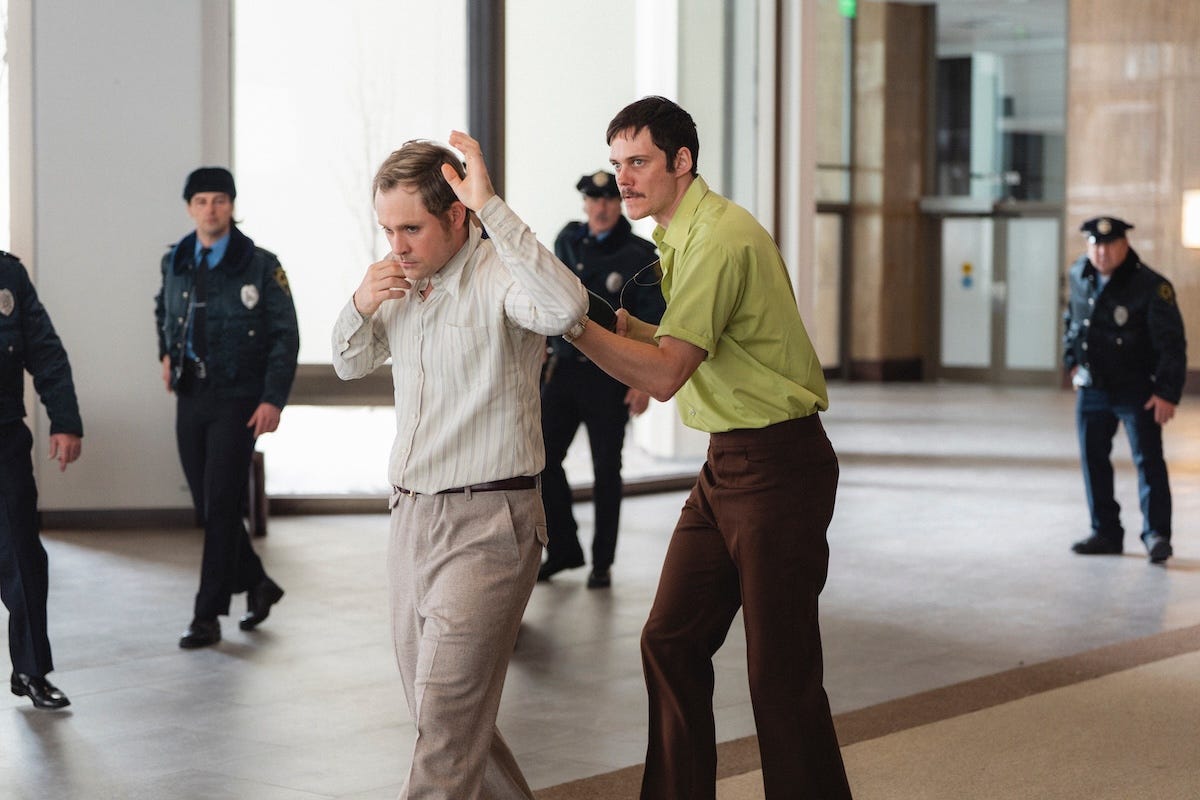
Dead Man’s Wire, the new film from Gus Van Sant, is a slyly comic, subtly stylish throwback that evokes populist-minded, angst-filled thrillers like Dog Day Afternoon and The Sugarland Express. Not quite an issue movie like a John Q or a Money Monster, Dead Man’s Wire is more a howl of rage, one that connects with audiences because there’s no shortage of stories about little guys getting screwed over by faceless banks and powerful moneymen. Some things never change.
The little guy who has been screwed here is Tony Kiritsis (Bill Skarsgård), who had a real estate deal go bad and takes mortgage company president Richard Hall (Dacre Montgomery) hostage to settle the score. A shotgun strapped to the back of Dick’s head and a wire looped around Tony’s arm and neck, the titular apparatus is rigged to blow if anyone tries to stop Tony from kidnapping Dick and getting five million bucks—and, perhaps more importantly, an apology—from Dick’s father, M.L. Hall (Al Pacino). Along the way to his money and his apology, Tony becomes a cult hero thanks to interviews with the voice of Indianapolis, Fred Temple (Colman Domingo).
What Van Sant, writer Austin Kolodney, and star Skarsgård understand perfectly is how important it is for a film like this to have a good sense of humor. It’s not funny ha-ha like Anchorman or Knocked Up, but it is still quite funny in an absurdist sort of way. We see much of the early action through the eyes of Detective Mike Grable (Cary Elwes, nearly unrecognizable with a beard and shaggy hair), whose main commentary on the proceedings is a combination of disbelief that Tony, who he knows from the local cop bar, would get himself jammed up like this, and frustration at the utter shitshow media storm he has found himself in.
One thing that jumps out about Dead Man’s Wire: It’s a film of great voices. Skarsgård plays Tony with an intriguing vocal cadence, stuck somewhere between Richard Nixon and Heath Ledger’s Joker. His pitch and timbre betray a lifetime of anti-elite sentiment steeped in a toxic stew of borderline madness and self-pity. The movie only really works if Montgomery delivers a believable performance, and it’s a hard role: For much of the film, he’s called upon to sit stock-still at a table, a shotgun pointed at his head. He has a sort of terrified weariness that occasionally bleeds into understanding and sadness, particularly when his father—played with gleeful petulance by Pacino—refuses to bend to Tony’s whims and apologize for the evils of interest accrued from missed loan payments. Montgomery has to do a lot with the way he mutters his apologies and begs Tony to let him go, to unleash him from this death trap.
But the best voice, unsurprisingly, belongs to Colman Domingo. The man just exudes a sort of perfect, 1970s cool: He is all silk and smoothness as the local DJ pressed into action by the police and the feds to help bring this thing to a peaceful conclusion. You understand why even a jittery cat like Tony would be calmed by the dulcet tones of Fred Temple. Domingo’s one of the best in the game right now; he simply lends whatever he’s working on instant heft, immediate credibility.
Dead Man’s Wire is sleek, efficient, and designed to be seen with a crowd; trust me, you’ll want to hear the awkward laughter of your seatmate as they squirm through Tony’s ridiculous efforts to show that he’s a good guy even as he has a gun rigged to blow a man’s head off if he twitches too far one way or the other. I’m glad I waited to see it with the crowd pulled together by co-executive producers William Nobel and Robbie Kruithoff of Wrong Turn Productions rather than at home with a screening link. You’ll want to hear it to confirm your own feeling: Yes, this is horrible, but even in horror there is sometimes great, dark humor.
Over at Across the Movie Aisle—which, as a reminder, spun off from The Bulwark late last year—Alyssa, Peter, and I reviewed a trio of Oscar-season movies: Die My Love, Sentimental Value, and It Was Just an Accident. Check it out and make sure to sign up over there if you want to keep getting it in your inbox!

Cultural Stagnation and the Attention Economy
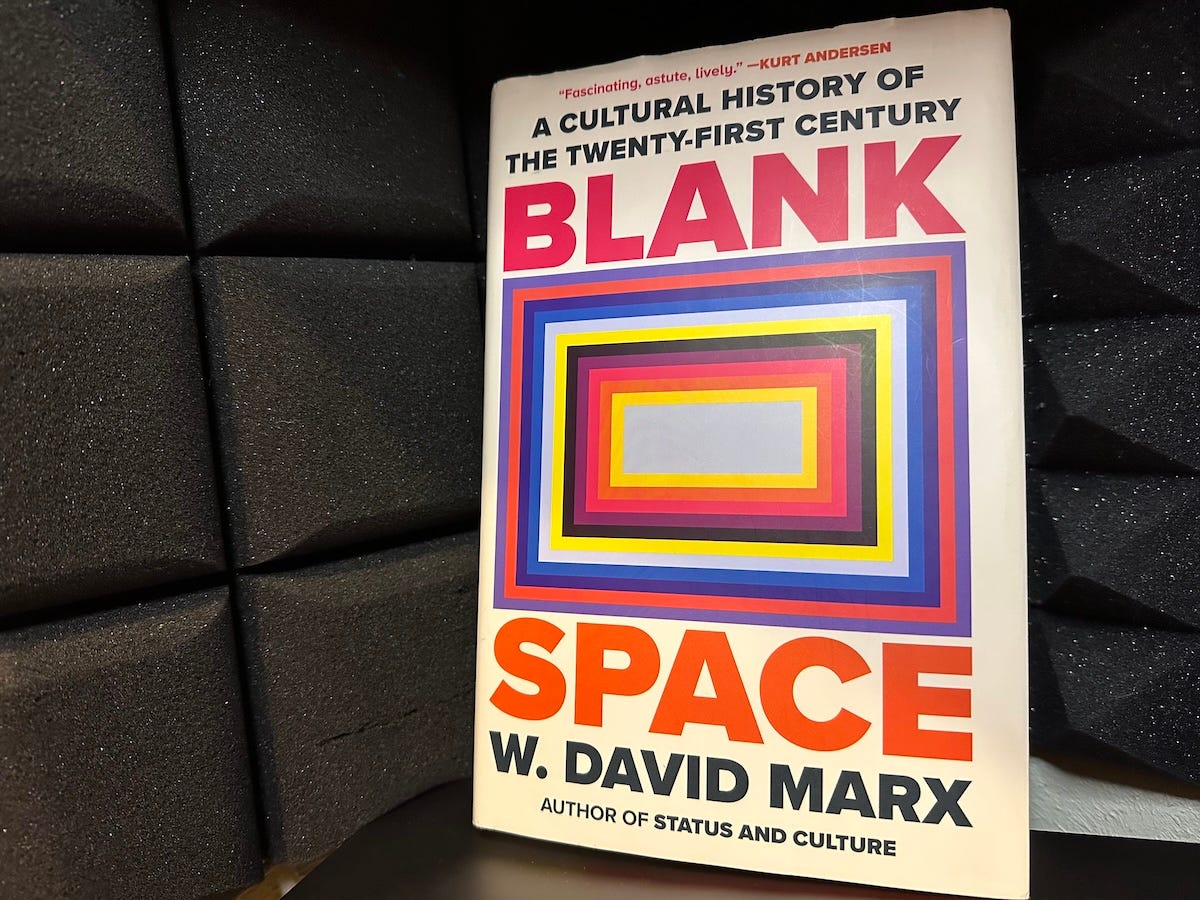
On this week’s episode of The Bulwark Goes to Hollywood, I interviewed W. David Marx about his new book, Blank Space: A Cultural History of the Twenty-First Century. It’s a succinct and damning portrait of the last quarter-century, a look at the absurdity that has enveloped us as “poptimism”—the urge to treat popularity as a substitute for artistry—and cultural omnivorism’s absorption of all facets of culture into one amorphous blob. We have stagnated, artistically, because few artists get removed from the canon and the new faces ushered in all make it via the same avenue: mass appeal. As he puts it, “Where society once encouraged and provided an abundance of cultural invention, there is now a blank space. Over the past twenty-five years, culture has prospered as a vehicle for entertainment, politics, and profiteering—but at the expense of pure artistic innovation.”
One thing we didn’t really discuss on the episode and one of the key points of his book is the rise of meme culture, the way the internet has started minting and discarding microcelebrities and influencers who come to dominate the public spheres. I keep coming back to one passage in particular, and it feels both important to understanding virtually every facet of modern culture, particularly as it relates to social media, and deeply, troublingly true.
“Even in a so-called populist era, a small cadre of celebrities continues to define what is possible, desirable, and righteous,” Marx writes. “Yet the blank space also opened the door for so many charlatans and reprobates. With creators no longer required to pursue artistic excellence, culture became a lowest-common-denominator battle for attention. Where there is no value other than money, honor is meaningless; and where there is no honor, there cannot be shame. And without shame, infamy and esteem become indistinguishable.”
Emphasis mine, because nothing could better describe the predicament we find ourselves in, twenty years after the advent of social media. Blank Space is not, strictly speaking, a book about social media. But it’s not not a book about social media and our memeified age, at least in part because the dynamics of cultural production and the dynamics of social media are so similar. In both realms, power producers dominate viral spaces; while streams determine Spotify payouts, likes and retweets determine a post’s value. Metrics rule, and the metrics on social media are almost always goosed by hate-views as much as honest conversation.
As a result, social media is absolutely dominated by shamelessness, by the willingness to say the most outrageous, indefensible things imaginable. This is why so many celebrate the murder of a father speaking on a college campus or an insurance executive gunned down on a street or a woman protesting ICE snatch-and-grabs on city streets: cruelty means clicks. We dehumanize our fellow citizens for the approval of faceless strangers on social media in the hopes of gaining nothing more than the dopamine hit of a notification.
I’m not above it; fighting off the urge to gleefully partake in such behavior is a constant struggle. But I’m trying, Ringo. I’m trying real hard.
Anyway, I hope you listen to the episode. I think it’s a pretty good one. And I hope you pick up a copy of Marx’s book.
An Age of Cultural Stagnation

On this week’s episode, I’m pleased to be joined by W. David Marx, author of the new book Blank Space: A Cultural History of the Twenty-First Century. Alongside Marx’s Status and Culture, th…
I wonder whether the lack of artistic innovation and interest in what we see is one reason for the apparent rise in participation. I'm surrounded by people doing art of some sort, and one thing the technology has made easy is on-line courses, sharing art, creating art communities, etc. And I think in some communities - basketry for example - there is a lot of innovation and it isn't all conformity with what's popular on Instagram right now. I'm seeing artists with distinctive voices, doing their own thing really well.
The humor in "Dead Man’s Wire" sounds comparable to the dark humor in last year's "Caught Stealing."