This Isn’t the End of NATO
There’s a reason every previous prediction of the alliance’s dissolution was wrong.

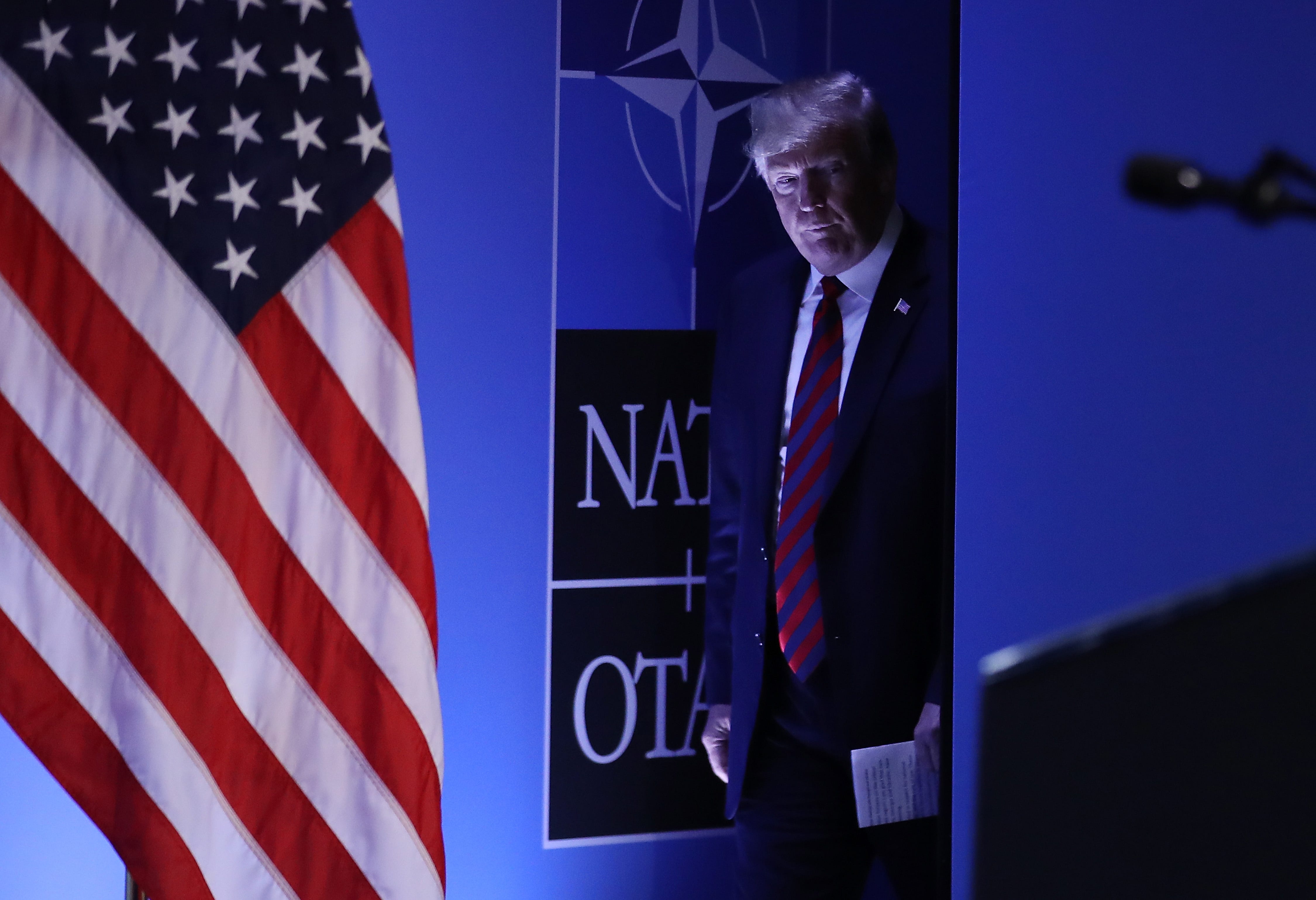
SINCE THE RELEASE OF THE SECOND Trump administration’s National Security Strategy, we’ve heard the strains of a familiar chorus rising once again: This time the NATO alliance cannot survive. This time the Atlantic bond is finally broken. This time Europe must prepare for a post-American world. This time NATO is really finished.
I understand why that fear feels plausible. I also know that the same tune has been heard multiple times before in NATO’s history. Yet every time, the strong security alliance has always bounced back.
I spent a significant portion of my adult life inside the NATO alliance: training alongside it, commanding alongside it, planning for war and peace and defending the nations that are part of it. I have seen its shortcomings up close and have watched during my career how it has grown. When I first arrived in Europe in 1975 as a new second lieutenant, there were fifteen member countries and the Cold War was at its peak; when I returned in 1988 as a major, there were sixteen nations, and while I was there the Iron Curtain fell. When I returned again in 2003, the alliance was nineteen members strong and growing. In 2011, during my tour as commander of U.S. Army Europe, there were twenty-eight members, and in the years since it’s grown to thirty-two.
In each of those tours of duty, I watched NATO absorb shocks that would have shattered weaker coalitions. I marveled as NATO participated in out-of-theater operations, reacted to its first and only Article 5 commitment (on behalf of the United States after September 11th), and contributed to extensive theater security cooperation exercises between the nations of so-called “old Europe” and their former foes, now democracies. And that long view leads me to a conclusion that history keeps vindicating: NATO may drift. Countries within NATO may threaten to leave or boycott. Various nations in NATO may indulge in isolationist temptation or even lean toward autocracy or extremism. But when reality intrudes—as it always does—the NATO nations come back together.
Today, it’s not Turkey or Hungary or France that observers are worrying will crack the alliance. It’s that the United States is turning inward. European allies are again being told they must carry more of the burden. American credibility is eroding. Our strategic focus is shifting to the Indo-Pacific. The post-Cold War Atlantic structure is supposedly entering its terminal phase.
Layered onto this are real anxieties: Russia’s ongoing war against Ukraine, instability across the Middle East, Chinese pressure on global trade routes, weaponized energy markets, cyberwarfare, space competition, election interference, industrial espionage, and rising distrust inside democratic societies themselves. Such threats that were unimaginable when I first set foot on the European continent fifty years ago.
Against that backdrop, alliance fatigue in the United States feels rational to some. But what is missing from much of today’s commentary is institutional memory. NATO is not an alliance that can be judged by a single election cycle or a single strategy document. It must be understood in decades.
And viewed in those decades, today’s moment—however unsettling—does not look revolutionary. It looks cyclical.
IN 1966, WHEN CHARLES DE GAULLE withdrew France from NATO’s integrated military command and ordered NATO headquarters out of Paris and foreign forces off French soil, it was an extraordinary rupture. The alliance was forced to uproot itself and reestablish in Brussels. The shock was profound: One of the pact’s founding nuclear powers had openly rejected American leadership. At the time, this was widely seen as the opening act in NATO’s decline. But France never left the treaty. French conventional forces continued to coordinate with allied militaries. And in 2009, after forty-three years of strategic estrangement, France formally returned to NATO’s integrated command. NATO did not fracture. It flexed—and then healed.
In the late 1960s and early 1970s, the United States and much of Western Europe were operating under fundamentally different strategic logics. America was consumed by Vietnam and global containment. Europe was turning toward détente, economic integration, and Ostpolitik. Many European leaders viewed American power as destabilizing. Analysts warned that NATO was becoming an empty shell. Then the Soviet Union deployed new intermediate-range nuclear forces that shattered that illusion. Once again, fear reunited what politics had divided. The alliance’s 1979 Dual-Track Decision—deploying missiles while negotiating arms control—realigned deterrence and diplomacy. NATO did not fracture. It flexed—and became stronger.
In 2003, when I returned to Germany just in time to deploy out of theater to Baghdad, the split over Iraq may have been NATO’s most bitter internal crisis. France and Germany openly opposed the invasion. Turkey blocked U.S. plans for a second front in Iraq’s north to confront Saddam. American leaders publicly ridiculed “Old Europe,” and some Americans even took to eating “freedom fries” with their hamburgers (which for some reason were not renamed). Then, too, American commentators declared NATO obsolete. Yet scarcely a year later, NATO took command of ISAF, the International Security Assistance Force in Afghanistan, the largest combat operation in its history. A few years later, NATO admitted a series of new members from Eastern Europe. The alliance many had declared dead was suddenly at the geopolitical center of gravity again. It flexed—and grew larger.
Then, during President Trump’s first term, an American president openly questioned the alliance’s core guarantee. Article 5 was left rhetorically ambiguous. Threats of U.S. withdrawal became routine. As the president insulted and threatened, European leaders openly debated whether the transatlantic relationship had become structurally unreliable. Yet even then, NATO proved more resilient than presidential rhetoric. Congress constructed bipartisan legal barriers to unilateral withdrawal. European defense spending rose. After Russia’s full-scale invasion of Ukraine in 2022, NATO experienced its largest strategic reinforcement since the Cold War—and welcomed two new members that had been neutral for generations. Again, NATO absorbed the shock and adapted. It flexed—and came together in the biggest crisis in Europe since WWII.
MUCH OF TODAY’S DEBATE TREATS NATO as if it exists solely for conventional war and must protect itself with tanks, aircraft, missile defense, and greater internal troop levels. Those might be good investments, but they don’t an alliance make. Reducing NATO to bean-counting or percentage of GDP spent on national defense misunderstands how modern power works, and it doesn’t comprehend how conflict is evolving.
The daily value of NATO is not that it fights wars. The greater value is that it prevents them by binding together the strategic nervous systems of democracies. When that system weakens, the United States does not become freer. It becomes more isolated, more exposed, and far more expensive to defend.
NATO is not merely a military alliance. It is an economic stabilizer, a technological commons, a legal and diplomatic force multiplier. It has evolved to connect supply chains, coordinate cyber defense, align industrial standards, secure undersea cables, enforce sanctions regimes, stabilize energy markets, and underwrite financial confidence.
NATO is more than troops and equipment from each country—and more even than political promises. It’s more than prepositioned stocks, rail corridors across Germany and Poland, and ports in the North Sea and Baltic. It’s air policing over the Baltics. It’s training centers that integrate doctrine, language, logistics, and intelligence. It’s access routes that connect Europe directly to the Middle East and Africa. The alliance is sustained by people. Soldiers who live overseas with their families. Spouses who build careers in host nations. Children who grow up bilingual. Most of all, it’s relationships among allied officers and allied governments formed in war colleges, staff exercises, and shared deployments.
The next great conflict will not begin with massed armored formations crossing borders. It will begin—as it already has—with fractured pressure across every domain at once: cyber intrusions, sabotage of infrastructure, disinformation, maritime harassment, satellite interference, election manipulation, energy coercion, industrial espionage, financial destabilization. The so-called gray-zone conflict is not a theoretical future. It is expanding today’s operating environment. Addressing these issues requires strong alliances because cyber defense requires shared detection, space networking requires shared sensors, supply chains require allied industrial depth, financial enforcement requires shared legal systems, and information warfare requires coordinated democratic resilience.
This is not a world in which alliances become outdated. It is a world in which alliances become structurally indispensable. Smart nations, with a true national defense strategy, realize this early. Other nations will realize it late. To pull away from alliances that have been built over decades is strategic malpractice.
THERE IS ALSO A REALITY OFTEN OVERLOOKED in today’s panic: The United States cannot totally withdraw from NATO by executive whim alone. Congress controls the funding, the force posture authorities, and the statutory architecture surrounding alliance commitments. Across multiple administrations, bipartisan majorities have reaffirmed NATO and erected legal barriers to unilateral withdrawal. NATO is understood to be a strong feature of international partnership, even if some in this administration don’t understand that.
This does not make the alliance immune to damage. It does mean that future administrations will know the importance of belonging and return to the partnership, while in the meantime America’s treaty posture still rests on constitutional ballast and generations of relationships, cooperation, and habit—not impulse alone.
None of this is meant to dismiss what is happening now. Europe is unsettled. Many of our closest allies are exceedingly alarmed and voicing their displeasure at the actions of the United States. There is open anger, not merely anxiety, in European capitals. Much of that stems, once again, from uncertainty about American reliability.
While some voices inside the Trump administration display a striking confidence that isolation carries little cost, their confidence reflects not strategic discipline but hubris and a lack of understanding about the future of conflict, glimmers of which we already see. Those who want isolation will soon understand the second- and third-order effects of withdrawal, and it will not arrive politely. They will arrive through disrupted supply chains, fractured intelligence sharing, contested shipping lanes, energy leverage, industrial bottlenecks, diplomatic chaos, capital flight, weakened sanctions enforcement, and lost deterrence credibility. That’s because security alliances do not operate in isolation from economics, technology, finance, or diplomacy. They are the scaffolding that holds those systems together. Pull the scaffolding away, and the structure does not collapse immediately—but the stress fractures appear quickly. The personalities driving isolationist thinking have not repealed geography, economics, the logic of deterrence, or history. They have not altered the fundamental truth that American power is magnified, not diluted, by partnerships. And they have not shaken our adversaries’ will to see us weakened, humiliated, and defeated.
There will come a moment—there always does—when the costs become undeniable. When intelligence gaps widen. When infrastructure becomes vulnerable. When sanctions fail because enforcement is fractured. When adversaries exploit alliance seams with new methods faster than unilateral tools can compensate. When markets price risk differently because credibility has been discounted.
When that moment comes, more strategically minded leaders—on both sides of the Atlantic—will again recognize what earlier generations learned the hard way: Retreat does not reduce exposure; it amplifies it.
Yes, Europe is angry now. That anger is real. But anger in alliances has always been cyclical. The deeper bonds—shared institutions, shared military culture, shared sacrifice, shared values—move more slowly than political tempers. Make no mistake, Europe will not simply “wait patiently” for the next alignment. It will hedge. It will seek alternative arrangements. It will diversify away from U.S. systems wherever possible. That process, once begun, will not automatically reverse. It will be extremely difficult to rebuild what we are giving away. But France returned. Germany transformed. Eastern Europe bet its sovereignty on NATO. The Nordic states abandoned centuries of neutrality because they concluded that collective defense was stronger than neutrality.
That did not happen because NATO is perfect. It happened because they all learned the alternatives were worse. We will understand that lesson, too. We will return.
Things will not be exactly as before. Each return reshapes the alliance. It adjusts burdens. It changes the balance of leadership. It recalibrates responsibility. What does not change is the underlying arithmetic of power. Thirty-two advanced democracies coordinating security, industry, intelligence, logistics, and deterrence will always outweigh one—even the most powerful one—acting alone.
Those experiences make it impossible for me to accept the idea that this alliance is merely transactional or disposable. The Atlantic Alliance has been declared finished more times than we can count. Every generation seems to discover a new reason to announce its demise. Yet each time the world grows darker—each time coercion surges, each time economic pressure becomes a weapon, each time authoritarians probe the boundaries of restraint—the same verdict reasserts itself: Nations are stronger with allies than without them.
We may wander, argue, and flirt with isolation. But when the consequences become clear—as they always do—we return. We always do.