Throw Everything at the Wall
After the Epstein vote, Dems debate shifting from just ‘kitchen table’ issues to an ‘even the kitchen sink’ approach.

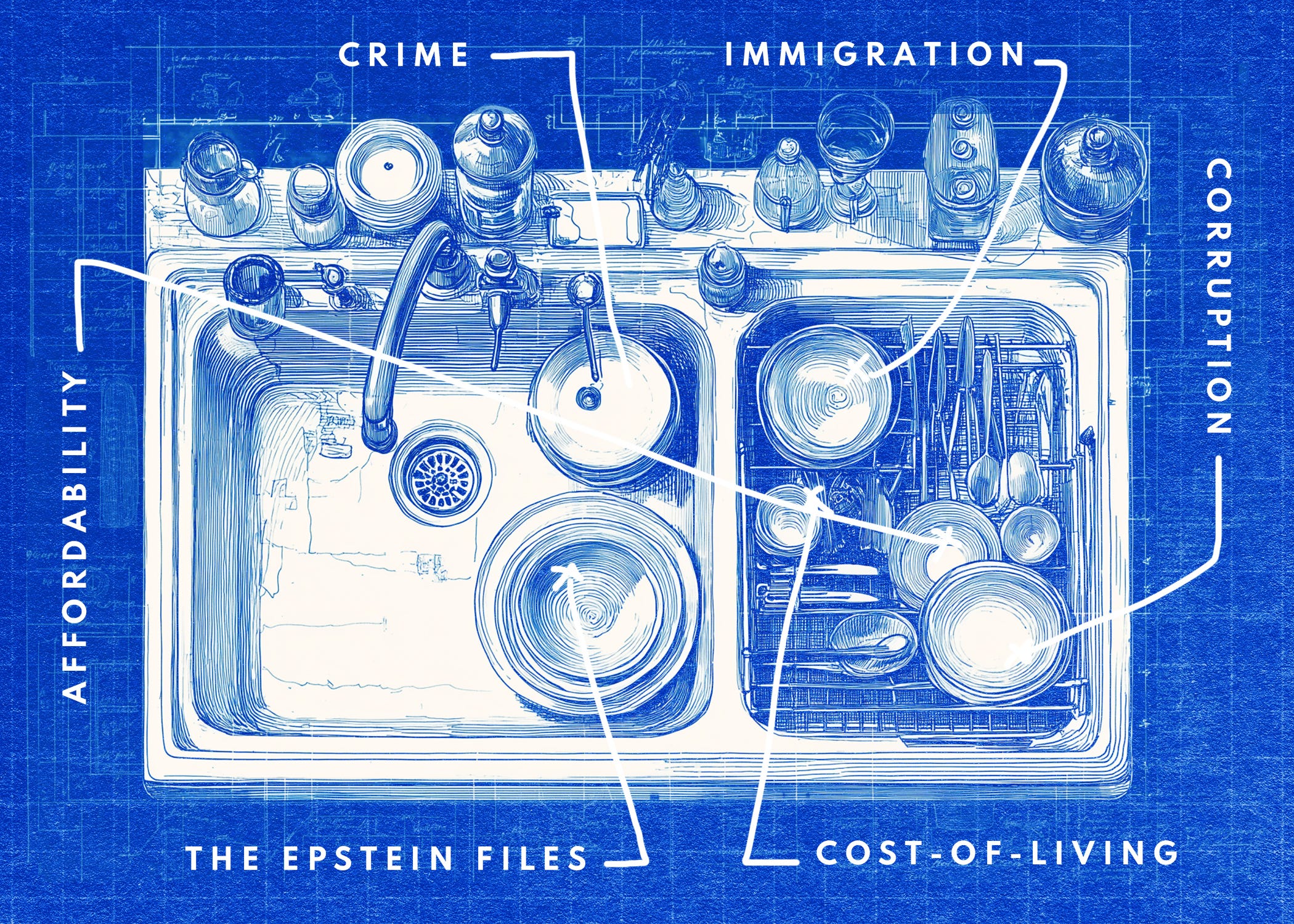
OVER THE LAST YEAR, much of the Democratic party clung to the belief that the path back to power would require a monomaniacal focus on affordability.
In podcast interviews and cable-news appearances, party officials religiously pivoted to talking points about groceries being more expensive, utility bills skyrocketing, and health care being ripped away from millions of people. The idea that kitchen-table issues will deliver congressional majorities in 2026 has become such a doctrine within the party that in certain quarters it’s now considered not only unwise but even gauche to run on anything else. The supporters of this approach see vindication in the results of this month’s elections, as Mikie Sherrill and Abigail Spanberger both ran their gubernatorial campaigns with a major focus on economic issues.
Then this week happened.
Democrats broke from their laser-like focus on affordability and rallied behind legislation that would force the Justice Department to release all files it has on Jeffrey Epstein. And it worked. Not only did the bill pass both chambers of Congress, but it fractured the Republican coalition in the process, putting Trump in a position he hadn’t yet been in during this second term: lacking control over his party. The president will now sign a bill that will, at the very least, serve as a public reminder of his friendship with a human trafficker and sex offender.
No one I talked to in Democratic circles over the past week said they believe that the Epstein saga would now be the determinative electoral factor in 2026. But the disruption it has caused—and the momentum it provided to their party—has sparked a type of reimagining of the playbook for taking on Trump. At a minimum, it has strengthened the argument of those convinced that the party, instead of strictly focusing on affordability, should throw everything at the White House to see what sticks.
“There’s stuff you can run on to show what you’re for and there’s also a really easy way to show what you’re against. Dems have to do both,” said Democratic strategist Rebecca Katz. “The real challenge is how much bad news there is and figuring out which pieces to hit.”
IT’S BEEN LOST IN THE DRAMA of this week’s votes, but it wasn’t that long ago that congressional Democrats weren’t unified in supporting an all-in strategy for demanding Epstein disclosures. In an interview with CNN this week, Rep. Ro Khanna (D-Calif.), the main cosponsor of the discharge petition and the lead sponsor of the resolution that forced the release of the files, said that when he first introduced the resolution over the summer, it was hard to get his party on board.
“I’m not going to say who, but some of the folks in our own party were like, eyerolls, ‘There goes Ro on one of his issues. . .’ ‘Why aren’t we talking about the price of eggs?’ ‘Why aren’t we talking about the price of health care?’ ‘What’s up with this?’ And I said, ‘No, there is something legitimate here.’”
Khanna was referencing the Democrats’ perpetual internal conversation about whether the party has allowed itself to routinely be distracted by the Trump scandal du jour. Over the summer, as the party was trying to go after Trump’s tax-and-spending bill, lawmakers warned that the Epstein story was a “distraction” from the issues that Really Mattered.
But other Democrats—not just Khanna—argued that the party had to do both: focus on cost-of-living issues while also going after Trump on his missteps, corruption, and malfeasance. Modern politics, this faction argued, demands nimbleness in response to events; and it certainly requires engaging in those stories that, while maybe ephemeral, grab people’s attention in the moment. That meant putting out TikTok videos about Tom Homan’s alleged Cava-bag bribery payment in addition to releasing yet another statement on rising costs. A balanced political diet.
Prominent among those making that argument was former Chicago mayor (and likely 2028 presidential candidate) Rahm Emanuel, whose February opinion piece for the Washington Post was an important touchstone in the debate. While it’s understandable, he wrote, that Democrats want to “narrow their definition of kitchen-table issues,” he reminded his readers that Americans discuss much more than how to stretch the family budget over dinner, and called on Democrats to talk more about crime and immigration.
Other Democratic leaders I’ve spoken with in the past few weeks have said that they too have come to believe that party officials could do a better job understanding that, whether they like it or not, more Americans are aware of the fact that Trump is building a new White House ballroom than the intricacies of his tariff agenda.
Blue Rose, a Democratic research firm, last month found that 76 percent of voters had heard of Trump’s decision to tear down the East Wing of the White House in order to build a 90,000-square-foot ballroom. Multiple polls found that a majority of Americans disapproved of the move.
The sweet spot, some Democrats told me, would bring together the scandalous material and the affordability messaging. Pat Dennis, the president of the Democratic opposition research firm American Bridge, said that his organization advises Democrats to focus their talking points on how Republicans “hurt” voters while also helping themselves. Earlier this year, the group cut a series of ads going after Trump for building the ballroom, aiming to associate swing-seat Republicans with the gaudy project. But Dennis also advised the actual candidates to leave the non-economic attack ads to allied groups, if for no reason than to appear above the muck.
“We need to enter 2026 with voters thinking every Dem elected wakes up in the morning thinking about costs. Attack dogs like us can focus on making sure they think that Republicans don’t wake up thinking about that,” said Dennis. “Republicans make it an easy job, to be honest.”
AMONG THE QUESTIONS driving this debate is whether Democrats would be sacrificing potential wins if they don’t fully engage the debates beyond affordability. In 2024, candidates largely shied away from immigration in hopes that they could wage campaigns on health care. They ended up getting clobbered on the former while not materially benefiting from the latter. A year later, these debates over just how fine-tuned and narrow the campaign focus should be have taken on added import and additional dimensions, in part because polling reveals that there are more opportunities.
The public—once supportive of Trump’s immigration policies—has grown increasingly uncomfortable with his aggressive ICE tactics. In an October survey from Echelon, 72 percent of respondents said that they had “seen, read, or heard” about recent ICE arrests and immigration enforcement. And many of the specific actions that they are seeing ICE take are overwhelmingly unpopular. According to an October survey from the progressive polling firm Data for Progress, majorities of likely voters disapprove of ICE firing rubber bullets, using tear gas against protesters, detaining legal residents, and (especially) restraining children with zip ties.
And it’s not just voters expressing these sentiments. Joe Rogan, the hugely influential podcaster who endorsed Trump last year, has been increasingly critical of Trump’s ICE raids. In an episode released this week with comedian Theo Von (another “manosphere” podcaster who had Trump on his show during the 2024 election), Rogan said that the raids were “scaring the shit out of everybody” and slammed the Department of Homeland Security for making a deportation “hype video” featuring Von without his permission.
All of this has added to the push among Democrats for the party to expand its aperture when it comes to the midterm campaign issues. The French revolutionaries, they argue, didn’t just talk about the price of bread being too high, they also focused on the rapaciousness of Versailles. Among those making the case is Neera Tanden, the president of the Center for American Progress, who has publicly agitated for Democrats to focus more on Trump’s ballroom, arguing that it is something voters were paying attention to and is a symbolic way for the party to tell a larger story about Trump.
“Cutting SNAP while you build a gold ballroom is some pretty Marie Antoinette vibes,” Tanden told me.
🫏 Donkey Business:
— A panel of three federal judges ruled Tuesday that Texas cannot use its new congressional map—which gives Republicans as many as five additional seats—in next year’s midterm elections. In the ruling, the court said that the new maps appeared to be an unconstitutional and illegal race-based gerrymander and instructed Texas to stick to the district lines that were created in 2021 following the 2020 census.
The ruling was celebrated by Democrats, who, if the ruling holds, would likely emerge from this year’s countrywide redistricting clash with a two-seat advantage (they gained seats in California and Utah). But that’s a very big if. Texas GOP leaders quickly appealed the ruling to the U.S. Supreme Court, and there’s ample evidence that the Court isn’t all that keen to uphold the Voting Rights Act. (The Texas Tribune has a great rundown of how this could play out.)
Complicating the situation is the fact that the candidate filing deadline is on December 8, leaving some candidates in limbo and unsure of whether they should continue campaigning in their current districts or prepare to file for another one.
— Speaking of redistricting, I’m going to chat tomorrow with Maryland state Sen. Bill Ferguson for Bulwark Takes. You may recall the newsletter I wrote on him last week, calling him “the most hated Democrat in America.” If you have questions for him, drop them in the comments.
My open tabs:
— As Border Patrol Floods North Carolina, Charlotte Asks, ‘Why Us?’
— Democrats see a plan to undermine elections in Trump’s surge of federal agents in cities
Does anyone think that the DOJ will actually turn over everything they have? Pam Bondi is a good little Trumpist, and I seriously doubt that Trump would have "agreed" to the vote unless there was an understanding behind the scenes that DOJ will start shredding and destroying files. Paranoia has infected me, I agree, but I certainly do not trust anyone in the administration to do the right thing.
I'm always amused by the idea they need to pick one message. Everyone under 45-50 has at least 3 tabs open on a browser at any given time. But maybe that's my laptop class brain talking