Trump and the Great Midwestern Divide
His Iowa visit highlights the divergent realities occupied by his supporters and the growing opposition.

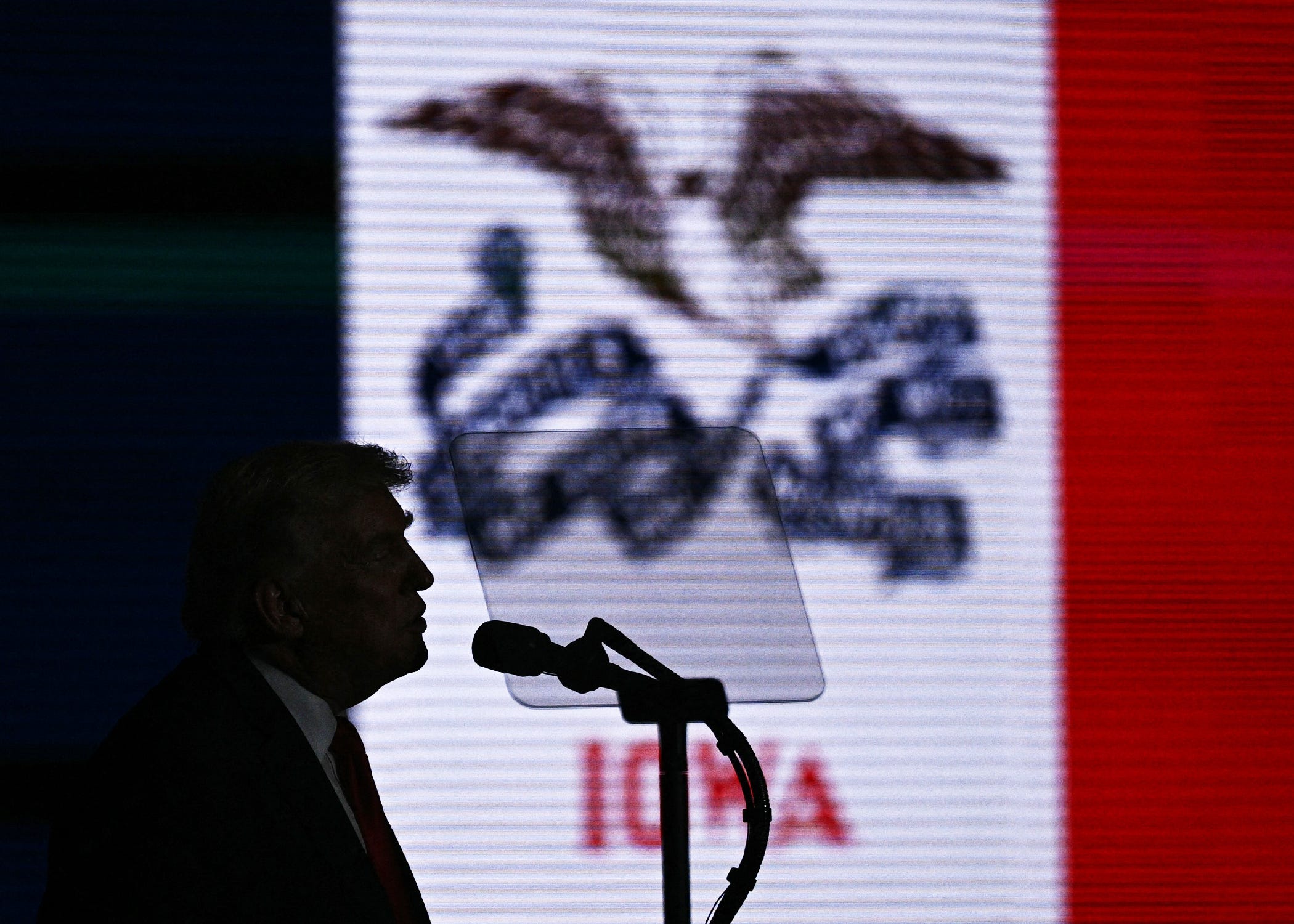
Clive, Iowa
THERE WERE MORE PROTESTERS outside Donald Trump’s event in Iowa on Tuesday than there were Trump supporters inside.
The Des Moines Register estimated that there were about 2,000 protesters outside the Horizon Events Center in Clive, a suburb of Des Moines. That number felt right to me as I walked between people screaming “Fuck Trump” and “Fuck ICE” in the cold. Liz Fleming, an Iowa Democratic influencer, texted me that she heard the number outside was closer to 3,000.
Inside the Horizon, I counted about 500 Trump supporters (700, according to an Iowa newspaper), who sat huddled on small plastic chairs or leaned against metal barriers. The college student next to me, errant hairs on his upper lip forming the hope of a mustache, chewed the skin off his fingers with a vigor matched only by his applause for every mention of law enforcement or the troops. The chatty grandma down the row joked that Trump was late because he stopped for McDonald’s. “I bet RFK wouldn’t like that,” she said.
A thin, older man sat on the other side of me, nervously sweating. I could smell the overwhelming, musty scent of skin and fear. At first, I thought he was ill. When I tried to talk to him, he seemed distracted. He was taking notes. I wondered: Is he going to light himself on fire? Or maybe he planned to scream at Trump. I worried that he’d brought a gun. But that’s impossible, right? The security to get in was effective and thorough, I reminded myself. Still, I kept noticing the way he nervously tapped on his phone. Nothing feels safe in America right now.
Renee Good and Alex Pretti were shot about 250 miles away. From Clive, where I was sandwiched between the finger-chewer and the sweaty man, Minneapolis is just under four hours away by car—a quick trip, by Midwestern math.
Iowa and Minnesota exist in opposition to one another. Iowa, once a blue-ish state, is now solidly red and is run by a Republican governor; Minnesota, once reddish, is now solidly blue, run by Kamala Harris’s running mate, though he’s retiring at the end of his term. One state is a willing testing ground for the government’s agenda. And the other is openly protesting the actions of the federal government.
TRUMP’S VISIT TO IOWA can be read two ways. If you’re a Democrat, you might believe that Trump came to shore up support in a red state where his popularity is eroding. Tariffs have been devastating for farmers, and Iowa’s economy under the state’s GOP leadership stinks worse than a hog confinement. So there is legitimate hope that Trump country is ready for a coup.
Of Iowa’s four House districts, three are looking competitive in next year’s elections, and there will be an open Senate seat thanks to Joni Ernst’s retirement. Republican Gov. Kim Reynolds is not running for re-election, so there’s an open governor’s seat, too. Senate Minority Leader Chuck Schumer has the party’s eyes set on Iowa as a part of the path back to the majority. And while a few Republicans are running for governor, Auditor Rob Sand, the lone Democrat elected statewide, is outfundraising everyone, Republican and Democrat.
On good days, it feels like Iowa, once firmly Trump country, is now in play.
And this is one of those days. Rep. Ashley Hinson, who is running for the Senate seat Ernst is leaving, and Rep. Zach Nunn, who is up for re-election, speak before Trump, and they have a warning for the crowd: If you don’t show up to vote in the midterms, Democrats will raise your taxes and impeach Donald Trump.
I can imagine the people outside responding, “Don’t tempt us with a good time.”
In the auditorium, there isn’t much acknowledgement of the protesters outside. When Rep. Mariannette Miller-Meeks, another warmup speaker, takes the podium, she mentions the protesters only to say she wanted to give them the “one-finger salute.” The audience offered up lukewarm applause.
The people around me don’t want to talk about them—the “paid agitators,” as one grandmother calls them. They’re “deranged,” a veteran behind me explains. And the folks around me definitely don’t want to talk about Minnesota at all. When I bring it up, the finger-chewer says people should comply with the police, and the grandmother changes the subject, asking me how many kids I have.
What’s happening in Minneapolis—and even outside the doors of this building—they can ignore while they are at this Trump rally. Here, the death of two Americans is not the issue. Here, we are talking about the economy and taxes. At this rally, for a moment, everyone inside can believe that America is the way Trump wants us to see it: We are respected abroad. Crime is down. There is no one crossing the border. And, most importantly, everybody loves Trump. They do, and we know, because when he gets up to speak, he tells us so repeatedly.
YET IOWA IS STILL Trump country, even though it feels like it’s in play. The Republican party controls the offices of governor, secretary of state, and attorney general, as well as both chambers of the state legislature. And has for the past ten years. This is a deeply red state. Republicans have almost 180,000 more registered voters than Democrats. Even independents have 115,000 more registered voters than Democrats.1 And the state only has about 3.3 million people, with around 2 million of them registered to vote. These are bad odds, especially when you consider that Democratic voters largely stayed home in the last presidential election. That math explains the gubernatorial race, where Sand, the Democrat, is running not for the base but for the independents. His campaign branding palette has no red or blue, and he repeats the line, “Not redder, not bluer, but truer” on the campaign trail.
Sand’s strategy makes good mathematical sense, I guess. But it isn’t the kind of message that inspires people and gets them excited to vote. Sand’s campaign is emblematic of the approach of Democrats across the nation: Afraid of Trump and the nastiness of his base, they’re leaning toward the center and calling for calm and moderation. Meanwhile, Iowa voters are in the street, screaming expletives. There were grandmothers outside the Trump rally insulting the size of ICE agents’ penises. The “No Kings” rally in October brought protests to rural counties that haven’t seen a protest in decades. Who is going to get out to vote for nebbishness when federal officers are shooting American citizens in the street? People are angry, and they want to fight. And they want someone who will fight for them.
It seems impossible to fight the fires of Trumpism with the tepid water of centrism.
WHEN TRUMP FINALLY takes the stage, he seems subdued, and he rarely veers from his script. But he comes with warnings of his own: If Republicans don’t win this midterm, his agenda is out the window. All his success—and he claims a lot of success—will be undone. Does this crowd want that? It feels a little like a threat.
Midway through the speech, the two worlds—the one outside and the one inside—started to collide.
Not ten minutes into Trump’s speech, a security guard walks up to the sweaty man near me. Without my noticing, the man had taken off his plaid jacket to reveal a shirt that had the word LIAR printed over it in red Sharpie.
“Is this about the president?” the guard demands. The man mumbles something I can’t hear. Two more men come over to escort him out.
A few minutes later, Trump’s speech is loudly interrupted by protesters. They, too, are escorted out. And then, a few minutes after that, there is a scream from the other side of the room. I can’t make out what is being shouted, and the crowd soon drowns them out with chants of “USA! USA!”
Trump calls them paid agitators. He is popular, he tells us. Anyone objecting to him has to be fake. He moves on.
But when we leave the events center, protesters are still there, waving signs that read “The mango moron!” “Trump is a liar!” “We stand with Minnesota!” Many opt for a classic: “Dump Trump.” To leave the parking lot, you have to see them, have to confront them. You have to look so many people holding signs that read “Fuck Trump!” right in the eye.
And even if afterwards everyone goes home and burrows into their preferred private narratives of what they want to believe happened rather than what exists, there will still have been a moment when those two worlds came into contact. And in that moment, whatever self-adulatory myth Trump had built up inside was forced to face the cold outside air.
Lyz Lenz is a journalist and author living in Iowa. She has written three books, God Land, Belabored, and This American Ex-Wife, which was a New York Times best seller. In her newsletter Men Yell At Me, she explores politics and personhood in red state America.
Correction (9:30 p.m. EST Jan. 28 2025): Because of an editing error, the original version of this story claimed there are 150,000 more registered independent voters in Iowa than registered Democrats. Registered unaffiliated voters instead outnumber registered Democrats by 115,000.
 | A guest post by
|