




The National Mall has a new feature. No, not the once-again-drained Reflecting Pool. And no, not the mysterious gash the president insists some vandal (or “Vandal”) made in it—the length of which has grown, somehow, to 300 feet since the last time he complained about it. No, the new feature is a 10-foot “participation trophy” to Donald Trump for his war in Iran, installed by an anonymous protest-art group near the Martin Luther King Memorial. Not everyone can be a winner, right? Happy Tuesday.
A couple programming notes: Tim has Pete Buttigieg on today’s Bulwark Podcast and Bulwark+ members will get early access to the show starting this morning.
But first: Tune in for Morning Shots Live at 10:30 a.m. EDT here and then watch your inbox for Tim’s exclusive interview from Iowa with Mayor Pete.

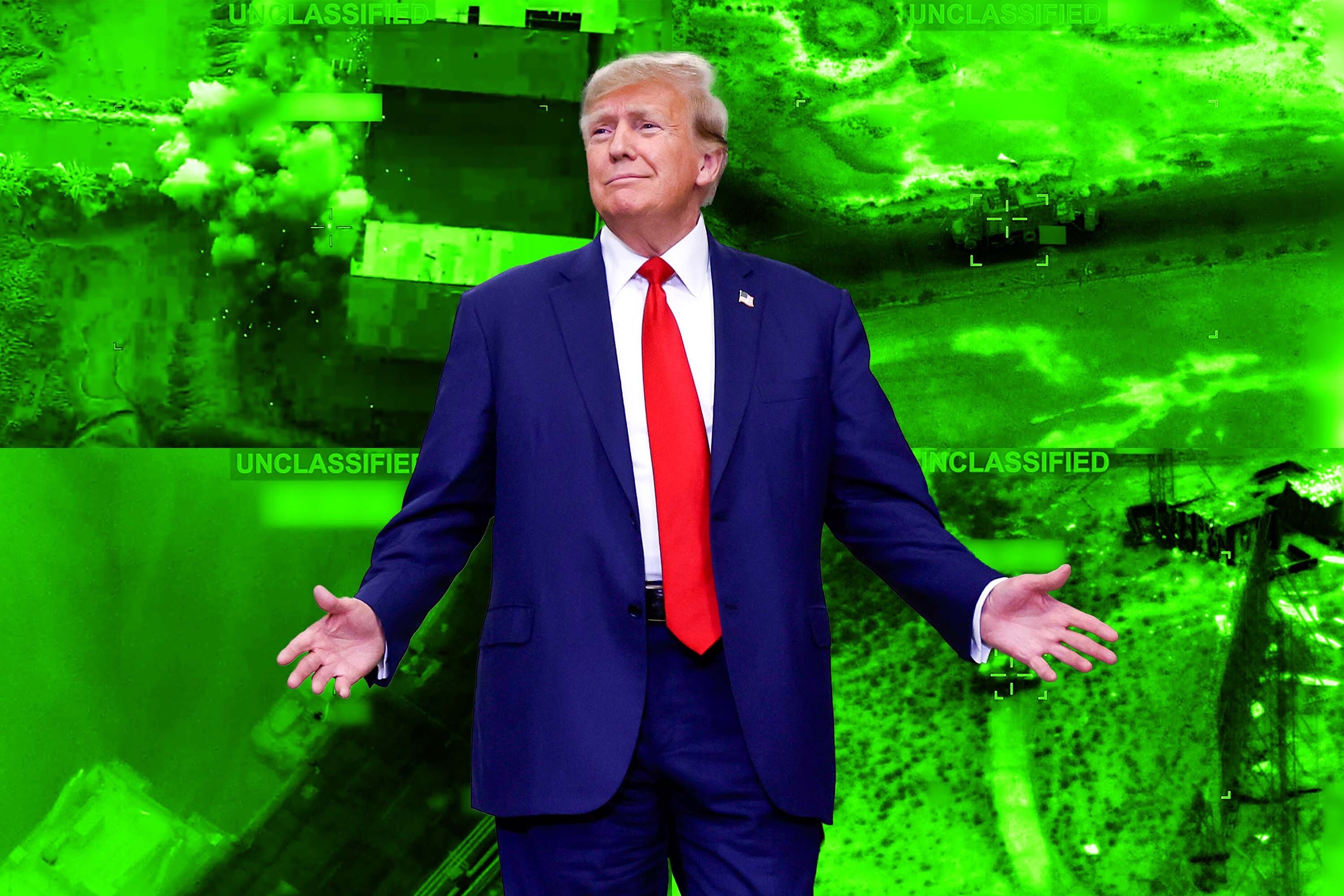
Destruction Alone Doesn’t Win Wars
by Mark Hertling
The United States can destroy more targets than Iran. It can sink ships, eliminate missile batteries, strike command centers, and impose military losses that Tehran cannot reciprocate. But Iran does not have to match American firepower to achieve its goals. It must only keep commercial shipping at risk, energy markets unsettled, Gulf governments nervous, American bases under threat, and U.S. forces responding to the next crisis.
Washington may be winning most exchanges of fire, but Tehran has the initiative: It still decides, for the most part, where the conflict occurs, which American assets must be defended, and how many additional missions U.S. forces must assume.
The Memorandum of Understanding between the United States and Iran called for an “immediate and permanent termination of military operations,” but it was never a peace settlement. Its vague language governing commercial shipping through the strait virtually guaranteed competing interpretations. Halfway through the MOU’s sixty-day negotiating period, questions about Iran’s nuclear program, sanctions, and U.S. force posture also remain unresolved.
With the resumption of combat in the Strait of Hormuz, the United States is being pulled into multiple overlapping campaigns: striking Iranian nuclear and military capabilities, protecting commercial shipping, suppressing coastal missile systems, defending regional bases, and reassuring Gulf partners. But there is no clearly articulated political end state. This is mission creep.
The Islamic Revolutionary Guard Corps, meanwhile, appears willing to absorb extraordinary punishment. Iranian facilities have been destroyed, missile and drone systems attacked, and commanders killed, yet Tehran continues launching weapons, threatening shipping, and striking facilities across the region. This exposes the critical difference between punishment and coercion: The United States is unquestionably punishing Iran, but not compelling it to change its behavior.
Strategy should start with a desired political outcome and then direct military, diplomatic, and economic power toward achieving it. It should not be assembled one retaliatory strike at a time.
America’s Gulf partners understand the danger. They fear Iran, but they also fear an unlimited American–Iranian war fought across their region. They want Washington to deter Iranian aggression and protect freedom of navigation, but they do not want their cities, energy infrastructure, airfields, and populations threatened or bombarded.
The United States can destroy more, but Iran can disrupt more. Iran can lose every tactical encounter and still produce strategic effects. It can raise shipping costs, disrupt energy markets, strain American alliances, expose regional bases, and draw the United States deeper into an open-ended campaign.
To get a sense of how that happens, look no further than Russia’s war in Ukraine. Russia is the stronger combatant on paper: It has more people, territory, weapons, industrial capacity, and ability to absorb casualties and replace equipment. Yet after more than four years of war, those advantages have not produced the political outcome Vladimir Putin sought. Russia has destroyed Ukrainian cities, seized territory, killed civilians, damaged energy infrastructure, and imposed enormous costs. But it has not conquered Ukraine, broken its government, divided NATO, or forced Kyiv to accept political subordination.
Ukraine cannot defeat Russia by matching its mass. It wins by surviving, and its survival has depended on three things Russia initially underestimated: adaptation, outside support, and national will.
That will is visible in both the Ukrainian government and its citizens. Ukraine is a democracy, so its continued resistance depends not simply on government orders but on public consent, political legitimacy, military service, sacrifice, and the population’s belief that national survival is worth the cost. That resolve is not unlimited, but it has already disproved Moscow’s expectation that the government would collapse, and the country would quickly submit.
Iranian will is different. In a theocracy, it is difficult to separate the determination of the regime, the Revolutionary Guard, and the broader population. Tehran can suppress dissent and impose costs on citizens in ways a democratic government cannot. Yet the regime’s willingness to absorb attacks, continue retaliation, and accept economic pain remains a form of strategic endurance that American planners cannot ignore. Military superiority matters less when the adversary believes it can outlast the stronger power politically.
Ukraine’s adaptation has repeatedly changed the character and geography of its war. It challenged the Russian Black Sea Fleet without possessing a conventional navy. It transformed inexpensive drones into weapons capable of attacking armor, artillery, command posts, airfields, ammunition depots, and energy infrastructure. It extended the battlefield deep into Russia, forcing Moscow to defend millions of square miles, including areas just recently considered beyond Ukraine’s reach.
Russia can destroy more. So Ukraine must adapt faster—and sustain the will to continue.
But adaptation and will cannot substitute indefinitely for soldiers, weapons, and allied support. Ukraine’s forces are under enormous pressure. Its cities remain vulnerable, its soldiers are exhausted, its air defenses are strained, and uncertainty about Western assistance continues to benefit Moscow.
But for all that, Russia’s strategic goals remain stubbornly out of reach.
Russia is unquestionably punishing Ukraine. But punishment is not coercion. Ukraine continues to fight, its government remains independent, NATO is larger than it was at the beginning of 2022, and Europe is rearming. Russia’s mass has produced destruction and territorial gains, but not the strategic victory that drove the invasion.
Wars are not decided solely by who destroys more. They are decided when military operations break an opponent’s ability, or will, to resist. Russia and the United States—in very different ways and with greatly varying degrees of professionalism and efficacy—have shown their abilities to destroy. While Ukraine fights for democracy and freedom and Iran fights against it, both have shown their wills to resist and to win by not losing.
Is It Too Much to Ask?
by William Kristol
“There ought to be a system of manners in every nation which a well-formed mind would be disposed to relish. To make us love our country, our country ought to be lovely.”
Thus the great Edmund Burke, friend of the American Revolution and critic of the French Revolution, a thinker and statesman claimed in the twentieth century as a great conservative but in the nineteenth century (more accurately, I think) as a great liberal.
“Our country ought to be lovely.” These words of Burke come to mind this morning in light of the now-familiar justifications and coverups by top government officials of ICE agents killing innocent people in our streets. They come to mind in light of the moving public service announcement by survivors of Jeffrey Epstein and Ghislaine Maxwell urging members of Congress not to confirm Todd Blanche, who has utterly and purposefully failed to seek justice for them. They come to mind in light of the announcement of a presidential speech later this week designed to rewrite history in order to subvert our next elections.
Burke aimed high, perhaps too high. Perhaps it’s too much to ask that one’s country be lovely. Maybe it’s better to lower one’s sights, as Burke’s friend, Adam Smith, did when he observed that “there is a great deal of ruin in a nation.” But even so: Surely our nation ought not be ugly. And if it is too much to expect that our government be lovely, it’s not too much to ask that our government act defensibly. It’s not too much to ask that our public officials behave decently.
But, you say: Our country is better than our government.
I hope so.
But it’s a representative government. Our president was elected, and then, after attempting to subvert the peaceful transfer of power, was elected once again. Our elected members of Congress have confirmed the leaders of the executive branch and funded its activities.
Our government isn’t behaving admirably. And so we have to say that we as a nation aren’t behaving admirably either.
It will take quite a while to restore decency and responsibility to our public life. What we can do now is to check the injustice and limit the damage. We can pressure our representatives not to confirm someone like Todd Blanche and not to fund an agency like ICE. We can help dissidents in the executive branch; we can appeal to the courts; we can act at the state and local level; we can work through civil society. We can argue and agitate and vote.
We can demonstrate love for our country by working to make it far less ugly, and far more lovely.
A MESSAGE FROM OUR SPONSOR
Have someone who doesn't like you? They already know where you live.

The Independent reported this year on a woman who’d barely used social media. A stalker still found her home, her relatives, her workplace—all from a single name search on a data broker site.
These sites don’t ask why someone is looking. They just answer. Your address. Your family members. Your daily patterns. Available to anyone—an angry ex, a stranger, someone who just didn’t like something you posted.
Incogni tracks down every site exposing your data, removes you, and removes you again when it comes back. Get 55% off annual plans with code BULWARKDEAL.
AROUND THE BULWARK
Ukraine Mourns an Unlikely Champion… History won’t judge Lindsey Graham in just one language, observes CATHY YOUNG.
The Lindsey Graham Conspiracy Theories Are Already Running Wild… but WILL SOMMER doesn’t think they’ll stick.
Sam Neill, 1947–2026… SONNY BUNCH remembers an unlikely superstar.
August’s Bulwark Book Club pick is Mark Twain’s Pudd’nhead Wilson. Mona and Bill Kristol will discuss this lesser-known but very interesting Twain novel on August 12, and also consider Twain’s remarkable life and work as a whole. Pick up the book, and leave your questions for Mona and Bill here.
Quick Hits
IMPROPER ROBBERY SCHEME: Remember when Trump sued the federal government for a bajillion dollars and then ordered the government to settle, and then they settled before any court could look under the hood? Well, a federal judge in Florida finally got a chance to comment on the case and what she found is every bit as corrupt as we expected. The New York Times summarizes:
A federal judge ruled on Monday that President Trump’s lawsuit against the Internal Revenue Service was an improper exercise in self-dealing and barred him from claiming that the extraordinary tax protections he received were part of a legitimate settlement agreement. . . .
“The nature of the suit itself and the conduct of the parties and counsel from its filing make plain that this was an attempt to use the court to provide some legitimacy to an agreement to confer immunity to people and entities affiliated with the president,” the judge wrote.
Judge Kathleen Williams even referred Trump’s lawyers—including Attorney General–designate Todd Blanche—to the New York and Florida bar associations for possible disciplinary action because their abuse of the legal system was so blatant and malevolent.
But she didn’t actually dissolve the deal by which Trump effectively granted himself immunity from IRS investigations. “Whether executive branch actors can privately agree to give themselves and their former clients blanket immunities and billions of dollars in tax moneys for legally undefined grievances was never an issue advanced to this court,” she explained.
That ruling will presumably have to wait for another day.
DISCOUNT HORMUZ: Ever since Iran announced that it was closing (or partially closing, or tolling, or whatever) the Strait of Hormuz, Donald Trump’s approach to the whole conflict seems to be: Anything you can do, I can do worse.
And so, yesterday morning, he posted to his social media network,
The U.S.A. will be, from this point forward, known as “THE GUARDIAN OF THE HORMUZ STRAIT,” but as such, and as a matter of FAIRNESS, will be reimbursed, at the rate of 20% on all cargo shipped, for any and all costs necessary to do the job of providing safety and security . . .
Well, Iranian Foreign Minister Seyed Abbas Araghchi knows a negotiation when he sees one. “POTUS is absolutely right. Whoever provides secure and safe passage of commercial vessels through the Strait of Hormuz should be compensated for this service,” he tweeted, but “20% is of course too much. We will be fair.”
Nothing like a little competition to drive down prices.
DO IT FOR LINDSEY: CNN reported yesterday that President Trump is planning to support1 a bipartisan bill imposing new sanctions on Russia that Sen. Lindsey Graham had advocated before his sudden death.
The endorsement comes days after Graham’s unexpected death, likely further smoothing the path for a bill that the South Carolina senator spent years working to push across the finish line.
Graham and Democratic Sen. Richard Blumenthal previously indicated the administration was prepared to back the package, saying Friday that they reached an agreement following extensive negotiations. Yet it was unclear at the time whether Trump would directly support the bill, as the president had repeatedly panned the legislation and pushed for more direct discretion on imposing sanctions.
The article doesn’t explicitly say that Trump changed his mind because Graham died, but it also doesn’t offer any alternative interpretations of Trump’s change of heart. Perhaps a paroxysm of sentimentality caused by Graham’s sudden death moved the president—but if so, that’s an awful way to move legislation.
Cheap Shots

In a normal administration, a White House source telling CNN that the president plans to support something is tantamount to the president supporting it, but with this administration, who knows?
Bill: "But, you say: Our country is better than our government."
If this were true, Donald Trump would have been blown out in 2024.
How lucky we and the Bulwark are to have the General making sense and keeping us informed. Worth the subscription right there!