Trump Just Gutted A Major Line of Oceanic Defense
Just in time for hurricane season, the Trump administration is defunding its global ocean-monitoring system.

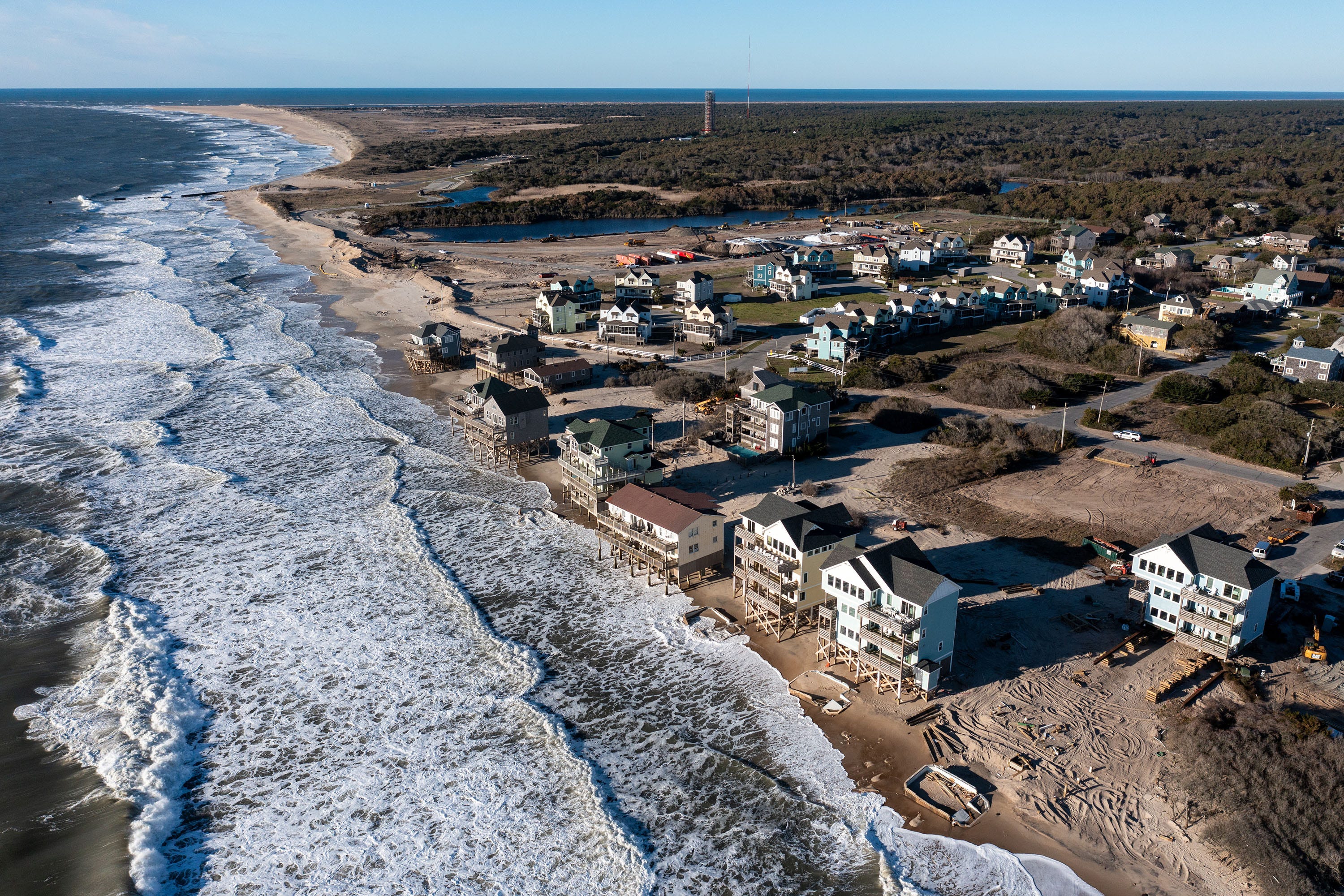
Buxton, North Carolina
IF YOU’VE WATCHED ANY hurricane coverage on TV in the past few years, there’s a good chance you’ve seen a house here fall into the ocean.
It’s happened thirty-two times in this wispy strip of barrier islands, known as the Outer Banks, since 2020. And not just during hurricanes! The most recent house collapse happened just last week, amid a relatively minor coastal storm. That little blue Buxton house was devoured by the sea in less than half an hour. Once-pristine “oceanfront” property is now just ocean.
Buxton and other towns around the Outer Banks have become the national poster children for the dangers of rising sea levels, coastal erosion, and intensifying storms linked to climate change. But last month, just in time for hurricane season and an intense El Niño event, the Trump administration announced it would strip the coastline of one of its most important lines of defense: the Ocean Observatories Initiative.
The OOI system is being defunded, and its sprawling array of deep-sea monitoring devices will soon start getting pulled out of the water. The loss of this and other data-collection infrastructure could well be existential for the tourism-dependent Outer Banks economy. But like other Trump administration efforts to dismantle federal scientific and statistical programs, it’s pretty problematic for the rest of us, too.
That’s because the $368 million, real-time ocean-monitoring system is responsible for 900 instruments strategically placed around the Pacific and Atlantic Oceans, where they have tracked data critical for weather, environmental, commercial, and military purposes since 2016. The categories of physical and biochemical information being collected are numerous: waves, currents, salinity, the soundscape for marine mammals, carbon dioxide levels, alkalinity, and more. Their measurements are all publicly available, and the data have been a godsend to public researchers, hazard planners and private companies alike.
Take hurricanes, for instance.
We’ve gotten better over time at forecasting the paths1 of hurricanes, but we are still pretty lousy at predicting their intensity, according to Mike Muglia, a scientist with the Coastal Studies Institute and East Carolina University. For intensity forecasts, he says, we need not only surface water temperatures—which we can collect relatively inexpensively from buoys—but also reliable temperature measurements at various ocean depths. That’s because a hurricane can be slowed by upwelling, the raising of (typically cooler) water from the depths below the storm to the surface. Those are exactly the kind of metrics collected via the Pioneer Array, a part of the Ocean Observatories Initiative located about fifteen miles offshore from Muglia’s home in Nags Head.
That will soon be gone.
Other measurements from the Ocean Observatories Initiative help scientists, developers, and government officials predict coastal erosion, which is helpful for figuring out which homes need to be condemned (or moved) before they too get eaten by the ocean and belched back up as dangerous seashore debris.
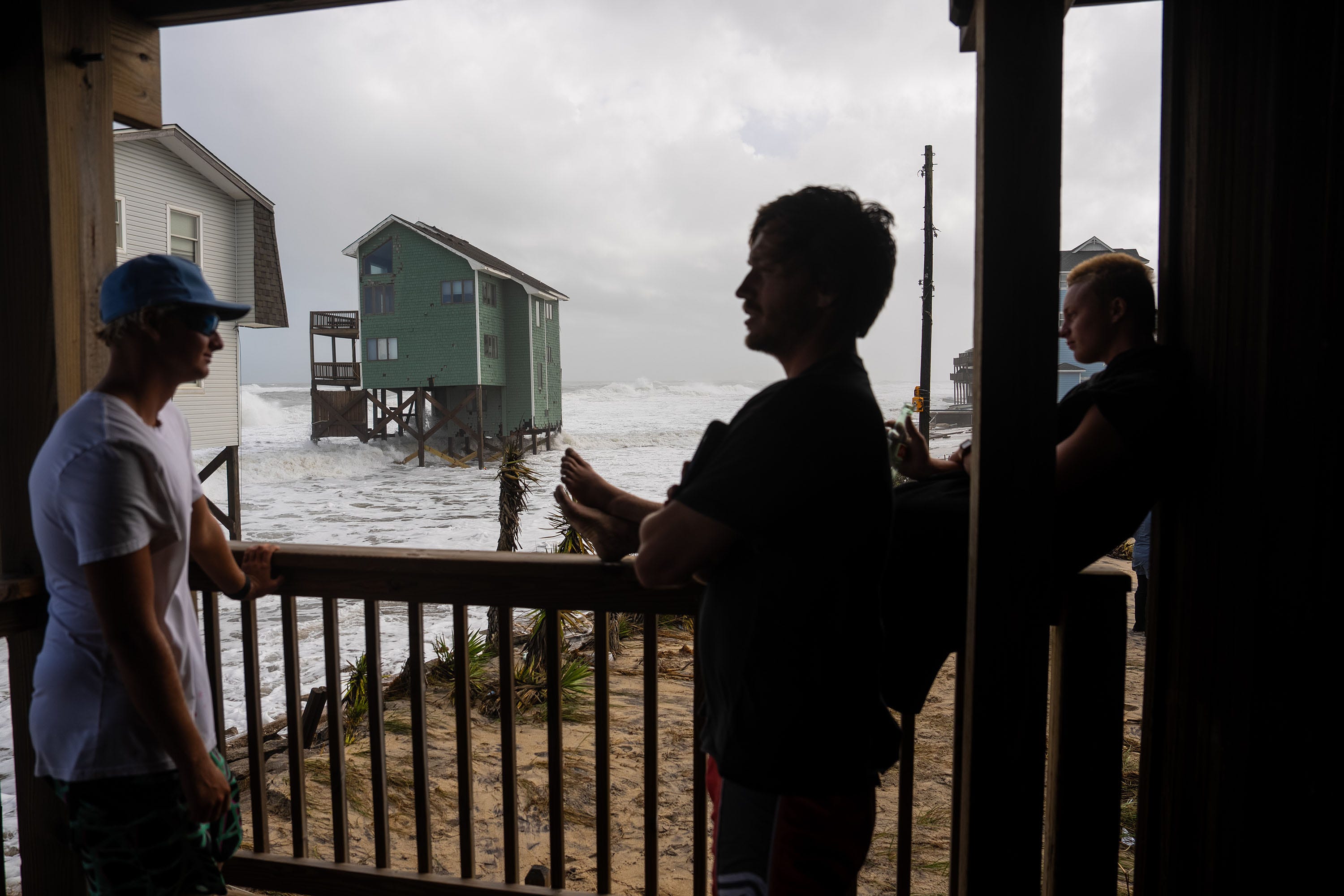
But lest you think the applications are limited to insufferably “woke” climate-change-related purposes,2 the instruments have lots of other useful functions. If there’s a search-and-rescue operation for a capsized boat, or cleanup for an oil spill, for example, the instruments help guide where to send help and resources.
“They’re not just taking a guess based on a model,” says Muglia. “They can look at what the current’s actually doing when they have to go make a rescue.”3
The military also has an interest in maintaining this infrastructure—particularly off the North Carolina coast, where German subs once hid in the deep water during World War II. (To this day, you can still scuba around some sunken U-boats that rest off the continental shelf.) Tracking the underwater “soundscape” here continues to be critical for U.S. naval defense. The global Ocean Observatories Initiative helps us do it.
The U.S. military also uses water current data to develop renewable-energy technologies—again, not for particularly bleeding-heart environmental motivations, but to harvest energy from currents so that it can power surveillance vessels or other remotely operated vehicles.
“The ocean drives our entire economy and life systems,” said Stanley R. Riggs, a retired coastal geologist who taught for decades at East Carolina University. He ticked off a list of other uses for publicly funded ocean monitoring instruments, such as deep-sea mining exploration and fishery forecasts. “We’re pulling the plug on some of the most important science being done.”
SO WHY IS THIS SYSTEM being dismantled?
The National Science Foundation’s official explanation for the “descoping” is that it is bringing the OOI into alignment with the research-funding agency’s larger strategy: “a nimbler approach to prioritizing support for evolving scientific priorities and emerging technologies as well as a deliberate approach to smart life cycle management within its portfolio of research infrastructure.” Whatever that means.
Apparently this “nimbler approach” includes a sweeping effort to delete, defund, or otherwise censor inconvenient data and scientific wrongthink4; purge Ph.D.s from government payrolls; and subject research grants to ideological purity tests.
And that was just in Trump’s first year-and-a-half back in office. The administration’s most recent regulatory effort could be even more apocalyptic for the research ecosystem that has powered the U.S. economy. Its proposed rule would require the president’s political appointees to review and approve all discretionary federal grants to ensure they align with his political agenda—and it explicitly forbids them from deferring to peer reviewers.
In other words, it’s not simply this ocean-monitoring system that’s being dismantled; it’s U.S. science entirely.
Ramparts
— Speaking of destroying STEM-related fields: The Trump administration says it wants more doctors, but then implements immigration policies that block them from coming here.
— And speaking of practical applications of diminished scientific capacity (and trust): The United States will almost certainly lose its measles-elimination status this year or next. (For more background, read our Jonathan Cohn’s piece on this from February.)
— Today the European Central Bank raised interest rates for the first time in nearly three years as warflation strikes globally. Now we wait to see who else, including the Federal Reserve, might follow suit. Two hot U.S. inflation readings for consumer and producer prices this week have certainly not made Kevin Warsh’s job easier as he heads into his first meeting as Fed chair next week. Right now, market consensus is that rates will stay steady through most of the year, with the next move—a hike—probably coming at the December meeting.
— There is one unexpected force helping Warsh: China. As the Wall Street Journal reports, China has sharply cut its crude oil imports during the Iran war. This has helped hold down global oil prices, and therefore prices for all the other downstream products that use oil.
— Trump is now threatening to end the U.S.–Mexico–Canada trade deal that he himself negotiated and that he claimed, at the time, was the “best and most important trade deal ever made by the USA.”
— Don’t try this at home, kids.
No thanks to Sharpiegate.
The state government doesn’t have the best track record on acknowledging climate change risks, either. In 2012, North Carolina famously passed a law banning the state from basing coastal policies on the latest scientific predictions for sea-level rise.
And there’s a lot of weird current behavior around here, given the cold, dense Arctic water flowing in from the north and the warm Gulf Stream coming from the south.
And we still do nothing to stop him from killing us. Most of the population has no idea about how all of us are being fucked by Trump and that is just sad!!
The El Niño to top all El Niños enters the chat