

No, There Was No ‘Imminent Threat’ From Iran
Team Trump shows that words made to mean everything will cease to mean anything.

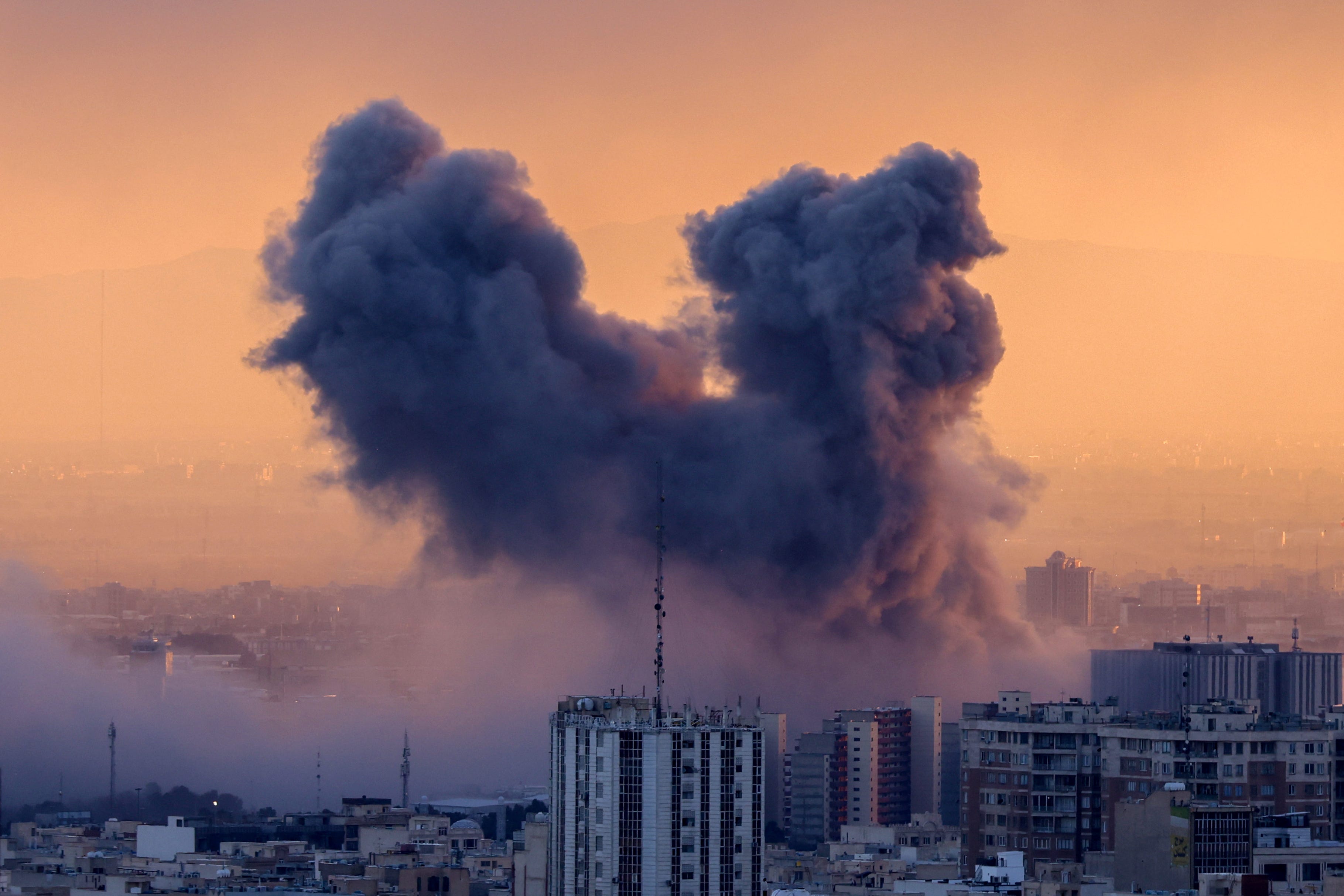
DONALD TRUMP SAYS his preemptive attack on Iran was justified, in accordance with international law, because Iran posed an imminent threat to the United States. In his speech announcing the operation, he declared, “Our objective is to defend the American people by eliminating imminent threats from the Iranian regime.”
But the threats posed by Iran to the United States, while potentially serious, weren’t imminent. So Trump and his officials have redefined “imminent” to include distant, indirect, and theoretical risks. They’ve stretched the word beyond any semblance of its meaning.
Here’s what now constitutes an imminent threat, according to the Trump administration and its congressional allies.
1. Imminent can mean “eventually” or “one day.”
On Sunday, NBC’s Kristen Welker asked Sen. Lindsey Graham, “What specifically were the imminent threats that justified this operation?” Graham replied, “They were building ballistic missiles that could eventually reach the United States.”
Then, at a briefing on Wednesday, White House Press Secretary Karoline Leavitt insisted that “Iran does pose an imminent and direct threat,” in part because it aimed to develop nuclear weapons that could “pose a risk to Americans in the region and even Americans one day here at home.”
One day. Eventually. If that’s imminent, then everything is imminent.
2. Imminent can mean more than three years away.
On Monday, Vice President JD Vance told Fox News that last year’s U.S. bombing of Iranian nuclear facilities “destroyed Iran’s ability to build a nuclear weapon during President Trump’s term.” But that wasn’t enough, said Vance. We had to strike Iran this time, he argued, because “the president determined” that “he didn’t want to just . . . keep the country safe from an Iranian nuclear weapon for the first three, four years of his second term. He wanted to make sure that Iran could never have a nuclear weapon.”
The imminent threat was gone. So we redefined “imminent.”
3. Imminent can refer to the first part of a multi-stage process.
In the same interview, Vance said Trump had to strike now because Iran refused to promise that it “would not pursue the ability to be on the brink of a nuclear weapon.” That’s a mouthful. If you take apart the sentence, Vance is describing a three-stage sequence: first the pursuit of nuclear weapons development, then the attainment of “the ability to be on the brink,” and then crossing from the brink to having a weapon.
That’s an easy way to assert imminence in any situation. You can always say the enemy is close to a critical step in a long sequence that might lead to a threat.
4. Imminent can refer to a pathway.
On Wednesday, a reporter asked Defense Secretary Pete Hegseth for evidence that Iran, after losing its major nuclear facilities in last year’s American bombing, “became a threat once again that required” another attack by the United States. Hegseth replied that since last year’s American attack, Iran had shown no willingness to give up “a pathway to a nuclear bomb.”
Pathway is a useful word because it describes a process, irrespective of what the enemy has achieved. You can always say having a pathway is imminent, even if the bomb is far off down the pathway.
5. Imminent can refer to ambitions.
“Ambitions” has become the administration’s go-to word, invoked by multiple officials. Hegseth used the word in reference to Iran seven times during his briefing on Monday. Iran’s “nuclear ambitions, which never ceased, are something that had to be addressed,” he told the press.
This is a handy rationale for perpetual war. No matter how fully you claim to have “obliterated” the enemy’s nuclear weapons program, you can always maintain that its “ambitions” remain intact and pose an imminent threat.
6. Imminent can refer to the construction of a shield.
On Monday, Secretary of State Marco Rubio said we had to strike Iran’s missile program because it could become “a shield where they can hide behind, meaning there would come a point where they have so many conventional missiles, so many drones, and can inflict so much damage, that no one can do anything about their nuclear program.”
By this logic, even if Iran never fired its conventional missiles, their existence represents a threat sufficient to justify our current attack, because they might deter us in the future from taking out Iran’s nuclear weapons program. We don’t even need to show that the nuclear program would produce a bomb. The shield itself is the imminent threat.
How imminent? Rubio said we had to strike now “because Iran in about a year or a year and a half would cross the line of immunity, meaning they would have so many short-range missiles, so many drones” that we couldn’t stop their nuclear program.
A year to a year and a half. And that’s not counting the three or four years, minimum, that Vance suggested Iran would need to produce a nuclear threat to the United States.
7. Imminent can refer to the pace of missile construction.
On Tuesday, House Speaker Mike Johnson told reporters that Iran was building conventional missiles “at a speed and at a scale that was exceeding the ability of our regional allies to respond appropriately. This created an imminent and serious threat.”
The missile program is a legitimate concern. But a widening military gap is exactly the kind of slow-moving challenge that warrants careful planning and consultation with allies and Congress, not an abrupt attack.
8. Imminent can refer to the intention to build a shield.
On Wednesday, Hegseth justified the current strikes by citing intelligence that Iran “had the intentions eventually to get to a place where they could have . . . a conventional shield to [protect] their nuclear capabilities.” That’s not even a claim that Iran would have such a shield in a year. It’s just a claim about “intentions.”
This is an extension of the argument that Iran has “ambitions” to build nuclear weapons. But it’s even less compelling, because the intentions Hegseth cited were to build a deterrent shield for the nukes, not the nukes themselves.
9. Imminent can refer to retaliation.
Rubio has repeatedly floated a bank-shot theory of imminence. “We knew that there was going to be an Israeli action” against Iran, and “we knew that that would precipitate an [Iranian] attack against American forces,” he told reporters on Monday. Therefore, he explained, “we went proactively in a defensive way to prevent [Iran] from inflicting higher damage.”
“Proactively in a defensive way” is an Orwellian gem. But setting that aside: Even if it’s true that Israel was about to strike Iran, that would be an attack by our ally. Iran’s subsequent attack on us would be retaliation. If the enemy’s retaliation counts as an imminent threat, then any preemptive American strike could be justified by asserting the intent of one of our allies.
10. Imminent threats can be detected by intuition.
On Tuesday, Trump explained how he discerned that Iran was about to strike us. “It was my opinion that they were going to attack first,” he said. “If we didn’t do it, they were going to attack first. I felt strongly about that.”
Who needs evidence when you have Spidey sense?
11. Imminent threats can be recognized after you attack.
At a Republican press conference on Wednesday, Rep. Brian Mast (R-Fla.), the chairman of the House Foreign Affairs Committee, outlined several recent attacks by Iran:
How imminent is this threat? Three U.S. service members killed at Tower 22 a year and a half ago: imminent threat. Strikes against our bases in Syria and Iraq, all through ’25: imminent threat. Lost a fighter jet off one of our carriers in the Red Sea: imminent threat. All the countless merchant marine vessels that were continually having drones fired at them while being protected by American ships: imminent threat. And the list goes on and on of the ways that they were constantly attacking us.
Where did that list come from? According to Axios reporter Barak Ravid, who spoke with Trump on Saturday, in their interview “Trump said that while writing his speech Friday announcing the attack, he asked his team to compile every Iranian-linked attack around the world over the past 25 years.”
In other words, Trump ordered the production of the list only after he had decided to strike. So claiming that this list of “imminent threats” required the strike is pure pretext.
12. Imminent can refer to our “last best chance.”
On Monday, Trump said he acted because “this was our last best chance” to “eliminate the intolerable threats posed by” Iran. Not our last chance, but our last best chance.
The difference is enormous. In their briefings this week, Rubio and Hegseth said we attacked now precisely because Iran was not at its most dangerous. Rubio said it was “a critical mission to undertake now, while they [Iran] were at their weakest point.” Hegseth concurred: “They’re at the weakest they’ve ever been.”
What was imminent, in short, was the opportunity, not the threat.
All these verbal gymnastics, in a vain attempt to find an “imminent threat” that forced our hand, tell the real story. The United States didn’t launch this war because we had to. We launched it because we could. Israel decimated Iran’s air defenses last year, the United States knocked out Iran’s main nuclear sites, and Trump’s successful attack on Venezuela last month emboldened him to go bigger in Iran.
Trump all but admitted the truth in a phone call on Sunday with ABC’s Jonathan Karl. He conceded that Iran had made important concessions in recent talks about its nuclear program, but he implied that his triumph in Venezuela had made him cocky. “A year ago, it would have been great to accept that deal for me,” he said of Iran’s latest offer. “But we have become spoiled.”
So he went to war. And he’ll keep going to war till one of his wars goes bad.
Although a great deal of effort has been devoted lately to demonstrating that the war on Iran is somehow different than Dubya's war on Iraq, the basic justification is the same for the two. Remember Rumsfeld and Cheney arguing that if there was a one percent chance of Saddam developing weapons of mass destruction that they might give to terrorists who might attack the US, that was enough to justify a preemptive strike? The word "imminent" was not bandied about as much as it has been over the last week, but the logic is identical. "Plus ça change, plus c'est la même chose..."
"So he went to war. And he’ll keep going to war till one of his wars goes bad."
Nailed it. Goober in chief just needed his jollies. And now the rest of the world pays the price. I'll never not be amazed at the choice of the American electorate.