A White House Ballroom Fit for a Bribe
GOP lawmakers don’t mind that the full list of donors and amounts given is under wraps.

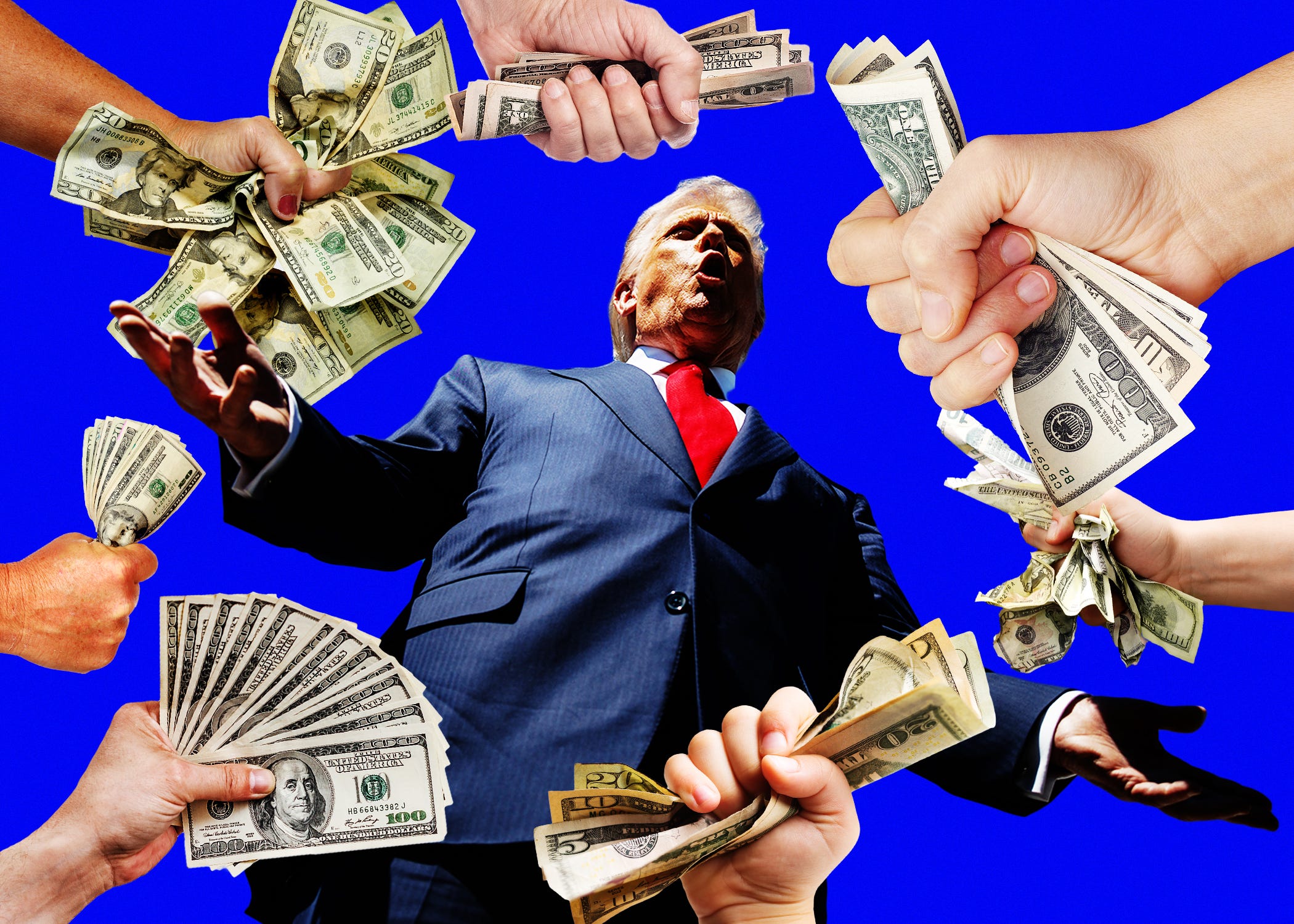
For describing itself as the “most transparent administration in history,” the Trump administration sure does value secrecy—at least when it comes to the question of who financed President Donald Trump’s future gilded ballroom, which is being planned to rise over the rubble of the former East Wing of the White House. As with so many things people care about, Republicans on Capitol Hill don’t seem to think people should care about it.
The White House has released the names of some of the donors to the ballroom. But not all of them. And not the amounts they’ve given. Indeed, in some cases, the White House has decided to just keep the details secret.
White House renovation projects have typically involved consulting with stakeholders around the capital and getting a signoff from Congress, which normally appropriates money to cover the construction and then provides oversight of the work. There have been exceptions in the past to these procedures, in cases where the renovation was privately funded; it’s on this basis that Trump acted unilaterally to level the parts of the White House he deemed obstructive to the new project. With the East Wing out of the way, ground has now been broken for a gargantuan new facility where the foreign and domestic elite who please the administration will occasionally be feted.
The White House shared with the press a partial list of individuals and companies that have donated money to fund the project, but it did not disclose the specific amounts they gave. Known ballroom funders include companies in technology, Big Tobacco, telecommunications, railroads, and the Hard Rock Cafe’s parent company.1 The private individuals include cryptocurrency moguls, the Adelson family, the Winklevoss twins (the primary antagonists depicted by the actor Armie Hammer in the David Fincher/Aaron Sorkin film The Social Network), and at least two of Trump’s own ultra-wealthy cabinet secretaries: Commerce Secretary Howard Lutnick and Small Business Administrator Kelly Loeffler.
One of the important subplots of the last several years concerns the many ways in which Congress has farmed out its responsibilities to the executive. The ballroom-funding episode provides yet another illustration of this theme. Do lawmakers want a more transparent process? Do they even care if people with clear interests before the government may be currying favor with the president in this way? Should “ambition . . . be made to counteract ambition”? For members of the current majority, the answer to these questions is the same: no.
“We got so much going on up here, that’s one thing I ain’t worried about,” said Sen. Tommy Tuberville (R-Ala.).
When I asked Tuberville whether it’s ethical to keep these donations hidden from the public, he gave a somewhat less than ethics-forward answer: “Well, private funds are paying for it, so I don’t know, do they have to release that? I mean if somebody’s going to give $400 million dollars, they might not want it released.”
“You know I’ve not tracked that at all and wouldn’t be able to give you a good, intelligent answer,” Sen. James Lankford (R-Okla.) told me before asking me if the Trump administration has disclosed donors to other projects, such as the inaugural committee. When I confirmed those lists are public—and, in that case, quite rich in specific information—he replied, “Yeah, I’ve not jumped into that at all.”
Meanwhile, Democrats have added the secret donations to their growing list of potential corrupt acts by the Trump administration. But because Democrats are in the governing minority, they have little recourse to do anything about it at the moment—save send letters.
In an October letter, Democrats on the House Oversight Committee requested further information on the ballroom, including donor details and whether or not agreements were signed in exchange for the committed funds. The White House has not responded.
A handful of Senate Democrats are also alarmed, having sent a similar letter to White House chief of staff Susie Wiles on Monday.
“The opaque nature of this scheme reinforces concern that President Trump is again selling presidential access to individuals or entities, including foreign nationals and corporate actors, with vested interests in federal action, often while personally enriching himself and his family,” wrote Sen. Adam Schiff (D-Calif.), who was joined by almost a dozen fellow Democratic signatories from the upper chamber. He went on to point out the extraordinary confluence of conflicts of interest giving rise to potential corruption in the published list of donors:
Many of the donors listed by the White House as contributors to the ballroom construction project have frequent business before the federal government in the form of contracts, pending regulatory approvals, litigation, and enforcement actions. Among these donors are corporations recently awarded federal contracts worth millions of dollars in revenue, many with close ties to administration officials. These circumstances risk blatant corruption as these companies and their stakeholders seek to position themselves in the government’s good graces.
In addition to the letters to the White House, Sen. Richard Blumenthal (D-Conn.) wrote to various executives of the companies that were not disclosed by the administration, but revealed in a New York Times report. Blumenthal asked the executives to provide details, contribution amounts, and any potential signed agreements between them and the administration.
For now, congressional interest in the ballroom donations and the avenues for corrupt dealing that they’ve opened up has not crossed the aisle.
Comer’s pile
House Oversight Committee Chairman James Comer (R-Ky.) has a lot of concerns about presidents issuing pardons without knowing what they’re doing. One likely offender, though, gets the benefit of the doubt from him. That offender would be Donald Trump.
The president revealed in a 60 Minutes interview this weekend that he knew virtually nothing about Binance founder and former CEO Changpeng Zhao, whom he pardoned last week.
“Okay, are you ready? I don’t know who he is,” Trump said. “I know he got a four-month sentence or something like that, and I heard it was a Biden witch hunt.”
When 60 Minutes host Norah O’Donnell noted that under Zhao, Binance facilitated a $2 billion stablecoin purchase from Trump’s World Liberty Financial, Trump ascribed responsibility for the crypto dealing to his sons.
“Well, here’s the thing. I know nothing about it, because I’m too busy doing the other—I can only tell you this, Norah, I can only tell you this” Trump said. “My sons are into it. I’m glad they are, because it’s probably a great industry, crypto, I think it’s good, you know. They’re running a business. They’re not in government.”
Prior to this point, Republicans have loved launching investigations and issuing subpoenas about this exact type of scenario: a president being utterly absent from consequential pardon decisions.
But they are largely (although not uniformly) uninterested in Trump’s strange account of his CZ pardon, even though the parallels with the case they made against Biden are hard to deny.
As for Comer, he told reporters Monday that it may have been a misunderstanding. Trump’s comments sometimes require further analysis, is all; taking great hermeneutical care helps us avoid making the mistake of concluding that the president has misspoken or committed a gaffe.
“Well I mean I would assume he knew,” Comer said. “But if he said he didn’t, I have to look and see what he said. Sometimes he says things and we have to really analyze and give him another opportunity to make sure he didn’t misspeak.”
Don’t expect a Trump autopen investigation to come up on the House Oversight Committee docket anytime soon.
Don’t be discouraged
After reading the past two sections of this newsletter, you might be wondering, “What’s one more scandal when everything is outrageous?” Jonathan Chait at the Atlantic has been thinking the exact same thing.
He writes:
I sympathize with the mainstream media’s inability to properly capture the breadth of Trump’s misconduct. The dilemma is that holding Trump to the standards of a normal politician is impossible. The Times would have to run half a dozen banner-style Watergate-style headlines every day, and the news networks would have to break into regular programming with breathless updates every minute or so. Maxing out the scale of outrage has the paradoxical benefit of allowing Trump to enjoy more generous standards than any other politician has.
Still, although holding Trump accountable to normal expectations of political decorum may be impossible, surely we don’t need to praise him for merely committing normal-size scandals. The people losing perspective here are not the ballroom’s critics, but its defenders.
The piece isn’t encouraging in an “every cloud has a silver lining” sort of way. It’s encouraging in the way a bracing exhortation is. The key point is that we have to keep talking about Trump’s scandals and corruption because we can’t count on anyone else to do it. We have to keep our moral vocabulary strong and alive and not let the endless flow of malfeasance sap it. We can’t simply trust that someone else is going to tell the story straight after Trump is gone. Our legacy media institutions are responsive to incentives that make normalizing this administration’s actions the likeliest outcome for the first draft of history that the news industry provides.
Of course, this all makes genuinely independent media outlets all the more important. Here at The Bulwark, we don’t have the same incentives; we can focus on topics we deem newsworthy and revisit them long after they’ve fallen out of the 72-pt font headlines at newsstands. The administration and its allies’ more alarming activities—like selling access to the government, pardoning friends or corrupt politicians who showered the president with the right amount of praise, replacing career officials with inexperienced loyalists, and on and on—these are worth as much coverage as we can give them, if for no other reason than to help adjust that shitty first draft.
We’re only able to do what we do with the support of our Bulwark+ members. We’d love it if you’d consider joining our growing community to help make that work possible.
Maybe the ballroom will feature vintage tour memorabilia from Slash and Bret Michaels.
I like JVL’s idea of the next president making a big deal out of tearing down the ballroom as a powerful metaphor. But I’d also accept the next president not mentioning it, and then one night, a month after taking office, at 2 a.m., razing that fucker to the ground so it’s a smoldering pile of rubble when DC wakes up. Either way, let’s make it happen.
The tearing down of this monstrosity and the reconstruction of the West Wing of the real White House will become a major issue in the future election.