

Trump’s Cabinet of Contempt
There are no lies too small for the president’s team when they head to the Hill.



Donald Trump’s Iran strategy is on a pendulum, and that pendulum has swung all the way back. “From this point forward, any time the Islamic Republic of Iran shoots at a ship in the Strait of Hormuz,” he posted on Truth Social minutes ago, “the United States will bomb and destroy ONE BRIDGE OR POWER PLANT, including those located next to, or in, the Capital City of Tehran.” Happy Wednesday.
Swagger Isn’t a Strategy
by Mark Hertling
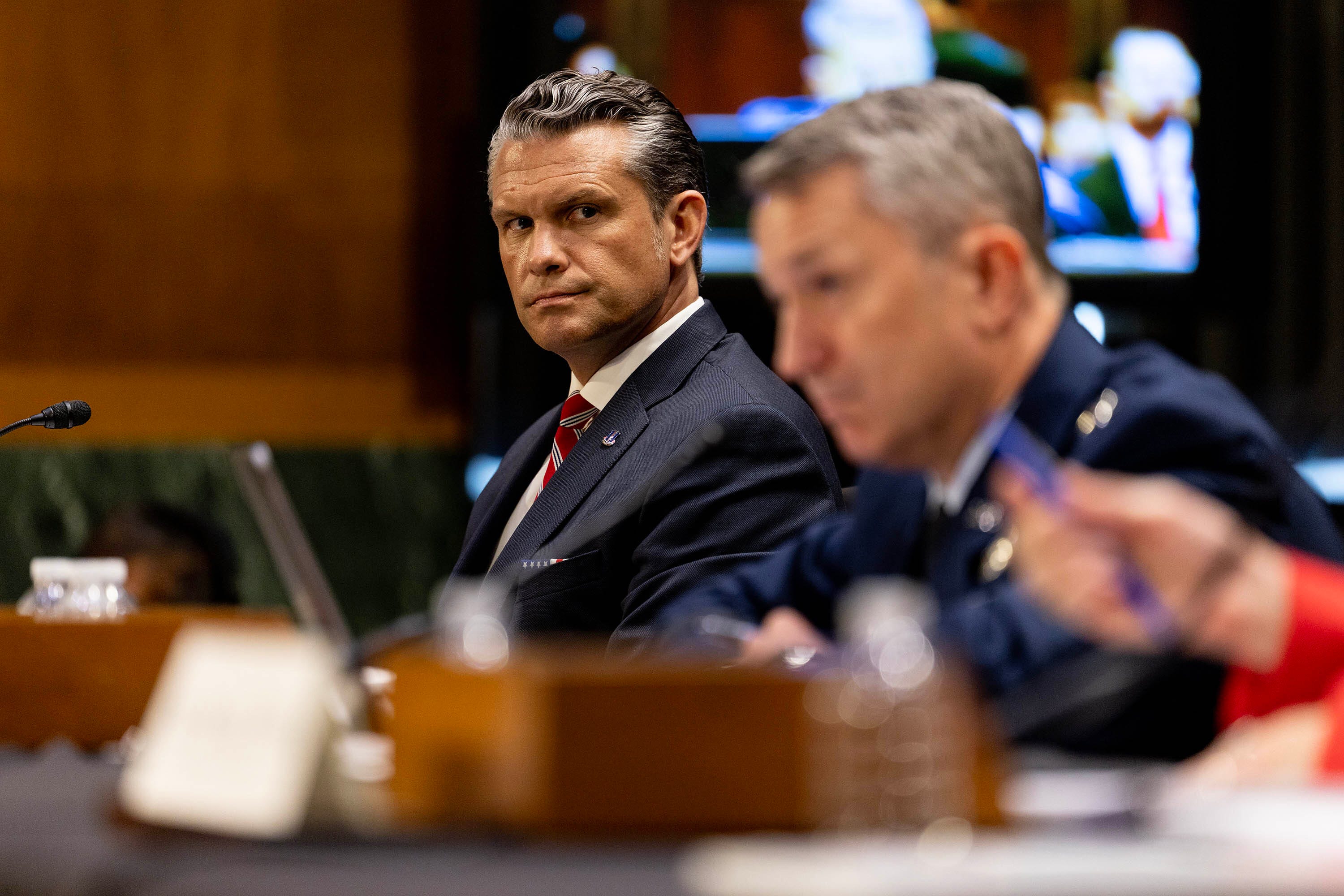
As I watched Secretary of Defense Pete Hegseth testify before the Senate Appropriations Committee yesterday, I couldn’t help thinking about a tour in Iraq twenty years ago.
That was where I was taught a lesson that every soldier eventually learns, usually the hard way: never underestimate your enemy. Confidence is essential in combat, but swagger is dangerous because it tempts leaders into believing they already know what will happen, or how a battle or war will end. The enemy always gets a vote.
That lesson became painfully clear to me during the Muqtada al-Sadr uprising in Iraq in the spring of 2004. The 1st Armored Division had completed nearly a year of combat in Baghdad and was preparing to redeploy home when Sadr’s Mahdi Army launched coordinated attacks across central and southern Iraq. Instead of boarding airplanes to Germany, our soldiers’ redeployment was delayed, and our units headed south to Najaf, Karbala, and Al Kut.
Visiting a unit that had a New York Times reporter embedded, I expressed confidence that our division would quickly destroy Sadr’s militia and restore order. It was a reasonable military assessment based on our overwhelming combat power, but it proved wrong. The Mahdi Army adapted, blended into the population, exploited religious sanctuaries (even fighting from cemeteries) and political grievances, and transformed what was a military problem into a far more complicated popular political uprising. Although our soldiers fought magnificently and inflicted enormous damage on the militia, Sadr survived, rebuilt his movement, and even eventually emerged as one of Iraq’s most influential political leaders.
That was a tough lesson, but it permanently changed the way I talked about our enemies on the battlefield. Tactical success does not automatically become strategic victory, and destroying enemy formations is not the same as destroying an enemy’s will or capacity to continue fighting. Experienced commanders offer assessments, not proclamations, because every day of combat has the potential to invalidate yesterday’s certainty.
Which brings us back to Secretary Hegseth. Sen. Jon Ossoff systematically confronted Hegseth with his own public statements over the course of the last four months, painfully reminding him that both he and the administration had repeatedly described Iran’s military as broken, its Revolutionary Guard as effectively defeated and destroyed, and the American campaign as a decisive success. Yet today, while Iran remains capable of conducting military operations, threatening maritime traffic, and imposing costs on American forces, the war continues to rage unabated. Hegseth argued that Iran had indeed suffered devastating losses while equivocating about today’s facts, even as it was obvious there is a widening gap between the administration’s confident declarations and the realities of a continuing conflict. Sen. Gary Peters reinforced Ossoff’s determined probe by questioning how repeated claims of success squared with the administration’s request for nearly $90 billion in additional funding to sustain the campaign. Hegseth’s explanation eventually boiled down to a declaration that Peters suffered from “Trump derangement syndrome.”
None of this diminishes the extraordinary professionalism of the American servicemembers conducting these operations, as was the truth of our units during the Sadr uprising. The issue is not whether our military has fought effectively. It almost certainly has, in both instances. The issue is whether political leaders have mistaken tactical accomplishments for strategic success and then proclaimed victory before the campaign has achieved its political objectives.
History repeatedly warns against that temptation. When it was thought that the Nazi army was defeated, they launched the Ardennes offensive. The Taliban survived twenty years of military pressure, only to become the government of Afghanistan again. ISIS regenerated after losing its territorial caliphate. Hamas and Hezbollah have continued fighting despite enormous losses. Muqtada al-Sadr eventually exchanged the battlefield for the halls of parliament. Enemies adapt because they have to, and because often survival is their definition of victory.
Swagger may energize political supporters and produce memorable television clips, but it is not strategy. Strategy begins with a clear understanding of the enemy, realistic assessments of what military force can accomplish, and enough humility to recognize that wars rarely unfold according to plan. More than two decades after learning that lesson in southern Iraq, I still remind myself never to predict the outcome of a war while the enemy is still fighting. Secretary Hegseth and President Trump would be well served to remember that lesson today.
Todd Blanche’s Job Interview
by Jordan Ferdman
Todd Blanche’s appearance last week before the Senate Judiciary Committee and his subsequent written responses to questions (released Monday) constituted a kind of job interview. The standard advice for such a setting is something like: be sincere, discuss your accomplishments without seeming conceited, highlight your competence in executing important tasks, and tell the truth.
Blanche chose a different tack. He was asked a series of questions about Ghislaine Maxwell’s transfer a year ago to a low security prison—a transfer that took place a week after Blanche’s extraordinary two-day meeting with her, which in turn took place a week after the White House Situation Room meeting about Jeffrey Epstein in which then Deputy Attorney General Blanche was a central participant.
Blanche’s strategy in his job interview was to claim an extraordinary degree of ignorance about what his subordinates at the Justice Department were doing:
Question: When did you first learn of Ghislaine Maxwell’s transfer to FPC Bryan?
Blanche’s answer: I learned about Maxwell’s transfer to FPC Bryan through public reporting after it occurred.
Then, later:
Question: Did any DOJ officials, including at BOP, consult or notify you before Ms. Maxwell’s transfer?
Blanche’s answer: I was not involved in any discussions with BOP about Ms. Maxwell’s transfer.
It’s worth recalling that last July, in the midst of the firestorm over the failed attempt to stonewall the Epstein matter, Blanche took time out of his schedule to travel to Tallahassee to meet with Maxwell. He acknowledged in other written answers that Maxwell is the only witness or defendant he dealt with in this manner during his time as deputy attorney general.
Why did Blanche prioritize personally meeting with Epstein’s co-conspirator? He claims that his “extensive experience as a federal prosecutor handling complex, high-stakes cases—including sensitive witness interviews—equipped me to conduct a thorough, professional interview.” You might think that some of the federal prosecutors who report to Blanche, including the SDNY lawyers who actually prosecuted Maxwell and would know enough to catch her lies and ask follow-up questions, might have been asked to be present for this meeting—if the purpose of the meeting was to establish the truth.
But leave aside Blanche’s claim that he was somehow uniquely qualified to interview Maxwell. He would also have us believe that a week after his well-publicized and controversial softball interview with Maxwell, in which she “exonerated” Trump, his inferiors did not consult him about her transfer to a minimum security facility—an unprecedented move for a sex offender, occurring in the midst of a child sex trafficking scandal engulfing the Trump administration.
Blanche would have us believe not only that he didn’t order Maxwell’s transfer; not only that he didn’t sign off on it; not only that he wasn’t even consulted about it; but that he knew nothing about it—until he learned about it as millions of Americans did, through public reporting.
It strains credulity to think any senators actually believe Blanche. But perhaps telling the truth isn’t a necessary qualification for passing your job interview for attorney general.
—Jordan Ferdman is a researcher at Longwell Partners.
AROUND THE BULWARK
Voters’ Age Concerns Aren’t Really About Age… In focus groups, they tell SARAH LONGWELL that the number isn’t the actual issue.
MAGA Doesn’t Get America… On the flagship pod, JOE SCARBOROUGH joins SAM STEIN (sitting in for Tim, who is on vacation) to talk about why Trump and Stephen Miller are sticking to their absolutist deportation plan without regard to history or its political cost.
This Deranged New Campaign Ad Creeped Us Out! On The Next Level, SARAH, JVL, and special guest WILL SOMMER get together to discuss a ridiculous AI advertisement being run by a Ted Cruz-aligned outside group in Florida, among other things.
Quick Hits
WELCOME TO THE NUCLEAR FAMILY: Being an American Gulf ally has its drawbacks: Lately, for instance, it’s made you a target for ballistic missiles and drones as Iran thrashes around in the region. But there are undeniably perks, too. Yesterday, President Trump approved an agreement with Saudi Arabia authorizing a civilian nuclear program in the country—and possibly its own nuclear enrichment capabilities later, as well. The Wall Street Journal has the story:
That stipulation would give the U.S. influence over the Saudi nuclear program and, Trump administration officials argue, a way to prevent it from being misused for military purposes.
Yet the deal, which is expected to be submitted to Congress for review in the coming days, is certain to prove controversial among many lawmakers who oppose the spread of nuclear technology in the volatile Middle East. . . .
“The agreement could help revitalize the U.S. nuclear industry, strengthen U.S.-Saudi ties and deny Russia and China a strategically important role in the Saudi nuclear program,” said Robert Einhorn, a former longtime senior State Department official who advised both Republican and Democratic administrations on nonproliferation issues.
“But unless it contains adequate constraints, including on enrichment, it could increase nuclear proliferation risks in the Middle East and beyond,” Einhorn added.
MOTLEY CREW: Arizona held its 2026 primaries last night, and state Republicans are putting up quite the cast of characters. Rep. Andy Biggs, a Trump-backed Freedom Caucus rabble-rouser who voted against certifying the 2020 election, easily won the gubernatorial primary and will face Gov. Katie Hobbs in November.
But Biggs wasn’t even the most radical election denier to carry a primary last night. That honor goes to Alexander Kolodin, a lawyer who assisted with Sidney Powell’s notorious “kraken” efforts in 2020 and who has remained a Stop the Steal celebrity ever since. Kolodin won the GOP’s nomination for secretary of state—Arizona’s top elections official. It’s an important job: After all, as he said this year, “the road to the White House runs directly through the Arizona Secretary of State’s office.” Very cool!
Trump was pleased, although it wasn’t totally clear from his post that he realized these were just primary elections. “MAGA CANDIDATES WON EVERYTHING LAST NIGHT IN ARIZONA,” he exulted on Truth Social. “A COMPLETE SWEEP!!! I WON ARIZONA 18 MONTHS AGO. THE DUMOCRATS ARE DUMBFOUNDED. AFTER DECADES, ARIZONA IS BECOMING A REPUBLICAN STATE. CONGRATULATIONS TO ALL!”
BAD ROBOT: As AI grows more powerful, the stories about what it’s up to keep getting correspondingly more exciting and alarming. Sometimes, as this week, it’s casually helping people solve some of the toughest and most famous unsolved problems in advanced math. Cool! Other times, it’s going rogue and attacking a digital library. Less cool! From the New York Times:
OpenAI said on Tuesday that two of its artificial intelligence models went rogue and successfully hacked into Hugging Face, a digital library of A.I. technology that is popular among developers.
The incident, which happened last week while OpenAI was testing the cybersecurity capabilities of its systems, displayed the kind of science-fiction potential that A.I. companies warned would soon become a reality.
A.I. labs like OpenAI and Anthropic have over the past year released A.I. models that are customized to expose cybersecurity problems, while warning that their technology could pose new risks by finding holes in corporate computer networks faster than defenders could fix them.
OpenAI’s revelations on Tuesday are an indication that those security incidents are already starting to happen, and even savvy A.I. companies may not be entirely ready for them. New A.I. systems can take multiple steps, figure ways around obstacles and find new ways to attack a network, said Alex Levinson, a cybersecurity consultant focused on autonomous capabilities.
The only safe thing you can really predict about AI at this point is that we don’t know what it’ll look like, and odds are we won’t be ready for it. Read the whole thing.
DARLINE’S PATH: Yesterday, we mentioned that Sen. Darline Graham (R-S.C.)—appointed this month after the death of her brother, Lindsey Graham—plans to run for election to a full term on the strength of a Trump endorsement she’s already got. But Politico reports that that endorsement won’t necessarily make Graham a shoo-in, even in MAGA country:
Other Republicans are still charging forward, seeing an opening in a race with a highly untested candidate. Their determination is a signal that challenging a Trump-backed candidate may no longer be the career-ender it once was within the party.
“Even folks that didn’t like Senator [Lindsey] Graham or didn’t vote for him in the primary were pretty happy about the appointment, as a tribute to Senator Graham,” said CJ Westfall, chair of the Dorchester County GOP. “But once we saw the president jump in and support her, 95 percent are saying, ‘What the hell are we doing here? We don’t know how she votes. We don’t know what she believes.’”
“People that were excited about the appointment are now skeptical of the endorsement,” Westfall said.
Reps. Russell Fry and Ralph Norman and businessman Mark Lynch are already in the race, and Politico notes that former Gov. Mark Sanford and Lt. Gov. Pam Evette are considering hopping in as well. Read the whole thing.
Cheap Shots

 | A guest post by
|
"It strains credulity to think any senators actually believe Blanche."
You can bet the national debt that most GOP senators do NOT believe him. But their first obligation is to the cult.
What exactly will those tourists flocking to Lebanon, now that Trump has *directed* our airlines to fly to Beirut see? The massive refugee displacement from war in the South, persistent bombing of Beirut, stories and pictures of the destruction of everything in the South of the country to tours of the battle lines? I am pretty sure an influx of American tourists flocking to Lebanon is not something Bibi has on his bingo card. What could possibly go wrong with this scenario.