Turkey’s New Missile Is a Symbol of Global Chaos
Why does Turkey want an ICBM? There are no good answers.

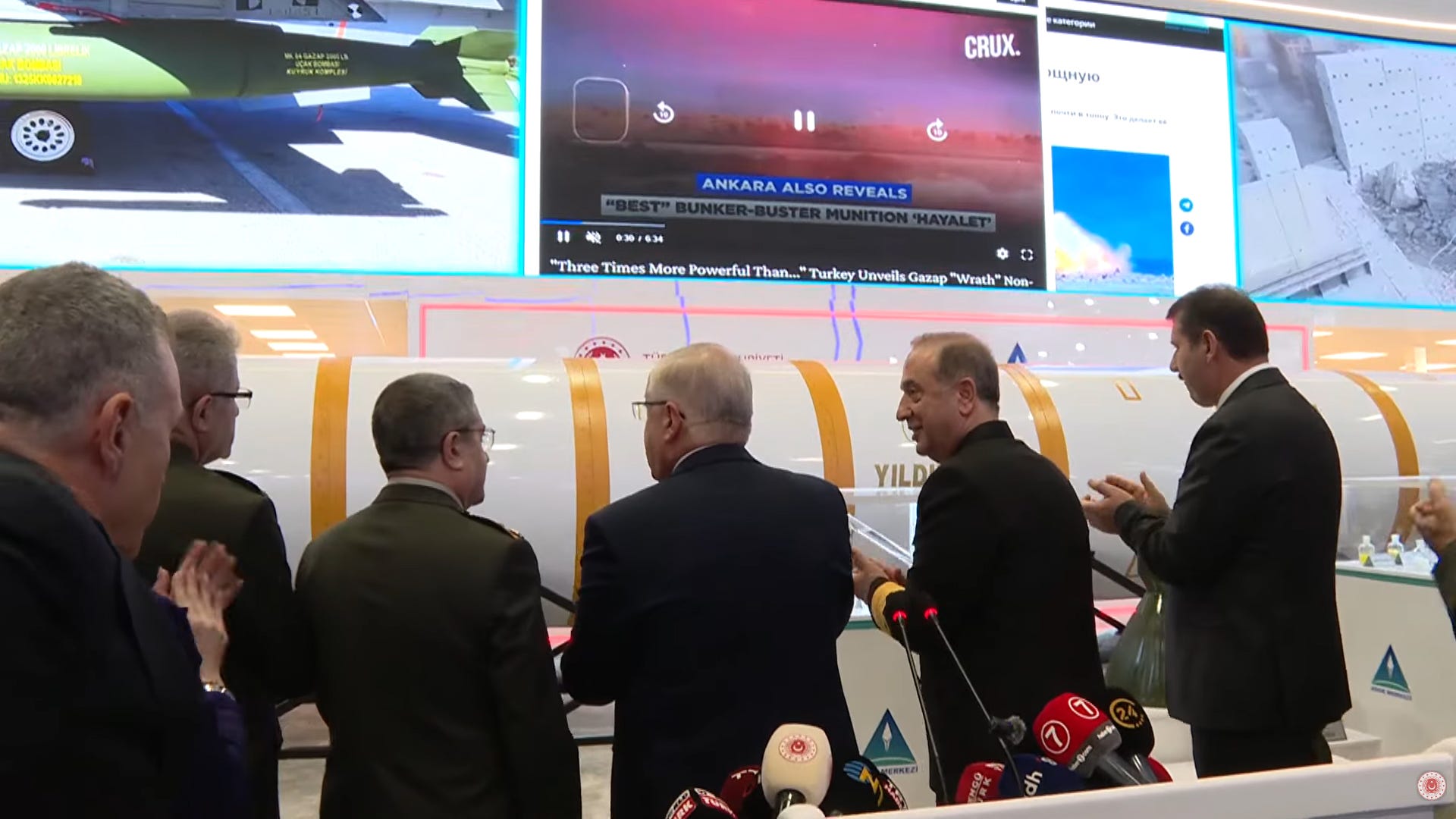
IF THERE IS ONE STORY FROM THE PAST WEEK that best represents the brave new world we are entering as the Trump administration continues its dismantling of the much derided “liberal international order” that was underpinned by U.S. military power, our system of alliances, and rules-based free trade, it wasn’t the will-they-won’t-they back-and-forth about the Strait of Hormuz ceasefire agreement, nor the thousands of pages of government documents about UFOs the administration released, presumably to distract from the Hormuz business. Instead, it was that Turkey, on May 5, unveiled an intercontinental ballistic missile in Istanbul at the 2026 SAHA defense and aerospace exhibition.
The body of the prototype missile on display this week interestingly bears the signature of Kemal Ataturk, the founder of the modern secular Turkish republic, and the tughra (a calligraphic seal or signature) of Sultan Bayezid I, also know as Bayezid “the Thunderbolt,” who in the early fifteenth century reduced the population of Anatolia to Ottoman vassalage, besieged Constantinople only to be defeated in a rearguard action by Tamarlane, and spent the end of his days as a prisoner. The “Yıldırımhan” or “Lightning” missile—which is designed to carry conventional warheads—symbolizes the fusion of Turkish nationalism and its Ottoman Islamic past, much as the ruling AK Party has attempted to do over its quarter century of rule. Not to put too fine a point on things, an AI video produced to tout the missile (which has yet to be tested) appeared to show it “hitting nuclear facilities and other targets that appeared to be in the U.S.,” according to the Financial Times. It was not totally reassuring that Turkish Defense Minister Yaşar Güler insisted the missile was meant for deterrence and appeared unaware of the AI video.
Before anyone heads to the nearest bomb shelter, it is worth noting that the Yıldırımhan has not been tested and its purported range barely achieves the standard necessary to be considered an ICBM. Despite what the AI video suggested, the missile would not have the range to hit the United States (though the coast of Newfoundland and Labrador might be at risk). Moreover, despite carrying a large warhead of some 6,600 pounds, the missile uses a single stage (most ICBMs usually consist of two or three stages) and liquid fuel, which means it would not provide prompt strike capability and would be very easily pre-empted by a capable adversary.
Turkey also lacks the ability to test missiles that have a genuine intercontinental capability, since their normal test range for short- and medium-range missiles, the Black Sea, is only about 730 miles at its longest point. That means the only way for Turkey to test an ICBM would be to fire it in a very steep parabolic trajectory, trading altitude for distance—the same method North Korea uses. Turkey’s purported interest in building a spaceport in Somalia could provide it with a better testing range in the future. Fabian Hoffman, a ballistic missile expert, said of the whole Turkish ICBM project, “it seems very ambitious and questionable.”
WHATEVER THE TECHNICAL LIMITATIONS, the unveiling of the Yıldırımhan highlights Turkey’s growing ambitions as a producer of not only UAVs—which have had notable battlefield impact in the Caucasus, Libya, and in the early stages of the war in Ukraine—but increasingly as a manufacturer of ballistic missiles up to and including ICBMs. As President Erdoğan has pointed out, between the Russia–Ukraine war in the north, the Israel–Hamas/Hezbollah war in the south, and the Iran war in the east, Turkey is nestled amid several hot conflict zones. Domestic ballistic missile capabilities might be, in the right circumstances, a reasonable deterrent. But that still doesn’t explain why Turkey needs a missile of such long range, considering that most of its potential threats are local, and that as a NATO member, it is a beneficiary of an alliance security guarantee.
In the best case, the unveiling of the new missile can be seen as an advertisement for foreign buyers of Turkey’s expanding defense industry as the country prepares to host this summer’s NATO summit. The Turkish defense industry will clearly play a role in Europe’s effort to rearm—especially its need for short- and medium-range ballistic missiles to offset the Russian missile threat—particularly after the Trump administration’s cancellation of the deployment of a U.S. Army brigade combat team armed with long-range precision strike capability. As a member of the Missile Technology Control Regime, Turkey would be precluded from exporting the Yıldırımhan—but maybe it’s a loss leader, meant to advertise Turkish missile engineering in general, even if that model is unavailable.
If one takes at face value the statements of Erdoğan and Güler that the Turkish ballistic missile program is intended to enhance deterrence—but also, as a recent report from the International Institute for Strategic Studies notes, for war-fighting purposes should deterrence fail—who is the Yıldırımhan meant to hold at risk?
Traditionally, one might look to Greece as a potential adversary. But ever since Turkey was excluded from the United States’ F-35 program (because it bought Russian S-400 air and missile defense systems), Turkey has cooled down its anti-Greek rhetoric in exchange for the transfer of more advanced U.S. F-16s. But Turkey, which boasts the second-largest land army in NATO after the United States, surely doesn’t need an ICBM to threaten Greece.
Russia and Turkey have had a complicated frenemy relationship for the past decade. They have been on opposite sides of disputes in the Caucasus, Libya, Ukraine, Syria, and elsewhere. At the same time, the Turks have vigorously defended their purchase of the S-400 and worked with Russia to negotiate prisoner exchanges with the United States and with Ukraine. They also brokered an agreement to open the Black Sea in 2022 when the Russian blockade threatened global food supplies. A conventional ICBM capability, however, seems unlikely to deter Russia’s nuclear arsenal of more than 1500 warheads—or at least, it adds essentially nothing to NATO’s security guarantee and the U.S. extended nuclear deterrent.
Turkey’s relations with Israel have been increasingly fraught for a decade and half. The war in Gaza, the collapse of the Assad regime, and the vivid demonstration of Israeli military power in both last year’s Twelve Day War with Iran (and the ongoing campaign) have all combined to fuel an incipient Turkish–Israeli rivalry. But again, if Israel were Turkey’s concern, why does their missile need a 6,0000 kilometer range?
The AI video showing Turkey attacking the United States “backfired,” as the Financial Times noted, by drawing attention to the missile’s actual limitations. But the video is revealing of the degree to which, after twenty-five years of relentless anti-Americanism by the Erdoğan regime, average Turks have come to see the United States as the main threat to their security, despite benefitting from the U.S. nuclear guarantee of NATO member states’ security.
All the talk of ICBMs and deterrents naturally leads to the question of Turkish aspirations for nuclear weapons. Erdoğan has mused for years about the possibility of Turkey becoming a nuclear weapons state, despite the fact that it is a signatory of the Nuclear Non-Proliferation Treaty of 1968. Observers have tended to downplay his musings, warnings, and threat as bluster, but in light of Turkey’s missile program, prudence would suggest that Turkey is, at the very least, pursuing a hedging strategy. A bit of caution should be in order as the Trump administration considers Turkey’s bid to be readmitted into the F-35 program.
PERHAPS THE REASON TURKEY WANTS an ICBM isn’t specific, but general. Turkey’s development of an ICBM capability is just one example of what results when American reliability as a security partner is called into question. The decline in European assessments of U.S. reliability as guarantor of European security and extended nuclear deterrence, underscored by the failure of the National Defense Strategy to even mention extended nuclear deterrence, has begun to open us up to a world in which nation states resort to self-help rather than relying on U.S. security guarantees.
Missile technology is proliferating, and the effects of large and diverse missile arsenals have been on display around the world in recent years, from Russia and Ukraine to Israel and Gaza to Yemen and the Bab-el-Mandeb to Iran and the Strait of Hormuz. One scholar has suggested we may be entering a new age of conventional ballistic missiles, with extraordinarily destabilizing consequences, including a decisive (if inevitably temporary) advantage for offensive missiles over missile defenses, and further blurring of the differences between conventional and nuclear weapons (especially when both types of warheads can be mated to the same missile).
Turkey’s ICBM, while not yet a reality, is indicative of the more disordered world we are now facing. Nuclear proliferation and the spread of conventional ballistic missiles of intercontinental range are likely to make the world uglier and incomparably more dangerous than what we have been used to since the end of the Cold War. Judging by their reaction to the current war against Iran, it seems likely that Americans will come to look back on the much-disparaged era of American “globalism” and “primacy” with nostalgia; they may soon see it as a golden age compared to what’s coming.
 | A guest post by
|