Vaccine Lies, Direct from the Oval Office
“Nothing bad can happen,” Trump says—as measles levels keep rising.

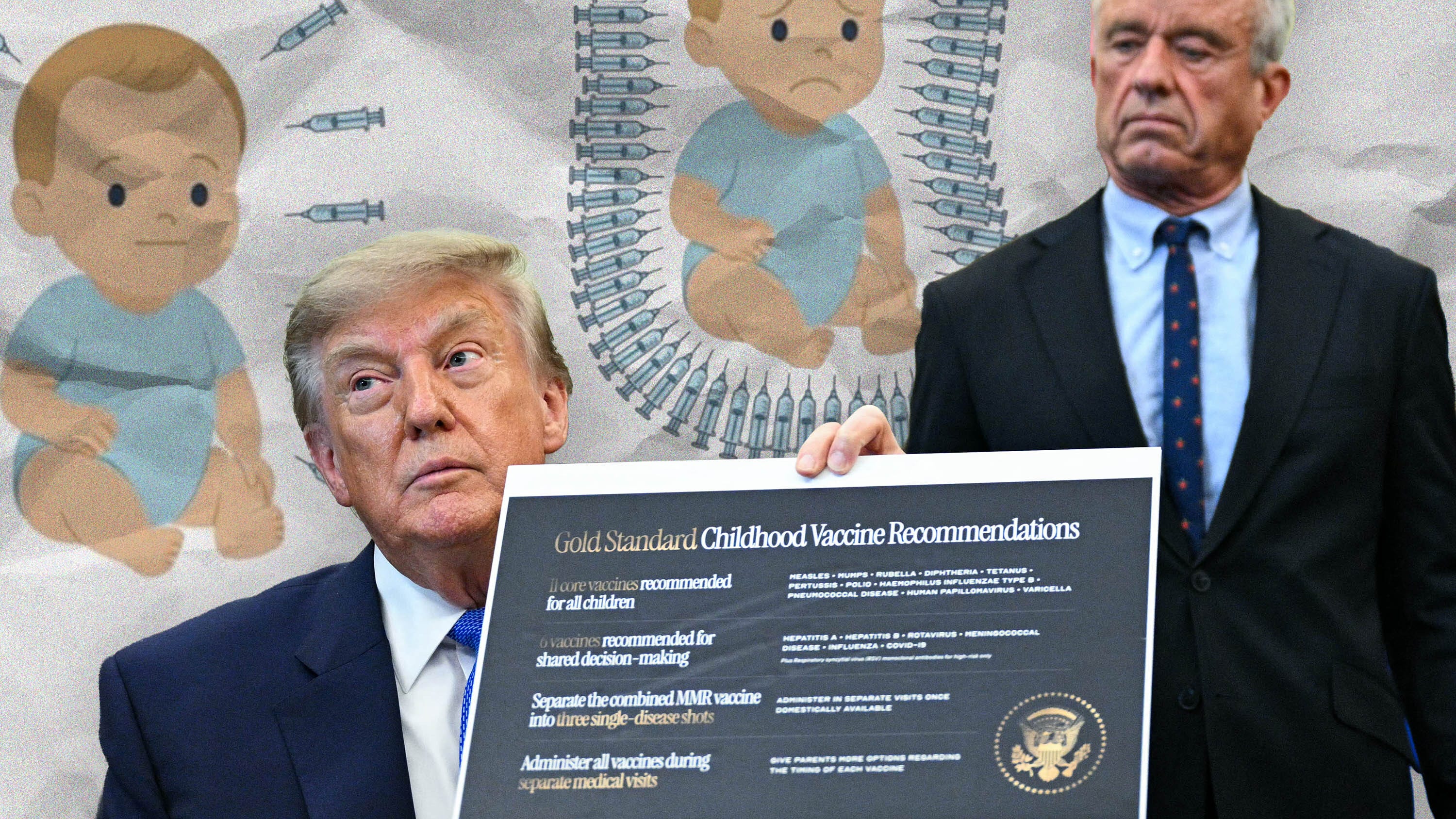
SOMEWHERE IN AMERICA, sometime soon, a parent is going to take their 1-year-old to the pediatrician for what should be a normal well-child visit including vaccinations. They’re going to be nervous, like so many parents are—trying desperately to do all the right things for their child’s health, doing their very best to figure out what the medical science really says. And when the pediatrician recommends the standard measles vaccine doctors have been giving safely for half a century, the parent is going to say no, because they heard the shot’s current formulation might be lethal.
At that point, the doctor might ask where they got that information. The parent will say they heard it from the president of the United States.
Sadly, they will be telling the truth.
On Monday, Donald Trump signed an executive order that seeks to make radical changes to the government’s official childhood vaccine schedule—first by reducing the number of vaccinations from seventeen to eleven and then by breaking up the current MMR shot, which combines measles, mumps, and rubella vaccinations, so that children get them as a series of three separate sets of injections. The order also calls on the Justice Department to scrutinize states that don’t allow what the Trump administration considers adequate leeway for parents who want to ignore school vaccination mandates for reasons of religion or personal conscience.
Legally speaking, the order may not do much. Health and Human Services Secretary Robert F. Kennedy Jr., who has spent decades crusading against vaccines, tried to implement the same schedule changes in January. A federal court blocked those changes, ruling that Kennedy had made the decision on his own authority without going through the proper procedures or consulting the kind of experts that the law requires. Trump’s order would seem to fail the very same legal tests, which means the official government recommendations should, in theory, not change.
But as a practical matter, the order could influence states, which have the power to set school vaccination recommendations—especially if the Justice Department starts launching lawsuits against states like California with tighter requirements. And that’s to say nothing of how actions and rhetoric by normally respected agencies and officials, including the president himself, can influence the behavior of parents.
That’s especially true when it comes to recommending taking the MMR as three separate vaccines. No American company manufactures the individual components or is even licensed to do so, according to University of California, San Francisco Professor Dorit Reiss, and the only foreign suppliers—in China, India, Indonesia, and Japan—haven’t gone through American certification. That means it would take years just to generate a supply of the individual MMR component vaccines, Reiss told me in a phone interview. And in the interim, parents spooked by supposed dangers of the combined version would be more likely to skip it, further depressing vaccination rates at a moment when the consequences should be clearer than ever.
Last week the CDC recorded 94 new measles cases, pushing this year’s national tally to 2,465. That is already higher than last year’s total of 2,289, which was by far the highest since 1991. And those numbers aren’t mere statistics: They are real people—mostly children who are unvaccinated or have unknown vaccination status, and are in some cases being hospitalized. They are at risk of encephalitis, long-term vision and hearing loss, plus a progressive brain condition that can injure or even kill children years after infection. A child in Los Angeles died from that condition late last year.
And it’s not just the measles making a comeback. Pertussis, the “whooping cough” disease that once killed thousands of children a year, is on the rise again. Doctors and hospitals are reporting more parents turning down Vitamin K shots that prevent potentially lethal brain clotting during infancy. Overall, one in six parents now say they skipped at least one of the officially recommended vaccines for their children, according to a KFF-Washington Post poll from last summer.
Kennedy and other administration officials get super prickly at the suggestion they are responsible for any of this, arguing the decline in vaccination rates behind disease resurgences antedates Trump’s second term. They are correct about the timing, just as they are correct to suggest that anger over public health policy during the COVID-19 pandemic helps to explain declining confidence in what the experts recommend.
But Kennedy has been no innocent bystander to this process. He’s long been one of America’s most influential sources of vaccine misinformation, especially when it comes to the unfounded suggestion of links between vaccines and autism. And since taking over HHS he has repeatedly used his office to undermine confidence in vaccines.
Monday’s announcement is a sign that Kennedy is still pursuing his crusade. And it makes clearer than ever before that the crusade is as much Trump’s as it is his.
Fresh reporting.
Sharp analysis.
Honest commentary.
TRUMP HAS BEEN CHEERING ON KENNEDY for a while, and just two weeks ago the Wall Street Journal reported that he was actually frustrated that Kennedy wasn’t pushing even more aggressively to change the vaccine schedule. If there are any lingering doubts about Trump’s interest in the matter, they melted away during a Monday Oval Office signing ceremony when he seemed especially—and bizarrely—fixated on the amount of fluid that vaccination supposedly requires injecting.
“I saw this early on, and I’ve seen proof of it, where they have a vaccination that looks like the size of a bottle of soda poured into a little child’s body,” Trump said. He brought it up again later, referring to “what seemingly looks like gallons, where they pump so much in.” And when explaining the order to break up the MMR into its three components, delivered separately, he said it would increase the time elapsed “between visits, so the body can handle this massive amount of fluid being pumped in. I think it’s going to make a big difference.”
In reality, the amount of vaccination fluid in a normal medical visit wouldn’t fill a fraction of a bottle cap, let alone a whole soda container. But Trump was tapping into a sentiment widely shared in the anti-vaccination movement—and evidently by senior adviser Stephen Miller—that both the total number of shots and the combination of MMR shots into one are hazards because they overwhelm the immune system.
“We get off of this ridiculous path of having our children get seventy to ninety shots,” Miller said, working himself into one of his familiar mini-rages. “That is wantonly excessive. Remember, every one of these shots produces a profound immunological response.”
It is true that doctors give kids more shots today than they did twenty-five or fifty years ago. It’s not true that this is provoking an overall greater response from the immune system. That’s because—as Stanford University infectious disease specialist Jake Scott told me in a phone interview—the shift away from whole-cell vaccines and more precise vaccine engineering means today’s vaccines contain far fewer antigens, which are the proteins and other substances that trigger the body’s immune response.
“We basically learned to strip vaccines down to only the pieces needed for protection, so there are more shots but less [antigenic] material,” Scott said. Overall, he noted, today’s vaccine schedule protects against 16 to 18 diseases with about 165 antigens, while the 1986 schedule protected against just 7 diseases with more than 3,200 antigens.
“The trade we made is more shots, far less immune burden,” said Scott, who also noted that children take in thousands of antigens a day through normal contact with the outside world. “So what is the concern? The number of needles, or the number of things that the immune system is being exposed to.”
TRUMP DIDN’T DISCOVER OR INVENT the claim that evidence shows a link between the combined MMR vaccine and autism. It traces back to a now-infamous paper in the Lancet by British physician Andrew Wakefield that the editors ended up retracting and the British Medical Journal found after an investigation to be “fraudulent.”1 British authorities ultimately took away Wakefield’s license to practice.
At the time, Wakefield maintained he was being punished for daring to question the scientific establishment. It’s the same posture Kennedy has long maintained, one that taps into widespread distrust (even outside of MAGA circles) of American institutions and once-revered experts.
“This is what gold-standard science means,” Kennedy said in the Oval Office Monday. “No predetermined answers, no institutional taboos, no sacred cows, no hiding uncertainty. . . . Be honest.”
But a truly honest assessment would acknowledge—as countless academic reviews and media fact-checks have shown—that researchers across the world have investigated vaccines over and over again, conducting exactly the sorts of inquiries Kennedy says have been lacking, and found no evidence to sustain fears of the vaccine skeptics and opponents.2
“There are so many studies, vaccines have been some of the most thoroughly studied medicines of all time,” Scott said. “I think the honest version of [Kennedy’s statement that scientists haven’t fully explored an autism link] is that people have studied it, they’ve thought about it, they’ve published on it for decades, and he just doesn’t like the answer.”
A truly honest assessment would also acknowledge that more than a hundred countries use the combined MMR vaccine. It would likewise acknowledge that the only exception among G-7 countries is Japan, which since 2006 has offered the mumps vaccine as a separate, optional shot. And now Japanese officials are considering a switch back to the combined MMR, amid concerns about mumps outbreaks from low vaccination levels.
“There is not a single legitimate medical or public health organization that has concluded the MMR vaccine should be split up into three vaccines,” Joshua Sharfstein, a pediatrician and former FDA deputy commissioner who is now a public health professor at Johns Hopkins University, told me. “There is no evidence to support splitting up the MMR into three vaccines. That concept was based on one study, which was later found to be untrustworthy and was retracted by the editors.”3
MONDAY’S EXECUTIVE ORDER CAME one week after the Senate confirmed Erika Schwartz to serve as CDC director, giving the agency its first permanent director since Trump, at Kennedy’s behest, fired Susan Monarez a year ago. Schwartz is a physician and former deputy surgeon general who during her hearings said she supported vaccines, while sidestepping questions about her willingness to defy Kennedy if he handed down orders at odds with the scientific consensus.
Schwartz was not present for Monday’s signing ceremony, despite the CDC’s central role in vaccine policymaking. And the HHS media office did not respond when I asked whether Schwartz agrees with the new Trump directive, or whether she wished to comment on it.
Public health experts, including some CDC veterans, have noticed.
“Seemingly the implementation of such an order requires participation by the new director or the secretary,” Demetre Daskalakis, the infectious disease expert who resigned from a senior CDC post after Monarez’s ouster, told me via text on Tuesday. “Given the lack of data supporting this order, silence from the director would be complicity.”
Trump did have a doctor with him in the Oval Office on Monday. It was Jay Bhattacharya, the director of the National Institutes of Health who had been overseeing the CDC while it waited for its new leader. Bhattacharya did not specifically endorse the scientific content of the order, such that it was. Instead he spoke about the importance of rebuilding faith in vaccines by acknowledging the questions about them.
This supposedly neutral approach is the way Kennedy frequently justifies his position, and it’s the type of thinking that Trump has referenced as well—that they are merely asking questions about vaccines, even though the questions have been asked and answered many times. “The message you’re sending is that our current schedule, which has been developed over decades, is not safe—that MMR is not safe,” Reiss said. “That’s going to undermine trust, not increase it. . . . It’s just going to create more fear, uncertainty, and doubt.”
If Trump had considered the possibility, he didn’t show it. “Nothing bad can happen from what we’re doing,” he said. But bad things are happening already, as the measles figures show, and more are on the way.
The investigation was by journalist Brian Deer.
Scott noted that one of the most definitive studies is one Danish researchers published last year. It took advantage of the nation’s exhaustive data-keeping to follow 1.2 million children born over a two-decade span, and found no link between the presence of aluminum salts—a vaccine additive many critics allege is harmful—and dozens of conditions including autism. Kennedy demanded that the journal, the Annals of Internal Medicine, retract the study. The editors refused.
For more background on the history of MMR and the perils of breaking it up, I recommend Matthew Herper’s latest article in STAT.
I wholeheartedly support somebody's rights to decide for themselves. But will these people accept responsibility when somebody else is injured due to their recklessness? And when they manage to self-incubate a new and improved measles strain which threatens the entire country, will they assume full responsibility? Oh I didn't think so.
Practicing medicine without a license...