Putin Belongs Before a Court, Not at the ‘Peace Table’
Real peace in Ukraine will require justice and accountability.

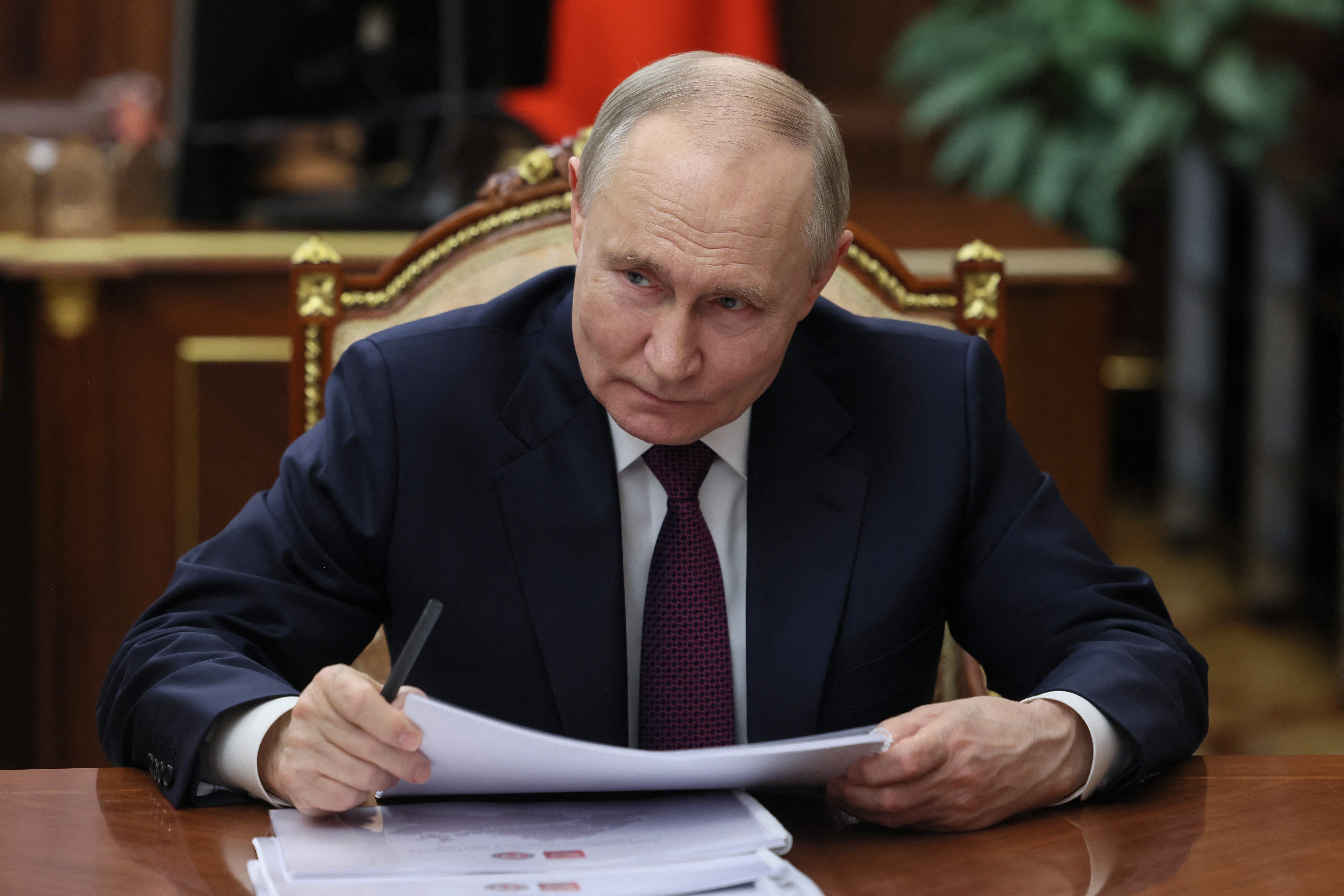
“PEACE WITHOUT JUSTICE IS MERELY a pause between crimes.” I’ve come across variations on this aphorism many times, in speeches by human rights advocates, in post-conflict reconciliation efforts, and in the writings of those who have witnessed war up close. It captures a hard-earned truth: peace that ignores accountability is not peace at all. It’s a temporary ceasefire between outrages.
President Trump, having apparently broken with Russian President Vladimir Putin (for now) and decided to supply Ukraine with more American weapons (that the Europeans will buy) seems intent on his promise to bring peace to Ukraine. But if he wants peacemaking to be part of his legacy—and he so clearly covets the Nobel Peace Prize—he must distinguish between two kinds of peace. The first is a true peace between these warring nations that would last. The alternative is a ceasefire that ignores accountability—the kind of peace that is only a lull and will invite new atrocities.
The idea that sanctions on Russian trade with the United States would do anything to accomplish the first kind of peace—much less the second, more troubling kind—is unrealistic. Vladimir Putin has already earned his place in the dock at the Hague. And it’s taken far too long, but Donald Trump has finally realized what much of the world has known for years: Putin is evil.
President Trump’s recent epiphany—offered with expected self-congratulatory flair—lands awkwardly against a decade of his previous public denials, private flatteries, and geopolitical accommodations. Ukrainians knew Putin was evil when missiles fell on maternity wards, apartment buildings, and critical infrastructure. Georgians knew it when tanks rolled through Tskhinvali. Syrians knew it when the Russian Air Force bombed civilians and then called them “terrorists.” Russian dissidents, journalists, and exiles have known Putin’s evil for years. So have senior leaders in the U.S. military, our intelligence community, European allies, and even many members of Trump’s first cabinet. They tried to warn him. He dismissed them.
But now that Trump has finally seen the light and spoken the truth, the question is not what he sees—but what we will do. Because merely recognizing evil doesn’t change the course of history. Acting against it does.
THE WORLD HAS BEEN HERE MANY times before. In the 1990s, another strongman sought to build his power by stoking nationalism, sowing ethnic hatred, and unleashing violence: Slobodan Milošević. Under his regime, wars in Croatia, Bosnia, and Kosovo killed more than 130,000 people and displaced millions. For years, the world watched violent reprisals against civilians and ethnic cleansing, until finally NATO acted. Shortly after, the International Criminal Tribunal for the Former Yugoslavia indicted Milošević and, eventually, scores of his subordinates and allies, plus other combatants who committed alleged violations of the laws of war, crimes against humanity, or genocide. The message was clear: You don’t get to commit genocide and retire comfortably.
Putin watched the Yugoslav wars and the subsequent trials from St. Petersburg and Moscow but drew a different lesson. In Putin’s mind, the West was slow, fragmented, and reluctant, so his solution was to be faster and more brutal, while finding ways to insulate himself from consequences. From Chechnya to Georgia, from Syria to Crimea, and in two separate invasions of Ukraine, Putin’s path was always paved with atrocities. His forces targeted hospitals, razed cities, deported children, sexually abused prisoners, and used starvation as a weapon of war. The massacre in Bucha, the leveling of Mariupol, and the forced disappearances in occupied Ukraine were Kremlin policy, boldly and brazenly executed with no shame fear of accountability. And in considering these overt violations of the Geneva Conventions, we must also include Putin’s use of assassination on foreign soil as part of his statecraft: Alexander Litvinenko, poisoned with polonium in London; Sergei Skripal, attacked with Novichok nerve agent in Salisbury; Aleksei Navalny, poisoned in 2020 in a Russian airport on his way to Germany; and others going back decades.
While the International Criminal Court had already issued warrants for Putin and his “Commissioner for Children’s Rights,” last month it expanded those indictments to include former Defense Minister Sergei Shoigu and Gen. Valery Gerasimov. Charged with war crimes for targeting civilian infrastructure and non-combatants, these men are the modern-day Radovan Karadžićs and Ratko Mladićs.
Putin, Shoigu, and Garasimov have a defense that Milosević, Karadžić, and Mladić did not: They rule in a country with nuclear weapons. Achieving justice for the Russians will be much more difficult than it was for the Serbs. But if President Trump wants to achieve real peace in Ukraine, none of these men can be allowed to live out their lives without at least the fear that one day they may stand trial for their crimes.
YET, EVEN AS HE ANNOUNCED the provision of providing arms to Ukraine, President Trump provided a 50-day grace period and a threat of “raised tariffs” if Russia failed to show up at the “peace table,” despite the fact that Russia’s economy, already decoupled from much Western trade, would feel little impact from raised tariffs. Immediately after President Trump’s announcement, Putin’s bureaucrats noted they were grateful for the delay so they can coordinate a response. Trump’s equivocation project weakness, not resolve. This is no time for arbitrary deadlines, diplomacy by calendar, or economic tokenism.
Trump has better options, like seizing frozen Russian sovereign assets—hundreds of billions held abroad—and using them to fund Ukrainian reconstruction. Or imposing secondary sanctions (not, as he threatens, “secondary tariffs”) on nations and companies that continue to trade with or support the Russian war machine. Or designating Russia as a state sponsor of terrorism, because targeting civilians with missile strikes and using chemical weapons across borders certainly qualifies. And finally, he could also support the expansion of the ICC indictments and lead a multinational effort to establish a special tribunal for crimes of aggression.
Sounds harsh? Not when we return to the concept that accountability and justice are not optional. They are the foundation of deterrence and global order. It is how today’s nations tell future autocrats that the world will not forget, forgive, or normalize their crimes.
Milošević was not stopped solely by NATO bombs or tribunal indictments alone. He was stopped because the Serbian people, facing international isolation and internal ruin, turned on him. That happened when the world made clear: There would be no normalization, no negotiation, no handshakes until the criminals and those who led them faced justice.
The same must apply to Putin and his enablers. No delays or off-ramps. No frozen conflicts. No rehabilitation. The war ends when Russia withdraws, reparations begin, and the guilty stand trial. That’s the only path to real peace—and the only way to ensure that future Putins, watching from Beijing or Tehran or Pyongyang, understand the cost of criminal conquest.
Justice is hard. Accountability is slow. But if we fail to pursue them—with every tool of national and international power: law, finance, diplomacy, and brute force—then we should stop pretending we care about order, sovereignty, or the victims of war crimes. Unnecessary delay increases suffering. Visible weakness invites escalation. And peace without justice guarantees only more bloodshed.
 | A guest post by
|