Warning Signs of Election Interference
The Fulton County raid and other recent developments show how Trump and his allies are moving to discredit losses and control future elections.

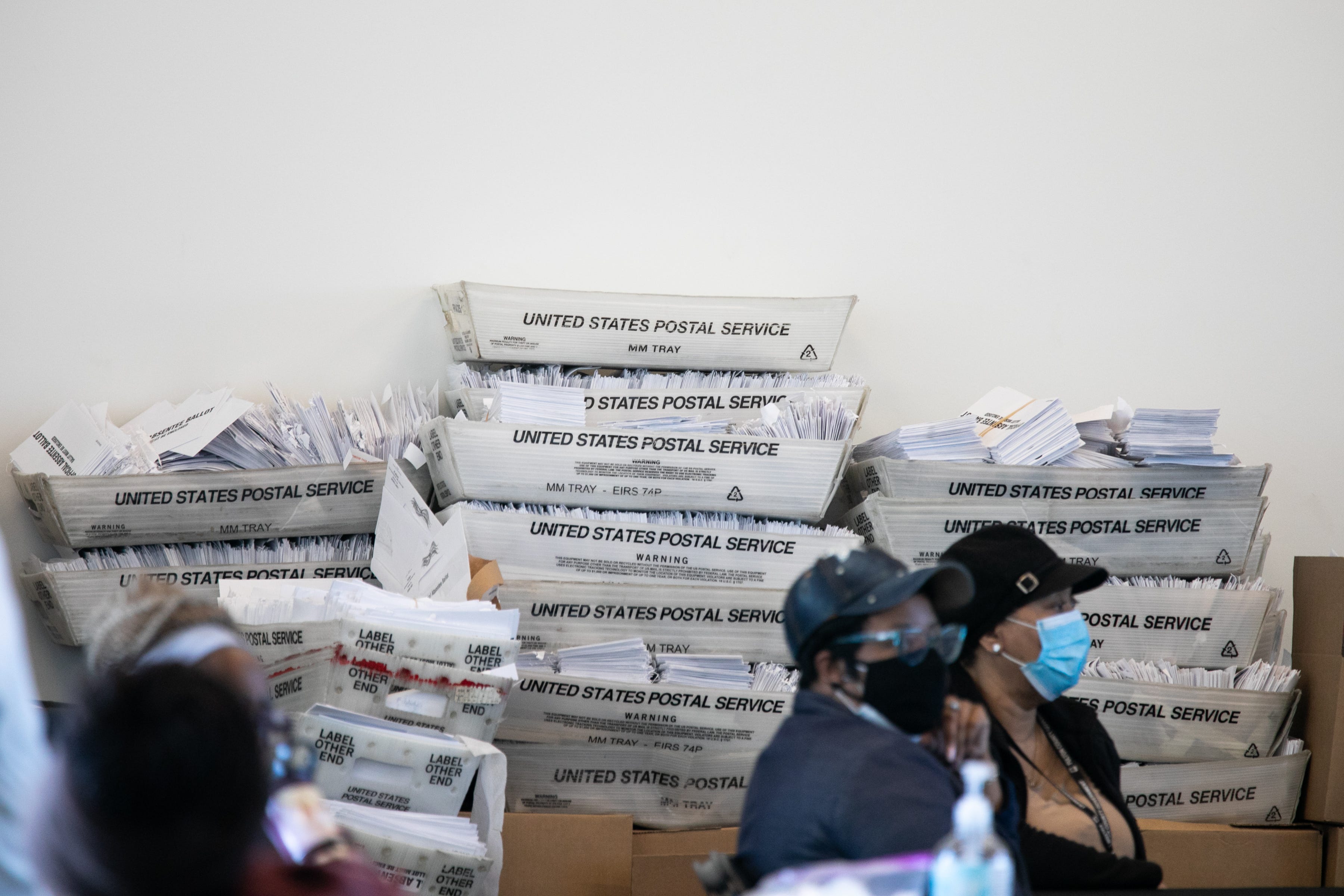
LAST WEEK’S RAID BY FBI AGENTS of the Fulton County, Georgia, elections warehouse seeking ballots and other materials is not only the latest salvo in President Donald Trump’s years-long effort to discredit the results of the 2020 election. It is also an alarming signal of the kinds of abuses we should expect from Trump and his allies in future elections.
Acting on a search warrant pursuant to an affidavit that remains sealed—so the specific supposed justification for the raid remains unclear—the FBI agents set out to collect “all physical ballots from the 2020 General Election in Fulton County,” as well as “all tabulator tapes for every voting machine,” “all ballot images,” and “all voter rolls” from 2020. This, of course, was the election in which Joe Biden defeated Trump in Georgia by 11,779 votes. Since Trump’s infamous phone call to the secretary of state to “find 11,780” votes, these ballots have been recounted and then recounted again.
Trump’s ambitions extend far beyond relitigating his 2020 loss. Just over two weeks before the Fulton raid, Trump lamented that he failed to activate the National Guard to seize voting machines to look for evidence of fraud following the 2020 election. The Fulton raid should set alarm bells ringing about Trump’s willingness to abuse the power of his office to undermine free and fair elections in 2026 and 2028.
FULTON COUNTY IS NO STRANGER to election conspiracy theories. Following Trump’s loss in Georgia in 2020, he and allies embarked on a strategy of litigation, speculation, and fabrication that can best be described as ‘throw everything against the wall and see what sticks.’
The president’s attempt to overturn the 2020 election in Georgia was soundly defeated in court. Its chief architects, including Sidney Powell, even pleaded guilty to election interference charges. But that doesn’t mean election deniers have abandoned their focus on the state.
Last November, the president issued a sweeping pardon to those who aided his attempt to overturn the 2020 election, and a top Department of Justice official posted a picture with Powell shortly after the Fulton County raid—a symbol of, if not exactly her rehabilitation, then at least a continued admiration for her among Trump’s followers.
Trump allies in Georgia have also stayed busy. In 2021, state lawmakers approved a law authorizing the legislature to take control of Fulton County elections. In 2024, the state election board attempted to impose new rules to disrupt election certification statewide—only for the rules to be blocked in court. The Georgia Republican Party’s 2026 agenda calls for an end to no-excuse absentee voting, eliminating automatic voter registration, and shortening the early voting period. In short, Georgia remains the top target for Trump’s campaign to interfere in our elections—whether it’s sowing disinformation about 2020 or laying the groundwork to contest 2026.
BUT EVEN THAT’S JUST THE BEGINNING. Indications are becoming plainer that Trump and his allies are pursuing a much more ambitious and more troubling agenda. The president’s March 2025 executive order on elections attempted to change election rules nationwide. The Department of Justice has sued twenty-four states (to date) to access state voter rolls, which include private voter information. Trump has used the bully pulpit to demand that state lawmakers enact his elections agenda—with mixed results.
And other things we’ve seen in recent days reflect a dangerous further escalation:
During a speech at the World Economic Forum in Davos, Switzerland, President Trump warned that “people will soon be prosecuted” for the events of the 2020 election.
The same day two federal agents killed Alex Pretti on the streets of Minneapolis, U.S. Attorney General Pam Bondi sent a letter to Minnesota Governor Tim Walz conditioning the removal of federal immigration agents on the state providing federal officials its state voter list, complete with sensitive private information.
Bondi also granted the Missouri-based federal prosecutor who oversaw the FBI search warrant special authority to investigate and prosecute “offenses” related to the 2020 election anywhere in the country.
On the scene for the Fulton County raid was Director of National Intelligence Tulsi Gabbard. The director of national intelligence is responsible for overseeing the nation’s foreign intelligence network; there is no discernible reason for her to have been present during the raid in her official capacity, as the DNI has no role in law enforcement.
In an appearance on Dan Bongino’s podcast on Monday, Trump said elections in fifteen states should be “nationalize[d].” “The Republicans should say, ‘We want to take over.’ We should take over the voting, the voting in at least many—fifteen places. The Republicans ought to nationalize the voting.”
With the 2026 midterms approaching, the Trump administration has shifted from imposing civil litigation and political pressure to threats of forceful, violent law enforcement and criminal prosecution and removing from states their constitutional prerogative to control their own elections.
WHAT COMES NEXT? No one should be surprised if the Fulton County raid turns out to be just the start of a broader strategy to potentially discredit unfavorable election results in 2026 and 2028. We know the president’s playbook: lie, distract, and divide. Six years on, maintaining—and growing—the Big Lie of 2020 is all about one thing: justifying Trump’s ongoing abuse of presidential authority to seize greater control over elections. Elections are the central acts of our democracy—and thus a clear target for Trump.
The courts remain a crucial backstop, but we cannot rely on courts alone to resist presidential overreach. State and local election officials need our support—we need them to continue following the law and to block presidential efforts to encroach on state and local authority in election administration.
At the same time, state lawmakers must work with election officials and community leaders to strengthen election laws and prevent the administration from manipulating our elections. That includes strengthening how we maintain accurate voter registration lists, allowing ballot pre-processing and early voting to speed the reporting of election results, and addressing how election disinformation is spread online—especially as AI presents new threats. This means implementing election audits and voter-verifiable paper trails, and cementing election certification as non-discretionary in state law.
The future of our democracy hasn’t been decided yet—even as Trump escalates his attacks in Georgia, Minnesota, and elsewhere. It’s being determined right now, in state capitals, county offices, and courtrooms, by hardworking Americans who understand that free and fair elections are the bedrock of democracy—in 2026, 2028, and for decades to come.
Samantha Tarazi is CEO of Voting Rights Lab, a nonpartisan, nonprofit organization dedicated to securing and strengthening elections in all fifty states.
 | A guest post by
|