


How committed is the Trump administration to erasing the history of slavery? Last month, the National Park Service removed exhibits about slavery from the Philadelphia site where George Washington—and some of the people he enslaved—and John Adams lived before the capital moved to D.C. A judge ordered them to restore the exhibits. And now the administration has appealed the ruling.
“The National Park Service routinely updates exhibits across the park system to ensure historical accuracy and completeness,” the Department of the Interior said in a statement. “Completeness” is doing some interesting work there.
Programming note: Our shows tonight and tomorrow at the Pantages Theatre in Minneapolis are pretty much sold out, but there’s a smattering of tickets left if you’re in the neighborhood and want to squeak in under the wire. It’s been an amazing couple of few months in Minnesota—we look forward to seeing some of you there tonight. Happy Wednesday.
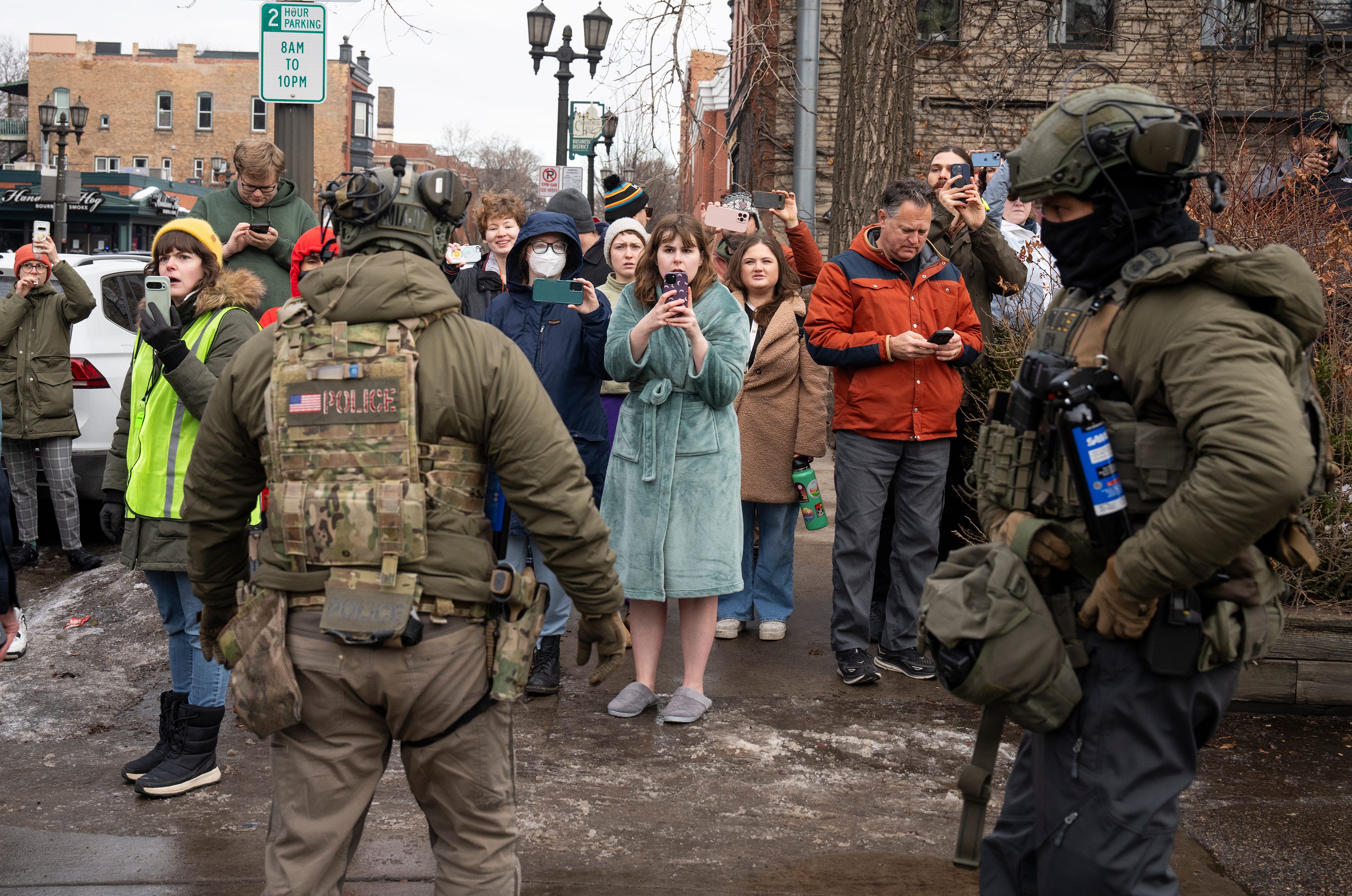
The Minnesota Model
by William Kristol
Minneapolis, Minn.
I’ve always been pro-Minnesota.
When I was a kid, New York baseball fans were divided into Yankee lovers (boring power-worshippers) and Yankee haters (daring fans of scrappy underdogs). As you’ve perhaps guessed, I was firmly in the latter group. And so I was pleased when the Minnesota Twins won the American League pennant in 1965, deposing the mighty Yankees, who’d been AL champs for fifteen of the preceding eighteen seasons.
My affection for the Twins only increased when they lost a dramatic seven-game World Series to the Dodgers and Sandy Koufax, who pitched complete-game shutouts in the fifth and seventh games, the latter on two days’ rest. So I was grateful to the Minnesotans both for winning the regular season and losing in the Series.
Three years later, in 1968, Minnesotans reappeared on my horizon. I spent part of my summer between tenth and eleventh grade as a volunteer for Hubert Humphrey’s presidential campaign. I admired Humphrey both for his leadership on civil rights and his liberal anti-communism, and some of that admiration spilled over to the state that elevated him to public office. And I’ll add that though I didn’t support him, I rather admired Humphrey’s rival and fellow Minnesotan, Eugene McCarthy, as well.
Then, a decade later, in the winter of 1978, as I was finishing up grad school, I visited Minneapolis for the first time for my first job interview. I remember only three things about that visit: It was really cold; I was nervous; and the University of Minnesota political scientists were nice to me. (I didn’t end up with the job—it would have been too much of a shock to my system to leave the East Coast.)
I can’t say I was excessively preoccupied with goings-on in the North Star State for the next several decades. But, over the past couple of months, who hasn’t been focused on events here? And who hasn’t admired the example of civic courage and citizen responsibility Minnesotans have provided for the rest of us?
I’m in Minneapolis now for Bulwark events tonight and tomorrow night. A friend arranged a dinner last night with a group of locals, some of them traditional liberals and some ex-Republicans. None of them seemed by career or disposition to have been long-time take-to-the-streets activists. But all of them have been very involved in the recent anti-authoritarian activism. And as they described what they and their friends and acquaintances have been doing to help immigrants and to try to check ICE’s depredations, as they explained the Signal text chains and the modes of cooperation among both neighbors and strangers, as they detailed the bottom-up, spontaneous character of the overall effort, I came away even more impressed than I expected.
These proud Minnesotans gave a lot of credit for their success to the state’s strong network of civic organizations and to its culture and tradition of public-spiritedness. Perhaps the people of Minnesota were especially suited to organize themselves for this moment. But surely this state isn’t that different from many others. My main takeaway was less the specialness of Minnesota, and more that the rest of us need to follow in Minnesota’s footsteps.
And we need to do so not just when DHS launches a surge in the streets of a particular city. We need the grass-roots, spontaneous exercise of civic leadership in the fight against authoritarianism on every front for the next three years.
After all, if you look at the overall balance of power between the Trumpist authoritarians and the pro-democracy resistance, it’s not great. The federal government generally has more power than state and local governments, and especially a federal government ruthless and relatively united in the service of its aims. Big business and many other powerful institutions are mostly going along to get along. Congress can’t be counted on to provide much resistance over the next year, and even if Democrats take both houses this November, a weaponized executive branch will remain powerful. The situation with big media is problematic.
The elites and the establishment, the big organizations and the august institutions, are unlikely to save us. Widespread citizen activism and resistance could make the difference, though.
And we need to be imaginative about what that would look like. We need citizens acting in many ways and at all levels. We need protests and organizing, but we also need more forms of resistance from within big organizations, sometimes publicly, sometimes privately, and yes, sometimes surreptitiously. We need internal dissidence and help for dissidents. We need leaks and exposés, and support for leakers and truth-tellers. We need to get beyond thinking about politics as usual—though conventional politics remains critically important. We need to think not only of election campaigns but of popular campaigns. We need to learn lessons from the civil rights movement of the 1950s and 1960s, and from Eastern European dissidents in the 1970s and 1980s.
The Trumpists, like the Southern segregationists and the Soviet-bloc communists before them, have been pretty effective in mobilizing the executive branch and associated organizations behind their deplorable actions, their crude propaganda, and their efforts at intimidation. And so we need an all-of-society resistance to defeat the all-of-government conspiracy against our liberties and democracy.
That’s why it’s important that Minnesota be not just a shining example of what can be done. It needs to be a harbinger of what’s going to be done. It needs to be a model not just admired but emulated. We should all be Minnesotans now.
Besides the civil rights movement and the Soviet-bloc anti-communist movements, what other models should we draw inspiration from? Who else has fought authoritarianism and won? Share your ideas in the comments.
AROUND THE BULWARK
NatCon Chief’s Muddled Brief… GABRIEL SCHOENFELD writes on Yoram Hazony’s confused attempt to sort out the problem of right-wing antisemitism.
America’s Generals Shouldn’t Face Political Loyalty Tests… Keeping politics out of the military is what keeps the military out of politics, argues MARK HERTLING.
Tricia McLaughlin’s Top Five Lies… JARED POLAND considers the outgoing Homeland Security flack’s pattern of mendacity.
Quick Hits
ADIOS, TRICIA: The Trump administration is losing one of its loudest megaphones. Tricia McLaughlin, the hard-charging Department of Homeland Security spox who over the past year became the leading proponent for many of the government’s least trustworthy claims, is leaving DHS next week. After Politico reported McLaughlin’s impending departure, DHS Secretary Kristi Noem praised her “exceptional dedication, tenacity, and professionalism” and said she had “played an important role in advancing our mission to secure the homeland and keep Americans safe.”
It’s not clear why McLaughlin is leaving. But her departure comes at an unusually vulnerable moment for her department, which has come under heavy scrutiny following the killings of two Minneapolis protesters by DHS agents and mounting reports of horrible treatment of migrants in DHS custody (see, for example, Adrian Carrasquillo’s latest Huddled Masses newsletter about the families with children being detained in Dilley, Texas). Rather than risk another broad government shutdown, congressional Republicans this month allowed Democrats to pry DHS funding out of a larger government spending package; funding for the department has partially lapsed while the Senate hammers out a package of reforms. McLaughlin—with her pedal-to-the-metal, incendiary style and richly earned reputation as a whole-hog propagandist—may not be the best fit for a department suddenly trying for a new PR strategy.
ELECTION DENIERS IN CONTROL: If you don’t like the Save America Act—the bill currently before the Senate which would require Americans in every state to produce a birth certificate or passport to register to vote—you ain’t seen nothing yet. The next election bill on the GOP docket is the Make Elections Great Again Act, a true election-denier fever-dream in bill form, being pushed by Rep. Bryan Steil (R-Wis.). The New York Times reports:
Mr. Steil’s bill would ban universal voting by mail and prohibit the counting of ballots received after Election Day. It would ban ranked-choice voting for federal elections and would prohibit voters from giving sealed mail ballot packets to someone else for delivery, a practice currently allowed in 18 states.
It also would grant far more authority to the Department of Homeland Security to obtain information about voters from states. And it would reinforce the House-passed bill’s voter ID requirements, including establishing citizenship by requiring people to show a passport or a birth certificate to register and identification to vote.
“Elections should end on Election Day,” Mr. Steil said at a hearing last week, echoing an assertion Mr. Trump made repeatedly after his 2020 election loss.
How trustworthy a character is Rep. Steil when it comes to elections? He doesn’t “just” believe that Donald Trump won Georgia in 2020, as your baseline vanilla election deniers do. During last week’s hearing, he refused even to admit that Kamala Harris had won Minnesota in 2024—a state that Harris won by more than four points (about 138,000 votes) and that hasn’t voted for a Republican for president since 1972.
NOT GOING QUIETLY: President Trump has declared a political fatwa against Rep. Thomas Massie (R-Ky.), the oddball libertarian congressman who led the fight to release the Epstein files. But if anything, Massie seems to be enjoying his status as persona non MAGA. “He called me a moron at the prayer breakfast,” Massie told Politico in an interview yesterday. “I’m glad to know I’m in his prayers.”
Trump and his operation are trying their best to squash Massie: Trump hand-picked a Republican challenger, former Navy SEAL Ed Gallrein, for the district, and his political allies are pouring millions into the race ahead of the May 19 primary. What has incensed Trump isn’t just Massie’s independent streak, which has caused the White House repeated legislative headaches. It’s also Massie’s status as a cocky, almost goofily defiant exception to the prevailing GOP orthodoxy that only bad things happen to those who cross Trump.
Whether Massie can survive Gallrein’s challenge remains to be seen. But at least for now, he seems happy with the gains he’s made during his maverick turn. “The [Republican] margin is razor-thin, so on any given day, I would need just one or two of my own co-conspirators to get something done,” he said. “And what’s happening is that the retirement caucus is growing and primary days are coming up and passing. Once we get past March, April and May, which contain a large portion of their Republican primaries, I think you’re going to see more defections.”
Cheap Shots

Re: Thomas Massie
I don't live in Kentucky, but I love this guy. Trump calls the guy with two degrees from MIT a moron at a prayer breakfast. He doesn't get all red-in-the-face. He thanks him for keeping him in his prayers.
Trump runs some ex-SEAL against him. Massie says "I vote with the President 91% of the time. The other 9%, when he's covering up for pedophiles, spending money we don't have and getting us involved in foreign wars, I don't." Let Mr. SEAL run out there and say he'll be 100% for Trump. Let's see how that works. Let's see how many Kentuckians want a guy who'll be all on board with that 9%.
I don't know if he'll win or not, but his seems to be the boldest way to take on Trump. Don't let him get away with the bullying. Call him out.
Some of this might be luck, but luck is good! The Epstein Files are a real thing and when Massie first started talking about them, they were kinda fringy. He got on the right issue at the right time and he deserves to benefit from it.
Someone needs to track down the front line spectator in the blue bathrobe and plush slippers who clearly came out in the cold (look at the clothing of the others in the crowd) to help document what the Felon's Storm Troopers were doing despite the words of the Border Czardine, Homan, that they would be withdrawn.
Perhaps "Leila Navidi/The Minnesota Star Tribune" can help the search, because that woman deserves some kind of public recognition for her dedication to doing what is right, regardless of the potential personal discomfort. If you find her fast enough, try your best to get her up on stage one of the nights you guys are there.