What Does Hungary’s New President Mean for Its Post-Orbán Future?
Poetic justice: A judge once purged by Viktor Orbán will be the new head of state as the country works to dismantle the authoritarian system Orbán left behind.

Budapest, Hungary
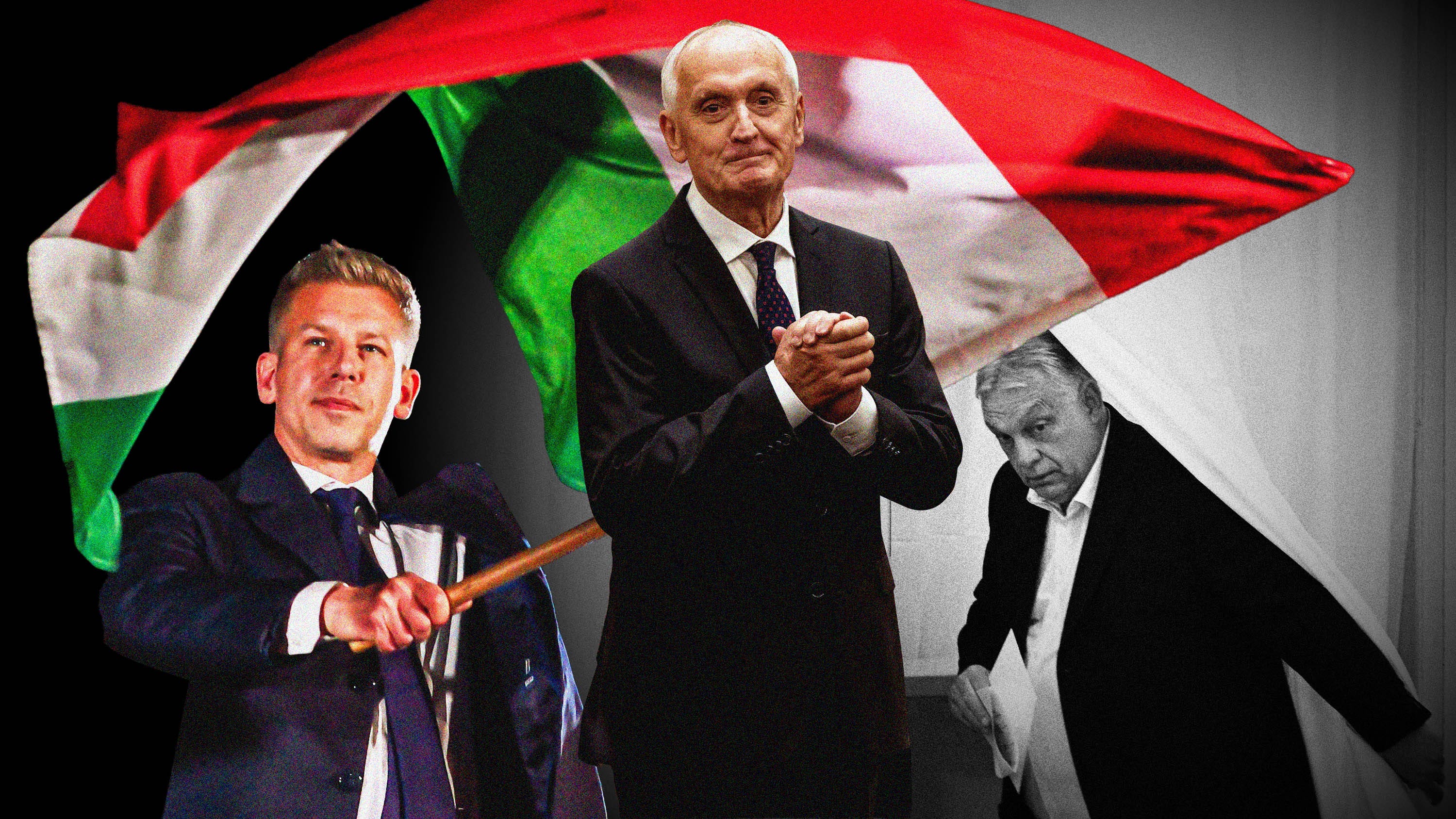
HUNGARY’S PARLIAMENT TODAY elected a new president, András Baka, a former head of the country’s highest court whom Prime Minister Viktor Orbán purged from office in 2011 for criticizing his assault on the independent judiciary. Baka’s presidency puts an emphatic, symbolic exclamation point on the end of Orbánism. In the words of Budapest’s mayor, “[The Orbán system] started with the firing of Baka; now it ends with his election as president.”
It’s the latest success for Péter Magyar, Hungary’s 45-year-old prime minister, who vanquished Orbán in an election four months ago. The mood in Hungary remains extraordinarily upbeat and hopeful. Over two-thirds of Hungarians believe their country is moving in the right direction, a measure of optimism not seen since 2002. According to polls, approximately 70 percent of voters support Magyar’s Tisza party, while support for Orbán’s Fidesz hovers around 20 percent. Another poll shows two-thirds of Hungarians wanting Orbán to stand trial. Magyar’s popularity stands around 70 percent.
Explanations for these jaw-dropping numbers are not hard to find. In the three months since he took the oath of office, Magyar has pursued the agenda promised in his campaign with a consistency and relentless determination that Hungarians have never witnessed in a politician. Magyar promised to dismantle Orbán’s illiberal “mafia state.” In under a hundred days, he’s taken large strides in that direction.
Magyar’s first achievement was to negotiate the release of 16 billion euros in frozen funds from the European Union. The deal depended, among other things, upon a commitment to battle corruption and to join the European Prosecutor’s Office. Additionally, Magyar’s government has established an Office for the Recovery and Protection of Assets (Nemzeti Vagyonvisszaszerzési és Védelmi Hivatal), charged with tracking down the byzantine networks through which Orbán’s government misappropriated and transferred public assets into private hands. The new government intends to recover these lost assets wherever possible.
A separate measure related to corruption has been to reclaim or dissolve “public interest asset management foundations” (KEKVA in Hungarian). These are special “nonprofits” created by Orbán and entrusted with the management of public assets. One of the richest of these organizations was the foundation that operated Mathias Corvinus Collegium (MCC), the faux university and think tank where illiberal American “thought leaders” like Rod Dreher, Gladden Pappin, and Patrick Deneen were once fellows. MCC no longer exists as a KEKVA, and its future as a think tank hangs in the balance. Both MCC and the Danube Institute, another Orbán think tank and partner organization of the Heritage Foundation, appear to be looking for funding from MAGA donors and the U.S. State Department.
Magyar also shuttered Orbán’s Putinesque Sovereignty Protection Office, and has temporarily shut down the state news media. Meanwhile, Orbán’s private media empire, operated by oligarchs and funded by the state, is crumbling as many outlets drastically downsize.
These are significant steps toward restoring democracy in Hungary, but they do not reach to the foundations. The foundation of Orbán’s regime is its illiberal constitution—adopted in 2011, a few months before Baka was removed from the highest court—as well as the many loyalists Orbán installed into constitutional offices during his years in power. As long as these remain in place, Hungary’s democratic transition remains in jeopardy.
Magyar Wants a Constitutional Moment
In a dramatic speech delivered in Parliament on June 22, Magyar announced his intention to initiate a process of constitutional consultation in September. He plans to solicit wide-ranging input from civil society, coupled with broad public debate, in a process that will culminate in a new constitution to be ratified by popular referendum. Magyar’s goal is to guide Hungary through what some legal scholars have called a constitutional moment. Constitutional moments are periods of deep democratic mobilization, when people directly engage questions of fundamental principle and arrive at a basic consensus about the foundations of their polity.
Magyar’s intention to lead Hungary through such a constitutional moment is enormously ambitious. To have a chance of success, it must proceed in steps. Before arriving at a new constitution, the illiberal state that Orbán built up must be torn down, which requires methodically removing Orbán loyalists who linger in key constitutional offices. Although individually these figures would be unable to block Magyar’s agenda, working together they could throw enough sand in the gears to sabotage Hungary’s democratic transition.
Magyar called for the resignation of key constitutional officeholders in his victory speech on election night. The officeholders did not oblige. Because Tisza holds a parliamentary supermajority, Magyar can essentially do whatever he wants, removing officeholders by constitutional amendment if necessary. But that approach carries risk. If Magyar’s objective is to lead Hungary to a constitutional moment, then abusing constitutional power the way Orbán did could undermine his noble goal. On the other hand, should Magyar refrain from using his extraordinary constitutional powers, Orbán’s loyalists can prevent him from restoring democracy to the country.
In short, Magyar confronts “the problem of means.” On the one hand—to quote an important decision of Hungary’s Constitutional Court—“a constitutional state cannot be created with unconstitutional means.” On the other hand—to quote the philosopher Jacques Maritain, who worried about defending democracy from totalitarian threats—means can only be effective if they correspond to the end. The choice of means must take account of context and reality. “When the social group is in a process of regression or perversion,” Maritain writes, “the precepts of morality do not change in themselves, of course, but the manner in which they must apply sinks also to a lower level: for our moral acts are concrete acts … which can be changed by the nature of the situation which one has to face.”
Hungary cannot arrive at a constitutional moment without confronting its illiberal past. Should Magyar ignore the fact that Viktor Orbán and his minions are determined to do whatever they can to prevent Hungary’s democratic transition, his constitutional revolution will fail. This recognition impacts the question of means.
The Battle to Remove the President
Magyar’s first gauntlet landed at the feet of Baka’s predecessor in the president’s office, Tamás Sulyok. In his inaugural address to Parliament, Magyar turned to Sulyok, who was sitting in the gallery, called him a cowardly agent of the Orbán regime, and told him to resign by May 31. Should he refuse, Magyar would remove him by constitutional amendment.
Hungary’s president is elected by parliament with very limited powers. The president signs legislation before it becomes law, but he has no right of absolute veto. If he has concerns about a bill, he may send it back to parliament to be reconsidered, but he must accept the bill once parliament passes it a second time. The president can also send a bill for review to the constitutional court, which can find parts of the bill unconstitutional. But in the case of constitutional amendments, neither the president nor the constitutional court has a right of review.
Sulyok remained publicly silent until a few days before the May 31 deadline. Then unexpectedly, he announced that he had requested the Venice Commission to urgently examine his case in order to prevent Hungary from falling into a constitutional crisis.
The Venice Commission is an advisory body of the Council of Europe established in 1990 to assist the former Communist countries of Eastern Europe in democratic transition. Its reports are carefully reasoned and can be helpful if received constructively, but they carry no legal force. Indeed, Orbán’s government consistently ignored criticism from the Venice Commission, which it accused of being an ideological tool of George Soros.
But now all of a sudden Fidesz politicians were screaming about the rule of law, constitutionalism, and the need for checks and balances. Things were different when Orbán held power. “The system of checks and balances is an American invention,” Orbán declared in 2014, “which Europe has adopted thanks to a certain intellectual mediocrity.” Another high-ranking Fidesz official, László Kövér, was blunter: “the system of checks and balances . . . is idiotic. . . . It has nothing to do with constitutionalism or with democracy.” Funny how, until four months ago, Orbán had a plebiscitary view of democracy. The states of Europe don’t really have checks and balances, he claimed, because “all power is delegated to the parliament.” And of course Orbán was the one who announced that Hungary was building an illiberal democracy.
This laughably transparent hypocrisy is too blatant to affect Hungarian public opinion. But the primary audience may not be Hungarians. It might be the European Union. Fidesz’s appeal to constitutionalism is part of a cynical strategy to take advantage of what Reinhold Niebuhr once called the “naïveté of the children of light.”
Niebuhr, an eminent figure of twentieth-century theology, believed that democracies were vulnerable to authoritarian threats because of their excessive optimism about human nature. This caused them to underestimate the persistence of forces determined to destroy democracy. The children of this world are wiser in their generation than the children of light, Niebuhr noted, adding, with words that might apply just as easily today, “Our democratic civilization has been built, not by children of darkness but by foolish children of light. It has been under attack by the children of darkness, by the moral cynics. . . . The children of light are virtuous because they have some conception of a higher law than their own will. They are usually foolish because they do not know the power of self-will.”
Viktor Orbán has no regard for principles of constitutionalism. Much to the contrary, he eliminated checks and balances and created a constitutional system designed to deliver parliamentary supermajorities to the winner of every election, enabling the governing party to rule with unchecked power. Unexpectedly finding himself in opposition, Orbán—who, while out of office, remains the head of Fidesz—is now cynically invoking liberal principles in an effort to sabotage democratic reform. He wants to take advantage of the asymmetry between the children of light and the children of darkness to gain a foothold in European legal institutions so as to undermine Magyar’s constitutional agenda.
The strategy is desperate, but Orbán can draw a modicum of hope from the situation in Poland. There, Donald Tusk’s government has encountered numerous obstacles in its effort to repeal illiberal measures enacted by the previous Law and Justice Party. One of those obstacles was a report issued by the Venice Commission in 2024. It concluded that the Polish government could not summarily dismiss judges appointed under the previous regime, because “returning to the rule of law . . . must not in itself violate the principles of the rule of law.” In the opinion of legal scholar Kim Scheppele, the Venice Commission’s report accords undue deference to the legal status quo, disregarding the broader context that brought about that status quo.
In their cynical attempt to keep hold of power, Viktor Orbán and his party can certainly make an argument that sounds principled. They are claiming that Magyar’s government cannot amend the constitution for the sole purpose of removing Sulyok, because amending the constitution to achieve narrow political objectives violates the principles of constitutionalism. Ironically, this same issue was raised when Fidesz removed Baka back in 2011. At that time, Baka was early in his tenure as chief justice of Hungary’s high court. He refused to cooperate with Fidesz and spoke out repeatedly against Orbán’s designs on the independent judiciary. To get rid of Baka, Fidesz amended the constitution, renaming the high court the Kúria, and creating pointless requirements for holding the office of chief justice that disqualified Baka. Baka took his case to the European Court of Human Rights, which ruled that the Orbán government had violated the European Convention by passing legislation directed solely against Baka in retaliation for his criticisms of the government.
Essentially, Orbán and Fidesz are arguing that Magyar’s government is doing to Sulyok what they did to Baka. This means Sulyok has been removed illegitimately. The argument is so shamelessly hypocritical that, as Hungarians say, one eye is laughing while the other is crying. Yet hypocrisy doesn’t matter if the legal argument is sound. Orbán is hoping to trap the children of light in the logic of their own principles.
Ludwig Wittgenstein once described a picture of an old man leaning on a stick on a steep hill. Simply by looking at the picture, he said, one cannot tell whether the man is climbing up the hill or sliding down it. In order to understand what’s happening one has to grasp the context. In a similar way, one can’t simply look at the status quo in politics and understand what’s going on. One has to know the context. And no one who knows the Hungarian context can seriously believe that Orbán, Fidesz, and Sulyok are champions of the rule of law and constitutionalism. To look at the status quo without examining the underlying intentions at play is to make short shrift of the question of means. To avoid the traps set by the children of darkness, the children of light need to be clear-eyed about who and what they are up against.
Amending the Constitution Anyway
Péter Magyar is not the sort of leader to let himself be handcuffed by misplaced liberal scruples. He did, however, appear thrown off balance by Sulyok’s appeal to the Venice Commission. Several weeks passed while the government worked out a plan for removing the president. In the end, it introduced a large package of changes under a single constitutional amendment, which, upon being adopted, would also “terminate the mandate” of the current president. By linking the end of the president’s mandate to a broader set of constitutional changes, Magyar’s government sought to avoid the appearance of writing legislation with the sole purpose of removing Sulyok.
The new amendment lowered to 70 the compulsory retirement age for judges on the constitutional court. This was a tactic Fidesz once employed to get rid of judges. In the current instance, the amendment forced a few judges to resign, including the chief justice, a longtime and corrupt ally of Orbán. But the majority of Orbán-appointed judges remain on the court. One suspects that the Hungarian government was deterred by the example of Poland. Had it removed all of Orbán’s judges on grounds of constitutional renewal, it might run afoul of the Venice Commission or European courts. Instead of summarily dismissing judges, the amendment creates a controversial procedure by which members on a so-called National Council of Judges can impeach the judges on Hungary’s high courts.
The amendment also establishes a term limit of twelve years on parliamentary mandates. This provision was highly controversial. Critics said it was the kind of issue that should be taken up more fully when Hungary began debating a new constitution in the fall. The term limit effectively prevents prominent members of the old opposition from running for office again. More significantly, it affects Fidesz, which has suffered for years from a dearth of young blood and new faces. The party’s leading figures are barred from running in 2030, and Fidesz could easily wither away into nonexistence under the impact of the term limits.
Once parliament passed the amendment, Sulyok had no choice but to sign it. If he refused, he would be abrogating his duties as outlined in the constitution, and parliament could impeach him. During the impeachment proceedings, a temporary president appointed by parliament would sign the amendment, and Sulyok would be removed from office anyway. Trapped by the illiberal constitution he sought to defend, Sulyok signed the amendment into law on July 18. At the same time, he released a defiant video, claiming that Hungary had ceased to be a legitimate constitutional democracy and that the president who succeeded him would be illegitimate.
These sweeping, histrionic assertions parallel Fidesz’s narrative exactly. According to Orbán, the Tisza government has become completely illegitimate. The new unconstitutional “regime” must be opposed in its entirety. (Fortunately for Orbán, Magyar eliminated Orbán’s Sovereignty Protection Office, or else such statements would probably count as crimes.) The fact that Sulyok’s rhetoric directly echoed Orbán’s strongly suggests that the two coordinated their actions, and that Sulyok was indeed, as Magyar alleged, an “Orbán puppet.”
Two days after he signed the amendment, Sulyok’s term as president ended. The Venice Commission plans to take up Sulyok’s case only in October, but the political question is now moot.
In contrast to Sulyok, András Baka will be nobody’s puppet. His earlier confrontations with Fidesz make clear that he has both backbone and conviction. Baka also enjoys an international reputation, having served as a judge on the European Court of Human Rights in Strasbourg for seventeen years. Even though the powers of Hungary’s president are limited, he will nevertheless play an important role as a national figurehead. In the pre-Orbán era, several Hungarian presidents exerted political influence by virtue of their integrity and prestige. Baka is therefore an excellent choice to help guide Hungary through its constitutional moment. In his speech before parliament today after his election, Baka conveyed both an awareness of the challenges and a sense of historic responsibility:
The stability of a constitution depends on its enjoying broad support in society. If we create another constitution that is exclusively a constitution for the current parliamentary majority, we will repeat the mistake whose negative consequences we are currently trying to overcome. The forming of a new constitution must be more than the work of parliament. It requires social and expert debate, genuine political negotiation, and procedures, which in their nature reflect the democratic culture which the new constitution will defend.
Meanwhile, critics of Péter Magyar, who continue to call his commitment to liberal democracy into question, will need to do a better job evaluating the context.
Meeting the Moment
The deeper lesson of the saga of Sulyok’s removal may have to do with limitations of legal reasoning. Law has a static quality. It presupposes the existence of an order that it seeks to refine and regulate. But order itself arises from political action. In times of great upheaval and transformation, the law inevitably ends up playing catch-up with politics.
Hungary is in a historic moment. The first “consolidated democracy” to fall prey to an authoritarian takeover, it now seeks to throw off the shackles of despotism and author a new democratic constitutional settlement. “It is in the nature of beginning,” Hannah Arendt points out, “that something new is started which cannot be expected from whatever may have happened before. This character of startling unexpectedness is inherent in all beginnings and in all origins.” Yet “the fact that man is capable of action means that the unexpected can be expected from him, that he is able to perform what is infinitely improbable.”
For Péter Magyar to succeed in leading Hungary to a constitutional moment, he will need to do more than resist the temptations of power, although that is important. He will need to venture a series of political acts that open up a space in which his countrymen can create something new in their nation’s history. Europe’s courts and councils cannot show them the way, nor can they guarantee the outcome. If after a hundred days Magyar continues to impress, his bold political acts remain subject to the risks and indeterminacy inherent in the human condition. We are still witnessing a work in progress. But Hungary, the former lodestar for illiberalism, now offers genuine hope to the forces of democracy. Having come to know illiberalism from the inside out, Hungarians may show the rest of the world how to defeat it.
 | A guest post by
|
Thank you for this superb essay and update for those of us not following events in Hungary daily. It warns us that, even with a super majority in 2029 or whenever, recovering our democracy here will not be easy or quick.
How dark does JD’s soul have to be to go campaign for orban? Personally I think he has near zero chance in 2028.