What I Saw at the Battle of Minneapolis
The national media has moved on. Minnesota is still under siege.

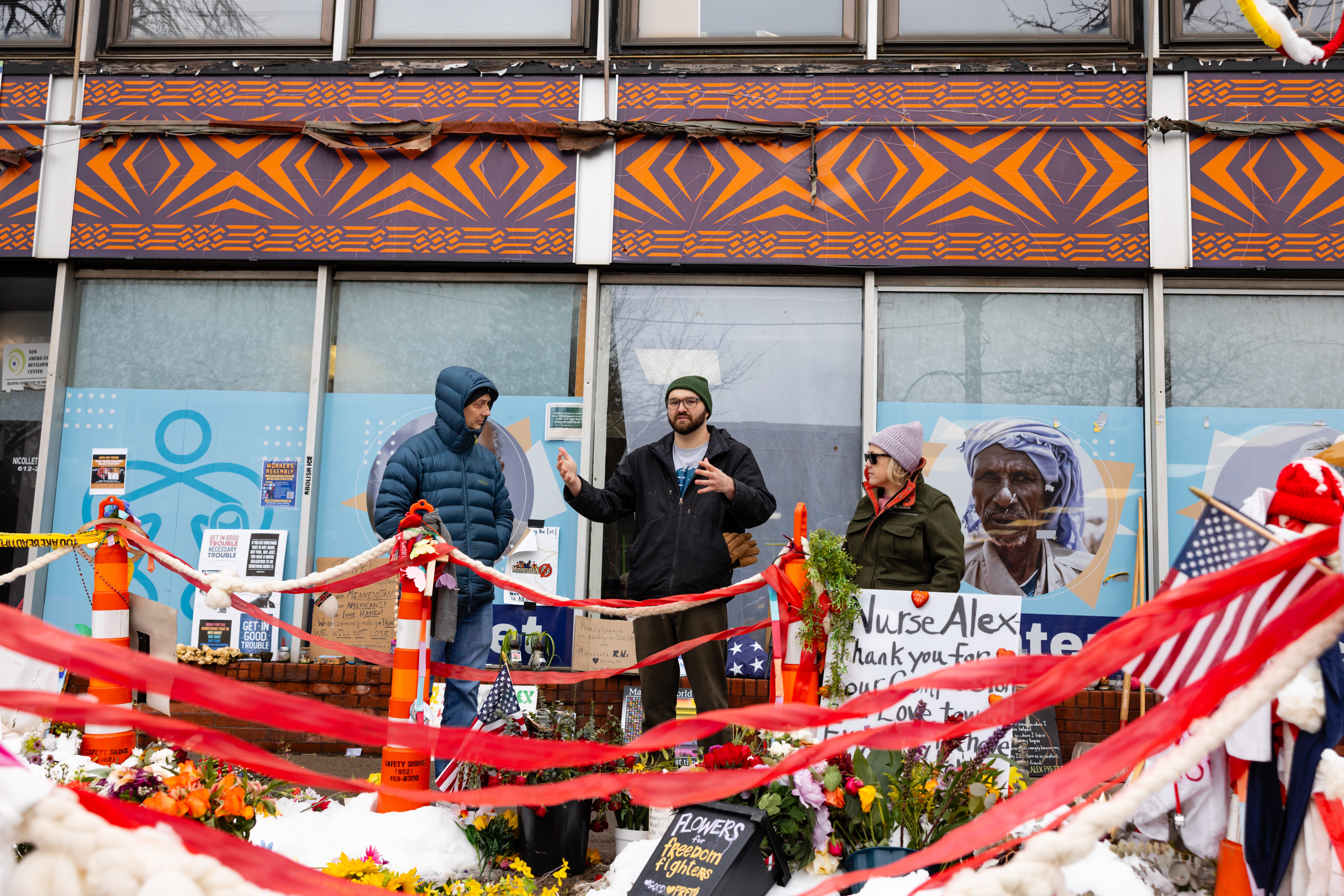
1. War
I understand that spending three days on the ground in Minneapolis is not real perspective. But it brought home something that may not be obvious from afar: Minnesota, especially the Twin Cities, has been—and still is—under a paramilitary occupation in which the federal government is at war with the population.
“War” is the operative word here.
One of the hallmarks of war is that combatants engage in a continual cycle of tactical adaptation and counteradaptation. Example: Russia invades Ukraine with tanks. Ukrainians deploy Javelin anti-tank missiles. Russians construct anti-missile cages around tank turrets, to detonate missiles before they can burrow into the armor. Ukraine responds by designing suicide drones that hunt Russian armor and attack not just weak points around turrets, but exhaust grates and other spots where there is an opening. Russia responds by building anti-drone drones, designed to hunt the hunters.
And so on. This cycle is as old as war itself.
New tactics succeed for a time; then the enemy adapts and your doctrine must shift to counter their adaptation.
It is useful to think about the Trump regime’s attack on American cities through this lens.
When the regime’s troops occupied Chicago, the city’s residents developed a number of tactics to harry them. They protested. They recorded. They used whistles to signal swarms of observers whenever DHS agents were spotted.
These measures succeeded. DHS left Chicago. The city was too big and the government didn’t have the manpower to counter the civilian population.
So the regime altered its tactics. It set its sights on a smaller city—Minneapolis–Saint Paul. It surged what it hoped would be an overwhelming force of more than 3,000 agents. And having seen what the whistles in Chicago did to alert the populace, it shifted from stakeouts to lightning raids, staging fast abductions to extract victims before citizens could respond.
This shift in tactics succeeded for DHS initially. But the people of Minnesota adapted, too.
They began using hyperlocal Signal chats to organize not just by the neighborhood but by the block. Simultaneously, they set up observation stations near the Whipple Federal Building, which DHS uses as headquarters, to observe DHS vehicles. As a vehicle left the building, observers would follow it. If they saw DHS agents deploy from the vehicle, they would tag the license plate and feed it into a distributed system used to keep track of known DHS vehicles. This way, local observers who spotted a suspicious vehicle in their neighborhood could check the plates against the database. This early warning system cut citizen response times to minutes (or less).
Various local civic groups—churches, PTAs, Rotary Clubs—morphed into a decentralized network of resisters, with hundreds upon hundreds of nodes. Some of them protested. Some observed. Many more worked to provide for the people the government was hunting. We’ll talk more about this last group in a moment.
The observers proved to be a problem for DHS, as its agents were caught on camera, over and over, striking, gassing, abusing, and murdering civilians. So the government adapted again.
DHS agents began recording the observers and scanning their faces. They then used government databases to identify them. Sometimes they showed up at their homes to threaten them.
In recent days DHS has continued to evolve its doctrine. They have attempted to stage their vehicles away from the Whipple HQ to avoid having them identified. They have employed a sort of camouflage, putting “Fuck ICE” or gay pride stickers on their vehicles. They have taken to using known DHS vehicles as “bait”—sending them out hoping to lead observers on a meaningless drive while new, untagged DHS vehicles slip away to carry out raids.
Move, countermove.
2. The Next Battle
DHS has adopted other tactics. I met two observers who recounted how they had been following a DHS vehicle only to have it lead them to their own house, where it parked and waited—a warning that the government agents knew who they were and where they lived.
The latest trick of the regime has been to pretend that the occupation of Minnesota is over. Greg Bovino was removed from command and the new head of operations, Tom Homan, announced that DHS was pulling out of Minnesota. But this has not happened. Minnesota Gov. Tim Walz told us, point blank, “I’ll believe it when I see it.” The observers I spoke to at Whipple said they have seen no reduction in the number of DHS vehicles going in and out on a daily basis, or detainees being released (more on this in a moment, too), or street abductions.1
Another adaptation has been for DHS to push its theater of operations outward from the cities and into the suburbs and exurbs, where the lower population density makes it harder for a critical mass of citizens to observe them.
It is important to understand that observation is what this war is all about. The federal government does not want anyone witnessing what it is doing. Citizens are neither stopping nor impeding the government’s work. They are merely documenting it. And for this affront, the government treats them as adversaries to be controlled, intimidated, arrested, beaten, and occasionally killed.
The people of Minnesota will have to adapt again. Population density is a tactical disadvantage for occupiers—that’s why cities are always hubs of resistance in any military occupation. If DHS is changing doctrine to concentrate on more diffuse population zones, resistance will be more challenging. It simply takes longer to assemble observers when there are fewer residents per square mile.
The resistance will need to devise its own doctrine for exurban operations and it will need to adapt to DHS’s attempt to carry out operations with less flamboyance. It will need to figure out how to resist an enemy that resorts to trickery, as DHS agents did last week when two women posed as distressed motorists to lure a man out of his home so that he could be ambushed and abducted when he came to help them.
In the future, citizens may have to counter the government’s facial-recognition technology. This might mean masks or other countermeasures. I invite you to consider what it signals when law-abiding citizens have to obscure their identities for fear of retribution from the state.
This is not an arrangement between a democratic government and its citizens. It is what happens in war.
3. The Underground Railroad
Nearly every person I spoke to in Minnesota told me about a web of clandestine services that have sprung up to support neighbors targeted by the government.
The Twin Cities have tens of thousands of residents who cannot leave their homes for fear of being abducted by DHS. These people cannot go to work. They cannot shop for groceries. They cannot go to doctors’ appointments. Many of them cannot send their children to school.
Various civic groups have self-organized to help them. Food banks deliver groceries. People donate money to pay rent. Doctors finish their shifts and then make house calls. The governor told us about a group of doulas who make secret home visits to deliver babies to mothers who cannot go to a hospital, because DHS agents view health care facilities as abduction traps.
Think about that: You now live in a country where volunteers deliver babies at home, in secret, off the books, because mothers fear that if they go to the hospital, they will be abducted by masked, armed agents of the state while giving birth.
This is not a hypothetical. It is your lived reality. It is America.
We don’t really have language for this state of affairs. It’s not a pogrom, exactly. I suppose it’s closer to a quasi-legal program of ethnic cleansing. But while we don’t have precise language, we do have precedent.
What is happening in Minnesota resembles what happened to blacks in the American South both before the Civil War, when an underground railroad was needed to smuggle enslaved people to safety, and after the the war, when Southern states created regimes for the quasi-legal subjugation of black Americans.
The difference, of course, is that during the civil rights struggle, the federal government stood against the states to protect vulnerable citizens from oppression.
Today, it is the federal government doing the oppressing.
I cannot emphasize enough how hostile the relations between the federal government and the citizenry are at this moment in Minnesota.
Many of the people abducted by the government are taken without cause. When the government runs out of excuses to hold them, or is forced to release them by the courts, they send them out the front door of the Whipple Building, often in the dead of night. Alone. No cell phone. No jacket. In the freezing cold and snow.
A civic group called Haven Watch now stands guard at Whipple around the clock so that former prisoners of the regime do not freeze to death after release. While we were at Whipple talking to observers, a mother and two small children emerged from the building. They had nothing with them other than the clothes on their backs. It was about 15 degrees, the day after an unexpected snow. The three small humans haltingly made their way across the ice and slush in the road. Someone from Haven Watch met them and ushered them into a warm car.
I ask you: What do you think would have happened to this woman and her children had the United States government sent them into the cold and snow, far from taxis or transport, with no way of contacting anyone for help?
What do you think would have become of these three vulnerable human beings at the hands of our government had the people of Minnesota not stepped in to care for them?
This is Anne Frank territory; the stuff of the Stasi and East Germany, or Kosovo and Sarajevo. And the only way it ends is with victory for the regime or a reckoning for all those who waged this war against America.
However alarmed you are, it’s not enough.
The greatest trick the Devil ever pulled was convincing the world he didn’t exist.
Thank you so much for coming here and witnessing this war firsthand. I was at your show on Thursday and could tell most of you were visibly shaken by what you had seen that day. And I’m sorry for that because it’s really hard.
We will continue doing what we have been doing and pray that we persevere.
When the day comes, when this regime is sent packing — however long we have to wait for it — there MUST be a reckoning. I don’t care how “destabilizing” it is. Fiat justicia, ruat caelum.