


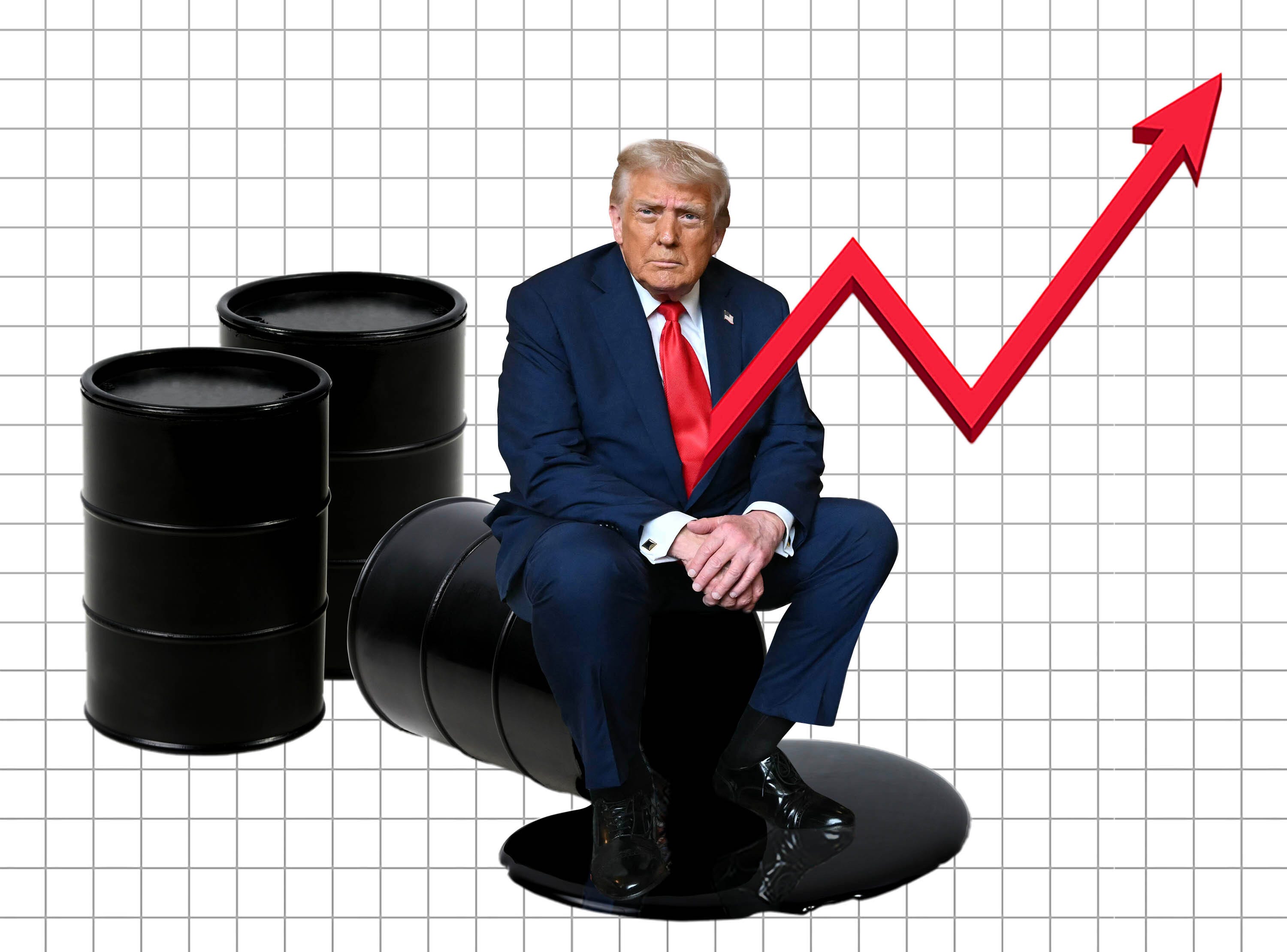
WHEN YOU CAN’T OFFER SOLUTIONS, just blame corporate greed. Democrats wrote this playbook, and now the Trump administration has adopted it.
Donald Trump’s war with Iran has disrupted global supply chains. Oil, natural gas, fertilizer, aluminum, helium, plastics, and other commodities that usually transit the Strait of Hormuz were blockaded first by the Iranian navy and then by the U.S. navy too. Additionally, infrastructure around the Persian Gulf has been destroyed, suggesting that even when the blockade(s) end, production won’t resume as normal.
As a result, prices have surged. U.S. gasoline prices just rose at their highest monthly pace on record. Fertilizer prices have spiked too, which will eventually lead to much higher food prices. And voters are big mad.
The Trump administration and its allies have cycled through various deflections and excuses for this mess. Maybe the price increases are temporary, unconcerning, or not that bad. Or, wait—if they are bad, they’re probably Democrats’ fault. Or maybe they’re a small sacrifice to pay for [insert whatever our objective is in Iran].
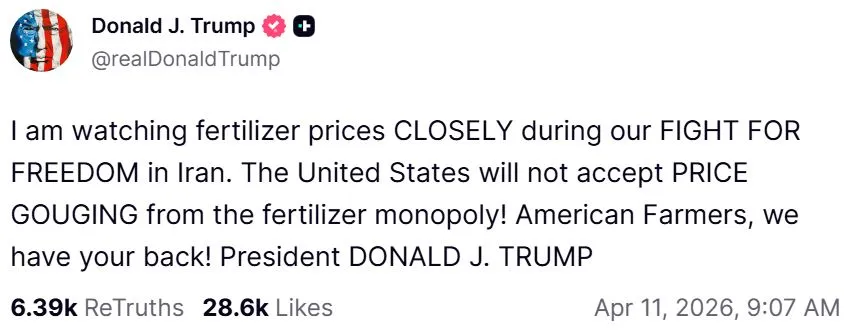
And now, Republicans are getting around to greedflation. Over the weekend, Trump preemptively criticized fertilizer manufacturers for “price gouging,” an ill-defined, catch-all term meaning ‘prices that are higher than politicians think they should be’:
U.S. Department of Agriculture officials have already begun working with antitrust officials at the Federal Trade Commission and the Department of Justice to investigate whether anticompetitive behavior is driving high costs for fertilizer, machinery, and other inputs farmers buy, Bloomberg reports.
Similarly, Treasury Secretary Scott Bessent said on Wednesday that “We’ll be looking at Treasury to keep the retail gas stations honest. ‘You did this on the way up, you better be doing this on the way down,’” he said, gesturing up and down to indicate rising and falling prices. “And I’m sure the president will call out anybody who’s a bad actor.”
Trump, an icon of the Greed Is Good era who generally has a light touch when it comes to antitrust enforcement,1 appears to be blaming greedy corporations for high prices and prescribing antitrust-related remedies. So let’s consider whether there are merits to this logic.
LET’S START WITH THE BASICS: Is more competition a good thing? Sure. I’m generally in favor of more aggressive antitrust enforcement (certainly more aggressive than the Trump administration has been to date). But as others have observed, promoting competition is like diet and exercise: good in the long run, but unlikely to solve acute crises.2
And right now we’re in an acute crisis, in the form of a massive supply shock. Whenever there are temporary supply disruptions you should expect short-run increases in prices—and often increases in profit margins as well, which can look “greedy.”
But let’s be clear: The cause of all this is the war; the cause is the closure of the Strait of Hormuz; the cause is Trump.3
A MESSAGE FROM OUR SPONSOR
Our Costs Just Went Up By $4.7T

Trump's EPA recently revoked the 2009 endangerment finding, a scientific consensus that greenhouse gases threaten public health. That finding was the foundation for clean air protections that Trump has eliminated — a decision that will cost Americans $4.7 trillion in additional expenses. Learn more.
What’s more, while the U.S. fertilizer industry is pretty concentrated, the retail gas industry is not. Most of the more than 100,000 gas stations around the country are owned by independent operators, competition is cut-throat, and most operators sell gasoline on razor-thin margins. (The slushies, beef jerkies, and other convenience-store wares are much higher margin.)
None of this is going to stop Trump from fruitlessly jawboning gasoline and fertilizer companies about how they should cut prices, even when doing so is against their economic interest—just as it didn’t stop him from jawboning companies not to raise prices in response to his tariffs.
ALL OF THIS SHOULD BE A LAYUP for Democrats: Look at the silly things Trump is saying to deflect from his price increases! The challenge, of course, is that Democrats have themselves used nearly identical silly rhetoric too.
They did it when prices surged circa 2021 to 2023, for similar reasons: a COVID-era mismatch between constrained supply and strong demand. In that case, the supply issues were caused by the pandemic and not of Democrats’ making (unlike with today’s supply-chain problems related to Trump’s war). But . . . Biden and the Democrats did boost aggregate demand in ways that made the inflation problem a bit worse than it might otherwise have been, at least on the margin.4
Something similar happened with the great eggflation crisis of 2024. That was also caused by a sudden supply shock (bird flu forcing farmers to cull their flocks).5
But rather than offering boring, technical explanations about supply and demand (which might in some circumstances implicate specific policy decisions), politicians have decided that it’s more politically useful to blame greedy corporations. Both parties do this: Both the Biden and Trump administrations presided over antitrust investigations of Big Egg, and both railed against gas stations for raising prices.
And you can go back much further: There’s a storied history of presidents (and lawmakers) demanding FTC investigations when gas prices rise due to a supply shock, and then not finding anything.
None of which is to say that companies never collude to set prices beyond where market pressures would align them; there are real cases of illegal and anticompetitive behavior (like outright price-fixing); when there is legitimate reason to suspect that’s what’s going on, those firms should be investigated and held accountable.
But when it comes to inflation, if presidents feel the need to Do Something about high prices, launching a performative antitrust investigation is a cheap, easy option, one with seemingly little political cost. Same with yelling about greed, price-gouging, profiteering, and other vague sins that the public loves to hate. The risk in this approach is that none of these actions will actually fix the pricing problem—and so the president just ends up looking ineffectual in the process.
Ramparts
— Given that those rising fertilizer prices are expected to feed into food prices soon, it’s maybe not the best idea for the Trump administration to propose cuts to nutritional assistance for low-income pregnant women, moms, babies, and toddlers.
— The U.S. fertility rate just hit a record low. This has major cultural, political, and economic implications worth exploring in a future newsletter. In the meantime, you can read JVL’s opus on the subject, from a little over a decade ago.
— Greedflation isn’t the only au courant example of horseshoe theory: Another is data centers. Red and blue states alike around the country are banning them (or considering doing so). The Democratic candidate for Texas agricultural commissioner also recently tweeted that AI data centers cause “chickens to lay 50% less eggs,” among other MAHA-esque claims. Incidentally I heard similar livestock-centric objections to wind farm developments when I reported on that subject in Kansas a few years ago.
Except when it comes to his perceived enemies, anyway.
It’s also definitely true that corporations are greedy, if by “greedy” we mean “profit-maximizing.” But companies didn’t suddenly become greedier. They also weren’t more altruistic in periods when inflation was cooler; see my favorite post-COVID chart, from Noah Smith. Firms set prices according to what the market will bear, and what the market will bear depends on supply and demand.
In the case of fertilizer, Trump’s tariffs had also contributed to price increases even before the war, even though Trump eventually exempted most fertilizer from tariffs.
So did Republicans, to be clear. For example, both Trump and Biden signed into law near-universal stimulus checks after it was already evident that demand was running hot and supply could not keep up because the economy was still reopening.
Demand for eggs, like demand for gasoline, is what economists would call “inelastic,” meaning it doesn’t fall much even when prices rise. In the case of eggs, that’s because they’re used in a lot of things and don’t have a lot of great substitutes. So when eggs became scarcer, customers kept buying, and prices got bid up a lot until chicken flocks got replenished again. Also, by the way: Similar to retail gasoline, eggs are often a loss leader for grocery stores. So even when prices were very high, your supermarket was still probably losing money on them.
Yes, both D's and R's have claimed greedflation... the difference being that the first price increase was caused by COVID that was mismanaged by 45 to exacerbate its effects and then handled better by 46 (and the Fed) than anywhere else in the world -and- this is a complete "own goal" or self-inflicted wound that is being exacerbated by 47, who votes idiotically re-elected.
Sorry, I've got no problem with blaming corporate greed. Not a major factor causing inflation, granted, but collusion, deceptive pricing, junk fees, shrinkflation, surveillance pricing--all are things, right? And all things that politicians should call out and legislate against.