Why Trump Iran Operation Isn’t Winning Over the Hill
Plus: Senators are confused about whether to call this a “war.”

IRAQN
How are senators approaching the Trump administration’s unilateral military action in Iran? To gain some perspective, I found it useful to speak with some of the lawmakers who were around in 2003 when Capitol Hill was enveloped in debate over the Bush administration’s actions toward Iraq.
I spoke to two senators—one who supported that war and one who opposed it—about how it compares to the one they’re being asked to support now.
Sen. Jack Reed (D-R.I.), the ranking Democrat on the Armed Services Committee, was in his second term when he cast his vote against the Iraq War authorization in 2003.
“The Constitution states very clearly that the initiation of war requires the approval of the Congress and this is a war—they said it themselves,” Reed said. “We’re at war, and they haven’t even made serious attempts to brief us beforehand and to get our permission.”
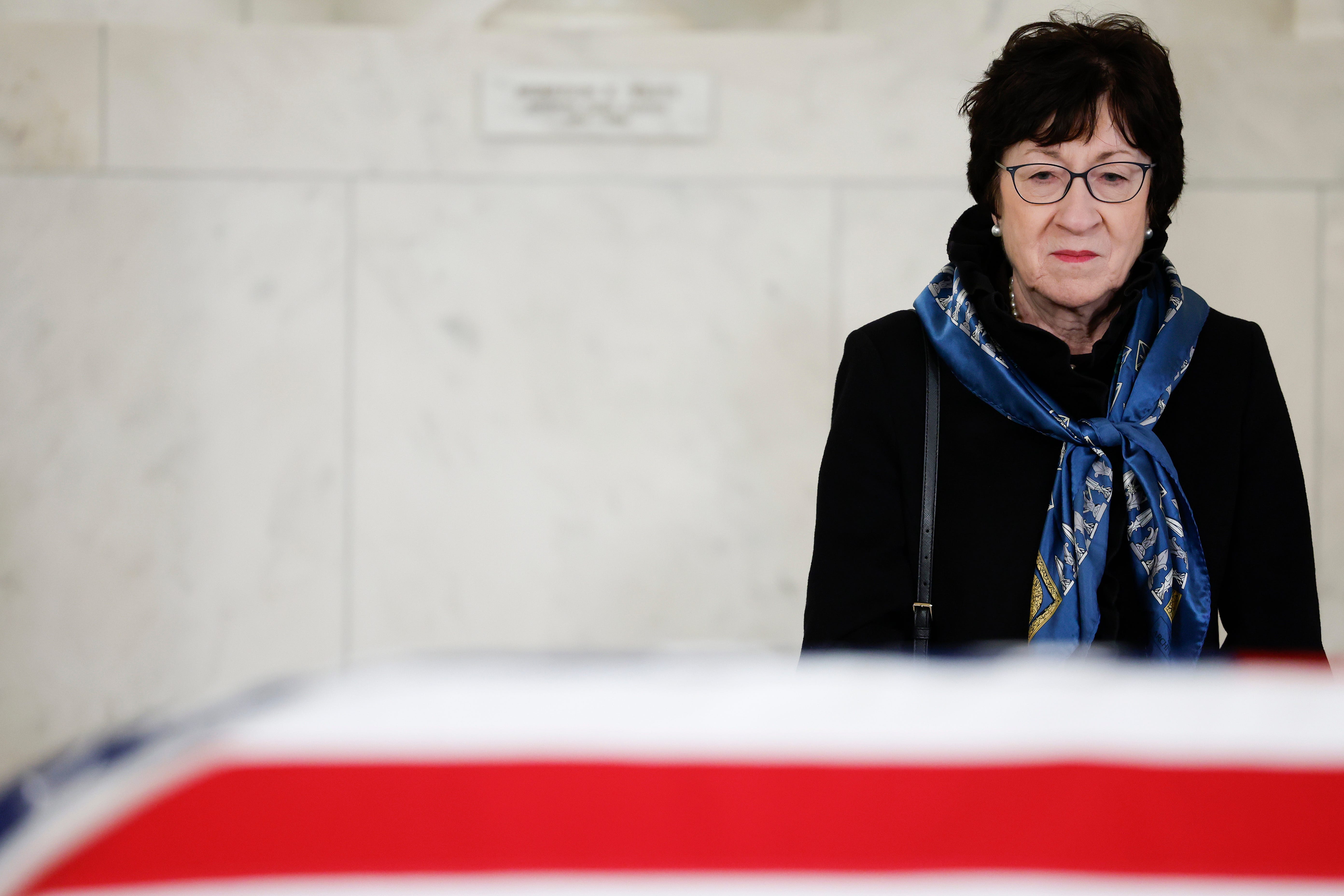
Contrast Reed’s clear assessment with the murky response I received from Iraq War supporter Sen. Susan Collins (R-Maine) when I asked her to compare the two wars.
“That’s a very open-ended question,” she said, demurring. When I then asked if we are now at war, Collins said, “I’ve just had a classified briefing and I’m not gonna . . .” before cutting herself off to step into an elevator. It’s not clear to me whether Collins feels ambivalent about the military campaign or she just found herself at a loss for words about it.
The senior senator from Maine is up again for re-election this campaign cycle, but she has a lot less political momentum this time around. According to a Reuters/Ipsos poll, just 27 percent of respondents said they approve of the strikes on Iran, with most expressing concerns about Trump’s eagerness to use military force and possibility of American casualties. Contrast this with the polling leading up to the Iraq War in 2003, when a majority of Americans supported removing Saddam Hussein.
Most of the senators serving today were not around during the runup to the 2003 invasion of Iraq, but I hope they know that history. They will have to deal with significant political consequences if they repeat it.
What is a war?
President Donald Trump and Republican leaders have been all over the place in defining the nature of their military actions in Iran. That’s left many GOP lawmakers at a loss for how to discuss the specifics of what is happening, fearful that any misstatement could be viewed as intentional dissent.
Trump himself called it war while discussing the recent American deaths as a result of the conflict.
“The lives of courageous American heroes may be lost, and we may have casualties,” Trump said. “That often happens in war.”
Defense Secretary Pete Hegseth also called it war, although perhaps inadvertently, since the word is built into a cliché he was using to give his remarks some extra gravity: “As the president warned, an effort of this scope will include casualties. War is hell and always will be.”
Secretary of State Marco Rubio, who is also the president’s national security advisor, told reporters in the Capitol Monday that we are bombing Iran purely as a defensive action, albeit one premised on an offensive action the Israeli government had decided to take.
“The assessment . . . was made that if we stood and waited for that attack to come first before we hit them, we would suffer much higher casualties. And so the president made the very wise decision,” he said. “We knew that there was going to be an Israeli action, we knew that that would precipitate an attack against American forces, and we knew that if we didn’t preemptively go after them before they launched those attacks, we would suffer higher casualties. . . . And then we would be here answering questions about why we knew that and didn’t act.”
House Speaker Mike Johnson parroted Rubio’s narrative, saying, “Israel was determined to act on their own defense here with or without American support. Why? Because Israel faced what they deemed to be an existential threat.”
“The president was acting well within his authority,” Johnson added. “What I just told you is the scope of what happened here and the situational awareness that they had at the time to make this decision. It was not—it’s not a declaration of war. . . . It’s defensive in nature and design.”
Sen. Tim Kaine (D-Va.), whose War Powers resolution constraining the president’s ability to continue this military engagement is slated for a vote this week, dismissed Rubio’s assessment as a bastardization of American foreign policy.
“Wait, the imminent threat was that Israel was gonna attack Iran? Yeah, that is what’s called a pretext, not an imminent threat,” he said.
“If we could just get Iran or Israel or some other nation to attack anyone we want . . . suddenly everything’s an imminent threat, right?” he continued. “Our foreign policy is not determined by what some other nation does. It should be determined by our own national interest.”
But much like Collins, Sen. Roger Wicker (R-Miss.), the chairman of the Senate Armed Services Committee, chuckled and refused to answer my question of how he would define this conflict and whether it should be characterized as a war.
Sen. Bill Hagerty (R-Tenn.), a member of the Foreign Relations Committee, expressed a great deal of confidence despite the paucity of information made public.
“We did not declare—the president did not declare war,” Hagerty told me. “What he’s done is a very targeted operation to take out the ballistic missile manufacturing capacity and the launch capacity of Iran. The mission is ahead of schedule. I think it’s been very successful.”
Sen. Thom Tillis (R-N.C.) was candid about the confusing nature of the military operation. Whether it counts as a war is, to him, an open question.
“Uh, I don’t know,” he said. “I’m looking forward to the briefing [on Tuesday] so that we can get an idea.”
“A lot of that has to do with the idea with whether or not it’s long-term,” Tillis added. “If it’s regime change, that doesn’t happen in a month, particularly in a part of the world as complex as Iran. So we just need to hear what the—if there is—I think there was a little bit of an adjustment of language in terms of the objective being regime change. So we just need to see that.”
Ice skating
Here’s an interesting story about a Russian man who finds and prepares spots to skateboard along the frozen rivers a few hours outside of Moscow.
In an interview with Jenkem magazine, Ilya Batrakov explained some of the challenges of skating in subzero temperatures over obstacles with an organic geometry. The list of hazards can even include falling through the ice.
How do you get used to skateboarding in such an extreme climate?
It’s a battle every time. It’s almost like Mission Impossible. But I like that it’s a battle with myself. I compete with myself, and over time I’ve gotten used to it.There is a special thing about this type of skateboarding. Some of these spots exist only as long as two or three days. Depending on the weather conditions, sometimes spots can break with your own body from a slam. With a normal spot you can go back, find a better moment, wait for better conditions, but here something is going to be different if you wait. The water level might be different or the structure will change. Everything only exists for a very limited period of time.
What can you do to make a spot easier to skate?
Almost all of them need to be cleaned up, but that’s the easy part. Sometimes I shape them with a chainsaw, and sometimes I use water. You can spill water on the runup, and it gets frozen and becomes ice. You can also use ash from a fireplace for better grip.Why don’t you just try snowboarding instead of going through all this trouble?
For snowboarding you need real mountains, and we don’t really have mountains around Moscow. I’ve snow skated a little bit, but it’s not as interesting as normal skateboarding. . . .Have you ever been in a scary situation where you needed help out on the river?
The craziest thing is falling through the ice. It happened twice. One time it was negative 28 degrees celsius. That’s super cold. I was doing a spot check that was really far away. I took a bus, and then took a half day hike to get there. When I fell through I did some quick analyses about what I should do, and I came to the conclusion that it was safer to try and start a fire and dry up before trying to get home. Luckily I was able to start a fire and I semi-burned my clothes and dried them.
Read the whole interview and check out the amazing pictures. There’s no paywall.
Susan looks very concerned in that photo.
Narrator: She will vote ‘aye.’
Trump wasn't preparing for a preemptive strike? 2 aircraft carrier groups, forward strike aircraft deployments. Give a kid a loaded gun and watch the results.