

Why You Should Be Optimistic That Opposition to Trump’s Slush Fund Will Prevail
Lawmakers from both parties are pushing a ban on taxpayer money going to Jan. 6th payouts

Keep Ya Head Up
President Donald Trump’s “settlement”1 with his own Department of Justice to establish a fund to disburse completely unaccountable payments to pardoned January 6th rioters and others who claim to have been unfairly investigated and prosecuted by the federal government has met significant opposition in Congress. Even Republican lawmakers have spoken out publicly against it. The situation has gotten bad enough that regular legislative business has gotten jammed up.
Intense intraparty disagreements over the slush fund derailed Republicans’ own plans to vote on a series of proposals for their upcoming reconciliation bill last week. During a conference lunch on Thursday in which acting Attorney General Todd Blanche sought to address lawmakers’ concerns, dozens of Republican senators spoke up—many more than usual—according to a source in the room. It seems as though their concerns were not addressed to their satisfaction: Lawmakers ultimately left town without finishing the week’s business.
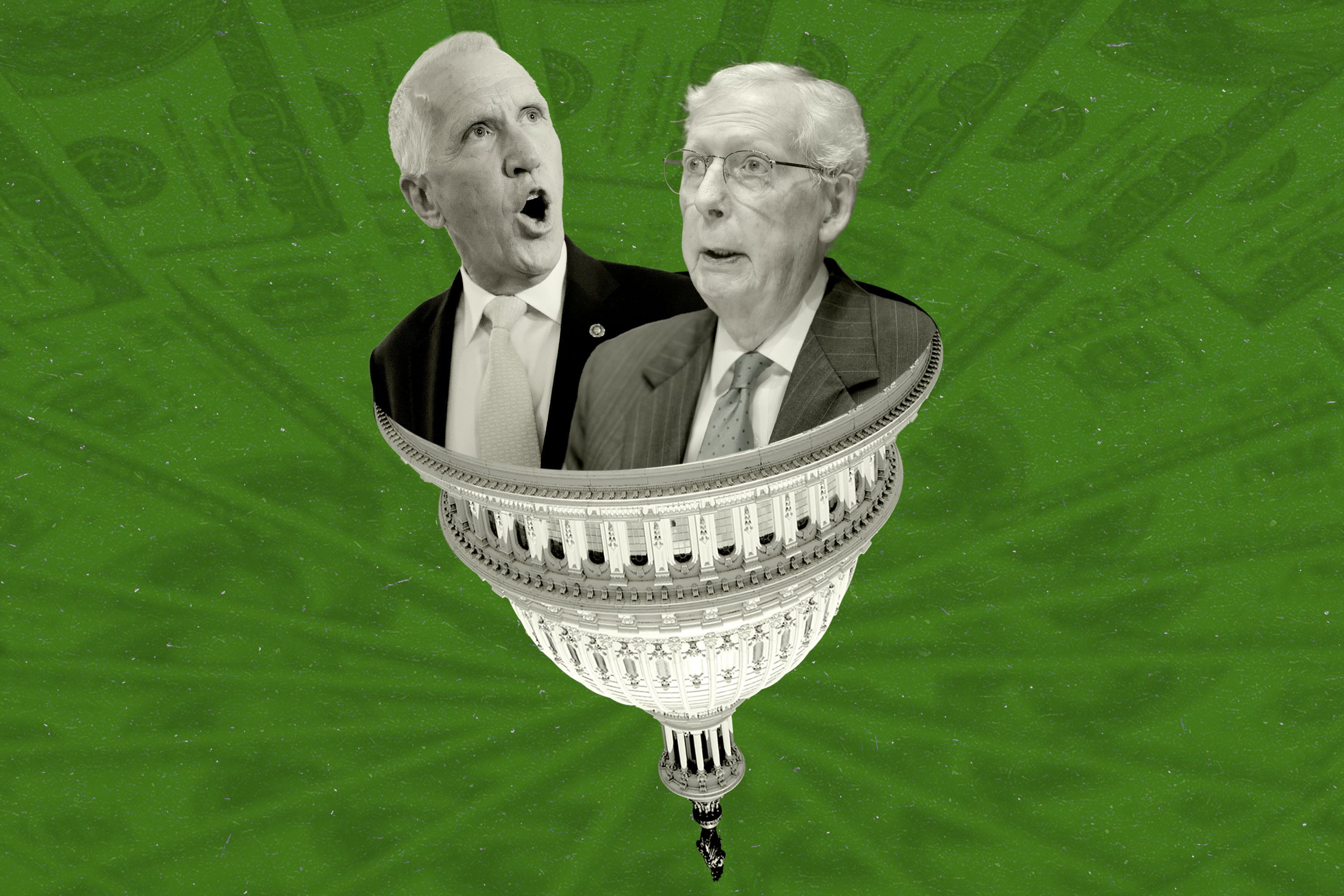
“These people don’t deserve restitution. Many of them deserve to be in prison,” Sen. Thom Tillis (R-N.C.) told reporters Thursday. “But this is just stupid on stilts.”
“They need to speak up,” Tillis said of his Republican colleagues who’ve opposed the settlement in private. “I mean, this is beyond the pale. This is not good for my colleagues. There’s not one positive thing that could be spun out of this between now and November. This is bad policy, it’s bad timing, and it’s bad politics.”
“So the nation’s top law enforcement official is asking for a slush fund to pay people who assault cops?” Sen. Mitch McConnell (R-Ky.) said in a statement.2 “Utterly stupid, morally wrong—Take your pick.”
In the House, where Republican opposition to the fund is weaker and more diffuse, Reps. Brian Fitzpatrick (R-Pa.) and Tom Suozzi (D-N.Y.) introduced a bill that would ban the use of federal funds for Trump’s “anti-weaponization” fund.
Fitzpatrick and Suozzi co-chair the Problem Solvers Caucus, the long-dormant bipartisan collective whose stated goal is, well, solving problems. And the government shoveling huge piles of taxpayer money into the beds of more than a thousand pardoned convicts' Dodge Ram 2500s might be just the sort of problem they are well positioned to solve.
“It’s really up to the Republicans to join with the Democrats. Everybody knows this is wrong,” Suozzi told ABC’s Jonathan Karl on Sunday. “That’s the purpose of the checks and balances in government, so that [when] one branch of government does something stupid or wrong, the other branch holds them accountable.”
While many share broader concerns about corruption and the precedent that would be set by the creation of such a fund, the primary sticking point about it on Capitol Hill is whether money will go to any of the hundreds of individuals convicted of assaulting police officers.
In response to a question about concerns that violent rioters would be eligible to receive money from the fund, Blanche told CNN, “People that hurt police get money all the time.”
The Fitzpatrick–Suozzi bill would effectively kill the president’s plan to compensate the rioters and criminals he pardoned hours after being sworn in for his second term. Unlike a number of popular pieces of legislation that have been brought up through the discharge petition process in defiance of House Speaker Mike Johnson over the course of this Congress, though, the anti-anti-weaponization fund bill may struggle to reach the threshold of the 218 votes required to override chamber leadership and force a vote.
While many of the successful discharge petitions have been direct rebukes of Trump’s policies and stated positions—notably the Massie–Khanna bill mandating the release of the Epstein files and the recent package of additional military aid to Ukraine, which will come up for a vote soon—those bills have also touched on key areas of interparty frustration. Johnson’s habit of slow-walking any legislation that isn’t a favor to Trump has inflamed tempers among both moderate3 Republican and Democratic members.
There is also the timing component. This tool can’t be used to force a vote overnight. Bills are not eligible for a discharge petition until they’ve sat in committee (in this case, the House Judiciary Committee) for at least thirty legislative days.4 At that point, a petition can start to circulate for signatures. Once the 218 threshold is reached, the curing process can further put off a vote by days or even weeks. But it’s not clear that a sufficient number of House Republicans are willing to go against the president on this for the Fitzpatrick–Suozzi bill to gain enough bipartisan support to reach the magic number of signatures
If Senate Republicans can manage to stake out a genuine policy position against the settlement fund, it’s possible they could actually dismantle it. Their similarly minded House colleagues may face an uphill battle to join them, but given the thinness of the GOP majority in the chamber and the party’s continuing attendance issues, anti-anti-weaponizers might find enough leverage to stop Trump’s slush fund before the trucks start backing into the Treasury Building to load up on the public’s money.
So Many Tears
Libertarians tend to style themselves a bit differently from their peers across the rest of the political spectrum. (This predilection dovetails nicely with some of their other signature preferences.) In a political environment where the men of the two major parties can sometimes be distinguished only by the color of their ties, Libertarians are easy to pick out for how they often resemble (or literally are) magicians or Bay to Breakers runners.
In the lead-up to the most recent Libertarian National Convention in Grand Rapids, Michigan, an attempt was made to rein in some of the fringe party’s most adventurously dressed representatives. Predictably, this caused quite the uproar.
Alexander Nazaryan reports in the Wall Street Journal:
Live free or die, but would it kill you to wear a tie?
That was the essence of Ben Weir’s plea ahead of the biennial Libertarian National Convention in Grand Rapids, Mich.
In a May 15 post on X, Weir, 36, declared that he’d had it with the wacky costumes, which have long been a staple of political party conventions but seem particularly popular among do-what-thou-wilt libertarians.
No more using a boot for headwear, as one convention mainstay named Vermin Supreme did. No more see-through clothing to promote government transparency.
Weir, who is running for Merrimack County sheriff in New Hampshire and couldn’t attend the convention, wrote that he was calling on the party’s national committee to establish “a baseline professional dress standard for participation in official proceedings.” His proposal called for business casual attire, neat facial hair and closed-toe shoes.
Weir, who is a member of the party’s “emo caucus,”5 faced immediate backlash for his post from his fellow Libertarians.
“BOOT HATS FOR EVERYBODY !!!” declared Vermin Supreme, a perennial candidate for president often affiliated with the Libertarian party.
Melissa Wong, the chairwoman of the Montana Libertarian party, joked, “If we could just get them to bathe, wear pants, and cover their toe fungus with shoes I’d be content.”
Some of the reactions were more serious. Ray Walden, the acting chairman of the Libertarian Party of Illinois, replied to Weir’s post, “You hate freedom of speech my dude.”
“Fuck you, I’m wearing band merch,” responded Justin O’Donnell, a former Libertarian candidate for Senate in New Hampshire.
Bottom line: Libertarians don’t like being told what to do, even if what they’re being told to do is in their best interest. Join me in wondering if this example of people failing to act in their best interest could have wider-ranging political and economic implications.
Only God Can Judge Me
Pope Leo XIV released his first encyclical on Sunday. Titled Magnifica Humanitas, the document called upon the developers of artificial intelligence to put aside their obsession with profit for the sake of the “common good” and encouraged them to “remain human.”
Gerard O’Connell writes in America:
He recalls that the Tower of Babel was “a project conceived without reference to God, supported by a uniformity that eliminated diversity and that chose homogenization over communion.” But the rebuilding of the walls of Jerusalem, described in the Book of Nehemiah, “shows how the city is reborn…through the shared responsibility of all. It is an undertaking with God at the center, which rebuilds relationships before rebuilding with stones.”
Pope Leo sees humanity today at a historic crossroads, symbolized by those two images, and writes, “Each generation inherits the task of shaping its own era, of guiding history to become a place where the dignity of every person is safeguarded, justice is promoted and fraternity is made possible.”
“Yet,” he writes, “every era also runs the risk of creating an inhumane and more unjust world,” and “we must ask God for the wisdom to interpret the great trends of our time, particularly technological advances.”
He emphasizes that “technology should not be considered, in itself, as a force antagonistic to humanity,” saying that it “has significantly improved the living conditions of humanity.” At the same time, he adds, “each phase of progress has also revealed the ambiguity of tools that can cause harm when not oriented toward the good.”
Read the whole piece. If you have the time, have a look at Leo’s entire 42,000-word encyclical.
It’s not a real settlement, of course. As a USC law professor told the New York Times, “There has been no class action, no allegations that laws have been violated, no judicial oversight, and to this day, there does not even appear to be an identifiable set of lawsuits for the government to settle . . . . The president is suing himself and compensating other people for legal claims that have not been identified from people that we don’t know.”
It’s worth noting McConnell’s shrewd choice of target here—the acting AG rather than the president.
Moderate is a subjective term in the House of Representatives. Many so-called “moderates” are only moderate in their temperament, not policy. Nevertheless, it’s a handy label for pointing out those who tend to hover close to the political center when the agenda item is just right.
Legislative days are days in which the House is actually in session. There aren’t a lot of those to go around. We’re on day 146 of the calendar year, but only around half of those have been actual legislative days. We’re probably heading for even smaller proportions: If you combine extended district work periods intended to allow for election year campaigning with Johnson’s affinity for canceling voting days to avoid embarrassments like failed rule votes, it’s easy to see how thirty legislative days may well extend far past the summer.
I trust the Wall Street Journal’s fact-checkers, who have verified that this is a real thing.
Interesting that moments before I opened this newsletter, I shot off messages to my senators and representative regarding the Trump slush fund from hell. I don't expect a quick responses, but will pass them on if and when I get them.
Also, let's not forget that payments from this fund won't be limited to J6 rioters. Trump's hand-picked Board will be able to hand money out to just about anyone.
This is straight up embezzlement of taxpayer funds, so I think the fund should be called the MEGA (Make Embezzlement Great Again) Fund.
Should we take comfort that some Republicans are pushing back on the stupidest, most offensive act this administration has taken: to enrich convicted felons and give American tax dollars to people who tried to overthrow the governmnet?