24 Hours Alongside an ICE Protester in Minneapolis
Carolina Ortiz, an immigrant advocate, is preparing for ICE’s next onslaught.

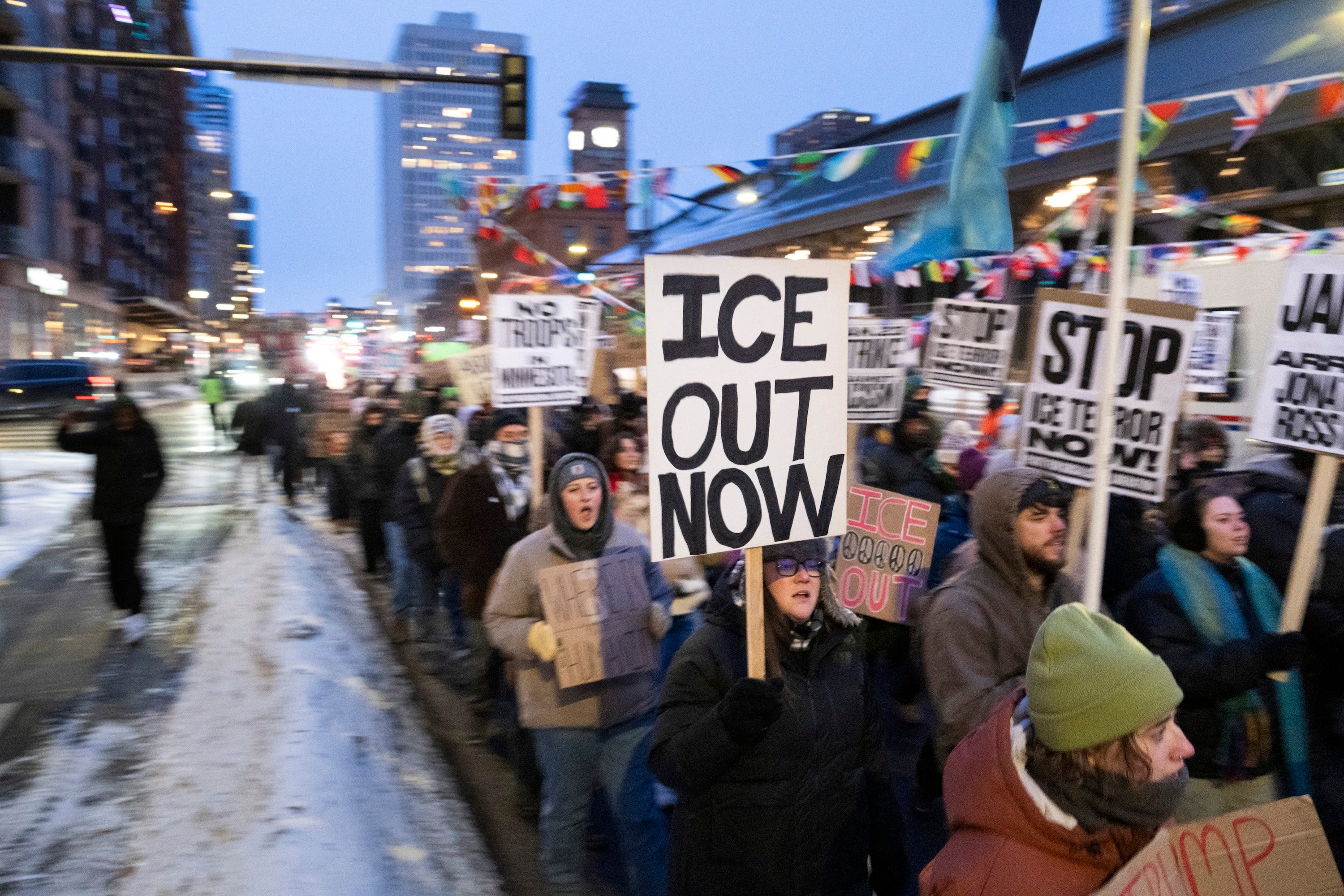
Minneapolis, Minnesota
SHE WILL NEVER FORGET the sight of Renee Nicole Good’s blood on the snow.
Carolina Ortiz is the associate executive director of Communities Organizing Latine Power and Action (COPAL),1 a community-based organization that advocates for Latino families in Minneapolis; it leads the Immigrant Defense Network, a group of 106 organizations like COPAL across the Midwest. She first grasped that something was wrong on January 7 when a colleague known for her cool demeanor in high-stakes situations called Ortiz in a panic. Something horrific had happened.
Ortiz’s team grabbed their gear—neon vests that say “Immigrant Defense Network,” bullhorns, whistles, masks, and first-aid kits—and headed to the site where ICE agent Jonathan Ross had just killed Good.That snowy Minneapolis street has since become familiar to the millions of people who saw the disturbing videos on social media. But Ortiz and her colleagues couldn’t press pause or look away. They were there on the ground.
She witnessed one community member get yelled at and thrown on the ground by an ICE agent for recording, despite being a safe distance from the scene. For about forty-five minutes, the area was blocked off, and then it was cleaned up—long before it was cordoned off as a crime scene, an order of events that struck Ortiz as unusual.
Meanwhile, Ortiz’s staff and others in the growing crowd were starting to be shot at with chemical irritants. Some cried out in fear when the agents started their volley against the crowd; as the masked men shouted at them, Ortiz and her staff didn’t know if the projectiles being fired were chemical devices, rubber bullets, or real bullets. It was chaos.
But what will forever stick with Ortiz was all of the blood. She describes an “extensive” streak of blood across the ground; it painted the snow. The extent of it helps to explain why the cleanup took so long.
Ortiz felt unmoored, scared, and traumatized by what she and her staff saw. In the days since, her constant challenge has been putting those feelings aside to continue doing her work—not only for the sake of her staff, but for the people they’re trying to protect.
“Its scary as hell when you’re in the middle of that, but also scary when you have a staff there that you’re responsible for,” Ortiz told me. “It’s terrifying at a whole other level.” The day of Good’s death, she was trying to keep her team calm and disciplined, even as ICE agents appeared intent on doing everything possible to escalate the situation. She debated whether her people should leave for their safety.
A week later, ICE descended upon Lake Street, a predominantly Latino business corridor. They showed up right outside Ortiz’s office, forcing her group to mobilize. COPAL members saw someone running down the block warning businesses to lock their doors, which many did. Outside, ICE vehicles seemed to appear on every corner. Ortiz jumped into her car to follow ICE and record what was going on, as a cacophony of whistles and honking horns filled the air.
It’s become a common sound in Minneapolis over the last few weeks.
After reading about and reporting on this escalating conflict since the events of January 7, I decided it was time to go to Minneapolis myself to report on the ground.
I spent the day after Martin Luther King Jr. Day with Ortiz. It turned out to be part of a relatively quiet forty-eight-hour period, which unnerved Ortiz and her team rather than calming them. They were still at the ready in case enforcement operations ramped up again.
Ortiz started driving at 5:30 a.m. to drop off groceries to three different people: a community member who had run out of food, plus a family member and a friend of hers who needed food but she also wanted to check in on. We met at 8:00 a.m. for breakfast.
8:18 a.m.: Eerily Quiet
We stop at El Mercado Central, a shopping mall that houses thirty-five Latino-led businesses. The place is usually bustling by this hour, with little parking available, but today we find it deserted. The owner informs us that they’re basically closed and only selling menudo. We head over to Midtown Global Market, another large retail complex that usually has everything inside, even a DMV. Also closed. I tell Ortiz that downtown Minneapolis has been eerily quiet since I arrived. It reminded me of the scenes of deserted streets in Atlanta from the pilot for The Walking Dead. “That’s exactly what it is,” she agrees.
8:28 a.m.: “Don’t Let Anyone Stop You From What You Know Is Right”
Ortiz came to the United States from Zacatecas, Mexico when she was 2 and eventually became a DACA recipient—one of those we call “Dreamers.” As we sit at Pineda Tacos for a chorizo breakfast burrito (one so good it gave me an out-of-body experience), I bring up the scene at Good’s shooting. I ask her about where her spiritual resilience (a term I’ve borrowed from my therapist) comes from—how she’s able to keep going in the face of something so dark. Is it a mantra, maybe, or some wise advice she remembers her abuela once uttered, or a physical item from which she draws encouragement?
The real source, she tells me, is a conversation she recently had with her father.
“As things started to get bad, I was nervous—not for me, but for my parents,” she says. “I talked to my dad and he had a really good conversation with me. He said, ‘I know what you’re doing. I know you’re brave, just do it, don’t let anyone stop you from what you know is right.’ That conversation allowed me to say, ‘Yep, let’s go all in.’”
She tells me more about her father, who is diabetic.
“My worst fear is he’s detained and his sugar levels spike,” she tells me, her eyes glassy, and rose-tinted on the edges. “I don’t know if he would be able to survive that, that is something that is hard to even imagine.”
This was the only time in our entire day together that Ortiz got emotional.
9:00 a.m.: The Immigrant Defense Network
As we head back to the COPAL offices, Ortiz joins a call with other members of the Immigrant Defense Network. They report that they received a staggering 450 phone calls just yesterday, during the federal holiday. About 35 percent of those calls were requests for food to be delivered to homes whose occupants were afraid to leave. Another 30 percent were requests for rent assistance because the callers are unable to work. The rest of the calls were split between legal-aid requests and reports of deportations. The conversation then turns to whether the coalition still has the capacity to give food; they decide to distribute $5,000 to experienced food pantries.
What amazes me, shocks me, depresses me each time I witness it is that these priorities are about basic necessities, something groups like this have done since the pandemic. The focus here isn’t raising awareness or organizing or raising money or influencing legislation. It’s just keeping people alive. Consider again what the federal government is doing to our neighbors, to U.S. citizens, and mixed-status families. Because federal agents are terrorizing the community, community members are going hungry, can’t safely go to work, and can’t pay their bills out of fear that they could be violently thrown against cement, arrested, flown to Texas to be detained, and deported.
In light of these realities, I try to channel some of Ortiz’s spiritual resilience. I allow myself to be amused that the participants in the meeting call St. Paul “San Pablo”—and I think I will, too, from now on.
9:42 a.m.: “We Love Reporters But. . .”
Oops. Despite Ortiz telling people I was on the call, someone says, “We love reporters, but let’s not have them inside the network.” I don’t mind at all. I know it shows pride and protection they feel towards their work. They are cautious because they want to protect something they feel is doing so much good.
Before I leave the call, someone notes the apparent decline in federal enforcement over the last forty-eight hours probably means “something is brewing” because agents haven’t left the city yet.
10:35 a.m.: “Do You Worry These Make You a Target?”
Ortiz introduces me to COPAL employees after the call and tackles her inbox, responding to donors and answering meeting and media requests. She tells me about “constitutional observers,” the term COPAL has given to what’s called “ICE watch” in other cities. She shows me the neon vest and beanies they all get, as well as handbooks, bullhorns, and walkie talkies. I see the neon fits and ask if she worries they mark COPAL people as targets “Of course,” she says. Her staff has been doxxed, and she installed a dash cam on her car and a camera on the front door of her home after threats.
It turns out the assistance COPAL provides isn’t limited to food, rent, and legal assistance. People who are staying at home are being connected with physicians to help get their medical needs met (and veterinarians to help get their pets’ medical needs met).
12:00 p.m.: “A Buffet of Information”
Ortiz has a private, off-the-record call with five dozen lawyers. I won’t recount the discussions except to say one of the participants described the purpose of the call as a chance to share a “buffet of information.” This is the kind of behind-the-scenes legal work that is helping people, defending their rights, and reinforcing their humanity.
12:34 p.m.: “This Has Happened Before”
Ortiz receives a text. Someone with DACA was detained hours earlier and needs legal support. I witness the urgency here, but also note that sometimes helping people during an ICE invasion feels like playing whack-a-mole. The goal in this case is to get this person an attorney who can draft a habeas petition to free them before they are relocated. ICE often keeps the detainee on the move without updating their locator, giving the government time and cover to get them to Texas unimpeded. “This has happened before with DACA recipients, TPS holders, visa holders, and green card holders,” Ortiz tells me, adding that among the hundreds of cases she’s seen, the agents have never had a warrant.
12:43 p.m.: The Need for Lawyers
Ortiz takes a follow-up call on getting more lawyers to volunteer. She needs to start categorizing them by who is pro bono, who is willing to do habeas paperwork, and who can do the work at a “super-low” rate.
1:34 p.m.: Doing It All
Ortiz grabs the keys of an SUV someone dropped off. She takes me with her as she fills up the gas tank for a community member who has legal status but is terrified of even going to the gas station.
1:49 p.m.: Where Are the Workers?
We head to COPAL’s Primero de Mayo Workers’ Center, which teaches computer literacy, offers citizenship and driver’s license classes, puts on health clinics, does intakes for wage theft, and offers career support. Housed in an old union building, the center has served more than 10,000 people over the last year, helping them with over 14,000 cases, and recovering more than $80,000 in wages. Ortiz tells me it’s normally packed, but when we walk in, there’s only one worker being helped despite a handful of employees there.
While Ortiz stays behind, half the staff heads in a van to Mankato, a city almost two hours outside Minneapolis/St. Paul, for the latest installment of COPAL’s new “The Brave of Us” tour, which is visiting thirty cities across Minnesota, Iowa, Wisconsin, South Dakota, and North Dakota in the coming weeks. They will be training 350 constitutional observers in each city, including government leaders and activists who will seed the ground for the coalition as it spreads ahead of a Regional Immigrant Defense Summit planned for April.
2:15 p.m.: Reports
At lunch, Ortiz looks down at her phone. ICE has been spotted at the Maplewood Mall, fifteen minutes to the north. Her team is already looking into it. Sometimes these reports are accurate; sometimes they’re false alarms generated by understandably jittery community members. Either way, COPAL has to run it down.
2:50 p.m.: An Exclusive Over Lunch
While we eat, Ortiz looks again at her phone, but this time I register her excitement. Before I can ask what’s up, she shares that COPAL is raising $800,000 to give directly to the community for rent and utilities assistance, groceries, mental health efforts, and more. She is comfortable telling me this because the group has already raised close to half a million dollars from individual donors from Minnesota to New York, and Vermont to California.
After spending a day with Ortiz, I can understand at least a little bit how life-changing this money will be. Regardless of how long ICE besieges the Twin Cities, people need food and rent and utilities money. The fact that people are willing to give so generously is hugely encouraging—for Ortiz, I’m sure, but also for me.
4:00 p.m.: “Imagine What Our Lives Would Be If We Chose to Do Nothing?”
Ortiz takes some time at the end of the day personally calling donors and thanking them. Some give her stories in return and she dutifully listens. I think to myself, this is tiring work. Then I hear her say that she “really needed” the message from one donor currently living in Brooklyn.
It turns out the donor is 81, from Minnesota, but had to move away because of the difficulty navigating a wheelchair in the bitter cold. Growing up in the 1960s during the Vietnam War, they took to the streets almost every day to advocate for change.
It’s sad that it feels like we are going back in time, but I am happy to see that Minnesotans are going out and speaking up. We need to speak up and be in solidarity to see change, that is the only way we can turn the tide.
I have my own organization now focused on issues around disabilities, and trust me, at my age, there are days when it might feel like the work is never done. Just when you think you solved one problem, you then realize that we are in a consistent cycle, the problem always comes back around. Unfortunately, prejudice, racism, and the anti-immigrant rhetoric are like a disease without a cure.
But imagine what our lives would be if we chose to do nothing? We have to fight against injustice. When it feels like it’s too much, take the day off, reboot. Deadlines are important, but don’t stress too much, it’s never as urgent as you think it is. Don’t take things personally, otherwise you’ll burn out. Be passionate, work hard—but not to the point of losing yourself in the process. Passion needs balance.
Know that you are making a huge difference. Who else is doing what COPAL is doing? Take pride in that. Be determined but be patient, as well. Even if things get worse, it won’t last forever. People don’t want that, injustice is not okay. I just don’t understand how people can carry so much hate, but if we don’t do anything about it, it won’t change.
5:30 p.m.: Tracking Tips
The hotline tip at the Maplewood Mall didn’t pan out but the team is looking into another tip: ICE was sighted in “San Pablo.” Constitutional observers are on the scene. As my time with Ortiz ends and evening falls over the Twin Cities, she and her colleagues return to their work, unsure of when it will end for the day.
Coda: Remember that quiet forty-eight hours I mentioned? The next day, as I was writing this newsletter, Ortiz sent me a concerned text. Men she believed were federal agents were snooping around outside her home—caught on the camera she has on her front door—and looking in her mailbox. They had serape-like coverings on and easily could have had ICE gear under them. She filed a police report and contacted her lawyer. She and her family are shaken up.
The group also goes by Comunidades Organizando el Poder y la Acción Latina.
Thank you for your reporting. This is important work.
Thank you. America is a country of immigrants.