A Bittersweet 20th Birthday for Romneycare
Mitt Romney’s legacy is a reminder of how governing used to work.


Boston
MITT ROMNEY WAS BACK IN MASSACHUSETTS this week to celebrate an achievement that still doesn’t get the credit it deserves—both for how it improved people’s lives and for how it modeled a kind of cooperative, solution-oriented governing that feels increasingly rare.
The achievement was the 2006 Massachusetts health care reform law. The people who put it together call it “Chapter 58” because that’s the official title in the state legislative record. You may know it as “Romneycare,” because Romney was the conservative Republican governor who worked with liberal Democrats to craft and then enact it.
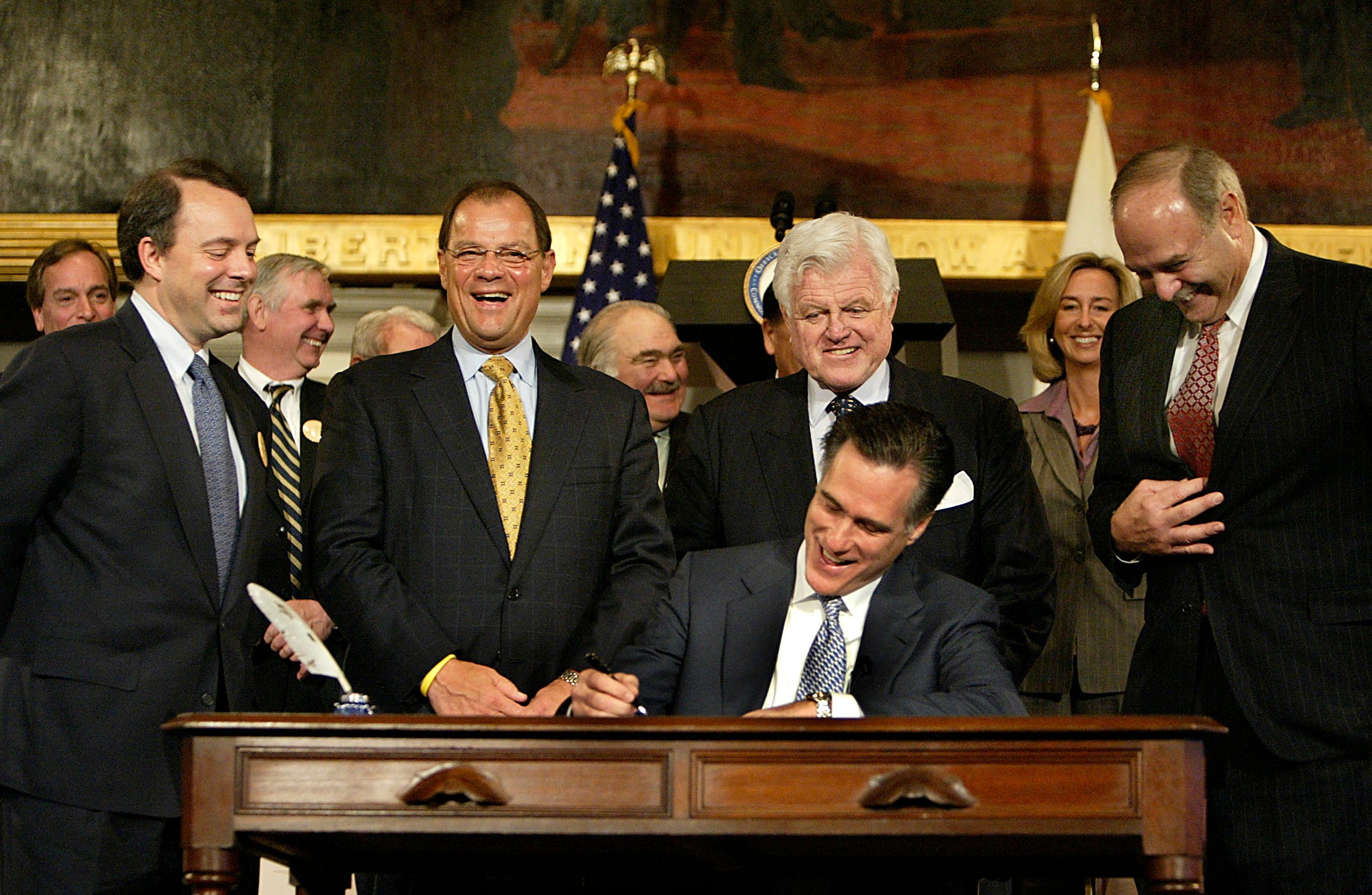
On Monday, Romney and his former partners, along with dozens of other dignitaries, gathered in Faneuil Hall, the eighteenth-century meeting place where Romney had signed Chapter 58 almost exactly twenty years ago to the day. They were all there to hail the law’s sweeping effects, and to reminisce about how they’d teamed up to make it a reality.
“Political rivals respected each other, buried political weapons and worked together to find solutions,” Romney said in brief remarks—which came, fittingly, after both the current Democratic governor (Maura Healey) and Romney’s Democratic successor (Deval Patrick) had praised him, generating hearty applause from the audience.
All that magnanimity wasn’t just for show. It was a recognition of genuine, quantifiable progress. In just the first four years after Chapter 58 became law, the percentage of non-elderly adults without insurance in Massachusetts fell from a state-estimated 13.4 percent to 5.8 percent, even as the percentage nationally was growing because the economy at the time had plunged into recession.
As of 2024, that figure sits at 3.7 percent, according to the Census Bureau.1 And while there are still people with insurance who have a hard time covering premiums and out-of-pocket costs, research has shown that the law has reduced economic hardship while improving access to medical care, and that people seem to be healthier.
But Chapter 58 may be just as important for the way it reverberated in national politics, helping to launch a reform effort that eventually produced the Affordable Care Act. Key architects of that law have described Chapter 58 as proof of concept—both in the sense that the Massachusetts policy architecture was a prototype for what Obama and his allies ended up creating at the federal level, and in the sense that Chapter 58’s passage demonstrated how enacting a quasi-universal coverage scheme was politically possible.2
In some ways, the impact of “Obamacare” nationally has been similar to the impact of Romneycare in Massachusetts: The number of Americans without insurance has fallen to historic lows, with data showing that Americans are better off financially and medically as a result. But most of the rest of America hasn’t gotten as close to universal coverage as Massachusetts has. A big reason for that is vitriolic opposition from Republicans.
For starters, Florida, Texas, and eight other states where Republicans hold sway have refused to expand their Medicaid programs, a step that more than half the states (including Massachusetts) took in 2014 and most of the remaining states did in the next few years. Because those states, preponderantly in the South, have held out, millions of Americans have remained without coverage, even though the Affordable Care Act means the federal government would pick up most of the cost.
Then there were the repeated efforts to undo the law. During Trump’s first term, Republicans came within one senator’s vote of repealing it outright, and when that failed Trump proceeded to use the levers of executive authority to undermine it. Since returning to office last year, Trump has worked with Republicans to weaken the Affordable Care Act even more—by enacting history’s largest cuts to Medicaid, by refusing to renew temporary extra subsidies Joe Biden and the Democrats had put in place, and by dialing back the requirements for what insurance must cover.
In that sense, the story that Romney and the Massachusetts dignitaries were celebrating on Monday is bittersweet. It’s a reminder of what could have been—and what could still be—with a different political mindset, especially in Washington. And probably nobody knows that better than Romney, whose journey through public life allowed him to see policymaking at both its most constructive and its most destructive.
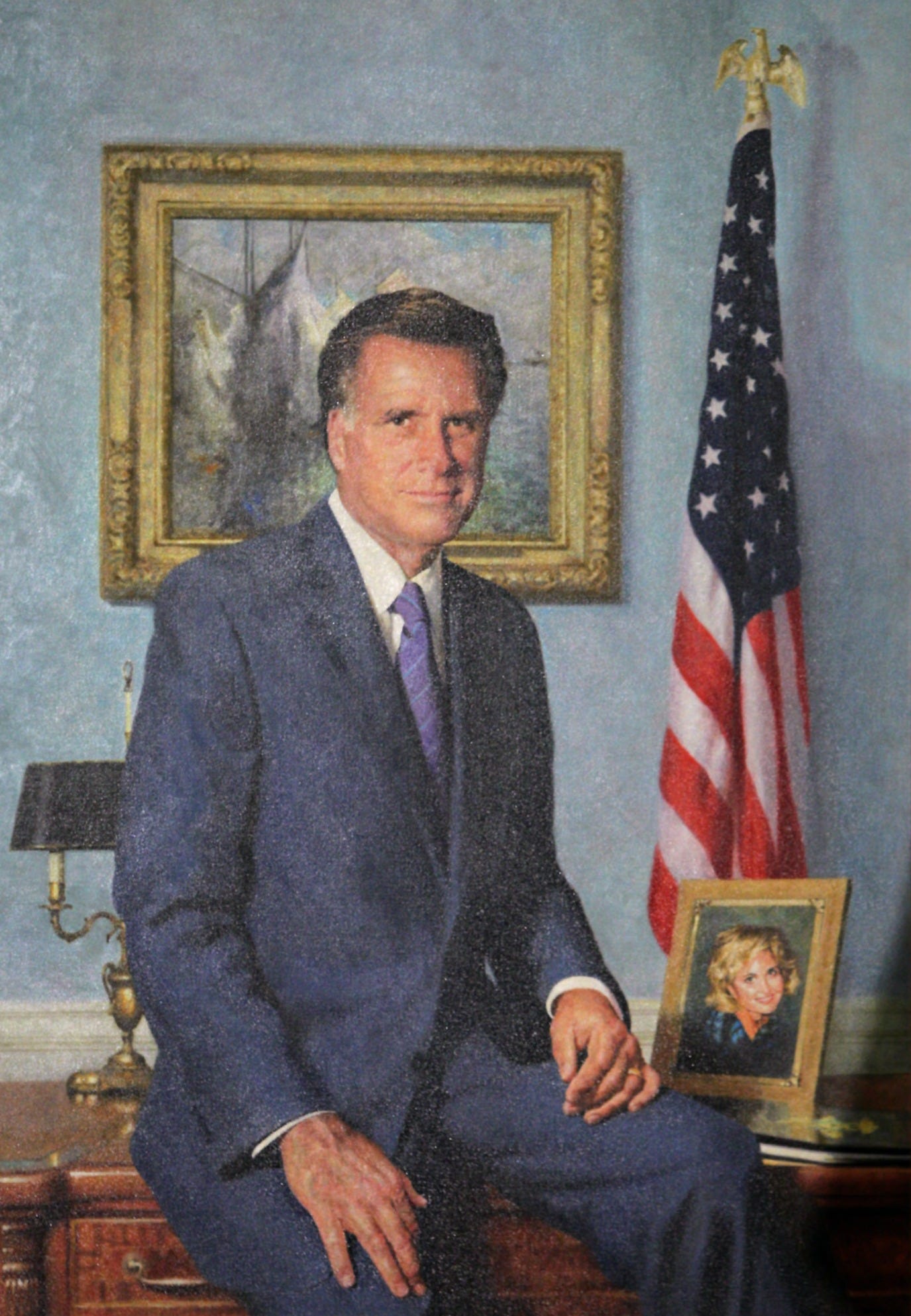
IF YOU DOUBT HOW IMPORTANT Chapter 58 is to Romney, all you have to do is glance at his portrait hanging in the Massachusetts State House. At his request, the artist depicted a copy of the signed law on the desk. The only other item there (besides a lamp) is a portrait of Romney’s wife, Ann.
But Romney had not come to office promising to tackle health care, and didn’t take much interest in the issue until a longtime friend and business associate suggested it—appealing to Romney’s analytical side, as a former investment banker, by pointing out that the cost of treating uninsured patients in emergency rooms was likely raising costs for everybody else. “That began to grind in my mind,” Romney told me in an interview after the anniversary event, “and I began to wonder what in the world can we do.”
Even that might not have turned health care into Romney’s legacy if not for another circumstance. Massachusetts was on the verge of losing hundreds of millions of dollars a year in extra hospital funding, which it had been receiving through a special program that the administration in Washington—George W. Bush’s—didn’t want to renew. The only way to keep the money was to use it differently, to pay for insurance rather than continue subsidizing hospitals directly.3
This was the point when Romney forged a partnership with Ted Kennedy, the iconic liberal Democratic senator from Massachusetts. It would be difficult to exaggerate how unlikely a pair they made, characterologically as well as ideologically, and that’s not to mention the fact that the two had faced off in a bitter, frequently nasty Senate race when Romney tried to unseat Kennedy in 1994.
But “we were friendly on a personal basis,” Romney told me, “we just had different ideas on how to get things done and what was the best thing to do for people.” And the situation with federal funding meant both men could get a win. Romney would get a chance to keep state finances whole, without having to raise taxes or cut spending elsewhere. Kennedy would get a chance to see Massachusetts get close to universal coverage, as he’d long wanted.
The two ended up visiting the then-outgoing secretary of health and human services on his last day before stepping down, then headed next door for a reception where—by some accounts, though Romney told me he doesn’t remember—the two entertained a crowd by telling jokes about each other. But the Bush administration’s agreement was only the beginning of the process. Massachusetts still had to come up with a new health insurance system, which meant Romney had to work with the overwhelmingly Democratic state legislature.
They were far apart on everything from the role of employers to the generosity of insurance. They also had to wrangle interest groups—hospitals, insurers, labor unions—each with different agendas and the power to kill a deal. Motivated to save that extra federal money, and pushed by advocates who had spent decades clamoring for universal coverage, Romney, legislative leaders, and their respective advisers worked through it all with weekly in-person meetings and daily phone calls. At one point, when negotiations were stalling out, Romney showed up—unannounced—on the doorstep of the House and Senate leaders to demonstrate his commitment to the project.
“I thought he was drunk and lost,” former state Senate President Robert Travaglini deadpanned in his remarks Monday, prompting loud laughter because Romney is an observant Mormon who doesn’t drink alcohol. But Travaglini struck a serious note too, recalling that “we were capable of putting aside egos, personalities, party affiliations for the good of the people that we represented.”
They really were—and a year later, all of them were together onstage at Faneuil Hall, where organizers had brought in a fife-and-drum corps and Kennedy quipped that his son had said “when Kennedy and Romney support a piece of legislation, usually one of them hasn’t read it.”
TED KENNEDY HAD MADE no secret of his hope the Massachusetts law would inspire national action—and he would go on to play a key role in making that happen after Obama was elected, up through Kennedy’s death in August 2009. It’s safe to assume Romney also had visions of how the law might play nationally, though more as a signature accomplishment he could tout in his own future run for the presidency.
A big part of that was the way Romney had insisted on an “individual mandate”—that is, a financial penalty for people who didn’t get insurance. Taking the advice of economists and analysts—and after satisfying himself by poring over the data—Romney was convinced the mandate was necessary in order to keep insurance pools stable. But he also believed it was true to his conservative principles on individual responsibility.
“If you’re a young person that’s healthy, you’ve got to have health insurance,” Romney told me, making the same pitch he made countless times while promoting his plan. “We can’t let you just be out there driving your car, skiing, paragliding and so forth—and if you get hurt, expecting everyone else to pick up the bill.”
A MESSAGE FROM OUR SPONSOR
Trump Picks Profits Over Clean Air

Trump’s allies have been fighting for 16 years to reverse a 2009 scientific consensus that climate pollution threatens public health. And his EPA just delivered them a near “total victory” by revoking that endangerment finding and overturning clean air & water protections. Here’s how to fight back.
But by the time of his 2012 presidential campaign, fighting the Affordable Care Act had become a defining political cause among Republicans, with the mandate a particularly sore spot among conservatives and libertarians who saw it as the federal government—and Democrats—coercing people into being part of the system.
Romney made the case then (as he did to me Monday) that he too supported repealing the Affordable Care Act, because he never envisioned the Massachusetts system as appropriate for every state. But while he was able to get the nomination, it was yet one more way he never won over the party’s emerging, more extreme wing—which, years later, would become the MAGA base.
“It strikes me as a Republican idea to say that if you can afford to buy insurance, you’ve got to have insurance, rather than showing up and expecting to get free care—that strikes me as conservative and Republican,” Romney told me. “But as soon as Barack Obama started talking about this, Republicans ran for the exits.”
Republican anger at the Affordable Care Act didn’t dissipate when Romney lost. It festered, and led to actions—such as the elimination of a federal fund designed to stabilize the insurance market for the first few years of the program’s operation—that made the already difficult task of implementing such a complex law even more difficult.
That attitude was a stark contrast to the way things unfolded in Massachusetts, where the spirit of cooperation across party and interest groups prevailed even after Romney’s term ended. Early on, stakeholders and local leaders met regularly on how to publicize the law and encourage enrollment, with even the Red Sox (through their charitable foundation) lending a hand with promotion.
And Massachusetts lawmakers didn’t stop trying to improve the system, with each successive governor after Romney (two of them Democratic, one of them Republican) pushing for reforms to address underlying forces constantly making health care more expensive—in part, to make the system more sustainable. That was actually a big theme of the festivities on Monday—the recognition that extending coverage was just one step toward making health care more affordable for everybody, and that success would require the kind of effort that had first led to Chapter 58.
“What made that progress possible in Massachusetts is needed again for this next hurdle we face, which is really around cost and affordability,” Audrey Morse Gasteier told me. Gasteier is executive director of the Massachusetts Health Connector, which operates the state’s insurance marketplace and which organized Monday’s event. “It was part of our hope that this gathering would help remind the Massachusetts health care community that it has it in it to do hard things, and that progress is possible.”
ROMNEY IN HIS PREPARED REMARKS alluded to the rarity of that kind of cooperative spirit in national politics nowadays: “Having spent six years in Washington, I have greater appreciation for what we did here in Massachusetts.” He was talking about his term in the U.S. Senate, representing Utah from early 2019 through 2025.
That is when he carved out the identity for which he’s probably best known today—as a principled conservative who stood up to Trump in his first term, becoming the first senator in history to vote to convict on impeachment charges a president of his own party. That legacy-defining decision earned him all kinds of grief from within the party, especially back home among the MAGA faithful, some of whom famously harassed him and chanted “traitor” as he was flying back to Washington for the January 6, 2021 certification of Joe Biden’s 2020 election win.
Two years later, Romney announced that he wouldn’t seek a second term—lamenting in a press briefing that “the Republican party today is in the shadow of Donald Trump.” He went on to explain that
my wing of the party talks about policy and about issues that will make a difference to the lives of the American people. The Trump wing of the party talks about resentments of various kinds, and getting even and settling scores and revisiting the 2020 election.
Romney had said he was optimistic that his wing of the party would become ascendant again. On Monday, I asked him if he still felt that way. “I’m obviously hopeful, but, no, not optimistic—not optimistic for anytime soon,” he said, moving immediately to speculation on who would inherit the party’s mantle after the president leaves the scene. “I think Vice President Vance is very much in the footsteps of Donald Trump, and will pursue that course if he’s the nominee. I’m not sure about Marco Rubio, maybe he would as well. But I don’t see a big departure.”
Romney did allow that both Vance and Rubio were “smart guys” who might not be prone to make the same sort of errors Trump has. (Romney didn’t specify which errors, but it’s not hard to imagine what he might have in mind.) And throughout our interview, Romney made clear he thinks Democrats deserve plenty of blame for the degradation of politics—because, he said, they took actions (like using executive orders to wipe out student loans) that violated constitutional norms and staked out positions on cultural issues (like transgender athletes) that he believes made more Americans sympathetic to MAGA.
But it says something that the MAGA base treats Romney as a persona non grata, while Democrats in one of America’s bluest states will embrace him the way they did on Monday. It’s not because those Massachusetts liberals see in Romney a kindred ideological spirit. It’s because they came to know him as somebody who—despite significant differences of opinion—worked with them to achieve something they could all find worthwhile. That too is a legacy, one especially worth celebrating now.
The Census Bureau figures are not a precise apples-to-apples comparison to the earlier data, which comes from Urban Institute research commissioned by Massachusetts. But together the figures convey a rough sense of how much the uninsured level declined both in the first years after implementation, and in the years since.
Here’s what former President Barack Obama told me during a 2020 interview: “I was never under an illusion that we would get majority Republican support. But it was my belief that a law signed by Mitt Romney, and that could be traced back to ideas that had appeared in the Heritage Foundation literature, would give some political cover to those Republicans who were so inclined to vote for it.”
As John E. McDonough, a leading state advocate who went on to become an adviser to Ted Kennedy in Washington, later wrote, “Massachusetts put a financial gun to its head . . . and the Bush administration provided the bullets.” McDonough, who also spoke at Monday’s event, has a book on health care coming out this summer called America’s Wrong Turn.
I liked Romney - still do! But him trying to push blame onto Democrats for the degradation of politics is a joke of an excuse for the party that brought rise to Donald Trump.
Romney was widely admired during his time in Massachusetts (both as governor and Senator), which many people may not realize that, while heavily Democratic, often had a Republican governor. Those Republican governors were normal human beings in those pre-MAGA days - they were socially moderate and fiscally responsible, and Massachusetts was fine with that.
What was sad to watch was Romney, when he ran for Senate in Utah, distance himself from his Massachusetts accomplishments and policy positions. For example, he voted for several Republican-backed measures that aimed to weaken or repeal parts of the ACA. Another case in point was Roe v Wade - when he was MA governor and Senator, he supported Roe V Wade, promising to preserve a woman's right to chose. After he left Massachusetts, he began criticizing Roe v. Wade and calling for its reversal or limitation and declared that he had become pro-life.
This has always colored my view of Romney. And not in a good way.