Abortion Is Back as an Issue for Dems—Even in Red States
Having had doubts about the salience of the issue after the 2024 elections, Democrats are no longer shying away from it.


AFTER THE 2024 ELECTION, Democratic leadership quickly concluded that a major factor for their losses had been the party’s significant drift left on social and cultural issues. And among the main policies where a recalibration seemed in order, abortion appeared top of mind.
In my conversations with party strategists during those months, many said that while support for abortion rights was foundational, Democrats needed to recreate the 2006 midterm model when pro-life (and pro-gun) candidates were recruited to run in red districts. They noted that it was on the backs of anti-abortion lawmakers like Heath Shuler of North Carolina, Brad Ellsworth of Indiana, and Bob Casey Jr. of Pennsylvania that Democrats regained majorities in both chambers of Congress.
But over the past few months, this Bush-era thinking has begun to seriously soften.
There is a growing sentiment among that same consulting class that abortion access can actually serve as a winning issue for Democrats running in red parts of the country. They increasingly view the traditional pro-life versus pro-choice faultline as a relic. In its place, they see a series of state-specific battles in which candidates focus on the state- and local-level restrictions directly affecting their constituents rather than a larger narrative about the legacy of Roe v. Wade.
“There is real value and imperative to be a different kind of Democrat. But the idea that being a pro-life Democrat is sort of a cookie-cutter cheat code—we’re not in that era anymore,” said Zac McCrary, an Alabama-based Democratic pollster.
McCrary, like other party operatives I spoke with, told me that the end of Roe, which came four years ago today, has fundamentally changed how people perceive the debate around abortion. No longer a right to be protected, abortion access has become, for many voters, a pain that is endured. In states with restrictive policies in place, people have now lived for years being denied medical care, sometimes in life-threatening situations. Such restrictions have allowed Democratic candidates to run against specific policies and outcomes, rather than having to mount a broad defense of an abstract right or the now-overturned Supreme Court decision.
“Pro-life was a comfortable theoretical stance for a lot of voters and politicians [before Roe v. Wade was overturned]. But that abstraction has been replaced by the messy reality of government-enforced mandates,” said McCrary. “The Republican party has pivoted from defending a moral principle to enforcing a restriction that compromises individual freedom. That’s an overreach that voters, even in red states, have found deeply uncomfortable.”
Anecdotal voter data bear this out. As The Bulwark’s Sarah Longwell wrote this week, participants in focus groups she’s recently conducted often bring up abortion as an issue—especially in states with restrictive bans. In these focus groups, it has been the Republican voters who have talked about what they see as the cruelty of forcing women to continue carrying a nonviable pregnancy, as well as the sheer terror of the possibility of being denied care that could save their life.
“I think we’re returning to it being an important issue. It may not be the number one issue, but it’s still part of the conversation,” said Josh Marcus-Blank, a Democratic consultant. “[Democrats] are a little bit more balanced in their perspective on it than they may have been right after 2024 when people were pointing fingers at everyone on every issue as the reason why we lost.”
Recent election results also support the idea that downplaying or running away from the issue of abortion isn’t necessary for Democrats to thrive. Abigail Spanberger went after her GOP opponent’s “extreme” stance on abortion in her successful bid for Virginia governor last year, and Virginia Democrats expanded their majority in the state House by thirteen seats by running pro-choice candidates who put money into ads focused on abortion rights. Earlier this year, Chris Taylor won a seat on the Wisconsin Supreme Court by 20 points after running multiple campaign ads focused on abortion rights that portrayed the conservative candidate as too extreme on the issue. Some of the party’s top-flight Senate candidates in traditionally Republican states are also not shying away from talking about abortion rights. Former North Carolina Gov. Roy Cooper, former Alaska Rep. Mary Peltola, and Texas state Rep. James Talarico all put out statements on Wednesday about the Dobbs anniversary and reaffirmed their belief in the fundamental right to reproductive care. And in Ohio, gubernatorial candidate Amy Acton also posted on social media about the anniversary of Dobbs.
“Spanberger really provided the model for how Democrats can do this in tough states, and it was using reproductive freedom and abortion as a deal breaker,” said Mini Timmaraju, president of the abortion rights group Reproductive Freedom for All.
There’s still an instinct among some Democrats—particaurly those who haven’t run in competitive races since the Dobbs decision—to shy away from talking about abortion or to reflexively tack to the center on the issue. While reproductive rights advocates have stressed that the country has moved beyond the Clinton-era talking point that abortion should be “safe, legal, and rare,” some operatives still see merit in that type of messaging. Timmaraju and others chalk this up to a failure to appreciate just how much the Dobbs decision and the restrictive abortion laws that followed have shifted public opinion on abortion access. Pollsters like McCrary told me that before Dobbs, the country was more “softly pro-life,” but that we’ve since become “more of a softly pro-choice country.”
“The anti-abortion movement really did a number on Democrats’ confidence on this issue,” said Timmaraju. “What we’re doing is trying to get Democrats to understand we’re not on the defense on this—we’re on the offense.”
The party operatives I spoke to told me that in the wider Democratic ecosystem, many people still worry that Kamala Harris lost in 2024 because she focused too much on restoring abortion access. They fear that Democratic candidates will gravitate single-mindedly toward attacking Donald Trump’s failed economic agenda and in doing so ignore abortion, potentially missing out on an opportunity to paint their Republican opponents as out of touch with voters.
“We need to be able to talk about the economy and abortion at the same time. And we as an entity are worried that Democrats are going to run away from abortion as an issue because of what happened in 2024,” said Priorities USA’s executive director, Danielle Butterfield. “Abortion needs to be centered in the conversation consistently.”
Butterfield told me that in Priorities USA’s research on the 2024 election, they found that Harris and Trump voters recalled Democratic ads on abortion more often than they did ads on the economy. Because Democrats had a clear point of view and an emotional story to tell on abortion issues, Butterfield argues, it stuck more with voters than an often vague economic message.
Priorities USA is one of a number of Democratic-aligned groups that is planning to spend serious money on abortion messaging ahead of the 2026 and 2028 election cycle. Earlier this week, Priorities USA announced a $30 million campaign aimed at defining potential 2028 Republican presidential candidates. The campaign is expected to focus on where officials like JD Vance and Marco Rubio stand on abortion. Reproductive Freedom for All also announced it would spend $23.5 million this cycle to boost pro-choice Democrats running in battlegrounds and has also launched a content creator program to highlight personal health care stories from states with abortion restrictions.
“This is a value driver for voters,” said Jessica Mackler, the president of EMILY’s List, which works to elect Democratic pro-choice women. “When they understand where Republicans stand on this issue, it says something about who they are.”
THE CURRENT DEBATE AROUND ABORTION has almost flipped the old dynamics of the Roe era. Back then, it was Republicans who were attacking Democrats for specific policy approaches, such as late-term or taxpayer-funded abortions. Now, they are the ones parrying Democratic attacks over the abortion-restriction laws their party has put in place.
But it isn’t all offense for those Democrats. The challenge for the party is figuring out how to run on abortion rights while accommodating candidates with more nuanced perspectives. It’s proven to be tricky in the past.
In 2016, for example, NARAL Pro-Choice America (which rebranded in 2023 to Reproductive Freedom for All) criticized Nancy Pelosi for saying she did not believe in “abortion on demand” or that “abortion is a form of birth control.” In 2017, Vermont Sen. Bernie Sanders and the Democratic National Committee were fiercely criticized for elevating a candidate for mayor of Omaha who had opposed abortion. And in some corners of the party, even signaling a willingness to endorse some restrictions—such as after fetal viability—can still feel taboo.
But in many ways, the GOP’s hard-line position on abortion has made positioning easier for Democrats. The post-Dobbs landscape has allowed candidates who may be personally uncomfortable with abortion to nonetheless talk about the consequences of restrictive laws and how they are bad public policy. This approach is already playing out on the campaign trail this cycle in competitive congressional races.
Nancy Lacore, the EMILY’s List–backed Democratic nominee in South Carolina’s 1st Congressional District, talks about her Catholic faith, but also how personal beliefs on the matter shouldn’t be imposed on others. Bobby Pulido, running in Texas’s 15th Congressional District, has also talked about his Catholic faith and personal opposition to abortion. At the same time, he called Texas’s law “draconian,” adding that it’s not his “place to tell somebody else what they can do.”
“Bobby Pulido—a couple of years ago might have felt comfortable being silent on abortion,” said Timmaraju. “But he really understands the impact and that you can’t run in Texas right now without making a commitment to address abortion access.”
🫏 Donkey Business:
— It was a good night for lefty insurgents in New York City yesterday, after a trio of candidates backed by Mayor Zohran Mamdani swept competitive House primaries. Most notably, democratic socialist Darializa Avila Chevalier defeated incumbent Rep. Adriano Espaillat, the influential chairman of the Congressional Hispanic Caucus who was endorsed by Minority Leader Hakeem Jeffries. Rep. Daniel Goldman also lost his primary to Brad Lander, who criticized the incumbent for his close relationship with AIPAC and for voting for military aid to Israel.
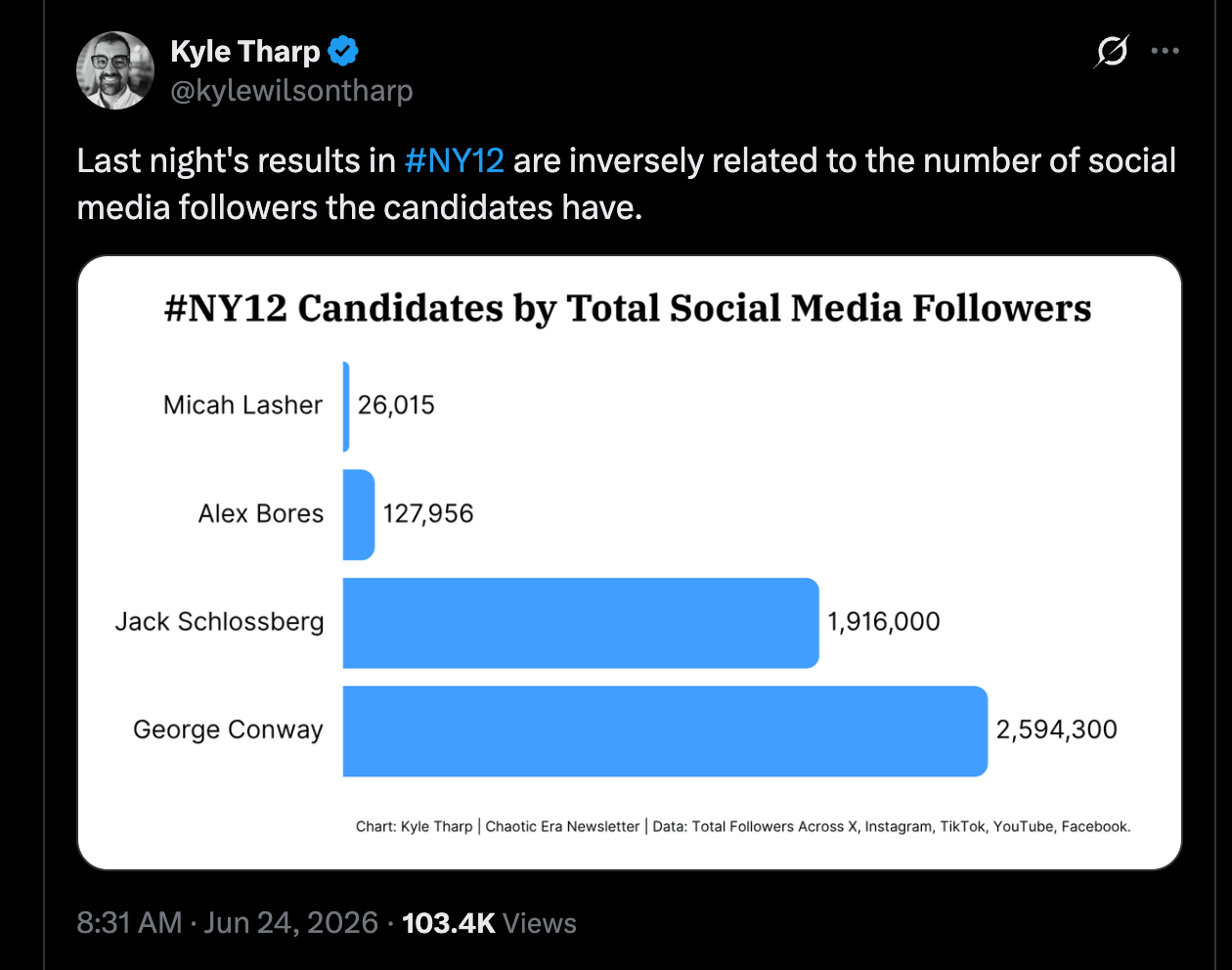
The primary results were the latest example of Democratic voters thirsting for outsider candidates willing to critique the establishment and question the status quo. But all the usual caveats apply: New York City is not representative of the rest of the country.
I’ll also leave you with this chart from Kyle Tharp:
— The Democratic primary in Maine’s 2nd Congressional District was finally called on Friday for Matt Dunlap—and some Democratic strategists that I’ve spoken with are heated. Dunlap, who pitched himself as the progressive in the race, defeated the DCCC’s preferred candidate, the more moderate state Sen. Joe Baldacci.
The mostly rural district voted for Donald Trump by 10 percentage points in 2024 and retiring Rep. Jared Golden—one of the most moderate members of the Democratic caucus—has narrowly eked out victories in his past few races. It’s not hard to see why some operatives don’t think Dunlap is the right fit for the district.
Strategists that I’ve spoken with are particularly frustrated with national progressive figures like California Rep. Ro Khanna, who campaigned on behalf of Dunlap ahead of the primary. New FEC filings also show that a Republican-aligned super PAC spent $500,000 boosting Dunlap’s primary, a sign that the GOP viewed him as the more beatable general election candidate.
My open tabs:
— Florida Can’t Stop Fighting Over a Bird
— They Looked Like They Were Getting Rich on Polymarket—but None of It Was Real
I think the argument should be simple. The government (and religions) should mind their own damn business.
May be more effective to argue that Dobbs allowed the States to impose a specific religious doctrine on women, thereby confusing the supposed separation of church and state. Arguing that the decision doesn't make sense and is based on cherry-picked data falls on deaf ears. Arguing that "originalism" is utter nonsense is too difficult for many people to comprehend. Easier just to explain that the consequence of Dobbs is arbitrary and capricious... Alternatively, it would be strikingly honest just to acknowledge that women have been aborting fetuses for centuries and will continue to do so for self-preservation.