America’s Kiddie-Pool Authoritarian
He can’t control the Reflecting Pool or the Strait of Hormuz, but he can arrest people for nothing.


Vice President JD Vance emerged from a weekend of peace talks in Switzerland with Iran to announce the first significant nuclear concession Tehran has yet made: International Atomic Energy Agency inspectors, he said, will be allowed back into Iran as a condition of the deal. More on the negotiations below. Happy Monday.
Join Sam Stein and Will Sommer for MAGA Mondays today at 10 a.m. EDT on Substack and YouTube.
Straight to Jail, Right Away
by Andrew Egger
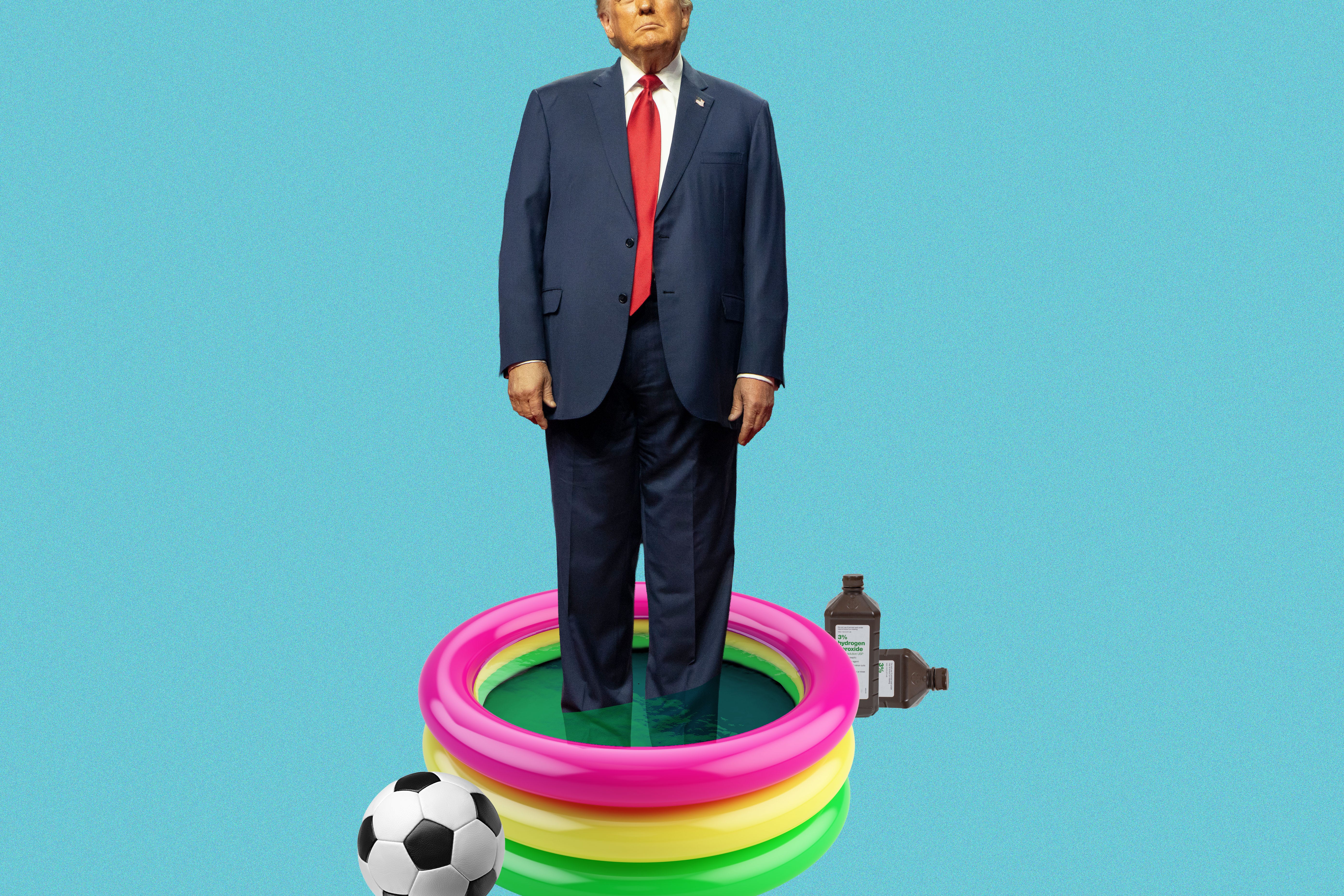
Until now, Donald Trump’s shambolic attempts to renovate the National Mall’s Reflecting Pool have been just a silly, funny sideshow. But this weekend, the story took a more sinister turn. As news spread that the new “American Flag Blue” coating was already sloughing off the bottom of the pool, Trump went looking for somebody to blame—and predictably went with the most authoritarian available option.
“The United States Park Police have arrested multiple individuals for vandalizing our Nations [sic] magnificent Reflecting Pool,” Trump posted on Saturday night. “These are very serious crimes having to do with the destruction of National Monuments. Years in jail!”
Nothing had been wrong with the pool coating itself, the president insisted: “Ours worked perfectly, including the mirror like finish . . . the Reflecting Pool was never so beautiful as it was just one week ago.” But alas, some theatrical villains had come along and ruined it for everybody: “They took some form of knife or blade, and put a 250 foot long gash into the beautiful facade of what took so much work, competence, and money to build and complete. They also poured corrosive and destructive chemicals into the Pool.”
These villains, it seems, were so cunning, so devastatingly dastardly, that they managed to pull off this shocking act of national blasphemy without once being visible on the cameras embedded in the Washington Monument that transmit a 24/7 public livestream of the Reflecting Pool. Plainly, we are looking at some serious criminals here. But rest assured that Trump is on the case: Many people, he claimed, have already been arrested.
Is that true? Who knows! At least one arrested person has already been identified, however: former U.S. Olympian David Hearn, who told ABC News he was arrested Friday after heading to the Reflecting Pool to see it for himself and touching a piece of the blue coating that had come partially loose. “I did not remove, I did not damage, I did not rip, tear, break, destroy, or harm any part of the Reflecting Pool,” Hearn insisted.
Last week, I argued that the Reflecting Pool renovation boondoggle was “a striking metaphor for the failures of Trump’s second term” that had failed in the same way Trump projects these days often fail.1 Trump’s attempts to spin the failure have been typical, as well: He first tried to insist the problems were invented or imagined; then, when they became too obvious for even his fans to ignore, he pivoted to denouncing them as deliberate sabotage from his enemies.
All this is still, I suppose, pretty funny. But it’s worth reflecting on the fact that it’s only America’s remaining free institutions that allow it to remain so. It is extraordinarily unlikely that David Hearn or anyone else will actually face legal repercussions for touching the failing pool bottom. But that’s no thanks to Trump, who would absolutely give a few wrong-place, wrong-time bystanders “years of jail” to pass the blame if he actually had the sweeping authoritarian powers he claims and craves.
Happy Globalist Independence Day!
by William Kristol
Ten years ago, on June 23, 2016, the people of Great Britain voted in a referendum to leave the European Union. This morning, Keir Starmer, Britain’s fifth post-Brexit prime minister, announced his resignation. Brexit hasn’t made Britain great again, and most Britons now regret the decision to exit the EU.
Nor are the most fervent Brexiteers happy. They got what they wanted, but it hasn’t worked out as they envisioned. Populist victories don’t lead to populist happiness. A good chunk of the country turns against them, but the populist movement doesn’t learn any lessons. It just gets more radicalized as its hopes aren’t realized. So ten years on, the British Right is more nativist, more xenophobic, and more bitter about the state of their country than ever.
Brexit’s victory was followed less than five months later by Donald Trump’s win here. Brexit was more than a harbinger of Trump, it was a help to him. It gave Trumpism the sense of having a wind at its back; it helped make nationalist populism seem like the next big thing. People like to think they’re part of a bigger movement, that they’re riding a wave of the future. And so the wish was father to the thought. And here we are.
I feel that I’ve seen this before, from the other side. I remember how Thatcher’s victory in 1979 encouraged us young conservatives to think we could win in 1980—that we weren’t just standing athwart history but had a chance to make it. I remember how during the 1980s, we Reaganites would look abroad, and see Thatcher and Pope John Paul II,2 and think we had the wind at our backs.
Politics can produce very unlikely leaders. The first female British prime minister, the first non-Italian pope in centuries, the oldest American ever to be elected president—together, they changed history.
If you want to be cheered up, think about being told the day after the Brexit vote that a decade later, a possible international revival of liberalism would be led by three inspiring leaders you’d never heard of: a Ukrainian comedian, Volodymyr Zelensky; a minor figure in of Viktor Orbán’s government, Péter Magyar; and the recently appointed bishop of Chiclayo, Peru, Robert Prevost. Who would have believed it?
The course of human events is often unpredictable.
Which brings us to the 250th anniversary of our revolution.
A few months ago, I was worried that Trump would succeed in hijacking our 250th birthday celebration. He’s certainly tried, but I now think we can say that his efforts to shape how we think about our country and its history have fallen flat.
Is anyone still talking about the cage match a week ago on the White House’s South Lawn? I don’t think so. Will people pay attention to Trump’s speech this Wednesday, June 24, kicking off the “Great American State Fair” on the Mall? I doubt it. If they take a look, it will probably be because they’re curious for an update on the Reflecting Pool.
I know that early that evening I’ll be home watching the World Cup on TV, as little Scotland, backed by its Tartan Army, takes on mighty Brazil. Can Scotland progress for the first time beyond the group stage at a World Cup and reach the knockout rounds?3
I will say that the World Cup has been a godsend as an alternative, a counterpoint, to Trump’s bicentennial. The high spirits of the tournament, the healthy enjoyment at hosting this—dare I say—globalist event, the examples it’s provided of good-natured and liberal national pride as opposed to narrow-minded and nasty nationalism: These have all been reminders of a better kind of patriotism. Of the best kind of American patriotism.
Of course the semiquincentennial will culminate on July Fourth. Trump has boasted on Truth Social that the day’s super-sized events in Washington, D.C. will be “the most spectacular TRUMP RALLY of them all.” But most Americans will ignore that rally. They will be enjoying a normal July Fourth, not an authoritarian one. For some of us, part of that enjoyment will be taking in the first two knockout matches in the World Cup round of sixteen that day.
How great would it be if Scotland or Cape Verde or Curaçao made it to at least the first knockout round? They have a chance. And let’s not forget the Knicks. They went all the way. It all gives me hope—even some confidence!—that though the next two and half years will be rough, the American experiment in self-government has a chance to prevail.
AROUND THE BULWARK
Swing Voters Are Still Mad at Republicans About Abortion… In tight elections, that might make all the difference, observes SARAH LONGWELL.
Iran Showed Us the Future of Asymmetric Warfare… America’s enemies will attack our political cohesion, our alliances, and our will, warns MARK HERTLING.
JD Vance’s Ideas Will Never Work… Postliberalism has been tried before, to ruinous results, writes MATT JOHNSON.
Trump Bombed Iran—Then Gave It Everything It Wanted… On The Mona Charen Show, MONA welcomes military analyst ANDREW FOX for a conversation on Trump’s Iran ceasefire.
Rising Antisemitism Is a Dark Omen for Society… On Shield of the Republic, DEBORAH LIPSTADT joins ELIOT COHEN to discuss her work as special envoy for monitoring and combating antisemitism from 2022 to 2025.
Quick Hits
PEACE PROCESS: Iran has been playing hardball in peace negotiations, canceling the first day of planned talks Friday and announcing yet again the closure of the Strait of Hormuz on Saturday, both in supposed retaliation for the ongoing fighting between Israel and Hezbollah in southern Lebanon. (This was only a partial closure; non-Iranian ships immediately stopped transiting again, while Iranian ships, against which America is no longer enforcing its blockade, kept sailing through.)
Still, some progress appears to be taking place at the talks in Switzerland. Early this morning, mediators Qatar and Pakistan said in a statement that the sides had agreed on “a roadmap towards reaching a final deal within 60 days” and on “the creation of a mechanism for further technical talks,” including a “de-confliction cell” aimed at bringing the fighting to Lebanon to a close. In other words, more agreements to agree on things later and more of the United States agreeing to put pressure on Israel in the hope of further softening up Iran.
Meanwhile, back in D.C., Trump was doing his own freelance negotiation, apparently back in an Israel-sympathetic mood: “Iran must immediately stop their highly paid PROXIES in Lebanon from causing trouble,” he posted Sunday morning on Truth Social. “If they don’t, we’ll hit Iran very hard again, just like we did last week, only harder!!!”
And I remember when he said only “stupid people” would call for more bombing of Iran.
MUSCOVITE HAYHEM: After the Kyiv Pechersk Lavra, a nearly 1,000-year-old monastery in the heart of Kyiv, was damaged in the early morning hours of June 15 in a blaze set off by Russian bombs, Ukrainian President Volodymyr Zelensky was asked what he could say to Vladimir Putin. “We’ll say it,” Zelensky laconically replied. The answer has come in an unprecedented wave of drone strikes targeting oil refineries on the outskirts of Moscow on Thursday. The images were apocalyptic: pillars of black and gray smoke rising and billowing over the city with bright orange flames visible through the smoke clouds. While some of the drones were intercepted by air defense, many got through—and in some cases, air defense missile hits resulted in damage from debris and even fires below. Altogether, seventeen people were injured, and the wreckage included an open-air market gutted by fire. The dramatic image of a roof being blown off an exploding fuel storage tank launched a thousand memes.
More strikes came this morning. The extent of the damage is unknown, but the city’s airports were shut down and traffic on a main roadway was temporarily closed off to deploy air defense systems.
So far, most residents of the city of Moscow itself have not been directly affected. But there is no question that such attacks are making it harder and harder for Russians in the privileged capital to pretend that the war doesn’t affect them. Given the Russian public’s state of learned helplessness that has set in over the last fifteen years or so, it’s hard to imagine this insecurity translating into popular discontent. But will the elites get fed up? As the fortunes of war look worse and worse for the Kremlin, we may be about to find out.
—Cathy Young
ALAN GREENSPAN, RIP: Alan Greenspan—the economist who became the Federal Reserve’s most influential and best-known chair—died today at the age of 100. The New York Times remembers:
The pre-eminent economic policymaker of his time and arguably the most recognizable economist of any era, Mr. Greenspan led the central bank under four presidents of both parties from 1987 to 2006.
Much of his tenure coincided with a streak of affluence in which he stood as the embodiment of a triumphant, post-Cold War strain of American capitalism: optimistic, faithful in the power of markets to improve living standards, captivated by the power of technology and averse to regulation.
But the ideological stamp he put on policymaking came to be associated as well with the destructive consequences of forces that emerged on his watch, including deregulation of banking and Wall Street, the loss of American jobs to free trade and persistent concerns about bubbles in stock and housing prices.
Cheap Shots

To recap: Step 1: Promise to solve a longstanding problem. Step 2: Ignore all challenges that had made solving the problem difficult in the past; insist that past presidents failed to solve them only because they’re fools. Step 3: Try the first solution you think of. Step 4: Fail at once.
Correction, June 22, 2026, 10:36 a.m. EDT: As initially published, this newsletter misidentified the non-Italian pope of the 1980s as John XXIII, rather than John Paul II, who was elected in 1978.
You might ask: Why, by the way, is Scotland—which is not an independent nation!—competing as a national team in the World Cup? Well, England, Scotland, Wales, and Northern Ireland were the first countries to play international football against one another in the 1800s, and each established its own independent Football Association. When FIFA was founded in 1904, it decided to respect these historical bodies and allowed them to compete as individual nations, rather than trying to force them to merge into a single United Kingdom team. I do think Scotland in the World Cup makes the case against what Michael Oakeshott called “rationalism in politics.”
"Ten years ago, on June 23, 2016, the people of Great Britain voted in a referendum to leave the European Union."
At the time, I thought this might prove to be the dumbest vote any country would make in the 21st century. But then November came around. And then it came around again in 2024. A quarter of the way through the century, American voters currently hold first AND second place on the list. Go USA!!!
It should have been an amazing celebration July 4 this year, especially since will fall during a long weekend. Instead, I will avoid seeing images out of DC and just catch some local fireworks and otherwise laying low.