Are Democrats Reaganmaxxing?
Prospective 2028 presidential candidates are proposing major tax cuts. They belong to a different party than you might expect.

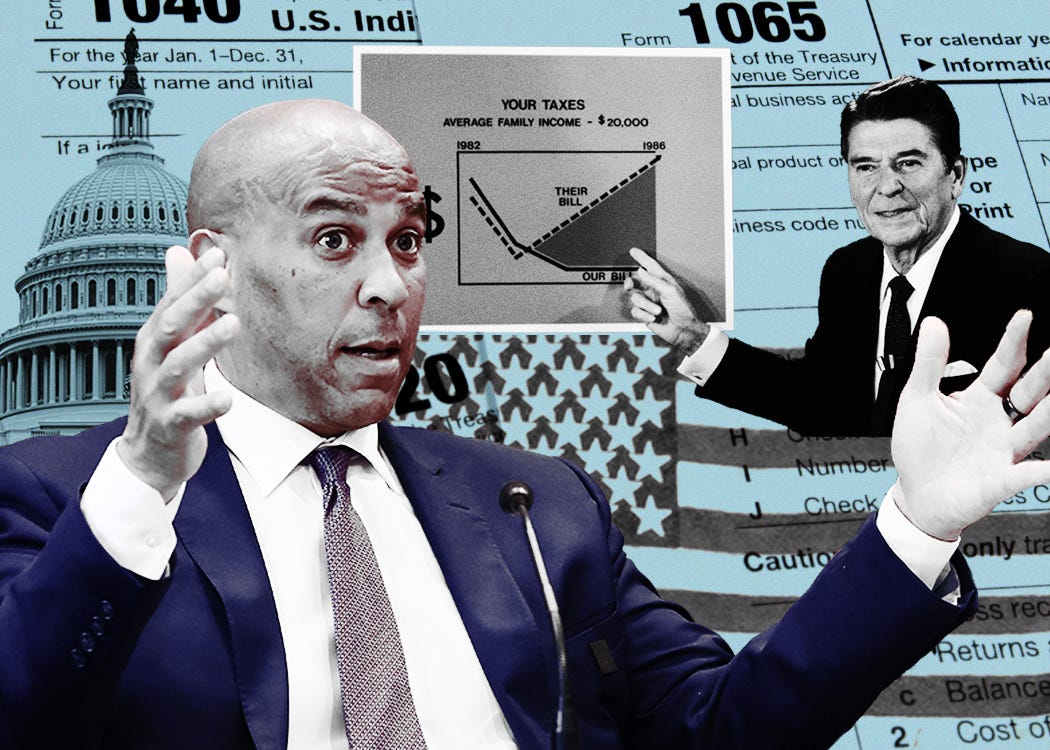
Following a ten-year period that featured two Republican-led, inequitable, deficit-ballooning tax cut bills, some Democrats are attempting to create a new narrative about which party knows what’s best for Americans’ taxes.
In just the past week, Sens. Chris Van Hollen (D-Md.) and Cory Booker (D-N.J.) have each unveiled a tax reform plan they claim would leave the average worker better off while forcing the ultra-wealthy to pay more into the system. While their proposals differ on a number of points, both call for cutting taxes for a large share of the population—something Democrats have not been historically known for advocating. The proposals enraged progressives who are eager to enter an aggressive rebuilding mode if Democrats regain power in the 2026 and 2028 elections.
“I think just taking the proposals at face value is important at this point,” Will Raderman, a senior policy advisor at the Searchlight Institute, told me in an interview. “And knowing that there’s only so much spending that you can do on new kinds of reforms, I think the attention and effort would be much better suited on other proposals.”
While Raderman praised part of Booker’s plan that would significantly expand the child tax credit, he said there’s likely room for it to be even larger if much of the proposal’s costs weren’t weighed down by such a large standard deduction—that is, the base amount that all taxpayers would be able to earn untaxed under the proposal.
“Could you actually do an even more robust CTC [Child Tax Credit] if you didn’t do the standard deduction components? Could you expand health care and improve health care in a lot of key ways? Could you fix the unemployment system? Could you improve job training pathways?” Raderman added. “I think what’s important to keep in mind is, if part of the proposal costs trillions and trillions of dollars, the ability to actually focus on and do a whole bunch of really important agenda items gets that much harder, and probably means we can’t do those.”
I spoke with Booker about his proposal, which features a $75,000 standard deduction1 as well as expanded tax credits for low-income earners and Americans with children. When I asked about the holes in his plan like the ones Raderman pointed out, Booker pushed back, arguing that overall, “the median earner is gonna see an eighty-five percent cut on their taxes, which is significant.”
He added that his plan “is equitable in the sense that you’re making sure that working people get to keep more of their money . . . a significant amount.”
“The Democratic party has got to get its act together and stop thinking that when a bold idea comes forward, it means that all the other important things don’t get done,” Booker said. “This is the biggest unrigging of our tax system that there is.”
However, neither Van Hollen’s nor Booker’s plan is meant to be ready for the legislative process right out of the box. When a prospective presidential candidate introduces a proposal—particularly a tax code overhaul—of this magnitude, their deeper goal is to advance a narrative about fairness and the dignity of work for the sorts of people whose votes the candidate might need to win someday. The proposal itself is not expected to also receive a committee mark up, floor vote, and due consideration in the House while Republicans control the government. Amplify, not codify, is the key verb.
In the lead-up to the 2016 elections,2 Republican presidential hopefuls floated all kinds of ideas that were poorly received or made little practical sense. Former Louisiana Gov. Bobby Jindal proposed the elimination of the standard deduction and a two percent tax rate for the lowest earners in order to be able to use the tagline that “every American has some skin in this game.” Reality television celebrity Donald Trump wanted to eliminate the Head of Household filing status. Sen. Rand Paul (R-Ky.) made his proposal into spectacle by printing out physical copies of the U.S. tax code and then shredding the stacks of paper with a chainsaw and a woodchipper. Later, Paul would continue to ply this theme by shooting the tax code with a rifle.

The Republican proposals did succeed. They were eventually cobbled together into a single plan that became law through the 2017 Tax Cuts and Jobs Act, which slashed corporate tax rates and redefined the brackets and standard deductions. Excluding Paul’s paper mutilation fetish videos, the TCJA took a little bit from most of the primary candidates’ proposals.
Booker, Van Hollen, and likely many other potential 2028 Democratic hopefuls are proposing these plans to make it known that they are eager to address the tax system. It’s obvious that the guiding ideas are stricter enforcement for the wealthy and greater lenience for the middle class. Like all drafts, these current plans might not be ready for prime time. But they indicate a direction, and it’s one that will probably poll better than last summer’s Republican tax cut law.
Open bigotry
Rep. Andy Ogles (R-Tenn.) posted a bigoted statement on X Monday, adding his name in ink to the growing list of Islamophobic members in the House.

“The burqas and hijabs have no place in this country,” Ogles posted over the weekend. “Let’s make America look like America again.”
Ogles is hardly the first congressional Republican to declare that all Muslims are unwelcome in this country and a threat to the United States. But he is the most recent to say so out loud.
While the House has been out, Ogles’s tweets have not received any condemnation from the chamber’s Republican leaders. Neither, for that matter, have similar comments from Rep. Randy Fine (R-Fla.). Both men have made remarks about Muslims that run exactly counter to American values, but because Republicans are so afraid of losing their razor-thin majority, Speaker Mike Johnson has downplayed the egregiousness of their comments. While they used different language than Johnson would, the speaker said this morning, they were voicing legitimate concerns, because of “popular sentiment that the demand to impose Sharia law on America is a serious problem.”
Shoegazing
Trump is obsessed with aesthetics, and more often than not, his preferences are garish or downright obscene. But lately, he’s developed a new interest in deciding what shoes his top staffers will wear in and around the White House—and in all honesty, his choices in this area are not bad.
The Wall Street Journal’s Alex Leary reports:
Trump has been gifting footwear to agency heads, lawmakers, White House advisers and VIPs. “Did you get the shoes?” he asks at cabinet meetings. Some people have laced up in the Oval Office. During a lunch meeting in January, Trump suddenly pivoted to his “incredible” new shoes and gave Tucker Carlson a pair of brown wingtips.
“All the boys have them,” said a female White House official. Another joked, “It’s hysterical because everybody’s afraid not to wear them.” The shoe-salesman-in-chief is paying attention.
Trump has fallen in love with Florsheim, the American brand that’s been pairing comfort and style for more than a century. They’re also affordable: many cost $145.
Look, I’ve never hesitated to criticize the footwear choices of the MAGA movement. But Florsheim is a quality American maker of Goodyear-welted shoes, which can be resoled, as well as cheaper models that have cemented soles; you can find high-quality vintage pairs on eBay for even less.3 (If you want to spend a little bit more money to get a pair of new, reasonably priced, high-quality shoes, though, I’d recommend checking out Meermin.)
Trump’s decision to clad his staff in polished Florsheims is an objectively good thing. The scourge of dress sneakers has lingered in Washington for far too long. It’s also good that they’re uniformly black—there’s minimal room for error with a clean black oxford.
The current standard deductions are $15,750 for single filers, $31,500 for married filing jointly, and $23,625 for heads of household. What Booker is proposing would be quite a jump up from the status quo.
You may have deliberately blocked that period out, in which case, I’m sorry to bring it back up.
Don’t let the concept of vintage and second-hand shoes gross you out. We’re not talking about beat-up gym sneakers here. When it comes to high-quality leather footwear, age really is just a number, provided the shoes have been properly maintained.
I'm more afraid of whatever Christian nation Mike Johnson wants than the chances of sharia law in the US.
Suggest that attending to Social Security might help! If the cowards in Congress had done their job and increased the wage ceiling for Social Security taxes in line with inflation, the wage base today would be around $1.5 million, and Social Security would not be at risk of going broke in the next 5-7 years.