

BREAKING: Dems Remember They Can Play Hardball, Too
Virginia voters decide turnabout is fair play—at least for four years.



Yesterday morning, with White House officials set to depart for Pakistan for further peace talks with Iran and a two-week ceasefire on the verge of expiring, Donald Trump issued one of his now-standard threats: “I expect to be bombing” Iran within a few days, he told CNBC’s Squawk Box, “because I think that’s a better attitude to go in with.”
Iran, however, seems to be putting less and less stock in such threats—and it’s hard to argue they’re wrong to do so. Yesterday afternoon, Trump suddenly announced he was unilaterally extending the ceasefire despite a lack of diplomatic engagement from Iran “until such time as their proposal is submitted, and discussions are concluded, one way or the other.”
Iran’s response, per an adviser to Iranian Speaker Mohammad Ghalibaf: “The extension of the cease-fire by Donald Trump has no meaning.” Overnight, Iran said it seized two ships that were attempting to transit the Strait of Hormuz. Who’s in charge around here again?
Programing note: For this week’s episode of Command Post, Mark Hertling and Ben Parker will be going live on Substack and YouTube at 10:30 a.m. EDT. Happy Wednesday.

Two Cheers for Gerrymandering (For Now)
by William Kristol
The Muse of History can be capricious. We don’t remember Elbridge Thomas Gerry (1744–1814) of Massachusetts as an important early supporter of the American Revolution. We don’t recall that he served in the Second Continental Congress, where he was not only a signer of the Declaration of Independence but a leading advocate of it. We don’t know that a decade later Gerry was elected to the first House of Representatives, where he was involved in the passage of the Bill of Rights.
We remember his name—alas!—only because later on, as governor of Massachusetts, he presided over a highly partisan redistricting by the state legislature. A local newspaper compared the shape of one of the new state senate districts to a salamander, coining the term “Gerry-mander.” And so we have memorialized this impressive Founder with the term “gerrymandering.”
When the history of the democratic resistance to Trumpism of 2026 is written, yesterday’s vote in Virginia will be called a ratification of gerrymandering. And not unfairly. The new maps approved by the voters have some salamander-like qualities in pursuit of a likely gain of four Democratic seats and a 10–1 Democratic congressional delegation for the state.
But just as Gerry’s redistricting deserves to be remembered as only one act in an impressive political career, so yesterday’s vote was merely one act in a broader patriotic effort. The Trump administration started the mid-cycle redistricting wars in the summer of 2025. Over the next several months Republican legislatures in Texas, Ohio, North Carolina, and Missouri (themselves gerrymandered to ensure lopsided Republican majorities) passed new maps to produce increased Republican representation from their states in Congress.
Would Democrats and anti-Trumpists respond only by hand-wringing and eloquent op-eds decrying the unfairness? No. California acted first, with a voter-approved congressional redistricting in November 2025. And last night, Virginia voters approved a constitutional amendment allowing the state legislature to temporarily reshape the commonwealth’s congressional districts, which had been drawn by a nonpartisan redistricting process in 2021. Maps drawn by a bipartisan commission will return after 2030.
Last night’s vote was close, with about a 3-point margin in favor of the referendum. It wasn’t an easy sell. Virginia voters had approved the nonpartisan redistricting process in 2020 by a two-to-one vote, and there was unhappiness among even Democrats and anti-Trumpists at having to resort to this unattractive counter-measure here to what Republicans had done elsewhere. There were also voters in central Virginia unhappy at being stuffed into districts that would be dominated by Northern Virginians, and likely represented by someone from Northern Virginia. And the anti-referendum campaign was sophisticated, making what appeared to be a case for good government, not for Donald Trump.
Still, the referendum passed. And so the bottom line is this: Democrats and liberals have likely wrestled Republicans and Trumpists to a draw—possibly even to slightly better than a draw—in the great redistricting war.
It’s an impressive achievement. Democrats are often thought to be hapless competitors in rough-and-tumble politics. Liberals are often thought to be unwilling or unable, in Robert Frost’s memorable formulation, to take their own side in a fight. But Democrats held their own in this contest of political hardball, liberals stepped up and fought back in this bare-knuckle political struggle.
I’d add that the fact that many Democrats and liberals were unhappy about having to resort to temporary gerrymandering is to their credit. It’s good to be part of a movement that is reluctant rather than exultant when it has to embrace a somewhat unsavory expedient. But it’s also good to be part of a movement that does what it has to do—peacefully and legally and democratically—in defense of fair elections and liberal democracy.
If I can close by returning to our friend Gerry, I’ll point out that no less of a figure than John Adams said of him in 1776 that “If every Man here was a Gerry, the Liberties of America would be safe against the Gates of Earth and Hell.” Virginia’s exercise in counter-gerrymandering was a contribution to making the liberties of America safer against the gates of a Trumpist Republican party. The Founders, including Gerry, would be pleased and proud. We should be too.
Undue Command Influenza
by Mark Hertling
Secretary of Defense Pete Hegseth recently announced that he is discarding mandatory flu vaccinations for U.S. service members. It may appeal to an anti-vax political base, and it may sound minor in the abstract—part of what Secretary Hegseth described as “restoring freedom to the joint force.” But “freedom” also comes with civic and community obligation, especially in a profession built on individual and group responsibility. In military units and on military bases, individual choices have immediate and cascading consequences for the health and readiness of others.
Consider how other high-performance organizations or facilities with throngs of people in close contact handle contagious illnesses. If a professional sports team has a player with the flu, that athlete often isn’t welcomed into the locker room or told to push through practice. He’s isolated to prevent the spread of the virus.
Consider a daycare center or an elementary school where a policy like Hegseth’s became commonplace. Parents would have justifiable questions. Classrooms are enclosed. Kids share space, air, and germs. One case becomes five, then fifteen. Teachers get sick, as do parents. Learning suffers, and families, especially those with vulnerable members, feel the ripple effects.
No serious organization would accept that risk. The military is a serious organization that does all it can to prevent such outbreaks because they know the repercussions—especially when sending people home or spacing them out aren’t options. Many soldiers live in barracks, train in formation (or share tight crew quarters in a tank, submarine, or aircraft), eat in shared dining facilities, and operate in close quarters every day. Additionally, troops who are married have families who live in base housing, send their kids to base schools and child care, attend religious services, and interact in a closed environment where exposure compounds quickly. What spreads in one unit rarely stays there.
I’m not a doctor, but as a former commander, I know that medical protection and ensuring the care of troops are critical tasks—and they’re unlike those in a normal private-sector company. In the military, health is not just an individual matter. It’s a readiness issue. That distinction is important.
In civilian life, getting the flu is usually an individual inconvenience—missed work, a few days of recovery, perhaps a ripple effect within a household or office. In the military, illness spreads rapidly across formations. One soldier shows up sick to morning physical training, and within days, an entire unvaccinated platoon would likely be degraded. Maintenance slows. Training schedules slip. Leaders spend time managing symptoms and manning rosters instead of preparing for missions. Scale that to a battalion or brigade, and the impact becomes operational. For units in training, missed days due to illness mean less preparation for the next fight, which could lead to higher casualties or mission failure. For units in combat, the consequences can be even more severe.
Commanders have long understood the implications of keeping their units healthy. That’s why routine vaccinations have never been about bureaucracy—they’ve been about illness prevention and military readiness. Not every flu case is severe, but the cumulative effect of many cases, spreading quickly through formations, creates a predictable and avoidable degradation of capability.
Good leaders don’t ignore predictable risks; they mitigate them.
There’s also a deeper issue at play: trust. Service members accept that their profession carries hardship, threats, and danger. They also trust that their leaders will reduce unnecessary risk wherever possible—especially in areas that are well understood and historically managed. Force health protection is one of those areas.
When leaders step away from established preventive measures, it raises questions not just about policy, but about priorities. Are they accepting risk because it is unavoidable, or because it’s politically popular? If the latter, that isn’t leadership.
In the Army, we emphasize that leaders are responsible for everything their people and their unit do—or fail to do. That includes anticipating second- and third-order effects. Illness in close quarters is not a new problem. Armies throughout history have been weakened not just by enemy fire, but by disease spreading through their ranks. That lesson hasn’t changed.
What has changed is that for a long time we have had the means to reduce the risk of infectious disease and have institutionalized prevention measures because they work.
A professional sports team can bench a player, isolate him, and move on with the season. The military doesn’t operate that way. Units are not interchangeable rosters. Cohesion, timing, and collective performance matter in ways that don’t allow for easy substitution or separation. You can’t “bench” a platoon. You can only prepare it—or degrade it.
Eliminating mandatory flu vaccinations may appear to be a small policy change by a naïve civilian leader appealing to his boss’s base. But he’s removing a layer of protection from a force that needs collective health to function effectively. And unlike a sports team or a school, the consequences aren’t just missed games or sick days. The results affect readiness, mission execution, and ultimately, the well-being of the force.
That’s not a medical judgment. It’s a command responsibility.
A MESSAGE FROM OUR SPONSOR
Happy Earth Day? MAHA Turns on DJT

MAHA activists are furious with Trump after he ordered an increase in production of a weedkiller and likely carcinogen that even Sec. RFK Jr. opposes. Trump’s EPA has reversed 30+ pollution protections including a 16-year standard keeping pollution in check. Learn more.
AROUND THE BULWARK
Trump Has Revealed MAGA’s Anti-Christian Nature… It’s time for sincere believers to pull the wool from their eyes and see the truth about the president and his followers, argues MONA CHAREN.
George Washington’s Woke Vaccines… What the Founders would have thought about Pete Hegseth lifting the requirement that service members get the flu vaccine, writes THOMAS LECAQUE.
Lawsuit: Blaze’s Crackpot Reporting Prompted a Wild, Unnecessary FBI Raid: Quickly debunked reporting based on “gait analysis” was enough to get the feds to descend with a helicopter on a falsely accused J6 pipe-bomber’s home, reports WILL SOMMER in False Flag.
Quick Hits
SCHRÖDINGER’S URANIUM HUNT: In yesterday’s Morning Shots LIVE video, your correspondents spent plenty of time breaking down Donald Trump’s long, rambling, newsy call into CNBC’s Squawk Box—from his insistence he would have won the Vietnam War very quickly had he been president, to his continued stubborn refusal to drop his pretextual criminal investigation of Fed Chair Jerome Powell, to his applauding companies like Apple for not (yet) seeking reimbursement of the revenues they paid under his illegal “Liberation Day” tariffs last year.
Still, there’s always lots more to chew on.1 Let’s just pluck out one more moment, shall we? Here was Trump discussing the problem of the uranium buried at the nuclear sites America bombed last year:
They can’t get the nuclear dust, because it was obliterated by the B-2 bombers that went in. . . . They’ve tried to get down there. You know, we have cameras from Space Force on it all the time. They’ve tried to get down. They can’t get down. That place was obliterated. . . . The left tries to demean all the time, like, ‘Oh, well, maybe it wasn’t totally obliterated.’ It was. And they can’t get it, or they would have tried to get it.
For the record, the question Trump was answering was about interest rates. As he often does, Trump spent much of this interview ignoring his interviewers’ questions to instead answer other critiques that have plainly been irritating him lately—in this case, the critique that it’s ludicrous for him to claim the United States has achieved a total military victory over Iran if its cache of enriched uranium remains unaccounted for.
Trump insists this is silly: that we don’t need to retrieve or account for the uranium, because it’s buried so deep that Iran can never get at it. But observe the two explanations Trump gives—back to back, one following immediately on the other—for how we know this is so. Iran has “tried to get down there,” he says, without success. (We know this, apparently, because of the “cameras from Space Force.”) But we also know “they can’t get at it” because otherwise “they would have tried to get it.”
So there you have it. Iran can’t get its uranium back, which we know for two reasons: because they have tried to get it back, and because they haven’t tried to get it back. Careful, kids: This is what becomes of a mind that has spent its entire career operating in the realm of spin rather than of fact.
BAD NATO! VERY BAD NATO!: The sanctimony of these people! The pure hectoring poutiness! Politico reports on the White House’s latest effort to break the bonds between ourselves and our NATO allies: the development of a “naughty and nice” list distributing head pats and finger wags based on how obediently other countries drop everything to throw themselves into American boondoggles like the Iran war:
The effort, which officials worked on ahead of NATO head Mark Rutte’s visit to Washington this month, includes an overview of members’ contributions to the alliance and places them into tiers, according to three European diplomats and a U.S. defense official familiar with the plan.
It’s the latest sign that President Donald Trump plans to make good on his threats against allies who don’t adhere to his wishes. And it’s another pressure point on the increasingly frayed alliance, which has been battered by Trump’s attacks—from his push to annex Greenland to his warning of a complete withdrawal from the pact.
Defense Secretary Pete Hegseth floated the broad idea in December. “Model allies that step up, like Israel, South Korea, Poland, increasingly Germany, the Baltics and others, will receive our special favor,” he said. “Allies that still fail to do their part for collective defense will face consequences.”
The funniest/bleakest quote in the piece comes from an anonymous European official: “They don’t seem to have very concrete ideas. . . when it comes to punishing bad allies. Moving troops is one option, but it mainly punishes the U.S. doesn’t it?” Sure, but that’s never stopped them before. Read the whole thing.
Cheap Shots
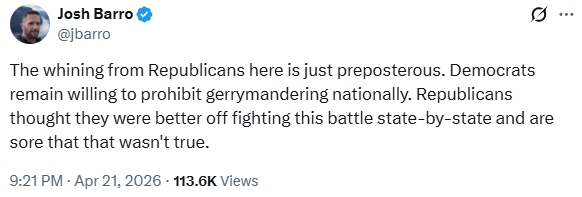
It’s amazing how a guy so loose in his language can consistently deliver such rich texts to analyze. You drop your bucket down anywhere and pull it up with something to say.
I voted for the bipartisan redistricting commission back in 2020. At the time, following on the heels of CA in the early 2010s and CO a little later, I firmly believed in wresting control of the process out of the hands of politicians. But you know what happened? Not a single red state followed suit. Democrats unilaterally disarmed and Republicans only became further entrenched in the process in places like NC and WI. For the first time in a long time, Democrats have said “fuck you” to Republicans. That Barro tweet was about a lot of “principled” conservatives whining about what Democrats did yesterday. Even the anti-Trump conservatives whined about it. You know what those people didn’t comment on, how bad NC Reps gerrymandered a purple state, or what a nakedly corrupt act the Texas redistricting was. The WAPO op-Ed page claimed Texas’ redistricting wasn’t a threat to democracy, but last night’s result in VA, is the end of democracy! Hypocrites, the entire lot of them. It’s about time Dems brought guns to a gun fight.
Pete Hegseth on not requiring flu vaccines in the military: "Your body, your faith, and your convictions are not negotiable."
Soldier: "Does that mean I don't have to take part in stupid foreign wars?"
Hegseth: "Your body, your faith, and your convictions are irrelevant."