




Big Hollywood business news this morning: Netflix has announced a deal to acquire Warner Bros for $72 billion, a deal that will give it ownership of both the storied studio—including film library—and the popular streaming platform HBO Max. Netflix will not acquire the other half of the firm, currently known as “Warner Bros. Discovery,” which owns CNN and other cable channels and will be spun off into a separate publicly traded company.
But just because Warner Bros. and Netflix have agreed doesn’t mean the merger is a done deal—Uncle Sam needs to sign off first. Some politicians, like Utah Sen. Mike Lee, are already railing against the deal on (ridiculous, some might argue) antitrust grounds. And the White House might have its own reasons to find these arguments compelling: Paramount, one of the other major bidders for Warner Bros., has a remarkably cozy relationship with the president these days. Happy Friday.
The New World Disorder
by William Kristol
Bob Kagan is a leading commentator on and historian of American foreign policy. In a conversation I had with him earlier this week, he argues that Trump’s second term could well prove a decisive break from the last eight decades of American foreign policy. It’s likely, he argues, to bring about a new world disorder very different from what we’ve experienced in our lifetimes.
Kagan’s bracing account of where we are and where we might be heading is very much worth your attention, and I provide some very lightly edited excerpts here. You can (and should!) watch or listen to it, or read the transcript.
Kagan on whether we’re entering a new period of history:
Normally, wearing my historian hat, I’m reluctant to say things have changed radically, because there’s usually tremendous continuity. And that’s particularly been true of American foreign policy since the end of the Second World War. It’s not that there haven’t been huge debates about American foreign policy, but mostly American policy, with a new administration, regardless of the rhetoric they’ve run on, is about 10 percent one way or 10 percent the other way in terms of our foreign policy.
But now I think we’re at a moment of a real break and a real discontinuity—and the beginning of a return to, I think the best way to put it is, “normal” international relations. Normal international relations are a very dangerous situation. We sort of take for granted the degree of peace that we’ve enjoyed over the past eight decades, the degree of prosperity, etc. And we sort of think that’s the norm. The norm is actually a lot more like what the world looked like before 1945. Certainly, the previous hundred years were one of constant great-power warfare. And I don’t think people are really quite ready for that, for the world that we’re now moving into.
On the consequences for the geopolitical order when the United States is an unreliable ally:
Trump has put us back in the position that we were in the ‘20s and ‘30s. We could help a country if we decide to help them. We don’t have to help them if we don’t decide to help them. This year we’re aligned with these guys; this year we’re aligned with that guy.
But it’s the permanence and reliability of the [post-1945] system that has been such a great force for peace.
For instance, the fact that the British could not necessarily be relied upon to come to France’s defense in 1914 had a huge impact on German calculations. If the Kaiser had known for sure that the British were going to come in on the side of the French, he would not have gone to war.
This whole notion that we are trapped into wars by the commitments we make to our allies—I think the opposite of that is true. We have not had to fight for any treaty ally. It is the reliability of the commitment that is the source of stability. And right now, we are absolutely anything but reliable.
On threats we face in Europe and Asia:
It’s hard to really get in the heads of both Putin and Xi Jinping. But I would say it would be logical for them to believe that they can’t count on the United States being Trumpy forever, that certainly the history of the United States is one where eventually we come back, and then we go to war and we defeat you.
In which case, I would say the urgency of getting done what you need to get done if you’re Putin is more than people think. I think there’s a lot of assumptions that whatever happens in Ukraine, he’s going to need years to deal with it. By the way, exactly the same arguments that were made about Japan in the 1930s—“It’ll take a while. We’ll have years to be ready for the next thing.”
It is clear that Putin’s building up a military that is not only about Ukraine, but also about Europe. And what some people are calling “phase zero operations” in Europe, which are really extensive, need to be understood as probes of European defense capabilities. And so if we have three years of Trump, I wonder whether Putin in particular—but maybe also Xi—thinks this is the time to make the move before the Americans have recovered their understanding of what needs to be done.
On Trump’s rejection of liberal principles:
One of the aspects of the turning point today is precisely that Trump, I think, is the first post–World War II president who does not share those basic liberal values. He doesn’t share them in terms of American domestic politics. And in foreign policy, his movement is also hostile to liberalism. They support all kinds of anti-liberal movements and governments around the world. And so that essential sort of ideological binding [of a commitment to liberalism broadly understood], which I think was kind of an essential glue to the whole system—that is gone.
All the presidents since World War II have shared that liberal outlook. So even Barack Obama, who I think was not happy with the American grand strategy—at the end of the day, he was unwilling to basically turn against the entire order in the same way. And that’s what’s different about Trump. He is willing to turn against the order.
Not a lot of happy talk in my conversation with Kagan, but important talk. Do watch, listen to, or read the transcript of the whole thing.
AROUND THE BULWARK
Trump Bites the Hand That Voted for Him... He couldn’t have won in 2024 without naturalized Americans—yet now he’s threatening their citizenship status, writes WILL SALETAN.
Trump’s Affordability “Con Job”... He pooh-poohs cost complaints as a “hoax.” Here’s what the numbers say, explains CATHERINE RAMPELL in Receipts.
MAGA Influencers Take Heat Over Qatar Junket... “Wow, America’s like really third-world compared to these places.” At False Flag, WILL SOMMER reports on the American MAGA influencers spending Thanksgiving in... Qatar?
We Got Ourselves a Mad King... Joining TIM MILLER on the Flagship Pod is SAM STEIN, who documents the many ways Trump 2 has flown off the rails.
Quick Hits
THE DOUBLE-TAP POST-OP: There are many crazy things about the double-tap boat strike that has plunged the Pentagon into still-deeper controversy over its campaign against Caribbean drug runners. But the craziest may be that it’s all on camera. Yesterday, members of Congress got to view the classified footage, and—this may shock you—Republicans and Democrats came away with very different interpretations of what it showed.
Sen. Tom Cotton (R-Ark.), who chairs the Senate Intelligence Committee, said the video showed an attack that had been “righteous” and “highly lawful.” The survivors of the first strike, he said, had been trying to flip a boat “loaded with drugs bound for the United States,” which made them still-legal targets.
But Rep. Adam Smith (D-Wash.), the ranking Democrat on the House Armed Services Committee, had a starkly different view. The survivors who were sitting atop the capsized boat when the military launched its second strike looked like “two classically shipwrecked people,” he told the New Republic yesterday. It was, he said, a “highly questionable decision that these two people on that obviously incapacitated vessel were still in any kind of fight.”
Earlier this week, President Trump told reporters that “we’d certainly release” the now-classified footage. He did not specify when. But we know President Trump is good to his word.
TEXAS’S GERRYMANDER STANDS: Texas’s mid-decade congressional gerrymander survived the Supreme Court on Thursday, with the Justices deciding to reverse a lower court’s ruling that had overturned the GOP’s newly-drawn maps. The court said that the lower court had “improperly inserted itself into an active primary campaign” and argued that there was no intent by Texas lawmakers to draw lines on considerations of race—just naked partisan politics (which, to be clear, makes it legal). The state is now locked with its new map at least through the 2026 midterms and the 120th Congress.
The decision is the latest development in what’s become an all-out redistricting war going into the midterms. Both parties are rushing to roll out tortuous new district maps that promise to eke out an extra congressional seat or two (or more!) in states where they enjoy unified legislative control. Senate Republicans in Indiana have found themselves in MAGA’s crosshairs for refusing to redraw their maps to net Republicans one or two additional seats, with some GOP opponents of redistricting saying they have suffered swatting attacks and bomb threats. Meanwhile, Virginia’s now overwhelmingly blue state legislature is the latest to enter the redistricting fray, having voted in October to give themselves the option to redraw their current map, which favors Democrats 6–5. Just how crazy could they get? The new fad among party members in the commonwealth is to envision a 10-1 split. We’re really in the Wild West now.
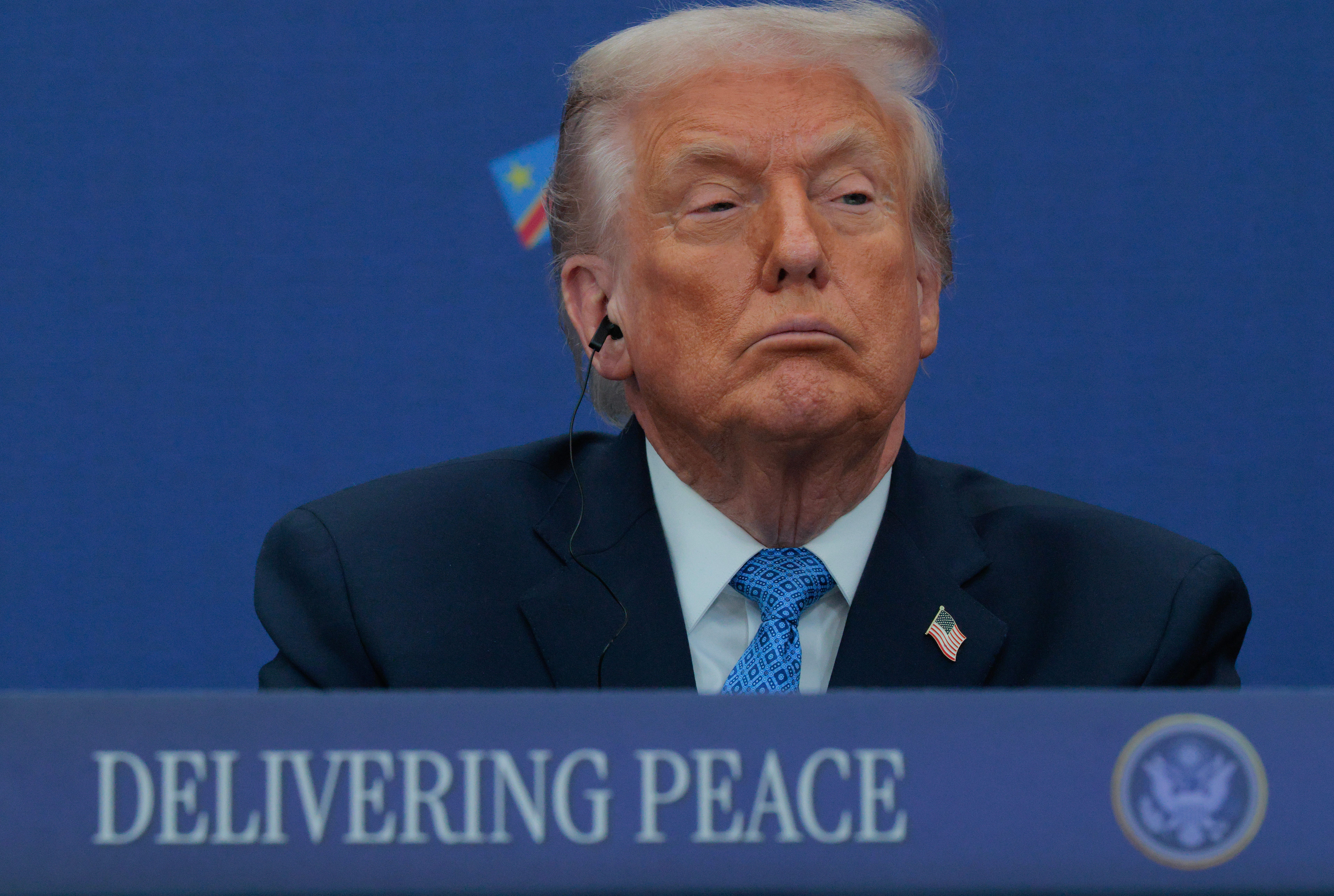
CONGRATULATIONS, SIR. YOU DESERVED THIS: Who could have seen this one coming? President Trump is set to get a coveted peace prize today. Just not quite the one he really wants. Per Politico:
President Donald Trump will take the stage at Friday’s World Cup final draw ceremony at the Kennedy Center in Washington where he will accept FIFA’s inaugural peace prize, according to a draft of the run-of-show obtained by POLITICO.
KASH. WHAT ARE YOU DOING??? FBI Director Kash Patel has been under an intense microscope for the . . . liberal . . . ways he is deploying his security detail and taking advantage of the FBI jet. So the latest from the Carol Leonnig and Ken Dilanian scoop factory over at MS NOW caught our attention:
FBI Director Kash Patel has—on more than one occasion—ordered that the security detail protecting his girlfriend escort one of her allegedly inebriated friends home after a night of partying in Nashville, according to three people with knowledge of the incidents.
Patel’s girlfriend, Alexis Wilkins, asked FBI agents on her security team at least two times, including once this spring, to drive her friend home, and agents objected to diverting from their assignment, said the sources, who were granted anonymity to discuss nonpublic matters. But Patel insisted they do as Wilkins requested and in one case called the leader of Wilkins’ security detail and yelled at him to do so.
A few questions on this one. Do they not have Uber in Nashville? Could the drunk friends not have hopped on one of those bachelorette party wagons that plague the city? Were the agents asked to send the friends a bacon-egg-and-cheese sammy with a yellow Gatorade to wash it down the next day? We’ll stay on top of this still-developing story.
Cheap Shots
Every time I start feeling better about our chances to overcome the horrors of the Trump administration and this iteration of the GOP, the Supreme Court dashes my hopes. I don't know how it can be done, but if and when Democrats ever come to power, there has to be some reform there. It has become a partisan arm of the the Republican executive branch, and not a true arbiter of justice or protector of the Constitution.
Don't let your friends drive drunk. If they seem drunk, tipsy, or buzzed, take their keys and call in an FBI SWAT team.
~The More You Know🌈⭐