The Danger and Foolishness of Trump’s Foreign Policy
There are no grand designs, just vanity and vindictiveness.


Over the weekend, the president of the United States made a social media post accusing Minnesota Gov. Tim Walz of ordering the murder of former state House Speaker Melissa Hortman last year. Too much happening in the news to really give that sentence the space it deserves, but that’s a thing that actually happened.
As we were about to press “send” on this newsletter, we got breaking news: Minnesota Gov. Tim Walz announced this morning he will not seek re-election, as he weathers a major political crisis involving massive state fraud on his administration’s watch. It’s a remarkable fall from grace for a politician who was his party’s vice presidential nominee just over a year ago. We’ll be going live on camera in just a few minutes—at 9:45 a.m. EST—to discuss. Head to our homepage or our YouTube page to watch. Happy Monday.
A Foreign Policy of Failure and Dishonor
by William Kristol
The British author and poet Rudyard Kipling was a conservative, even a reactionary. He was certainly no anti-imperialist. Yet in his 1897 poem “Recessional,” written at the height of the British empire, Kipling warns his countrymen against becoming “drunk with sight of power” and indulging in “frantic boast and foolish word.”
Needless to say, there’s no chance that Donald Trump will attend to this warning. Trump has always been drunk on fantasies of power. His entire rhetorical repertoire consists of frantic boasts and foolish words. He’s not suddenly going to heed Kipling’s advice.
He won’t, but we should. Trump is our president. He’s acting in our name. Unfortunately, we won’t be able to undo all the dangerous mistakes he’s already made. And we won’t be able to stop him from continuing to indulge in frantic boasts. But an awful lot depends on whether we can limit the damage that he seeks to bring about over the next three years, and whether we can at least hold out hope of a responsible road ahead.
The case against Trump’s foreign policy isn’t a difficult one, and it can be made by a broad coalition of people. They may differ on what a responsible foreign policy would look like going forward—whether it should be more or less interventionist, more or less democracy-promoting, more focused on Europe or Asia, more reliant on hard or soft power, etc. But judging from public opinion polls and congressional support for, for example, aid to Ukraine, a broad coalition opposes a foreign policy based on bullying and greed, and would support a foreign policy of strength used responsibly, in line with American principles, and on behalf of both our own well-being and that of others.
The case against Trump’s foolish foreign policy is easy to make. It’s pretty obvious that boasting that we “we are going to run” Venezuela, as Trump did on Saturday, doesn’t mean we are in fact going to be willing or able to run Venezuela. Repeating last night on Air Force One that “we’re in charge” of Venezuela doesn’t in fact put us in charge. Claiming American oil companies are soon going to reap great profits from Venezuela won’t make that unlikely eventuality a reality (about which more below).
But Trump’s empty boasting and self-congratulatory bullying aren’t cost-free. They have consequences. Either they can lead us into reckless actions that will ultimately weaken us, or they can make us look weak when we back off from doing what Trump has said we’re going to do.
Last night, on Air Force One, Trump threatened military action against Colombia, Mexico, and Greenland. There is no legal or prudential case for military action in any of these instances. But the case of Greenland—a semiautonomous territory of our NATO ally Denmark, with whom we’ve had a very cooperative and constructive security relationship—is most instructive.
“We need Greenland from the standpoint of national security,” Trump said last night. A couple of weeks ago, Trump said, “We have to have it.” And in a phone call earlier yesterday with Michael Scherer of the Atlantic, Trump said that “we do need Greenland, absolutely. We need it for defense.”
This is a bizarre fantasy. But the danger that Trump’s vanity and grandiosity will lead him to try to seize Greenland is real. Early yesterday, before Trump’s latest comments, I received a text from a friend and occasional Bulwark contributor, Michael Wood: “Dark horse prediction for 2026: US will shoot at or seriously threaten to shoot at Danish troops.” I don’t know that Wood is wrong. And this would of course mark yet another sign of the end of an already tottering NATO, and of an alliance system that is the basis of any international order somewhat friendly to liberal democracy.
I’m tempted to close by denouncing Trump’s hubris. But to use that term would be to dignify him too much. Hubris implies a certain grandeur of purpose. Trump has no great ambitions to shape a better world or even a better hemisphere. With him, it’s all boasting and bullying and lying, greed and narcissism and vanity. If we permit Trump to go down his chosen path—if we permit him to lead us down this path—the legacy will be one not just of policy failure but of national dishonor. That will be Trump’s legacy. But it will be ours too—unless we stop it.
The Belly-Button Rule
by Mark Hertling
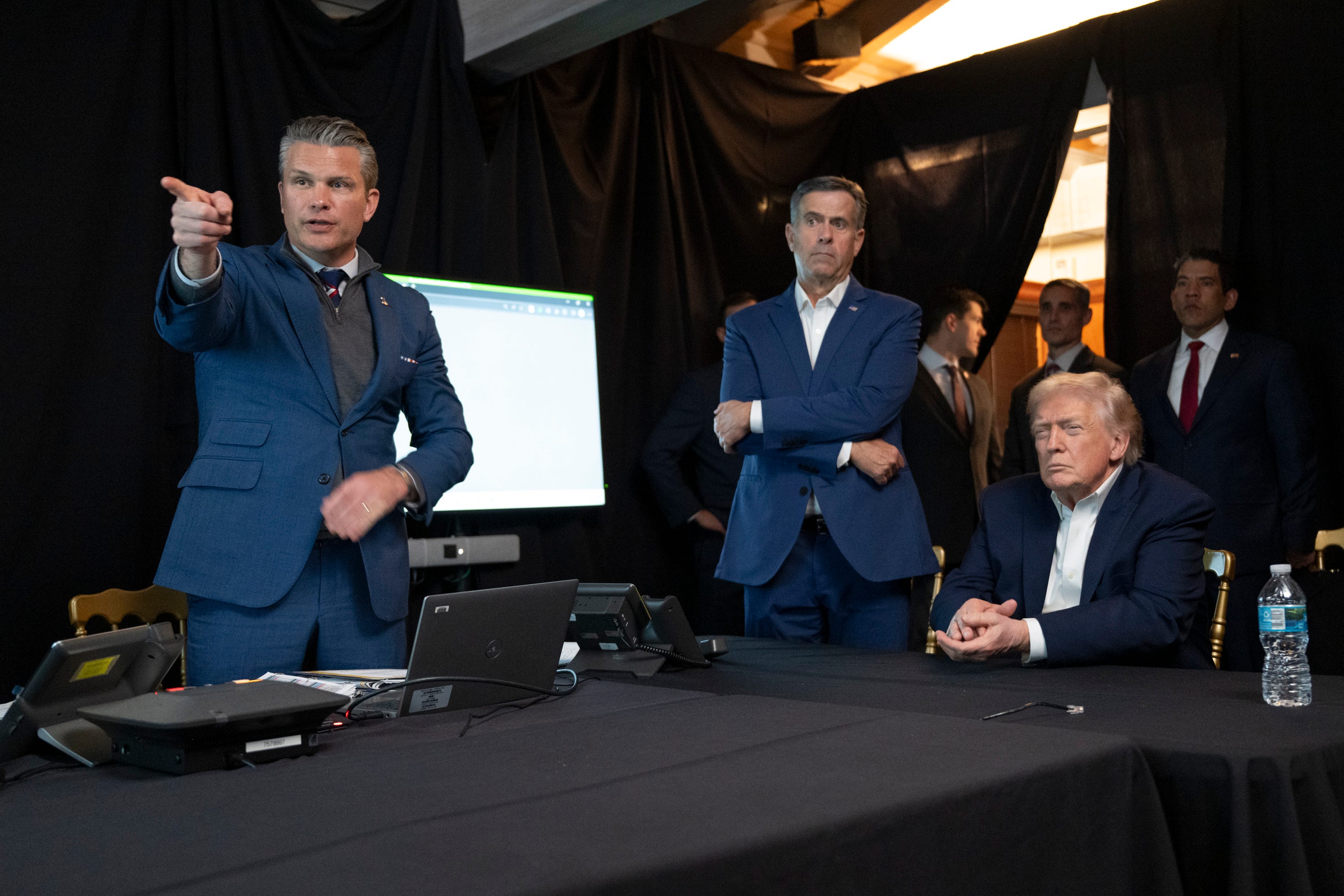
On Saturday, at his press conference after American military forces attacked Caracas and apprehended Nicolás Maduro and his wife for arraignment in New York, President Donald Trump announced that the United States was going to “run” Venezuela. He was then asked who oversaw U.S. actions in Venezuela and what the plan was. Rather than describing the details of what was going to happen and the myriad tasks associated with removing a foreign leader, or naming a single accountable official, he gestured behind him toward a group of senior advisers—Secretary of Defense Pete Hegseth, Secretary of State Marco Rubio, CIA Director John Ratcliffe, and Deputy Chief of Staff Stephen Miller—suggesting collective responsibility.
From a leadership standpoint, that answer should concern anyone who understands how complex operations succeed or fail. As I wrote just before the Caracas operation, regime change demands a whole-of-government approach with objectives that have extraordinary clarity, unity of effort, and sustained accountability across every element of national power. Even when carefully planned, regime change is among the most difficult undertakings a nation can attempt. When it is improvised, ill defined, or politically fragmented, it almost always ends badly.
Regime change fails less often from a lack of resources than from a lack of both planning and responsibility. Over decades of command, I learned what I call the “belly-button rule” for assigning responsibility: When a task is truly hard—complex, risky, politically sensitive, or strategically consequential—a senior leader in government, business, or on the battlefield must be able to point to one person and say, “You’re in charge.” One person. One belly button.
Every serious operation requires three things to be unmistakably clear: what must be done, by when (or under what conditions), and who is in overall charge of making it happen. If any one of those is ambiguous, execution suffers. If responsibility is diffuse, accountability disappears—and so does disciplined decision-making and follow-up by the strategic leader.
Assigning responsibility does not mean dictating how a task must be accomplished. In fact, it means the opposite. Assigning responsibility empowers initiative. Once a subordinate leader owns the mission, they gain the authority to coordinate, adapt, innovate, and make tradeoffs. The strategic leader sets the objective and the boundaries. The responsible leader determines the method.
The kind of diffuse responsibility President Trump handed out on Saturday reminds me of what I saw in post-invasion Iraq. In the early days after the 2003 invasion, postwar stabilization was fragmented. Lt. Gen. Jay Garner was initially placed in charge of reconstruction and governance, but his authority was limited, contested, and ultimately undermined. He clashed with Amb. Paul Bremer, who replaced him, while major decisions were pulled upward to Secretary of Defense Donald Rumsfeld and operational commander Gen. Tommy Franks. No single leader was clearly empowered—and held accountable—for aligning political objectives with post-invasion security realities on the ground.
The result was not merely bureaucratic friction. It was strategic incoherence and chaos.
Regime change magnifies every leadership failure. It requires synchronized diplomatic messaging, economic pressure, intelligence operations, security forces, and post-conflict governance planning. When responsibility is shared, decisions slow. When outcomes falter, blame disperses. When reality intrudes—as it always does—no one has both the authority and obligation to adjust course decisively. The tasks aren’t accomplished and the mission fails.
The belly-button rule is not about hierarchy for its own sake. It is about seriousness. It forces leaders to confront whether they truly understand what they are asking others to do. It requires trust in the person in charge to execute a plan to meet their objective, and it requires that person’s trust in their superiors that they will be supported when friction and failure inevitably arise.
Most of all, clearly assigned responsibility signals credibility. To allies, it shows unity. To subordinates, it provides clarity. To adversaries, it communicates resolve.
Complex operations do not fail primarily because they are hard. They fail because responsibility is blurred. If the strategic leader—in this case the president—doesn’t put his finger into the belly button of the person he is placing in charge, he’s not leading. He’s just hoping things magically work out.
And hope, as every commander learns, is not a method or a plan.
AROUND THE BULWARK
The Venezuela Regime Change Operation… From Saturday morning, SAM STEIN, MARK HERTLING, SARAH LONGWELL, BEN PARKER and JOE PERTICONE reacted live to the Trump administration’s press event on the Venezuela operation.
Which Countries Will Trump Invade Next? He’s Given Us a Guide. The reasons he listed for toppling Venezuela’s Maduro apply just as well to many other governments, warns WILL SALETAN.
What to Expect from the Supreme Court in 2026… Three areas of law where the right-wing majority could remake our democracy cautions KIM WEHLE.
The Dem House Campaign Chief Outlines Her Case for the Midterms… In The Opposition, LAUREN EGAN interviews DCCC chair SUZAN DELBENE on the search for candidates who click with their communities.
Trump Says We Have the “Hottest” Economy. Markets Tell a Different Story. The U.S. economy entered 2025 as the “envy of the world.” It exited well behind its peers, writes CATHERINE RAMPELL in Receipts.
America Is Losing Faith in Everything… OLIVER LIBBY joins JOHN AVLON on How to Fix It to discuss why the American Dream feels out of reach—and what it would actually take to fix it.
How Bad Can It Get? On The Bulwark on Sunday, SARAH LONGWELL joins BILL KRISTOL to share her thoughts on possible paths 2026 could take—from a democratic rebound to a far darker slide.
Quick Hits
PUTIN’S HUMILIATIONS: Four days in, 2026 has already presented a string of humiliations for Vladimir Putin. On New Year’s Eve (which was already 2026 in Russia), U.S. intelligence shot down (as it were) his complaint to Donald Trump about being targeted by Ukrainian drones. The much-hyped, evidence-free Russian claim about 91 drones headed for Putin’s residence near the town of Valdai was a remarkably clumsy excuse for the Kremlin to back out of peace negotiations it apparently sees as tilting against it.
The next shoe dropped on January 2. The recently reported death of Denis Kapustin, commander of a pro-Ukraine Russian volunteer force, was revealed as a fake—staged by Ukrainian intelligence to thwart the Russian special services’ hit on Kapustin, whom Putin is said to view as a “personal enemy.” Kapustin, a self-styled “traditionalist” with alleged far-right ties, isn’t exactly a good guy; even so, this was a brilliant Ukrainian maneuver which not only exposed Russian operatives but, hilariously, netted a $500,000 bounty from the Russian government.
For whatever else it means and portends, the U.S. raid on Venezuela and the capture of dictator Nicolás Maduro is a huge slap in the face to Maduro’s Kremlin pal. Was there talk between Putin and Trump in 2019 of a Ukraine-for-Venezuela spheres-of-influence trade? Maybe. But in 2026, the United States took less than three hours to grab Maduro. Meanwhile, Putin’s army is stuck in Ukraine trying to take ghost towns in the Donbas while Volodymyr Zelensky—notably un-kidnapped, despite Putin’s best efforts—makes pointed jokes about the next dictator the United States could take down. No wonder Russia’s war-hawk bloggers are beside themselves.
Putin’s string of embarrassing bad luck probably won’t make Trump more inclined to help Ukraine. But a headache for Putin is always a silver lining.
—Cathy Young
GO GET THE OIL: Much of what’s to come in Venezuela remains in flux, but Donald Trump seems pretty sure how at least one part of its post-Maduro future is going to go: the part about the oil. “We’re going to have our very large United States oil companies, the biggest anywhere in the world, spend billions of dollars, fix the badly broken infrastructure, the oil infrastructure, and start making money for the country,” Trump said Saturday. The money to rebuild would be “paid by the oil companies directly,” although “they will be reimbursed for what they’re doing.”
To which oil executives seem to be responding: Wait, who, us?
It’s not exactly surprising that the administration didn’t loop the industry in before executing its top-secret mission to decapitate the Maduro regime. But Trump’s confident predictions about what the industry will do now stand in stark contrast with the early signals from the oil companies themselves, which have been far more guarded. Administration outreach to the industry is “at its best in the infancy stage,” one oil executive told Politico this weekend. “It’s been sporadic and relatively flatly received by the industry. It feels very much like a shoot-ready-aim exercise.”
EYES ON THE PRIZE: One of the many surprises of the weekend was Donald Trump’s offhand dismissal Saturday of the possibility of a new government run by Venezuelan opposition leader María Corina Machado, the recipient of last year’s Nobel Peace Prize, whose stand-in candidate won more than two-thirds of the popular vote in last year’s Venezuelan elections. “It’d be very tough for her to be the leader,” Trump said Saturday, since “she doesn’t have the support or the respect within the country.”
A remarkable piece of reporting on that front, via the Washington Post this weekend:
Two people close to the White House said the president’s lack of interest in boosting Machado, despite her recent efforts to flatter Trump, stemmed from her decision to accept the Nobel Peace Prize, an award the president has openly coveted.
Although Machado ultimately said she was dedicating the award to Trump, her acceptance of the prize was an “ultimate sin,” said one of the people.
“If she had turned it down and said, ‘I can’t accept it because it’s Donald Trump’s,’ she’d be the president of Venezuela today,” this person said.
File under: shocking but not surprising.
Cheap Shots
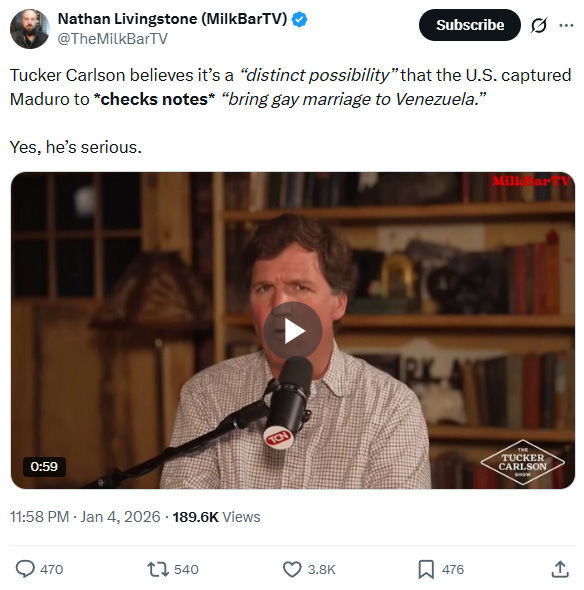
We’ve got to admit: We hadn’t considered this angle.
... If we attack Greenland... does that trigger Article V? And all of NATO goes to war with us? An attack on Greenland is legally an attack on Denmark for NATO purposes, no? The U.S. would be the clear aggressor, and there is no carve-out for attacks by a NATO member against another NATO member. Christ.
Watching the 20-something Trump supporters and the isolationist America First-ers go all in on Venezuela is hilarious. I feel like it’s 2003 and I’m 20 all over again. I remember watching W announce “mission accomplished” about 3 months after the invasion. The single bloodiest day in Iraq was in 2006. I can guarantee that if American boots are on the ground in Venezuela, there will be American casualties. And all of the AF-ers will then bray for even more blood. What a fucking mess.