Donald Trump, Alpha President, Has Been a Disaster for the He-conomy
The manly industries have not thrived under the current administration. If anything, they’ve suffered.

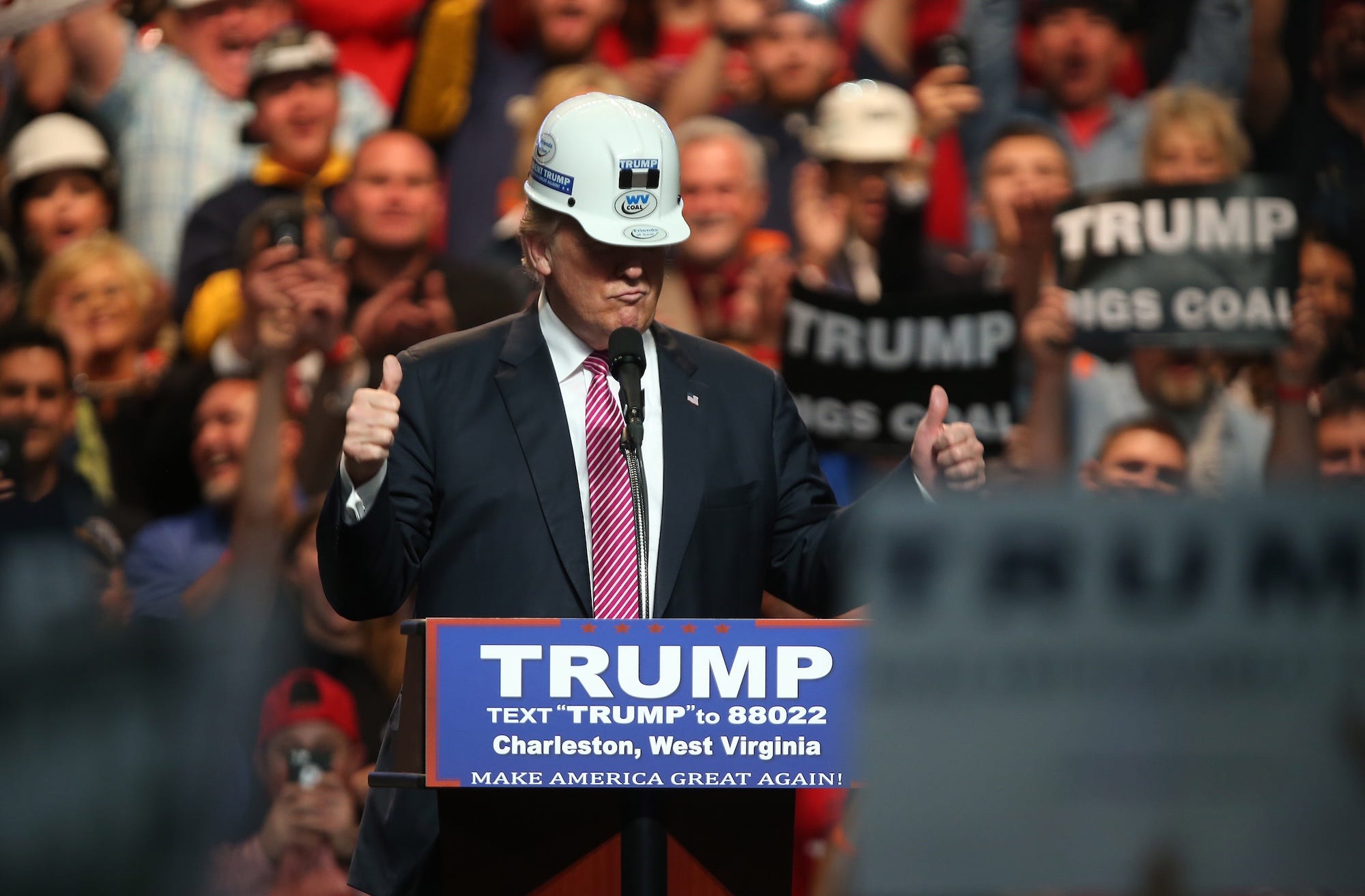
MOVE OVER, Joe Camel. Get lost, Jared Fogle. The newest, grossest, most child-endangering industry mascot is ready for his closeup, courtesy of the Trump administration.
Meet “Coalie.” He’s a cartoon lump of coal with a yellow hard hat and large, anime-like googly eyes, and he’s been enlisted as the “spokesperson” for Donald Trump’s “American Energy Dominance Agenda,” per Interior Secretary Doug Burgum. Coalie is here to make coal look cute and cuddly, so young Americans can learn to love coal and older ones can rekindle the romance.
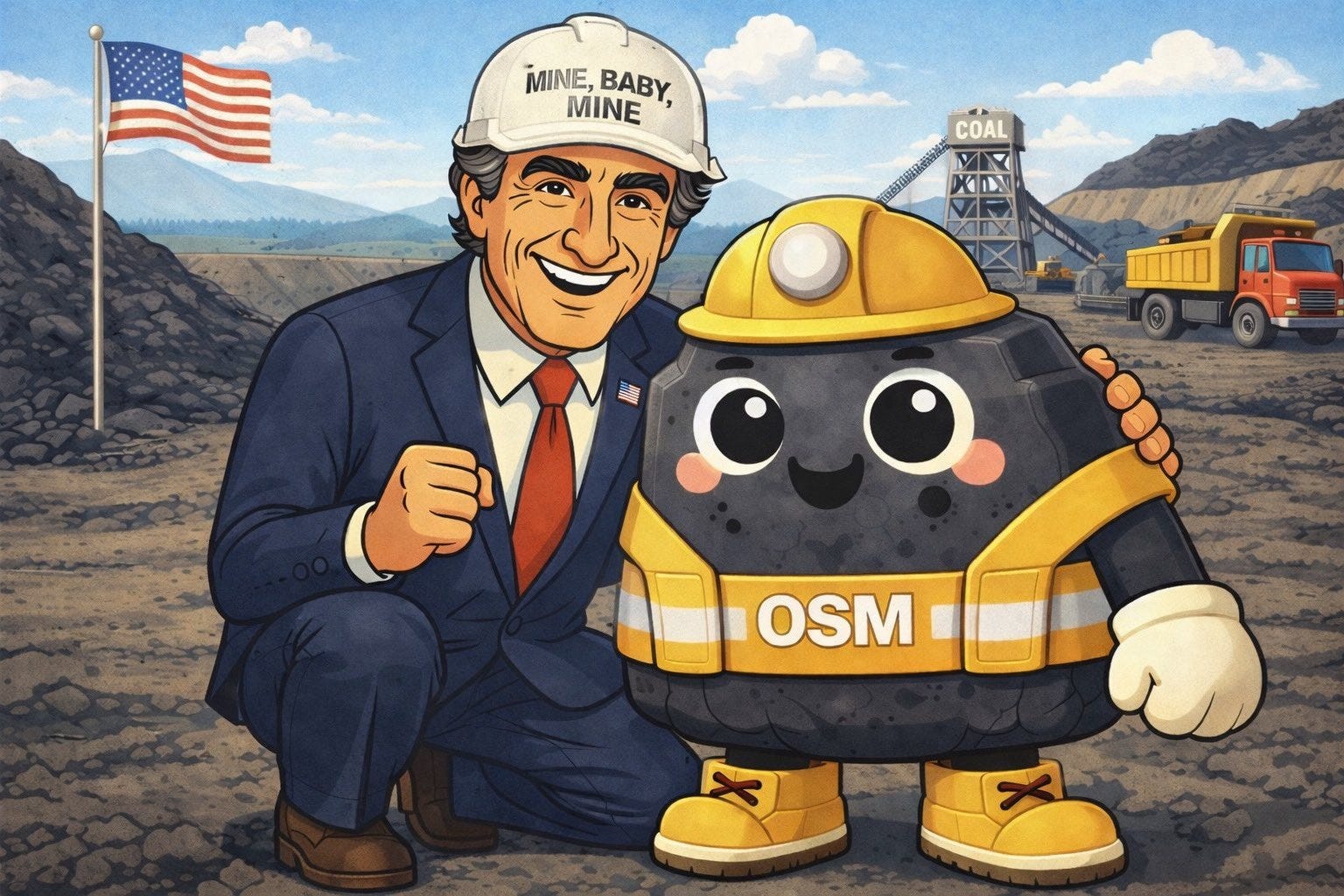
Make Black Lung Great Again!
Despite Coalie’s sweet kawaiian gaze, coal is obviously not the most wholesome energy source out there. Emissions from coal-fired plants are bad for the climate, bad for the local environment, and terrible for nearly every metric of children’s health. Coal extraction has sickened or killed generations of miners, and the Trump administration’s deregulatory agenda has made it easier to poison today’s workforce too. But even with a mawkish marketing campaign ignoring all these drawbacks, coal is unlikely to enjoy the economic renaissance under Trump.
And that’s part of a larger, underappreciated pattern with this administration. Trump has promised to revive a host of brawny, blue-collar industries that apparently remind him of when America was great. These tend to be predominantly male-dominated sectors that have been in long-term structural decline; their employees, mostly engaged in physical labor, have been displaced partly by trade but mostly by automation. But no matter how much money he throws at the old-timey he-conomy, these sectors continue to fall behind—in part because Trump’s own economic agenda is hampering them.
As a source of energy in the United States, coal has been in decline for more than a decade.
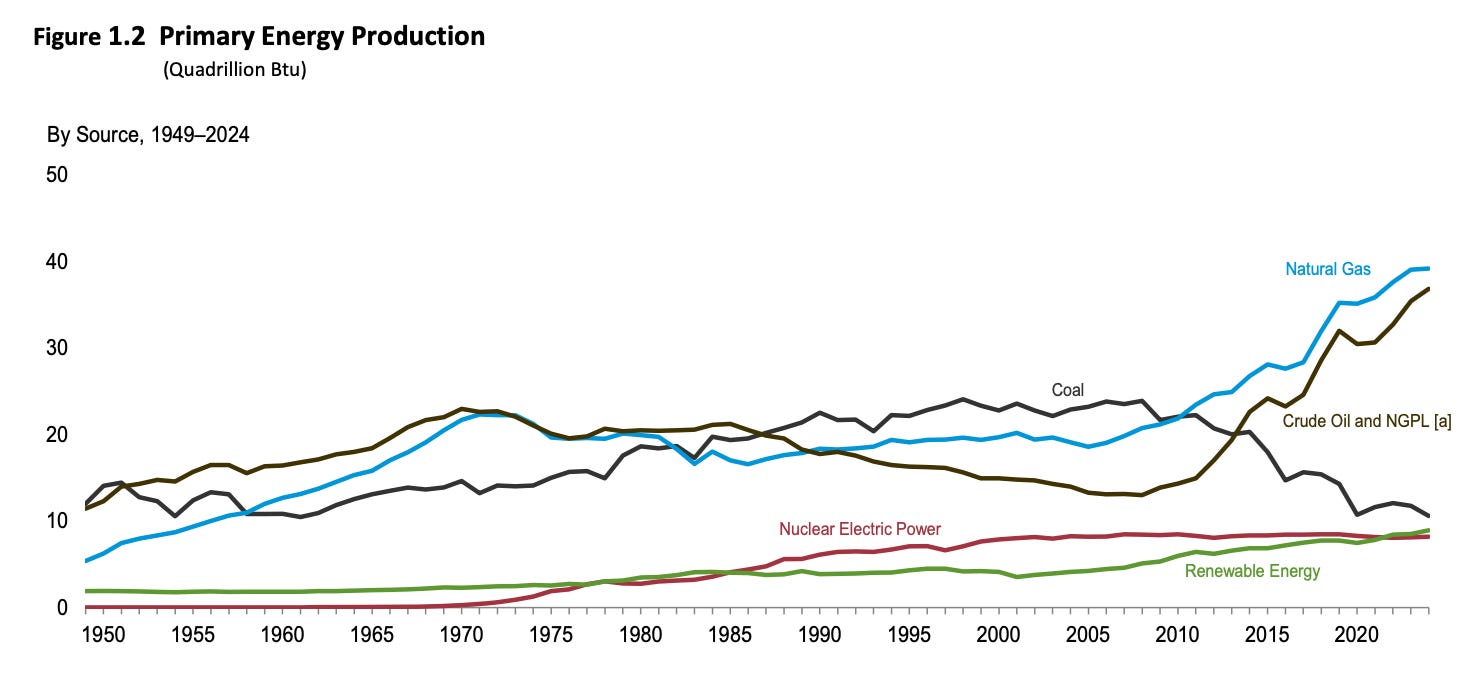
That’s because coal is just no longer cost-competitive relative to other energy sources, particularly natural gas in the post-fracking era.1 Nonetheless, Trump has tried to prop up coal out through various means, including:
1) spending hundreds of millions of dollars directly subsidizing the coal industry;
2) rolling back mine safety regulations and oversight, ostensibly to encourage more investment;
3) mandating that some coal plants slated for retirement remain open—even if their equipment hasn’t been maintained, is experiencing mechanical failures, or is otherwise in disrepair; and
4) trying to sabotage other energy sources or else make them more expensive. For instance, the administration has tariffed solar parts, repealed renewable energy tax credits, and revoked federal approvals for wind and solar farms.
But even this isn’t enough.
There are now about 40,000 people working in the coal industry. For comparison, that’s less than the undergrad enrollment at Penn State. And employment in the coal industry has, on net, declined slightly in the past 12 months, losing about 1000 jobs.
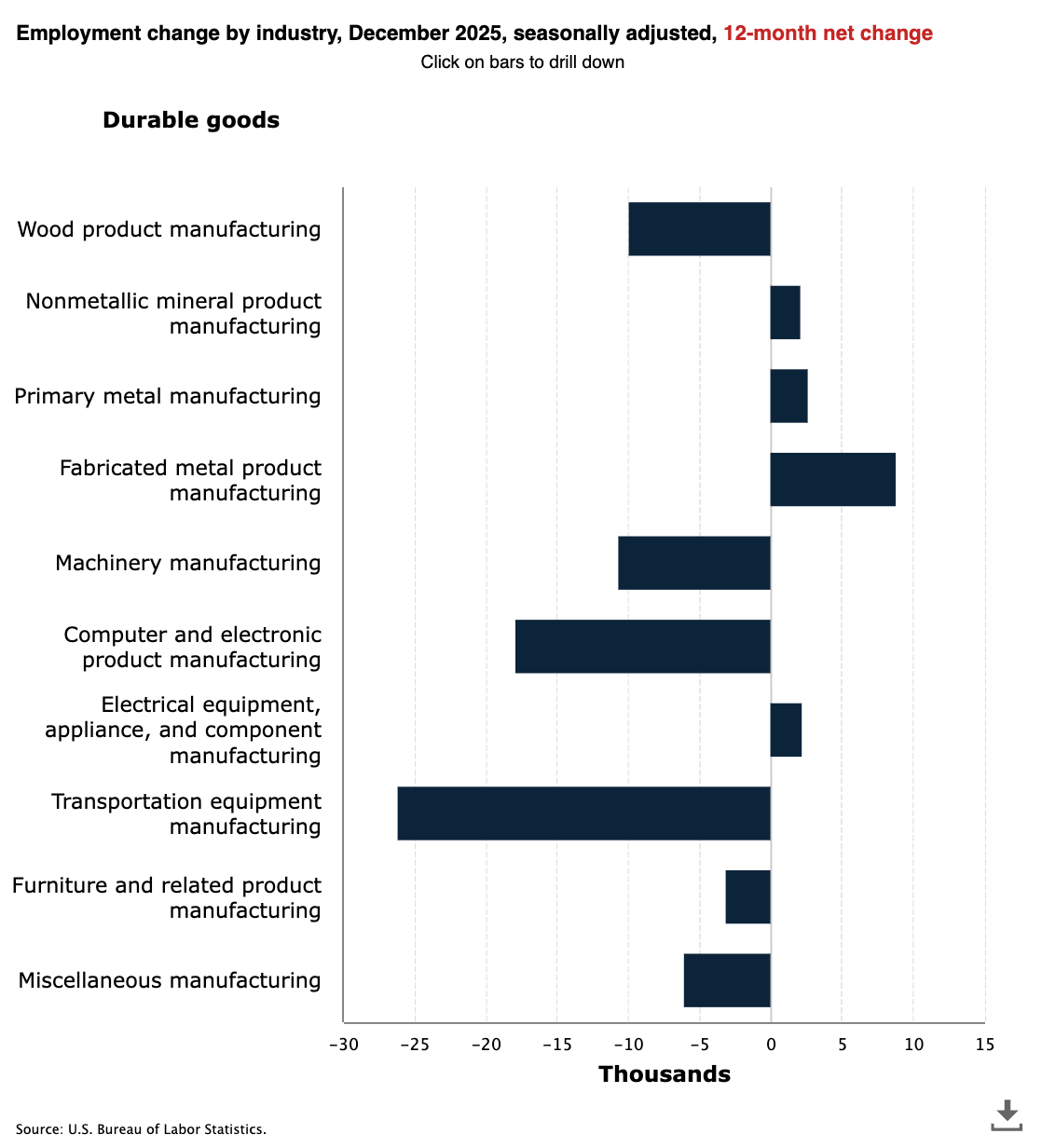
Like coal, manufacturing was also supposed to enjoy a new golden era under Trump. Instead, it lost 68,000 jobs over the past year. Other metrics show it in contraction for most of Trump’s current term (and prior to his inauguration, to be clear).
This is part of a long-term structural decline. We are a services-based economy, and have been for many decades. Lower-value manufacturing has moved abroad, and higher-value production is increasingly done by a few people and many, many robots.
In addition to these longer-term challenges, manufacturing now also must contend with Trump’s disastrous trade wars. These trade wars have hampered or killed off many of our export markets, and also made it much more expensive for U.S. firms to operate. After all, American factories purchase materials and equipment from abroad. And even when they switch to domestic producers shielded by tariffs, their input costs still rise. That’s sort of the whole point of the tariffs: to help domestic producers capture more of the market and give them more pricing power.
Take the examples of steel and aluminum. Trump has placed draconian global duties on these metals. As a result, steel prices in the United States have skyrocketed relative to prices abroad.
Employment in domestic metal manufacturing firms is now doing okay—it’s up a touch year over year—because Trump pummeled the international competition with tariffs. Meanwhile, American firms that have to buy steel (machinery, furniture, electronics, cars) are screwed and shedding workers.
Then there’s the agricultural sector, which is also struggling.
Key inputs (fertilizer, machinery) have been tariffed to death, raising farmers’ costs. Much of the agriculture workforce is being rounded up, or is preemptively fleeing ICE. And again, export markets have closed off, with soybean sales to China completely suspended for an unprecedented six straight months. Farm bankruptcies in the first nine months of 2025 were 36 percent higher than the total for all of 2024. Trump’s measly $12 billion payoff “bridge payment” to farmers will not heal this damage, particularly if their export markets are lost for good.
Construction employment isn’t down yet, but hiring has significantly slowed. And deportations, tariffed inputs, and high interest rates (driven in part by tariff-related Trumpflation) are all weighing on the sector, too.
It’s proving tough to be a worker in the male-dominated sectors of the Trump economy. Assuming the tariffs aren’t going anywhere, they’re gonna need a lot more cutesy cartoon mascots.
Looking for a Hero
One running theme of my newsletters is exploring what it will take for the corporate sector to finally stand up to Trump’s threats to democracy—if not out of a sense of duty or patriotic ideals, at least to protect its own self-interest. After all, destruction of the rule of law, corruption, erratic authoritarian decrees, expropriation, weaponization of government powers against perceived enemies, etc. are all terrible for the bottom line and economic growth writ large.
This week got my hopes up—at least a little.
Citadel CEO Ken Griffin, a GOP megadonor, made headlines with some terse comments at a Wall Street Journal event in West Palm Beach. Griffin has been critical of Trump’s policies before, including tariffs and assaults on Fed independence. But somehow this felt different, in part because Griffin criticized not just poorly thought-out policy, but also corruption.
Asked about reports that Trump secretly sold a 49 percent stake in his crypto firm to an Abu Dhabi royal days before his second inauguration, Griffin alluded to possible self-dealing.
“This administration has definitely made missteps in choosing decisions or courses that have been very, very enriching to the families of those in the administration,” Griffin said. “That calls into question, is the public interest being served?”
I don’t want to make too much of this. Griffin also praised Elon Musk for selflessly walking away from the private sector in pursuit of “public service” via DOGE—a laughable assertion considering how little DOGE achieved, and Musk’s overwhelming conflicts of interest in that role.2
Griffin also managed to both-sides his critiques of Trump’s corruption: “Most CEOs just don’t want to find themselves in the business of having to, in some sense, suck up to one administration after another to succeed in running their business.”
Nonetheless, even this gentle criticism is braver than what most titans of industry have been able to muster. So I’ll say: more of this, please.
My real hero for this week, though, is Julie Le, an ICE lawyer who had been working as a detail for the U.S. attorney’s office in Minnesota.
You may have seen her now-viral comments saying “This job sucks,” and suggesting she almost wished a judge would hold her in contempt so she “could get 24 hours of sleep.” But the rest of the transcript of her colloquy with Judge Jerry Blackwell is equally remarkable.
Le said that she had tried to resign, but ended up staying to help wrongfully detained people get out of detention. She also observed that her own family was at risk: “I am not white, as you can see,” she told the judge, “and my family’s at risk as any other people that might get picked up too.”
She was later fired from the U.S. attorney’s office; it’s unclear whether she was fired from her ICE post as well. Read an annotated version of the transcript here, courtesy of Chris Geidner.
The cost disparity is partially due to public policy, like renewable energy incentives that became law during the Biden administration and regulatory costs associated with coal. But according to the investment firm Lazard, renewables are still “the most cost-competitive form of new-build generation on an unsubsidized basis (i.e., without tax subsidies).” In some parts of the country, it’s cheaper to build an entirely new solar or wind plant from scratch than to continue operating an existing coal plant.
Here is Griffin’s full comment:
I mean, even just look at the backlash on Elon Musk, right? We can—we can quibble back and forth, and we can do more than quibble, about some of the choices or things that he said. But you do you know what? The most successful business person in the United States walked away from his companies to commit himself to public service for months. We may not love everything we did, but we should admire that willingness to give up oneself to make our country better.
Biden worked very hard to bring back manufacturing jobs, including especially in Red states. He was reasonably successful in doing so despite Republican efforts to sabotage his policies. He received no political benefit for his actions. Trump has just about killed job growth with erratic tariff policies, except in healthcare where demographics drive growth that even Trump can’t sabotage, and of course ICE.
The voters don't care about reality anymore. The lowly retarded rural republicans aren't smart enough to see beyond the culture war victory of having their god king in charge. They would establish a Kingdom here if it meant owning the Libs. And all the rich fake Republicans are rolling in riches beyond measure on their way to making a sovereign nation devoid of any tax responsibility to the USA. They will extract all the value from America's corpse for their vain immortality projects.