

Drug Courts Save Lives. That May Not Save Them From Trump.
An Alabama man’s recovery story shows what the program can do—and what could be lost.

Helena, Alabama
DANIEL OLDHAM WAS STANDING in a holding room inside a Birmingham-area jail, waiting for a judge to appear on the video monitor and anticipating what he assumed would be one of the worst days of his life.
It turned out to be one of the best.
It was April 2018. Police had arrested Oldham three days earlier for drug possession—a felony charge of which he was guilty, and for which he was likely to spend at least several months in prison. It was the first time Oldham had faced criminal charges, he told me in a recent interview, even though he was nearly 40 and had been taking illicit substances ever since he was in his early teens. He had learned to use and sell drugs from close family members whose own lives were lived in the world of addiction.
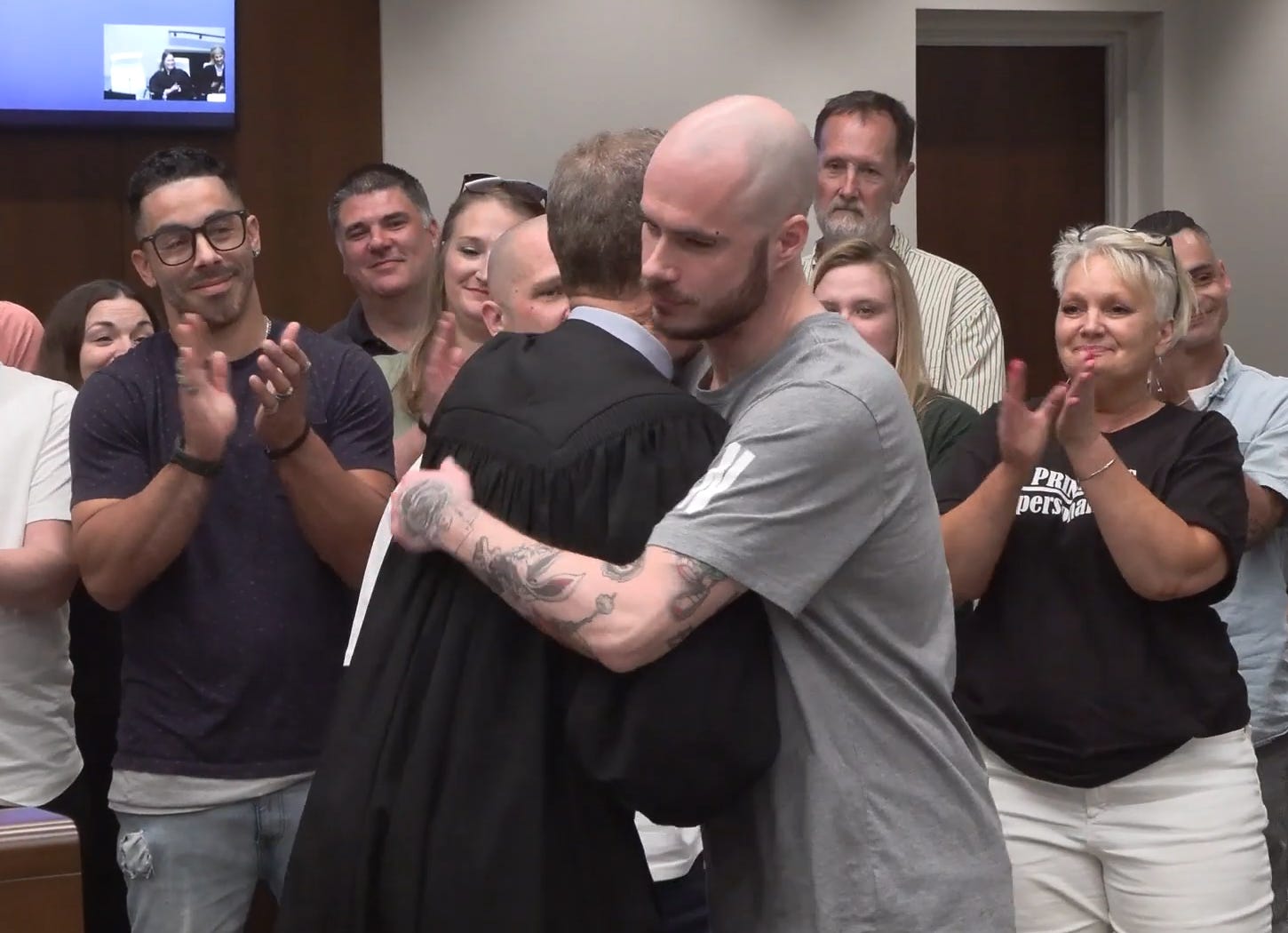
But before the hearing began, Oldham learned that he had another option. The state of Alabama was willing to send him to “drug treatment court,” an alternative to standard criminal proceedings that was available to first-time, nonviolent drug offenders. The accused who go to these courts agree to enter into recovery and find work and housing, all under the watchful eye of a judge who serves as mentor, nurturer, and enforcer.
That sounded better than jail time, so Oldham said yes. He spent the next eighteen months meeting program requirements: taking drug tests three times a week and appearing before a judge once a week, all while logging meetings and activities to show he was participating in recovery and generally getting his life in order. As he was approaching the end of those eighteen months, he stood in a wood-paneled law library downtown to offer a “testimony” about his journey—how he had landed work as a painter and had found faith in a nearby church, and how his long-term plan was to help others overcome their substance-abuse disorders.
“When I got in there,” Oldham told me. “I just got a heart for helping people.”
Today, six years out of the program, Oldham is doing just that. He leads a Christian-based recovery group that he started in his church and speaks to gatherings across the greater Birmingham area, as part of his work as a certified recovery-support specialist. His painting business is going well, he says, and in 2021 he married a woman who was also in recovery. They recently bought a house in a quiet, middle-class Birmingham suburb, not far from the site of the arrest that first got him to drug court.
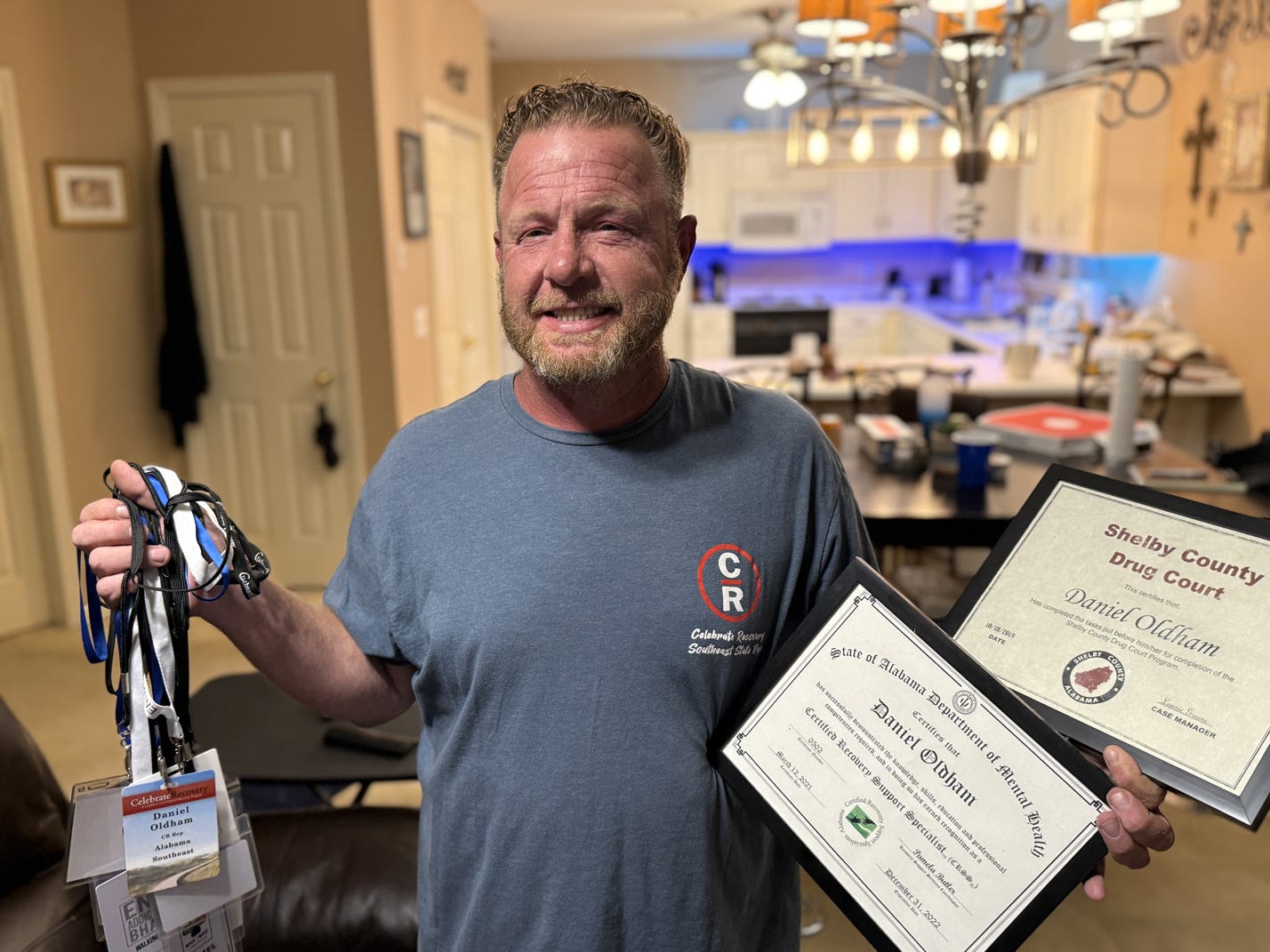
The story of how Oldham turned around his life is, like all such stories, a complex one, rooted in everything from the strengths of his personality to some episodes of good fortune—which, he believes, was the work of God. But Oldham says he would not be around today if not for the drug court, which was one of hundreds that have popped up across the country over the last thirty-five years.
They are part of what is widely considered one of the more promising initiatives to combat substance abuse, and they have benefited from substantial federal support. But now that support is in jeopardy, because the key agency administering it is being ripped to shreds by the Trump administration.
THAT AGENCY IS SAMHSA, the Substance Abuse and Mental Health Services Administration, which Congress created in 1992. SAMHSA’s primary job is doling out grants to states, local governments, and independent nonprofits, though it handles some other projects like overseeing the ‘988’ suicide and crisis line, and conducting the gold-standard national survey on substance abuse.
With an overall budget of just $9 billion last year, it represents barely a blip on the landscape of federal spending. But it sits within the Department of Health and Human Services, and like so many other divisions in that cabinet department, SAMHSA has taken heavy blows in the form of firings and forced resignations.
The precise toll is not clear because the administration has not provided a full accounting of who’s gone and who’s left—not to reporters like me, not even to members of Congress with oversight over the agency. But the best available estimate, which two House Democrats and a government union have put together with crowdsourcing, suggest SAMHSA today has fewer than half the employees it did when Trump took office.1
That estimate includes people who lost their jobs in a round of October layoffs now on hold while courts consider whether the dismissals were legal. But HHS Secretary Robert F. Kennedy has openly declared his intention to eliminate SAMHSA entirely, as part of a proposal to collapse agencies like it into a single “Administration for a Healthy America” that will operate with fewer staff and resources—all in the name of efficiency, which is also how his department is justifying the cuts to date.
“SAMHSA continues to carry out its mission to lead public health efforts to advance the nation’s behavioral health,” an HHS spokesperson said in response to a (mostly unanswered) set of queries I sent. “All HHS employees that received reduction-in-force notices were designated non-essential by their respective divisions.”
But the notion that SAMHSA could come even close to carrying out its functions after such deep cuts sounds preposterous to former officials I interviewed—and to Rep. Paul Tonko, a Democrat from New York who has been spearheading efforts to document and publicize the cuts. “They can talk all they want about streamlining and addressing waste, fraud, and abuse,” Tonko told me. “They haven’t done that. They have cut programs simply for the sake of cutting government.”
A case in point is the office that oversees SAMHSA grants that fund drug treatment courts.2 It lost all six of its career employees, leaving only two public health officers that, by law, the administration cannot fire in a standard layoff. It’s not clear who is going to manage the grants now, former SAMHSA officials told me, and there’s widespread concern this is a prelude to reducing the value of those grants, as Trump’s 2026 budget has proposed.
What baffles these sources is that the drug court initiative has strong support in some of the reddest parts of America. Among those who have talked up or promoted the idea in recent years are former Texas Gov. Rick Perry and former House Speaker Newt Gingrich, as well as current Trump Agriculture Secretary Brooke Rollins and Oklahoma Gov. Kevin Stitt.
Also on the list is Sarah Stewart, a Republican who is chief justice of the Alabama state Supreme Court. Last year she praised legislation expanding the types of offenders eligible for the state’s drug court program because, as she put it, the courts “address the root causes of crime—whether it’s addiction, mental health struggles, or lack of employment—while holding offenders accountable.”
This is exactly the language Daniel Oldham uses too.
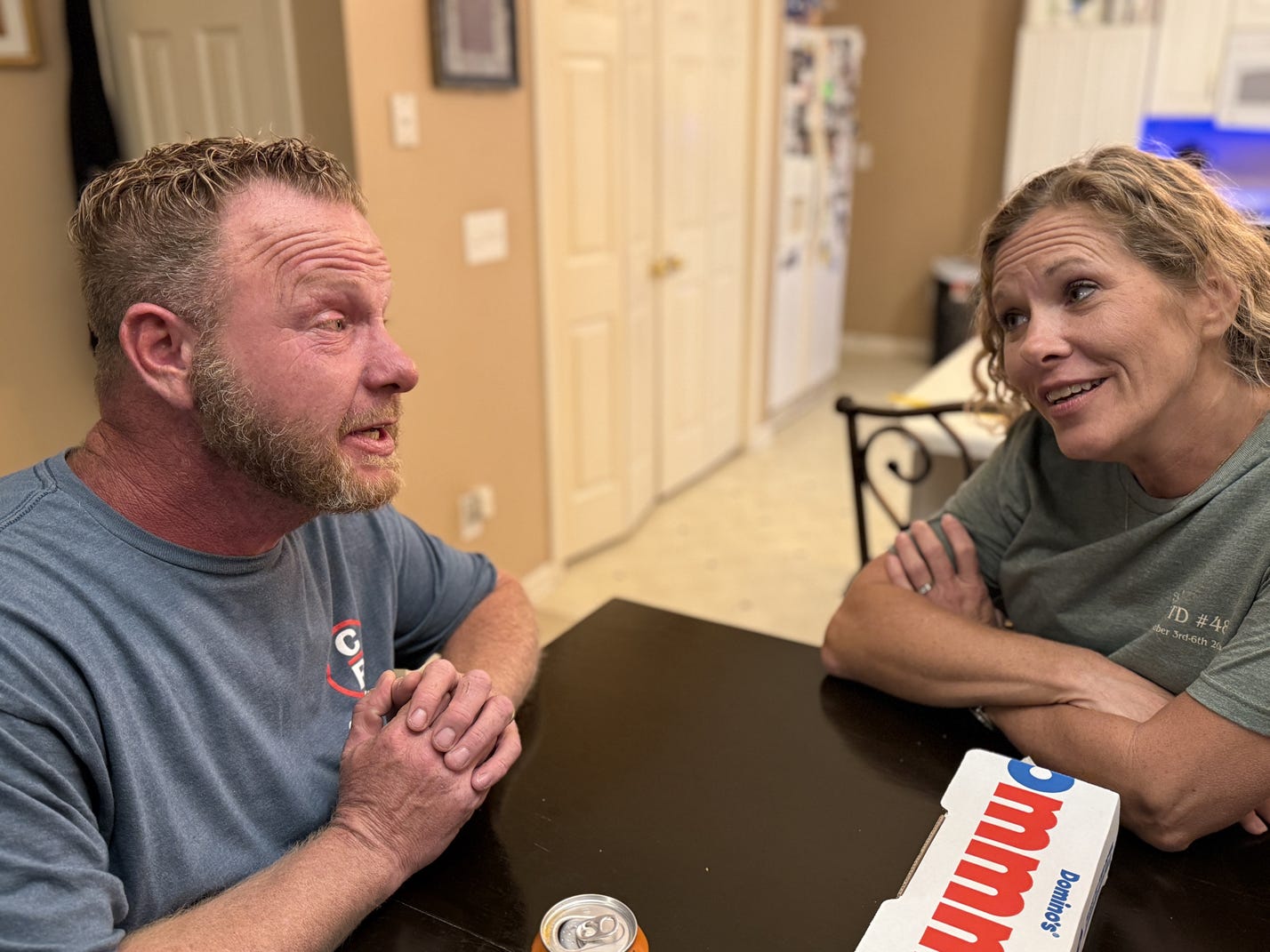
OLDHAM SHARED HIS STORY one night in late October, as he and his wife Michele sat across from me at a high-top dining room table, sipping sweet tea and nibbling at thin-crust Domino’s. Oldham has a stocky build and ruddy complexion, full cheeks and a broad smile, making it even harder to visualize the description he gave of what he looked like in the worst of his heroin days—“125 pounds, my ribs sticking out, my hip bones sticking out.”
Oldham told me his parents divorced when he was 7, his father moving to Florida while he lived with his mother in Alabama. He said most of the adults in his life had some kind of connection to the world of illegal drugs—selling or using, sometimes heavily, and literally teaching him about both when he was a child. By the time he started middle school, he said, he was dealing marijuana. “I’d sell to the band kids, to the football team, to the hippies—I was the man at 12 years old, I knew it all,” Oldham said.
He wasn’t just a dealer; he took drugs too—marijuana first, pills and heroin later in life. He got by on odd jobs and staying with friends, or with his grandparents who had sometimes served as surrogate parents. (“Thank God for them,” he said.) But he was on his own a lot, and it was on one night in 2017, sitting in the front of his Nissan with all of his worldly possessions in the backseat, that he realized a policeman was standing outside his window.
Oldham already had a needle plunged into his arm. He pushed it down, immediately losing consciousness and going into cardiac arrest—as he’d later learn—because the heroin was laced with a deadly amount of fentanyl. The officer revived him with Narcan, the fast-acting anti-overdose treatment, and then brought him to jail for a few days before the courts released him without charges.
The experience was enough of a scare that he tried to get himself through a local recovery program. But he couldn’t stick with it. He resumed his drug use until police caught him again—this time, with his supply still intact. That’s how he ended up facing the felony charge, and going into drug court.
Drug courts were spreading through Alabama by then, although that’s not where they had started. The U.S. prototype, by most accounts, was a 1989 pilot program in South Florida, followed by programs in Houston and New York City. They were—and still are—frequently considered a form of “diversion,” meaning they are a way to deal with nonviolent drug offenders without putting them through criminal trials and into jail.
But drug courts typically emphasize accountability in a way other diversions don’t—by, for example, forcing participants to report to a judge regularly, and to suffer the consequences when they don’t meet program standards.3
Oldham experienced that personally twice, serving a 24-hour and then a 48-hour jail term after failing drug tests because he’d had alcohol. One time he said he did it impulsively because he was thirsty and there was an open beer nearby; the other time, because he was at a Bush concert and thought it was worth it.4 Afterwards, Oldham told me, the judge smiled and said, “Did you have a fun time? I’m glad. Now I need to send you to jail.”
But those were his only two breaches, Oldham said. The accountability made a big difference, he said, though so did the support he felt from everybody associated with the program.
“There is just so much love there,” Oldham said. “The judge and the whole staff—the court-appointed lawyers, the police that are in there, the bailiffs—I mean, they will come to your house and check on you, these people really, really care.”
THAT’S NOT TO SAY the case for drug courts is clear-cut. Nothing in a field like this ever is. In the eyes of some critics, they focus too much on punishment and not enough on support. In the eyes of others, they don’t have enough oversight.
Oldham’s story represents the best-case scenario—which is why a national advocacy organization for drug treatment courts now called AllRise recruited him to testify before Congress in 2023 in support of a funding increase then up for debate. But the program doesn’t work for everybody, as Oldham is the first to acknowledge.
“I’ve seen people stay in this program for five or six years,” he told me. “I’ve had friends die and never get out of drug court.”
But multiple, peer-reviewed analyses have found the courts reduce recidivism—which, combined with their support from so many high-profile conservative figures, have left some former SAHMSA officials speculating that the decisions to cut down the program and other initiatives are coming from high up in the Trump administration with little or no pushback. And that makes sense: The senior, experienced officials who would provide that pushback aren’t around anymore.
“I think that the people who are making these cuts don’t really understand what it is that these programs do,” one former SAMHSA official told me. “Maybe they just see numbers, or they see general descriptions of what these offices do, they think it seems similar to something they’ve seen somewhere else, and they just assume it’s duplication.”
Nobody thinks drug courts would disappear altogether if SAMHSA stops watching over federal grants so carefully, or even if some of the federal grant money itself goes away; too many state and local officials recognize how much the courts contribute. The worry is that, with less money and guidance from SAMHSA, programs would become less effective and reach fewer people—leaving an even bigger load on the criminal justice and penal systems, which are already under a great deal of pressure.
It would also mean fewer people getting the opportunities Oldham had. Among those who have seen the effects is Scott Jones, a facility manager and chaplain at Birmingham’s Brother Bryan Mission, which is where Oldham first tried to start recovery and where he still addresses groups of men in situations like he once faced.
“When he shares his pain with the guys, they respond to that,” Jones told me. “That’s what they need. They need to know that they’re not alone. They need to know that somebody else has been where they are, or where they’ve been, just as bad, if not worse, and is doing well.”
Oldham’s whole face lights up when he talks about work like that—or the chapter of Celebrate Recovery, the Christian-based program he started and leads at his church.5 They get between 100 and 150 people every Friday night, he told me, though the work never really stops. “I’m getting texts and calls all the time,” he said, “weird hours of the night—but you know, that’s what I do now.”
Sometimes Oldham’s work as a speaker and counselor even takes him to the suburban Birmingham jail where he spent three days in February 2018, when his chance at the drug treatment court gave him a chance at a new life. “I used to be a middleman for getting people drugs,” he said. “Now I’m a middleman for sending them to churches, and to recovery.”
The two House Democrats are Madeleine Dean from Pennsylvania and Paul Tonko from New York; the union is the National Treasury Employees Union. According to their estimate, the number of full-time SAMHSA employees had fallen from 876 to 551 by July. That number doesn’t account for attrition since July, with so many workers leaving amid worries the agency itself will not be around much longer—and, again, it doesn’t account for the October layoffs whose status awaits a court ruling.
The office overseeing the drug court grants is part of SAMHSA’s Center for Substance Abuse Treatment. And to be clear, it is not the only part of the federal government involved. The Justice Department also provides some grants, though those underwrite the legal side of the program while SAMHSA’s money funds the support and recovery side.
A bill that has been under consideration in the Alabama legislature would actually rename its drug courts “accountability courts.”
Correction (November 2, 2025, 1:10 p.m. EST): As originally published, this sentence mistakenly said Oldham “was at a Kate Bush concert”; it has been corrected to note he was at a Bush concert.
Oldham told me he is also Celebrate Recovery’s central Alabama representative.
Tragic. The Trump presidency offers1001 ways to destroy our own people.
Both of my brothers went through the drug court programs here in Illinois in their early twenties, and it saved both of their lives. They are both nearly 40 now, and absolutely thriving at life, which I would have never thought possible while carrying them out of the house with blue lips after ODing many years ago.