Exclusive Focus Group: Trump Bleeding Latino Voters
He won the presidency with their support—now they’re angrily turning against him.

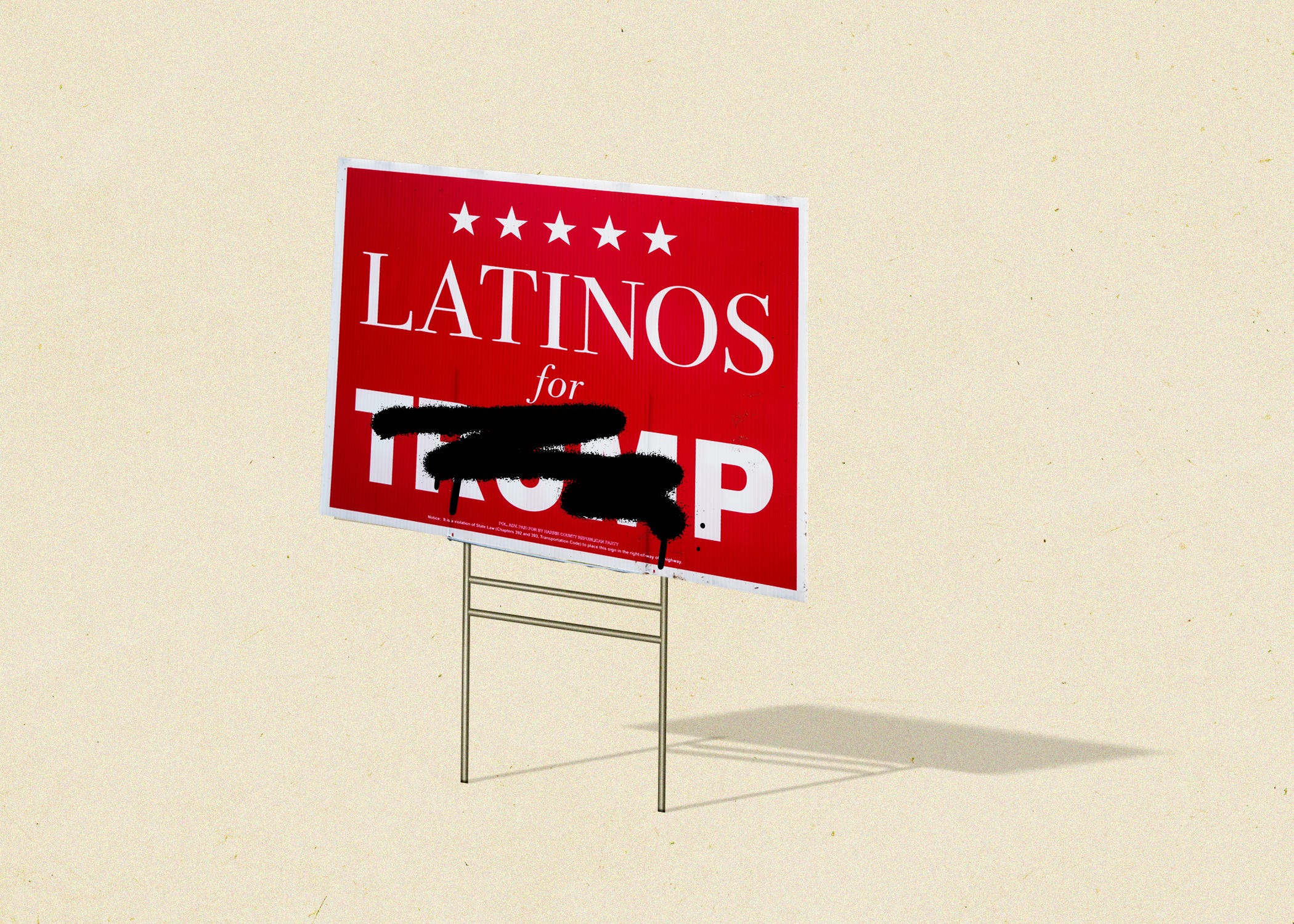
LATINO VOTERS FLOCKED TO DONALD TRUMP in surprisingly large numbers last November to help him retake the White House. But a year later, the same cohort has soured on his presidency, with many saying they regret their vote.
That’s the main takeaway from a new focus group of Latino Trump voters conducted by The Bulwark on September 10. The seven participants were selected for having cast their ballots for Trump in 2024 but now looking unfavorably at his job performance. (Audio clips from the discussion will appear in the next episode of the Bulwark podcast The Focus Group, dropping this coming Saturday.)1
The participants said they were angry over the state of the economy and frustrated by Trump’s handling of immigration and deportations. Asked to give the president a letter grade for his term thus far, six gave him D’s and one gave an F. Asked later about her grade, one participant who gave a D said she was just trying to be nice.
There were no A’s for America First.
The focus group included voters from swing state Nevada, blue state California, and red state Florida, as well as states, including New Jersey, that have traditionally been heavily Democratic but moved toward Republicans in the Trump era. New Jersey is one of two states with gubernatorial elections this November.
A participant from the other state picking a governor this fall, Kimberly from Virginia, was asked what direction the country is going in. “I would say negative,” she said. “Grocery prices, we have the tariffs, we have the immigration going on, and also using the National Guard instead of police to fight crime.”
Kimberly and others painted a picture of a nation struggling to grapple with a darker blend of politics and open divisiveness from its leaders.
“I think a lot of people are a lot more hateful, they feel they can be a lot more open about it, because they see it everywhere so much that no one is really trying to be nice and get along and respect differences,” said another participant, Kandy from Colorado. “They think it’s okay to pass their judgments and stereotypes willy-nilly because no one does anything about it, because they see the people in control doing it.”
Members of the focus group agreed to participate on condition that only their first names and states of origin be used. For most of them, the top issue remains the economy, which is the prism through which they make their decisions. But after an election where Joe Biden’s weakness on the border allowed Trump to use the full force of his demagoguery to exploit immigration fears, what caught my eye was the nuance with which these voters expressed their displeasure with how the president was executing on his restrictionist vision for America.
One participant, Reed from Nevada, said that he initially viewed Trump’s moves on immigration positively. But then he was confronted with the human suffering the administration was causing.
“Then you see the other flip side where you see families being ripped apart,” he said. “I didn’t think it was going to be that dramatic where it’s going to be hurtful in that sense. So that kind of changed your mood from ‘Okay, the country is getting better on that immigration part.’ The borders are getting more strict, but at what cost?”
Beth from New Jersey also said she initially supported a tougher stance on immigration. “We do need safety, we do need security, we owe it to our country,” she said. But she quickly added that she had lost confidence in the administration on the issue due to the lack of a “humane” approach to deportations. She tied Trump’s haphazard and heavy-handed execution on the issue to his and Elon Musk’s arbitrary firing of hundreds of thousands of federal workers as part of the DOGE initiative.
“It’s bullying at another level,” she said. “I live in America, I don’t want to be in a dictatorship. I still want to be in a democratic nation that has rules, has regulations. . . . This is America, we gotta treat people with respect and dignity and I think a lot of that has gone out the window.”
Paolo, an 18-year-old from Florida, agreed.
“We see he’s super-extremist and ignoring history,” he said. “He’s taking down government history websites, he’s changing [the Department of Defense] to the Department of War. It seems that power has taken control of his mind where he thinks he can change the Constitution and control the entire country by himself.”
While the participants in this focus group were selected on the basis of their unfavorable views of Trump’s job performance, there were echoes of another exclusive focus group I wrote about a few months ago in which half of the participants, Latino men from Arizona who had voted for Trump, regretted their vote.2
FOCUS GROUPS PROVIDE useful snapshots of sentiment at a given point of time. But what stands out about this one is not just the wide range of issues over which Latinos have disagreements with Trump, but the texture it adds to trends we are seeing elsewhere. Anecdotally, as I’ve reported across the country, I’ve watched as Latinos who backed Trump have grown increasingly unhappy with his performance each month. And new survey data backs this up.
A poll of 800 Hispanic voters by Somos Votantes conducted in late August and early September reinforces the idea that Trump is bleeding Latino support, with the president registering a -23 percent job approval rating (including a -26 percent rating on the economy). Trump’s weakness was also pronounced among young people and men, both categories that were bright spots for him in November.
Trump’s approval dropped 10 percentage points from 43 percent in May to 33 percent in September among young Latino voters, according to the Somos Votantes poll. His favorability rating dropped 5 percentage points among Hispanic men over the same period.
Chuck Rocha, who served as the architect of Sen. Bernie Sanders’s Latino voter plan during his 2020 presidential run and as a senior adviser for Sen. Ruben Gallego’s 2024 campaign, said Trump is losing Latinos because voter anxiety on the economy was being coupled with personal fears about community and safety.
“There’s enormous anxiety in the community. There was lasting anxiety from the economic downturn and what Trump has done is add in a new layer of anxiety that ICE agents are patrolling our U.S. streets and picking up people because of the color of their skin,” Rocha told me. “Latinos were all for getting rid of criminals and rapists but now he’s picking up your abuela who is watching your baby in the park and it’s gone too far.”
A REFINED BIT OF CONVENTIONAL WISDOM that took hold after the 2024 elections said that one reason Trump won more Latino voters than recent Republican nominees was precisely because he promised a crackdown on illegal immigrants. Many voters felt, instinctively, that undocumented immigrants had not followed the rules. At least for many Latino voters, their ethnicity or country of origin was immaterial.
What becomes clear in the focus group is that voters did initially support the crackdown. But they did so only in theory. When smacked in the face with what was happening to their neighbors or parents of kids they knew, they changed their tune. When it hit them economically or personally, their perceptions changed.
Janella from California said immigration sweeps were now affecting her life, with her child’s school sending letters home saying they won’t let ICE come in and take kids. A week ago, she said, someone in her neighborhood was taken by ICE.
“You see it more and more, in our neighborhood they have announcements ‘ICE is here today,’” she said. “It’s just a big thing. My family is not worried about it, but my kids go to school here and they have friends that [are] worried about it, and for kids that’s not okay—to be worried that they’re going to come home and not have their parents home.”
There is an obvious opportunity for Democrats to capitalize on this discontent, but it is complicated by challenges facing their own party. While every single member of the focus group said they regretted their vote, none said they would back Kamala Harris in a hypothetical election rerun. Instead, they all said they would support a third party candidate or stay home.
Rocha agreed there is an opportunity here for Democrats, if they are smart enough to grab hold of it.
“Democrats have run one election after another not being Trump, not being for military in the streets, and not for higher prices, but this is not a cut-and-dried case for Democrats,” he said. “We have to say what our plan is and get them to trust us again.”
Clarification (September 17, 2025, 1:15 p.m. EDT): As originally published, this paragraph could have been misread as suggesting the focus group participants were selected at random from a pool of Latinos who voted for Trump in 2024; it has been modified to make clear that an unfavorable view of Trump’s job performance was one of the screening criteria.
Update (September 17, 2025, 1:15 p.m. EDT): This paragraph was added, and a sentence was added to the following paragraph, after the newsletter’s original publication.
I saw the headline and went “no shit.” Lol only so much a group of people can get stomped on before they say enough is enough. I’m just astounded so many of Latinos voted against their own interests. As a latina myself it continues to blow my mind.
If only they they had been warned!!!!