Jerome Powell Didn’t Ask for This Sh*t
He doesn’t want to lead the Resistance, and his likely successor is trapped.

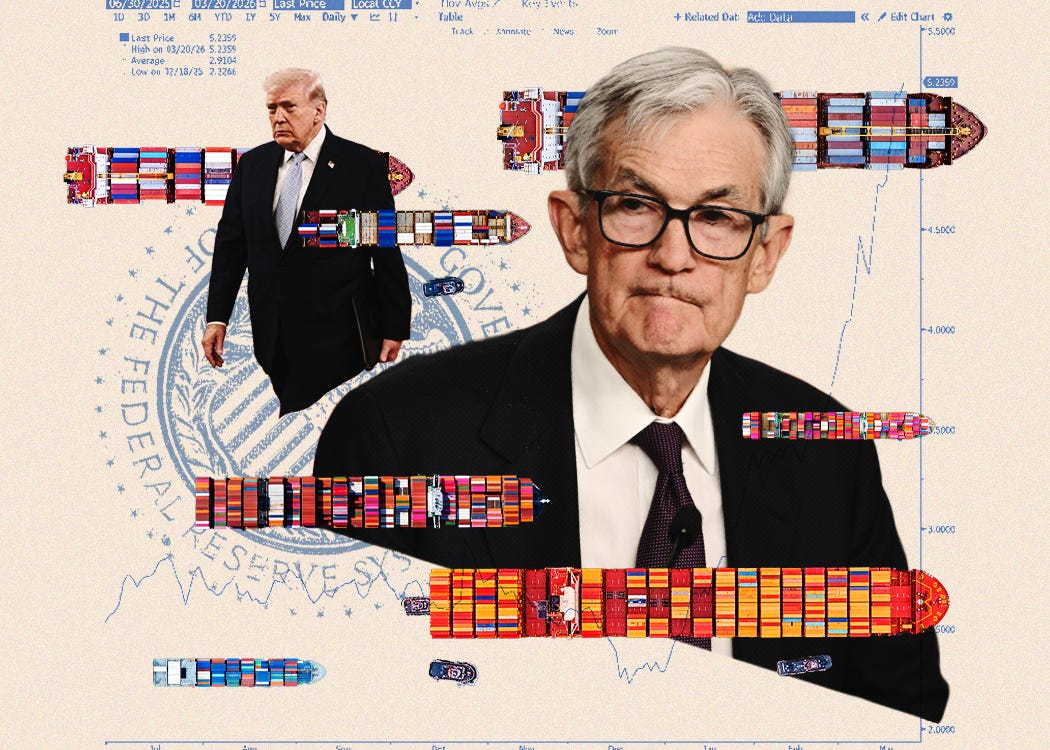
MOST PEOPLE THINK ABOUT the Federal Reserve as a dull, technocratic agency. If they think about it at all. Unlike other parts of government, the Fed isn’t trying to make headlines. They’re not trying to have viral moments.
Which is why it’s so weird that Fed Chair Jerome Powell has become something of a folk hero.
The John F. Kennedy Library Foundation announced last week that it would be honoring Powell with its Profile in Courage Award for “protecting the independence of the Federal Reserve . . . despite years of personal attacks and threats from the highest levels of government.”1
That’s a euphemism for: Trump launched a bogus criminal investigation into Powell to try to bully him into doing Trump’s bidding; and at great personal and professional risk, Powell stood his ground. This unlikely gallantry included some (yes) viral moments, such as a tense exchange with Trump on a hard-hatted tour of the Fed’s renovation project. And Powell’s dry-mouthed, direct-to-camera video, released late on a Sunday night, in which he revealed that the DOJ had threatened to criminally indict him.
The Fed has not released a statement on the award, but confirmed to me that Powell will accept it, and will speak at the May ceremony where he’ll be honored.
For those of us who cover the Fed—as I have for almost two decades now—this has all been super weird. For a few reasons.
First, on the rare occasions that Fed news has gone viral before, it’s never been for anything good. At least I can’t think of anything comparable to this. If normies are sitting around discussing the Fed, and Fed officials are getting memed,2 something has usually gone very wrong for the economy, or monetary policy, or both.
Second, Powell does not want to be a leader of the Resistance. Central bankers are nerds who fiddle with interest rates. They sit around debating the value of r*.3 They’re not looking for political battles; in fact, they deliberately duck them, cognizant of the fact that the central bank needs to be politically independent in order to function.
By “politically independent,” I mean not just that Fed officials have to make decisions without regard to politicians’ preferences. They also must be perceived as operating entirely apart from politics. The public needs to believe the Fed is willing to do politically unpopular things, like hiking interest rates if necessary. That credibility—the mere belief that the Fed would willingly play bad cop—meant it rarely had to, and helped keep inflation low for decades.4
Powell doesn’t want to be viewed as a friend to Trump; and he also doesn’t want to be perceived as an enemy either. He wants to be seen, rightly, as a nothing to Trump.
This situation is also super weird when you think about the kinds of people and temperaments the central bank tends to attract. The Fed is an institution that operates largely via consensus.5 Fed officials are generally not the kinds of personalities looking for public confrontation, or for opportunities to flaunt how brave they are. They’re not looking to win awards for “courage.”
Then again, maybe most people who truly deserve such awards aren’t those who seek them out. Winning an award for “courage” is like the moral equivalent of having a disease named after you. It’s nice to be recognized, I suppose, but maybe not worth going through what you had to go through to get it.
Just as Trump likes making apolitical things political, he also has a knack for forcing people to reveal either their courage or (too often) their cowardice. Powell’s choices have clearly resonated with the American public. If normie Americans are suddenly stans of a 73-year-old investment-banker-turned-technocrat, it’s because the country has been so starved of basic public virtue.
IF POWELL DESERVES OUR ADMIRATION, his presumed successor may soon warrant our pity: Trump has already put Kevin Warsh in a horrible position, and Warsh hasn’t even been confirmed yet.
Trump selected Warsh to succeed Powell as chair of the Fed when Powell’s term ends in May. A lifelong inflation hawk, Warsh nonetheless secured the nomination after declaring his intention to cut interest rates—something you don’t usually do when inflation is high. Trump had made clear this was a prerequisite for anyone wanting the job, after all.
But Trump is making it increasingly difficult for Warsh—assuming he’s ultimately confirmed6—to keep this pledge.
Even before the Iran war, inflation had been running stubbornly high, boosted in part by Trump’s trade wars. When inflation is elevated, that usually means the Fed wants tighter, not looser, monetary policy—i.e., higher interest rates.
And now, with the war disrupting oil markets (among many others), inflation is expected to rise even higher. The latest OECD Economic Outlook, released today, predicts U.S. inflation this year will be 4.2 percent. Meanwhile investors expect headline inflation to exceed 5 percent in the next twelve months.
There is an ongoing debate as to how the Fed should think about this risk.
Normally, central bankers would be expected to “look through” a one-time energy shock and not worry too much about it feeding into ongoing inflation. In fact the Fed’s preferred inflation gauge excludes energy and food prices precisely because they’re so volatile.
But that’s not obviously the case now. This is not just an energy shock, it’s arguably an everything shock. And we’ve had five years of above-target inflation already. This raises the alarming question: What if businesses and workers start to expect broad-based price increases, and turn them into a self-fulfilling prophecy? If businesses expect higher prices for inputs, they could raise prices now—and voila, hypothetical future inflation becomes real, here-and-now inflation. The Fed would need to nip that in the bud.
Markets have already been pushing back their expectations for when the Fed will make its next rate cut, and some Fed officials, Powell included, have even suggested that the next move could well be a rate hike.
On the other hand, the U.S. economy has also shown serious signs of weakness lately. The Fed believes there’s been zero private-sector job growth over the past six months. The war is also raising the risk of recession. Maybe rate cuts, usually adopted during recessions, are a good idea after all?
This particular set of economic conditions would be challenging for any Fed leadership to make sense of. It’s genuinely hard to know what to do when you’re staring down the barrel of stagflation. But this will all be especially challenging for Warsh, who has promised to cut rates—and whom Trump has “joked” about suing if lower rates don’t materialize. Warsh and his Fed colleagues presumably also have to think about whether the public will view any rate cuts as an acquiescence to Trump (regardless of their actual rationale), and therefore a threat to that perceived independence of the Fed that I mentioned earlier.
On the bright side, at least Warsh won’t have to make this decision alone. As I mentioned, interest rates are set not unilaterally by a chair, but by a twelve-person committee. And among those committee members may well be . . . Powell.
Last week Powell made an unusual announcement: Unlike nearly every Fed chair who preceded him, Powell said he had “no intention” of leaving the Fed Board, even after his term as chair ends in May—and will not depart at least until that bogus criminal investigation into him is over. Indeed, he says he may well stay even after the investigation is dropped, depending on what he judges to be best for the institution and the country.
Things may be super weird. But they’re also about to get super awkward.
Ramparts
— Trump administration officials are reportedly modeling what a potential spike in oil prices to $200 a barrel could mean for the economy, Bloomberg reports. Maybe something they should have considered earlier?
— Relatedly: This past week has seen a brutal series of polls on the economy and Trump’s role in it. Just one example: Approval of Trump’s handling of the economy is at its lowest level across either of his terms as president—and lower than the measure was at any time during the Biden administration.

— Jed Kolko notes that “Miami is the new San Francisco,” in that it had the highest out-migration rate of all large metro areas last year.
— Deutsche Bank has developed a “pressure index” for Trump,7 defined as a “proxy for upcoming rhetoric or strategic adjustments by the U.S. administration.” Its inputs are: one-month change in Trump’s approval ratings; one-year inflation expectations; and the performance of the S&P 500 and U.S Treasury yields. When the index gets higher, a TACO is supposed to be more likely to happen.

The problem is this measure kinda undermines itself. If it’s a good proxy, people will trade on it; its financial components (S&P, bonds) won’t gyrate as much because investors will anticipate the TACO and not freak out. But then the feedback loop that causes Trump to TACO gets short-circuited, and he doesn’t TACO because no market freakout forced him to.
What we want is probably something more like a positive feedback loop that causes Trump to TACO more. Normally shame might serve that function. But, you know.
The award, bestowed by the John F. Kennedy Library Foundation, is also being given this year to “The People of the Twin Cities, Minnesota.”
Okay, fine, there is one benign/delightful Fed-adjacent meme, of former Fed chair and treasury secretary Janet Yellen. But that is very niche even among econ nerds. Hardly a viral phenomenon.
“R*” or “R-star” is the “neutral” rate of interest—meaning, the short-term interest rate that would be neither contractionary nor expansionary when the economy has both stable inflation and full employment. It is a major subject of debate. If this sounds boring—yes.
Twas not ever thus. Arthur Burns infamously bent to political pressure from Richard Nixon, who wanted to keep interest rates low for political reasons. This contributed to the ultra-high inflation the country experienced in the 1970s. As Powell made clear in an interview in November 2024, he does not want to go down in history as another Burns.
The Fed has a twelve-person committee, with some members rotating on and off, that votes on major policy decisions such as interest rates. The chair usually tries to forge broad agreement, if not unanimity, on those decisions. Throughout the institution’s long history, dissents have remained relatively rare. This consensus-based approach is thought to send clearer signals to markets.
Sen. Thom Tillis (R-N.C.) has said he will block any further appointments to the Fed unless the investigation into Powell is dropped.
As my colleague Will Saletan observed, it should have been called a “tacometer.” Missed opportunity.
Kevin Warsh may deserve our pity, but . . . nah. He won’t get it. When you prostitute yourself to get a promotion, anything you get is just deserts.
You know that warsh can't change rates on his own, and i know warsh can't change rates on his own, but does trump? I doubt it.