For Success at the Polls, Dems Look to the Pews
Can candidates of the cloth help the party close the ‘God gap’?

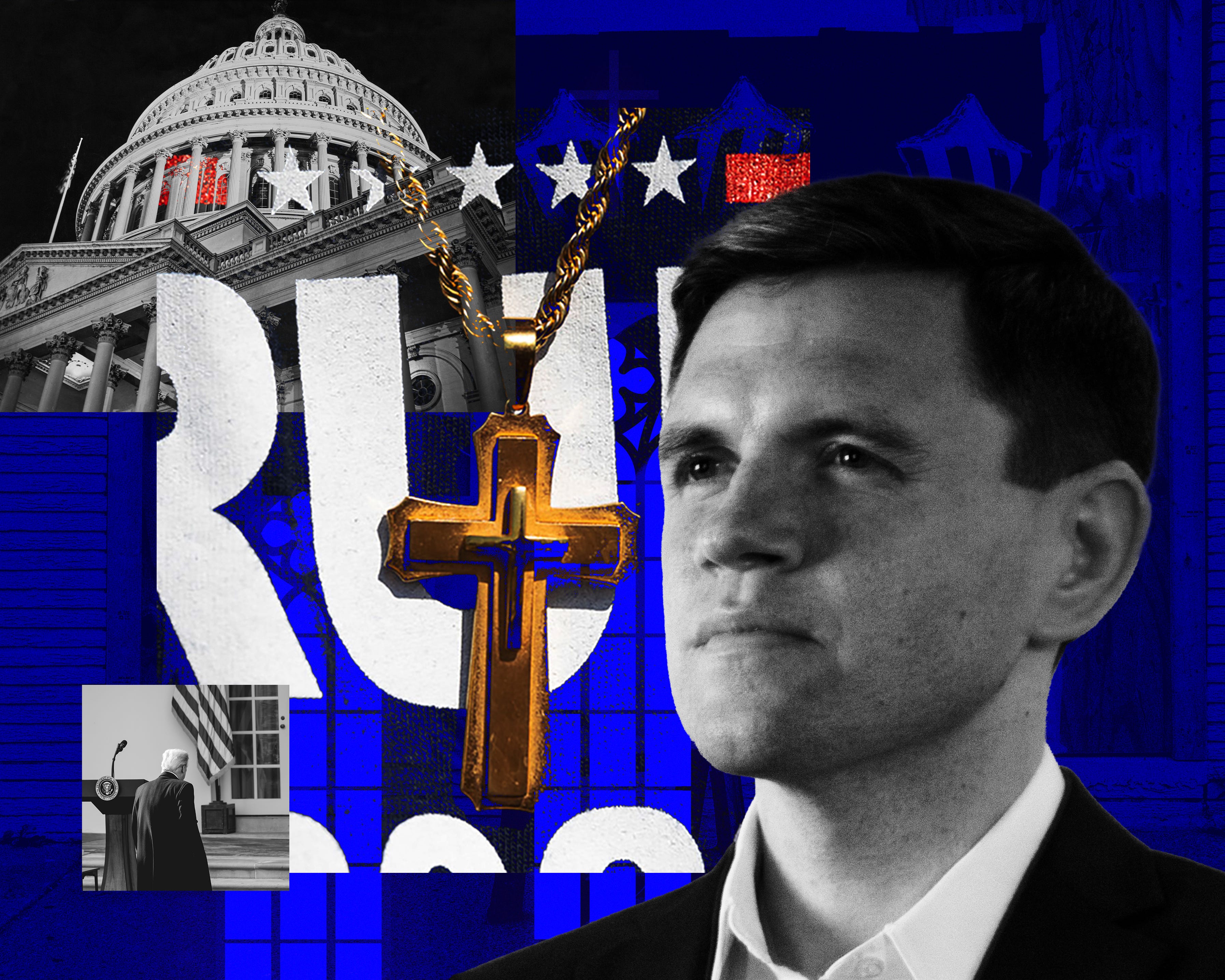
THEY HAVE THE FAITH. Now they just need the majority.
As Democrats scope out the emerging midterm landscape, party strategists and officials have grown excited about the number of candidates for whom religion is a major part of their biography and identity.
The most prominent so far is James Talarico, the middle school teacher turned Texas state representative running for U.S. Senate. The grandson of a Baptist preacher, Talarico is an outspoken Christian and an aspiring Presbyterian minister.
But Talarico is far from the only Democratic candidate notable for the role of faith in his life. There is also Sarah Trone Garriott, a Lutheran minister, who has a shot at flipping Iowa’s 3rd Congressional District. Meanwhile, in the state’s 2nd Congressional District, Lindsay James, an ordained Presbyterian pastor, and Clint Twedt-Ball, a United Methodist pastor, are both vying for the party’s nomination. Matt Schultz, the head pastor of Anchorage’s First Presbyterian Church, is running for Alaska’s sole congressional seat. Chaz Molder, a small-town mayor and Sunday school teacher, is running in Tennessee’s fifth district. The list goes on.
Democratic leaders and strategists are eager to see whether the party can regain ground among faith-based voters by running candidates of the cloth. But the candidates themselves, several of whom I spoke with in recent days, also see their entry into elected politics as symbolic of a larger development: the public recoiling at the immorality and cruelty of the Trump administration.
“People of faith are more and more stepping forward to run for office because part of the job of being a pastor is, to use the metaphor, ‘to be a shepherd,’” Schultz told me in a phone call from his home in Anchorage last month. “All of these people are coming to me and saying, ‘Please, won’t you help me? Please, won’t somebody do something to stop this onslaught of cruelty? We’re crying out in pain.’ And as a pastor, it’s my duty to stand between the abusers and the abused.”
The other candidates I spoke with had similar reflections. They didn’t see themselves as inherently political. But they felt morally and spiritually called to run for office. Much of their motivation arose from Trump’s treatment of immigrants and his slashing of the social safety net. But their aperture extended further back than the current administration. They felt that for too long the Republican party had distorted Christian values and the Democrats had allowed their opponents to monopolize faith.
“As a white Christian voter, you know, I think perhaps we’ve let the Republicans take some ownership in that space of faith-based leadership,” Molder told me.
Their task won’t be easy, even in a midterm climate that is looking better and better for Democrats. The so-called “God Gap”—a term used by political scientists to refer to the religiosity divide between the two parties—is real, as reflected in polling data and election results going back decades. Democratic leaders of course know this well, as witness the fact that officials were pitching me to report and write this very piece (along with several other outlets). They also know that demographic trends make it critical to build inroads here.
Keep up with all our coverage of this year’s midterms—from the first primaries through the high stakes of Election Night and beyond—with a Bulwark+ membership. You’ll not only be able to enjoy all our journalism and commentary, but you’ll be joining our rapidly growing pro-democracy community:
WHILE DEMOCRATS HAVE LONG had support from the black church—and while there has been a long history of black clergy serving in office, including current Sen. Raphael Warnock, the senior pastor of Atlanta’s Ebenezer Baptist Church, famously the home church for Martin Luther King Sr. and Jr.—there’s a growing belief within the party that rebuilding sustainable majorities will require gaining credibility among white Christian voters. Some party strategists are pointing directly to the declining importance of religion within the Democratic party ecosystem as an explanation for how the party became so out of touch with working-class Americans.
“There can be a profound, profound disconnect that is harmful and prevents candidates and prevents staff from seeing the country as it is,” said Michael Wear, the former director of Barack Obama’s 2012 faith-outreach effort, when I asked him about what the party risks by not engaging with Christian communities more directly.
“The Democratic party contains some of the most religious people in America and some of the least religious people in America. It’s not just [that] there’s a God gap between Democrats and Republicans. There’s a God gap within the Democratic party itself,” Wear added. “One of the ways to navigate that is to just take it off the table. But the problem when you take it off the table is you leave a pretty profound lane for someone like Donald Trump to say, ‘Well, they don’t care about you. They don’t hear you, but I do.’ And that’s a lot of what has happened over the last twelve years.”
Although the country has become less religious in recent decades, with the fastest-growing category in this century being the religiously unaffiliated “nones,” nearly 70 percent of Americans continue to identify as religious and 62 percent identify as Christian, according to Pew Research Center. But the shift in religiosity has not been reflected evenly between the parties: Since 2008, the percentage of Christians in the Democratic coalition has dropped by an astounding 20 points while it’s slipped by only 5 points for Republicans. The nones, who now make up some 28 percent of U.S. adults, largely vote for Democrats.
Democrats also have to contend with the reality that it’s probably not enough to run liberal pastors and expect to make significant inroads with religious voters without also shifting on social and cultural issues. Democratic operatives told me that the party has not been tolerant of voters who are less comfortable with abortion, gay marriage, and transgender rights—and they said that all too often the party seems hostile to voters who disagree with the party mainstream on these issues. All of that creates significant difficulties to run as a Democrat of faith, especially in red states. Trone Garriott, for example, has had to explain how she can be a Christian and pro-choice.1 Talarico is often pressed about his support for trans rights.
“Democrats who are running in contested districts are going to need to show not just that they can talk about faith, but that their faith, and the way that they view the role of faith in America, actually affects their thinking,” Wear said.
DEMOCRATIC STAFFERS WHO HAVE worked on faith-outreach efforts over the past few election cycles told me that the problem is systemic. They said that few of the party’s top decision-makers are religious and those calling the shots don’t understand how to interact with religious voters outside the black church. One (white) Democratic staffer told me that the fact that he regularly attended church was seen as nearly alien to his colleagues.
“The country is overwhelmingly religious. But the people who run our party, buy our ads, and shape our message don’t actually see or understand it at all,” a Democratic official who has worked on multiple presidential campaigns told me.
Even the candidates who are on board with talking publicly about their faith find themselves struggling to figure out just how to center it in their politics. Party operatives told me that candidates often get tripped up trying to figure out how to talk about their faith while also being responsive to voters who might be turned off by talk of religion. In an interview with the New York Times last month, Talarico said he often hears from people who are “bothered” by how much he discusses faith.
“I can’t tell you how many emails or messages I get with people telling me to stop all the religious talk because it makes them uncomfortable. I get that, and I try to be as sensitive as I can be to the religious trauma in this country,” Talarico said. “But it is who I am. I can’t be anybody else.”
Twedt-Ball, the United Methodist pastor running for Congress in Iowa, told me that “there’s been some hesitancy and skepticism toward the church among some people in the Democratic party.”
“I think part of the reason for that is they’ve looked at this kind of Christian nationalist movement that is very exclusionary and said ‘We don’t want that,’” he said. “There is a lot of work to do, but I think part of it has to happen from religious leaders like me that are willing to show that there is a clear difference between what we bring and what the Christian nationalists bring.”
Ultimately, running candidates more conversant in the Bible and more comfortable in the pews may not materially matter when the decisive forum is the polls. After all, the party has made a similar push into this community before—albeit without quite as many religiously oriented candidates running—and it’s fallen flat. Self-identifying Christians, particularly white evangelicals, have shown a remarkable attachment to the Republican party, and in particular to Donald Trump, despite his being far from the most pious occupant of the Oval Office.
According to a Public Religion Research Institute (PRRI) survey, Trump won 85 percent of the white evangelical vote in 2024. But to get a sense of the hill Democrats have to climb, consider another PRRI survey. In late March 2018, porn actress Stormy Daniels appeared on 60 Minutes to detail the affair she had with Trump as well as the threats she faced around it. Weeks later, a PRRI poll showed Trump’s support among white evangelical voters had risen, in fact reaching a record high, with 75 percent saying they viewed him favorably.
🫏 Donkey Business:
— Democrat Taylor Rehmet flipped a Texas Senate seat on Saturday by 14 percentage points, delivering a massive blow to the GOP. All of the usual caveats about overreading the results of a special election apply. But it was still a remarkable victory considering that the Fort Worth–area district voted for Donald Trump in 2024 by more than 17 percentage points and Rehmet was far outspent by his GOP opponent. As former Obama adviser Dan Pfeiffer argued, this was not a case of the Republican party getting caught napping. The GOP invested in the race and yet it appears that at least some independent and Republican voters broke for the Democratic candidate anyway. The Texas GOP’s mid-decade redistricting gambit has never looked so dicey. . .
— Alexander Vindman, a retired Army lieutenant colonel who was a key witness in President Donald Trump’s first impeachment, raised $1.7 million on the first day of his campaign for Senate in Florida. Regular readers of this newsletter know that Florida has been a bit of an obsession of mine. For months, it seemed like Democrats were going to throw in the towel and not even try to compete in the state’s Senate race—which, from my perspective, would be complete political malpractice given how important it is for Democrats to win back the state ahead of 2030 census changes that will shift Electoral College votes.
Some strategists have compared Vindman to Amy McGrath, who raised over $90 million in her 2020 campaign against Sen. Mitch McConnell only to lose to him by nearly 20 points. Time will tell whether Vindman is just the latest version of that, but I’m planning to get down to Florida later this month to do some reporting on this race and the party’s future prospects in the state. I’d love to hear from some Florida readers in the comments about what you make of the race and questions you think I should be asking.
My open tabs:
— The Film Students Who Can No Longer Sit Through Films
— How a trans woman’s removal from a restroom tore the world of competitive pinball apart
— A Tale of Murder and Martyrdom in the Florida Everglades
Correction (February 1, 2026, 9:05 p.m. EST): As originally published, this sentence erroneously described Sarah Trone Garriott as being “Christian and pro-life.” As the sentence now reflects, she is pro-choice.
I think the Democrats have an excellent opportunity here to take the moral high ground. It doesn't matter how many of us are religious or not, we can certainly elevate the Christian view of things like shooting, beating and incarcerating innocent people and wave it around for all to see. One of our most obvious failures is NOT calling the GOP out enough on their blatant hypocrisy. Look at what the Vatican is doing, i.e., Pope Leo and his bishops--they've been hammering at the totally un-Christian cruelty of what the right is doing. We need to hoist those images up in full view and remind them of that fact. The point is, they call themselves a Christian movement, we need to remind everyone how wrong that claim is.
As someone with just about no time for organized religion, I nonetheless find it easy and appealing to listen to James Talarico’s interpretation of the Bible and of the meaning of Jesus of Nazareth’s life. (Full disclosure: I’m partial to Father Richard Rohr, too.)
It seems to me that Talarico is building bridges across the single biggest ideological/political divide in American politics. But don’t just read about him, listen to him. He’s got the knack of putting words together in a way that makes me say, “Hey, that’s what I think, too.” It’s powerful, and I think it’s going to put him into the U.S. Senate. From Texas! After that, we’ll see.