


At a speech in Pennsylvania last night, in the midst of a remarkably racist rant about Somali Americans and Democratic Rep. Ilhan Omar, Donald Trump said something interesting: “We had a meeting and I said, ‘Why is it we only take people from shithole countries,’ right? ‘Why can’t we have some people from Norway, Sweden?’”
He was recounting a controversy from 2018, during his first term—and admitting saying something he point-blank denied when it was first reported. “This was not the language used,” he tweeted at the time.
“Hey, this guy lies” isn’t exactly a huge revelation. But it’s a remarkable sign of how far things have deteriorated that the sort of bigotry even Trump used to try to walk back he now deploys as a rally applause line. Happy Wednesday.
We the People
by William Kristol
“We the People.” It’s a grand phrase. But what, really, is one to think of them? Or to put it better, what is one to think of us?
On the one hand, you can be a firm, even an ardent supporter of Lincolnian “government of the people, by the people, for the people” without bowing unquestioningly to claims made on the people’s behalf. After all, it was Lincoln himself who in the 1850s fought against the allure of the slogan of “popular sovereignty” as a solution to the question of slavery expansion.
On the other hand, you can have a firm grasp of the deficiencies of public judgment without embracing the attitude of the Roman poet Horace: “Odi profanum vulgus”—“I hate the common crowd.” You can be willing to stand against popular sentiment without endorsing the supposed remark of Alexander Hamilton: “Your people, sir,—your people is a great beast.”
So which is it? Are the people the problem? Or the solution?
A little of both. But right now, I’m pro-people. They, not our elites, seem to be our best hope to save the American experiment in free government.
On November 4, voters in Virginia and New Jersey voted against Trump and Trumpism in gubernatorial contests, as did voters in Pennsylvania and Georgia in less high-profile races. Last week, in a special congressional election in Tennessee, popular support for Trumpism was markedly lower than it was a year ago.
And yesterday, in South Florida and northeastern Georgia, the public administered Trump’s party resounding defeats.
In its mayoral runoff election, for the first time in nearly thirty years, the city of Miami elected a Democrat as mayor. Eileen Higgins, the Democrat, defeated a Trump-endorsed Republican, Emilio Gonzalez, by 59 percent to 41 percent. A year ago, Kamala Harris defeated Donald Trump in the city by just a single point, 50 percent to 49 percent.
Meanwhile, Democrat Eric Gisler narrowly defeated Republican Mack Guest IV in a special election in the 121st state house district of Georgia. The district had been held by a Republican state legislator, and Trump carried it in 2024 by 12 points. Guest outraised Gisler, and was endorsed by the popular Republican Gov. Brian Kemp. But he couldn’t survive the anti-Republican wave.
So in repeated results over the last five weeks, we’ve seen Democrats running about ten points ahead of their 2024 results. Not coincidentally, an average of current polling shows Donald Trump’s approval at about 42 percent, almost ten points behind his approval when he was sworn in almost eleven months ago. (His net approval rating has fallen by some 24 points, from +12 to -12.)
God knows, there will be endless political zigs and zags over the next eleven months. All kinds of factors, local and national, will interact unpredictably. All kinds of events, big and small, will surprise us.
But it’s a pretty safe bet—maybe as safe as any in politics—that Trump’s approval rating will be a very good predictor of next November’s results. If Trump’s approval doesn’t rebound over the next year, Democrats should do well—or, to put it better perhaps, Republicans should do poorly. If Trump’s approval declines further, into the 30s, Democrats should do very well next November, and Republicans very poorly.
So the public is turning against Trump and his party. The political priority for the next year is to help them continue to do so.
I’ll add one lament: Our elites—from Republican senators to business big shots to reputable civic leaders—seem less willing than the people to turn against Trump. Among the elites, accommodation is still outstripping resistance. The acquiescence of the powerful and the cowardice of the fortunate in the face of Trumpism are pushing me to my own version of Horatian disgust: Odi timidos electos. I do kind of hate the cowardly elites.
But that’s a topic for another day. For now, let’s enjoy last night’s results. And let’s offer a tip of the cap to the American people.
AROUND THE BULWARK
Trump’s Attack on Somali Americans Is Vile Fascism… He’s testing our country’s tolerance for ethnic persecution. And we’re failing the test, observes WILL SALETAN.
Trump (Still) Hates Europe… MARK HERTLING joins TIM MILLER on the Flagship pod to unpack Trump’s attacks on Europe, the rigged “peace” deal with Putin, corruption among Trump’s his negotiators, and the Pentagon turmoil over lethal boat strikes in the Caribbean.
New Trump Security Strategy Turns Against the Free World... and toward racialism, Russia, and the right wing, writes CATHY YOUNG.
Republicans Can Smell Trump’s Weakness… On The Next Level, SARAH, TIM, and JVL sort through a wild week: GOP women turning on Mike Johnson, MTG flexing her new “America First” identity, Elise Stefanik scrambling as a primary threat appears in her race for NY governor, Trump’s snoozy decline, Hegseth’s utter incompetence regarding Venezuela, and the fight over tariffs and executive power heading towards SCOTUS.
President Trump Is a Sleepy Boy… He’s up all night to get posty, reports JOE PERTICONE in Press Pass.
Quick Hits
ANYTHING BUT THE U.S. COURTS: Last week, Sen. Tom Cotton pointed to two survivors of a U.S. military boat strike that the United States ended up repatriating to Colombia and Ecuador as evidence that the Pentagon wasn’t behaving indiscriminately toward people on the Caribbean boats it was destroying. But the New York Times reports that Pentagon lawyers originally had another idea for those survivors: What if they just sent them to CECOT?
On a call with counterparts at the State Department, Pentagon lawyers floated an idea. They asked whether the two survivors could be put into a notorious prison in El Salvador to which the Trump administration had sent hundreds of Venezuelan deportees, three officials said.
The State Department lawyers were stunned, one official said, and rejected the idea. The survivors ended up being repatriated to their home countries of Colombia and Ecuador.
The Times goes on to report the thinking behind a subsequent Pentagon policy that all survivors of the strikes should be repatriated: “to ensure survivors did not end up in the U.S. judicial system, where court cases could force the administration to show evidence justifying President Trump’s military campaign in the region.”
It’s a lot easier to write people off as “narco-terrorists” (whatever those are) when you don’t have to prove anything about them in court. Then again, it makes you think: If they’re narco-terrorists, why are we in such a hurry to release them from U.S. custody?
PARDON ME?: Friends and foes of Donald Trump alike might reasonably wonder: Just how much thought is he putting into these pardons, anyway? Asked by Politico’s Dasha Burns to justify his pardon last week of Honduran ex-president Juan Orlando Hernández, Trump returned to a bizarre old habit: a grumpy “I don’t know him.”
“I know very little about him, other than people said it was like an Obama/Biden type setup, where he was set up,” Trump groused, as though it was ridiculous to assume that the guy with the pardon power would get up to speed on who he was pardoning. “He was the president of the country. The country deals in drugs—like probably you could say that about every country, and because he was the president, they gave him like 45 years in prison. There are many people fighting for Honduras, very good people that I know. And they think he was treated horribly, and they asked me to do it, and I said I’ll do it.”
It was remarkably similar to the reasoning Trump gave after issuing a pardon for crypto baron (and business partner of Donald Trump Jr. and Eric Trump) Changpeng Zhao: “I don’t know who he is,” he said then. “I heard it was a Biden witch hunt.”
After he pardoned Democratic Texas Rep. Henry Cuellar—a decision he reached without touching base with House Speaker Mike Johnson—Trump seemed blindsided this week when Cuellar announced he would run for reelection next year, still as a Democrat. The development could prove costly to House Republicans: Cuellar’s ability to run again gives Democrats a strong chance of keeping his Texas seat. Following the news, the Cook Political Report yesterday changed its rating for Texas’s 28th Congressional District from “Toss Up” to “Lean Democrat.”
WHEN WILL HALLIGAN PULL A HABBA?: With Alina Habba giving in to reality and agreeing to step away from the U.S. attorney’s office in New Jersey, some federal judges are asking: When is Lindsey Halligan, who was also illegally appointed to her role, going to follow her out the door in Virginia? The New York Times reports:
A federal judge in Virginia suggested on Tuesday that Lindsey Halligan should resign as U.S. attorney after a ruling declared her appointment unlawful, making her the third jurist to challenge Ms. Halligan’s continued claim to the post. . . .
During the hearing on Tuesday, the judge, Leonie M. Brinkema, pressed a federal prosecutor to explain why Ms. Halligan’s name remained on such filings, despite the court ruling last month. The judge noted that the U.S. attorney in New Jersey, Alina Habba, who was appointed in a similarly unorthodox manner and was similarly found by the courts to be serving unlawfully, had resigned on Monday.
“That’s the proper position, in my view,” Judge Brinkema said. The judge also questioned whether there was any legal guidance issued by the Justice Department to explain why Ms. Halligan was still in the job.
The lawyer representing the government said only that the staff of the Eastern District of Virginia had been told in an email to keep using Ms. Halligan’s name as the U.S. attorney.
Sort of makes you wonder who sent the email!
Cheap Shots
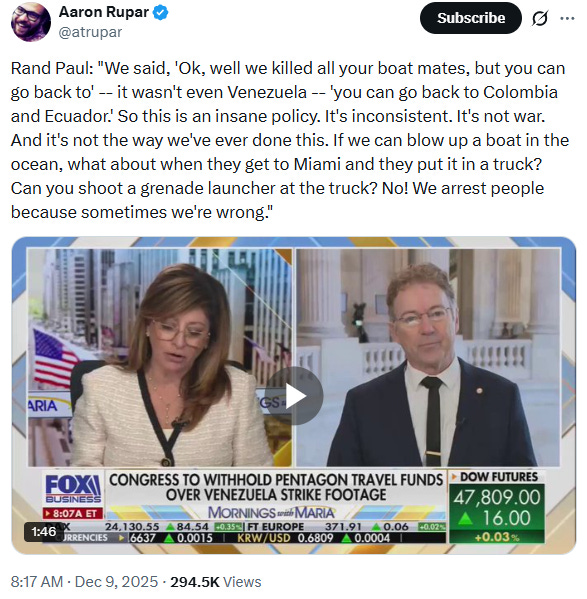
I do not trust a republic whose continued survival depends on the incidental ineptitude of its own arsonists. It is a profoundly fragile civilization that owes its endurance not to constitutional rigor or collective virtue, but to the sheer maladroit spectacle of the men attempting to immolate it. Trumpism hasn’t been thwarted by moral revulsion. It’s been stalled by the staggering incompetence of its standard-bearers, political figures so inept they trip over their own authoritarian fantasies.
That is not reassurance. That is borrowed time. The most brittle, bankrupt form of luck.
Trump vomiting out the slurs he once denied isn’t a descent, it’s an unmasking. A man announcing that he has taken the measure of the public and concluded it will swallow anything, hatred, contempt, falsity, even the contradictions of his own past denials. When the crowd answers with applause, he learns he was correct.
So yes, some voters recoil, but recoil is not redemption. It is instinct, not awakening. The movement hasn’t dissolved; it has merely retreated to molt. It is searching for a host with precision, with discipline, with the cold intellect required to finish what this first, bumbling emissary began.
We have not outwitted the fire.
We have merely survived the spark too dim to ignite the whole structure on its first try.
Perhaps I’m a pessimist, Bill. But I won’t be trusting the voters until they make the smart choice in two consecutive elections. Until then, I will go with JVL in saying that the voters are idiots who vote against their best interests.