

How Somalis Became the New ‘Welfare Queens’
Trump has reinvented Reagan’s old attack, with one key twist.

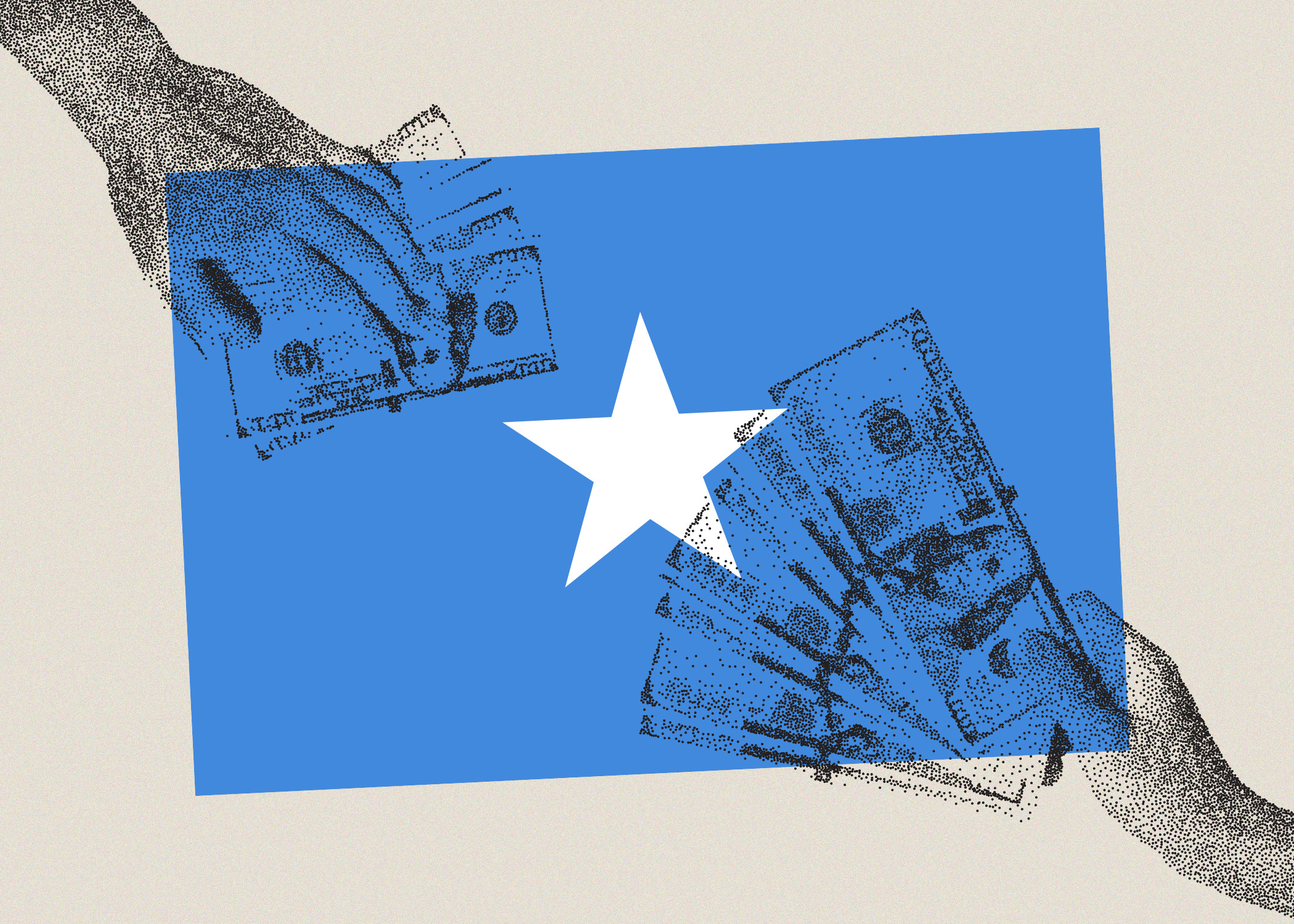
HOMELAND SECURITY SECRETARY KRISTI NOEM announced on Tuesday that the federal government is revoking “temporary protected status” for more than 2,000 Somali refugees. The ostensible rationale is that “country conditions in Somalia have improved,” which is a strange thing to say about a place very much still wracked by political turmoil and in the throes of a humanitarian crisis.
Not that anybody takes the rationale seriously. The move comes after weeks of hostile Trump administration rhetoric toward Somali immigrants, including the president calling them “garbage” and “lowlifes” ” and vowing to “send them back from where they came.” Lately his administration has been trying to do just that through a massive immigration crackdown in Minneapolis, home of a large Somali diaspora—and where last week an immigration officer killed local resident Renee Good, who was protesting the enforcement action.
The spark—or, at least, the excuse—for the crackdown and rhetoric was a welfare fraud controversy involving mostly Somali-run service organizations stealing money that’s supposed to finance programs to support needy Minnesotans. The decade-old scandal attracted national attention in December following new indictments from federal prosecutors and a now-viral video from a MAGA-aligned, self-described “citizen journalist.”
Animus toward Somalis is nothing new for Trump and his supporters. The uptick in just the last week is almost certainly linked to the administration’s desperation to justify the killing of Good, a native-born, white U.S. citizen. But something else is going on here too. What you’re seeing and hearing is the fusing of two parts of the Trump administration’s agenda.
One is its war on immigration, which every day seems less like an attempt to control the border and more like an effort to minimize—and bully—America’s non-native, non-white population. The other is Trump’s war on the welfare state, which feels less like an effort to cut waste and more like an attempt to gut core programs that provide health care, childcare, and other critical services to many millions of Americans
You can imagine why Trump and his supporters are putting these two narratives together. And that’s especially true if you’re familiar with a political trope that first became part of the national conversation fifty years ago—one that, like the Somali fraud story, twisted some real facts and mainstream policy arguments into a fictional tale that leveraged ugly sentiments against a minority group in order to promote a more radical agenda.
RONALD REAGAN WAS IN THE EARLY STAGES of his 1976 presidential campaign when he began sprinkling his speeches with references to a Chicago woman who, in his telling, was using fraudulently collected welfare benefits to buy fur coats, a Cadillac, and other luxury items. Reagan was referring to the real-life story of a woman named Linda Taylor, whose exploits the Chicago Tribune had revealed two years before. Though Reagan didn’t use her name, eventually he started using the same moniker the Tribune did, referring to her as a “welfare queen.”
The story was a perfect fit for one of Reagan’s core claims, which was that a bloated, corrupt federal government was squandering tax dollars on wasteful, ineffective anti-poverty programs. It tracked some serious arguments made by prominent conservatives—and even the occasional liberal—that the welfare system didn’t provide incentives for recipients to find work.1 Politically, it tapped into the post-Vietnam, post-Watergate cynicism that had sent faith in government (as measured by Pew Research polling) plunging from more than 70 percent in the 1960s to below 30 percent by the time Reagan became president in the 1980s.
But it wasn’t just a failed war in Asia or a corruption scandal in the Oval Office that explained the public’s turn against the government. Attitudes about race played a big role too. The backlash against anti-poverty programs specifically and government programs more generally had a lot to do with the fact that, after the civil rights movement and the Great Society reforms, large numbers of white voters believed that their hard-earned tax dollars were going to black people who didn’t deserve it, just like Reagan’s welfare queen was widely presumed to be.
Except the real welfare queen story was more complicated, as journalist Josh Levin later detailed in his acclaimed biography The Queen.2 Taylor had indeed defrauded welfare, but only by a small amount. The more troubling parts of her life, Levin wrote, were potential (but never prosecuted) transgressions like alleged kidnapping that had nothing to do with public assistance.
And just as the truth about Taylor didn’t line up with Reagan’s rendition, the truth about the welfare system belied Reagan’s simple morality-political tale. Actual fraud in the program was relatively low, as research later showed. Blacks were never a majority of recipients, though many voters assumed they were.
Misrepresentations and misconceptions like these helped explain why the very phrase “welfare queen” became such a political Rorschach test—either a racist lie or a sign of a welfare system run amok, or maybe some combination of the two, all depending on whom you asked. But the political effects were less ambiguous. Attacks on welfare recipients helped to elect Reagan, and to reset the conversation about assistance programs for the poor—so much so that it was a Democratic president, Bill Clinton, who two decades later signed a Republican bill scrapping the old welfare system.
The idea of undeserving welfare recipients from a racial minority group made regular appearances in subsequent political debates—including during the presidency of Barack Obama, the nation’s first black president (whose mere presence in the White House may have triggered, as some research later suggested, fears by some white Americans that they were losing power).
One especially memorable instance took place over free “Obamaphones” that his administration was supposedly giving to people on public assistance. The truth was that it was a program to provide discounted phone service, funded by providers, that had started in the Reagan era.
It was during the Obama years that the concept of the “welfare queen” also took on a new meaning highly relevant to the debate today. Republicans started shifting their focus to immigrants, especially the illegal kind. One of their lines of attack on the Affordable Care Act was that it would supposedly subsidize insurance for undocumented immigrants.
That claim, the focus of a memorable episode in the House chamber, was largely false. But the argument was a glimpse at the future: It prefigured arguments Trump and his allies would later make about immigrants soaking up taxpayer resources, including those made last spring and summer as Republicans passed $1 trillion in Medicaid cuts as part of their One Big Beautiful Bill. Through it all, Trump, JD Vance and other top Republicans justified the cuts as necessary to stop undocumented immigrants from taking the program’s money.
In reality, the only spending reduction that had anything to do with undocumented immigrants was a tiny fraction that reimbursed hospitals for emergency or life-saving care they are legally obliged to provide.
HISTORICAL PARALLELS are never precise, and not even Reagan’s toughest critics would suggest he belongs on the same moral plane as Trump.3 But you don’t have to stare too long at what’s happening now to see some important similarities to what’s happened before. And that starts with the fact that some of the arguments Trump and his allies are making are actually true.
Large influxes of migrants really can strain the resources of local and state authorities. That is why in the later years of the Biden administration, as migration increased, a number of Democratic mayors and governors appealed to the White House for tighter control at the border or at least some financial relief to defray the costs.
And when it comes to the Minnesota story specifically, there’s no question that significant fraud took place: Federal prosecutors have already racked up dozens of convictions, including some for a scheme that involved roughly $250 million in fraud. What remains to be seen is how much more graft is out there—and whether the lack of effective oversight was a byproduct of insufficient resources, bureaucratic incompetence, or political interference.
But as with the welfare queen story, the narrative that Trump and his allies are selling has a relationship with reality that is, at best, distant. The video that really turned the Minnesota scandal into a national story consisted of right-wing YouTuber Nick Shirley visiting Somali-run childcare centers unannounced, and taking the lack of response or (in some cases) hostile reception as evidence those centers were operating fraudulently. Subsequent reporting by professional journalists turned up evidence that state inspectors had seen kids on the premises during previous, unannounced inspections.
Shirley’s video unleashed a torrent of online disinformation. It also inspired copycats around the country, with would-be MAGA influencers (and one washed-up baseball player) banging on the doors of Somali-operated childcare centers—evidently just as oblivious to the fact that providers might be wary of answering out of concerns for their kids’ safety.
Layered on all of this is the singling out of the entire Somali community as collectively responsible for the behavior of the scam artists in their midst, in a way Trump and his supporters would never generalize about native Mississippians, even though you can find plenty of corruption in that community too.
And if tying that selective outrage to racial attitudes seems unfair, then you probably missed Elon Musk’s tweet warning about America becoming like Rhodesia and South Africa—and Stephen Miller holding up an old Dean Martin–Frank Sinatra Christmas special as proof we don’t need “infinity migrants from the third world.” You also probably haven’t kept up with official administration social media feeds trafficking regularly in white nationalism themes, like the recent Department of Labor tweet that proclaimed “One Homeland. One People. One Heritage.”4
A particularly distinct echo of the welfare queen trope came on Tuesday, when Trump during a speech in Detroit took another swipe at Somalis: “They come from a place with nothing and drive around here in Mercedes-Benz,” Trump said. “It angers me so much.” He went on to decry the “Somali scams,” saying “We’re not paying Minnesota anymore for any of that crap.”
You could argue this sort of rhetoric is more hateful—and crude—than anything from the Reagan era, and you would be right. Another change from the Reagan era may be that the dynamic is reversing itself: Trump seems to be using outrage over welfare fraud to fuel his policies singling out a minority group, rather than using anger at a minority group to fuel an agenda of rolling back the welfare state.
But that raises one other, highly relevant parallel to the past.
Reagan and his ideological heirs didn’t just target welfare. They also waged a broader attack on government, including efforts to privatize Social Security and Medicare—and to downsize Medicaid in the same way they had downsized cash assistance. House Speakers Newt Gingrich and Paul Ryan and President George W. Bush all pursued elements of this agenda.
They failed. A big reason was that they overinterpreted their mandate, assuming all the voters angry at welfare shared the GOP elite’s disdain of these programs.5 Something similar may be happening with the immigration crackdown, with some early polling showing majorities feel that it has become too brutal—and that the Good shooting was not justified. Even Joe Rogan is getting angry.
The polls could be wrong, the sentiments might not last. But for now, there are real signs that Trump and his allies are losing the public—that they have taken things too far. It may be that stealing a page from Reagan’s playbook doesn’t guarantee political success, even in this MAGAfied era.
Whether unconditional cash support actually discourages work is a whole other, complex debate—and a subject for another day. For now, if you want to read an argument challenging that idea, here’s an old Derek Thompson article.
The book started as an article and podcast for Slate.
Just to reiterate, it was possible to oppose the old welfare system for reasons grounded purely in ideology, morality, or policy analysis—that is, without racism—and plenty of people did just that. At the same time, it’s impossible not to notice the way some leaders repeatedly invoked the idea of “undeserving” welfare recipients who, inevitably, had dark skin.
On the same subject, don’t forget the thoroughly discredited stories about Haitian immigrants in Ohio eating dogs that Trump and Vance kept spreading during the 2024 campaign.
One reason voters saw these programs differently is that they could imagine themselves or loved ones benefiting from them, in a way that was rarely true for cash assistance programs. And, yes, that includes Medicaid, even though it is a program for poor people. Most people have experience with the program—if not directly, than through a friend or loved one—in part because it’s the primary financier of long-term care for the elderly.
Just a tremendous piece, a must-read to understand the historical parallels of the GOP tying race baiting to its policy objectives. As a former Republican there is no president I've downgraded more over the years than Reagan for a lot the reasons Cohn outlines (along with Reaganomics ushering in an era of income inequality that persists). The irony tying Reagan and Trump is that it was Reagan who initially used "make America great again" as a campaign slogan, something that to my knowledge Trump has never given attribution to.
"Whether unconditional cash support actually discourages work is a whole other, complex debate"
Like those $2,000 checks we're all going to get?