The Real Story Behind the Minnesota Welfare Fraud Scandal
You don’t have to buy the MAGA narrative to worry about how government failed here.

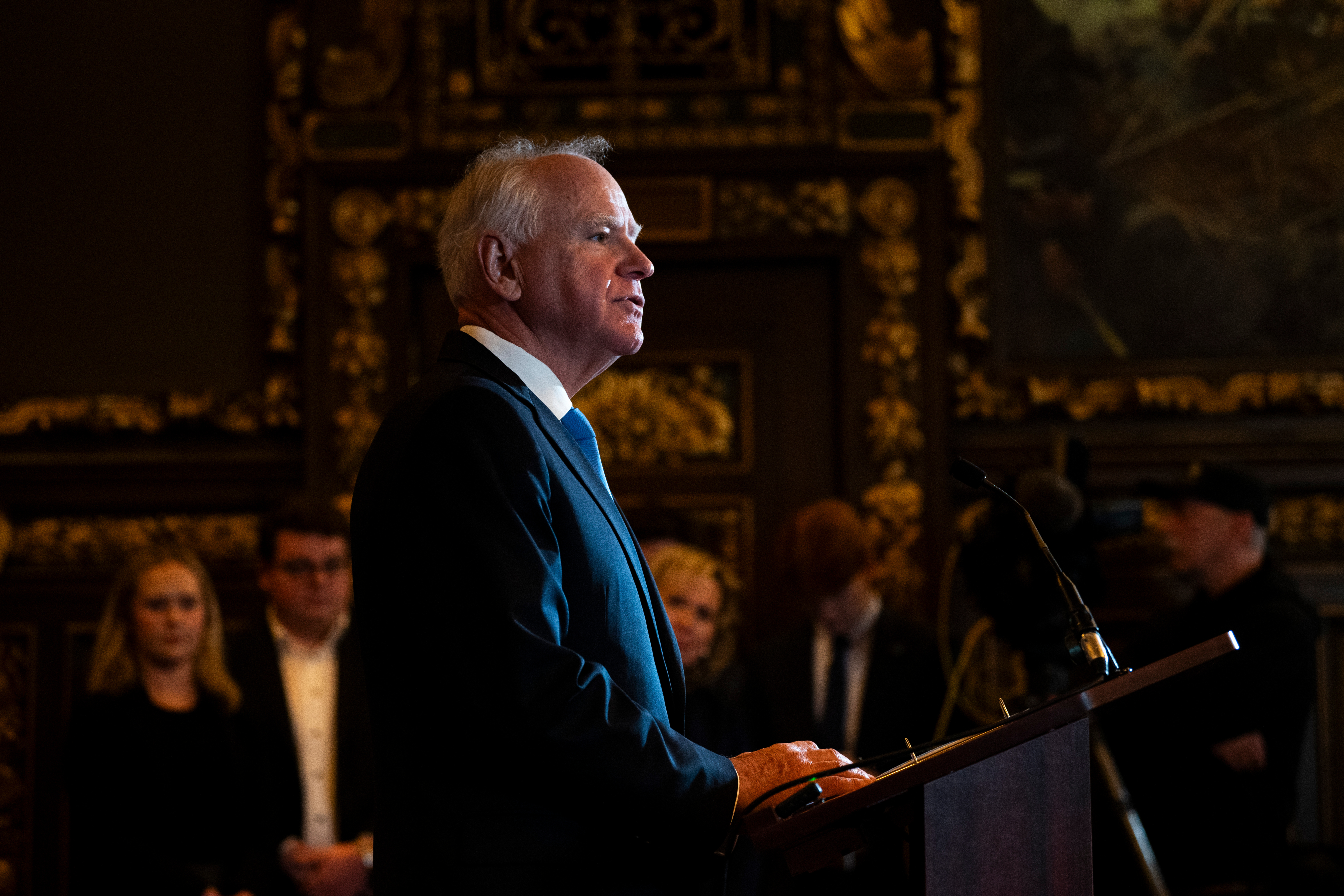
TIM WALZ ANNOUNCED MONDAY that he’s dropping his bid for a third term as Minnesota governor. His decision was prompted by the ongoing scandal involving some of the state’s welfare programs that was threatening his candidacy—and, no less importantly, continues to threaten the Democratic party’s brand in Minnesota and beyond.
The scandal is actually a series of scandals, going back a decade. They all involve private organizations that took government money to run food banks, childcare centers, and other supports for needy Minnesotans—and then didn’t provide the services. Instead, the leaders of those organizations stole the money, sometimes using it to pay for sports cars, vacation villas, and other luxury items.
The scandals have led to a series of prosecutions and convictions, many of them during the Biden administration, including one over fraud that prosecutors said totaled nearly $250 million in stolen funds. And there may be more to come. Last month, the assistant U.S. attorney for Minnesota announced the Justice Department had evidence suggesting that the total amount of fraud uncovered may reach well into the billions.
Much of this grift took place while Walz was governor, and for years he has faced criticism—led by Minnesota Republicans—that he was not doing enough to stop it. He has denied that, saying his administration has been chasing down fraud where it’s real and putting in mechanisms to prevent it. In his Monday statement, Walz said one reason he’s dropping his re-election bid is that he feels his campaign would be a distraction from this work.
“Every minute I spend defending my own political interests,” the statement read, “would be a minute I can’t spend defending the people of Minnesota against the criminals who prey on our generosity and the cynics who prey on our differences.”
“Cynics” is a reference to Donald Trump, his political team, and his army of online MAGA influencers who have latched on to the Minnesota fraud story—not only because it involves such a high-profile Democrat, but also because many of the implicated organizations are either run by or serve members of the state’s large Somali community.
“Much of the Minnesota Fraud, up to 90%, is caused by people that came into our Country, illegally, from Somalia,” Trump posted on Truth Social. He went on to take a swipe at Rep. Ilhan Omar, the Somali-American Minnesota Democrat he frequently attacks, as an “ungrateful loser” and “one of the many scammers.” He added: “Lowlifes like this can only be a liability to our Country’s greatness. Send them back from where they came, Somalia, perhaps the worst, and most corrupt, country on earth.”
Trump as usual cited no evidence to back his figures or his accusations against Omar—or explain why he was holding all Somalis responsible for the actions of a few scammers when he doesn’t do the same for, say, native Mississippians. It’s just one example of the dishonesty, hypocrisy, and immigrant-bashing he and his allies are spreading all over social media right now, and why it’s tempting—so, so tempting—to dismiss this whole saga in Minnesota as just another instance of MAGA hysteria.
But if you look past all that, you’ll find a genuinely troubling episode of government failure. And that matters because it’s tough to run public programs effectively—and to keep up public support—when grifters have an easy time stealing the funds.
“A really bad thing happened, and it demonstrated a real failure of public management that has to be addressed. And the scale of it was just incredible,” said Harold Pollack, a social sciences professor at the University of Chicago and longtime defender of safety net programs. “The Trump people are going to take this thing and they’re going to run with it so aggressively, it becomes a little bit easier for us to overlook the important substance here.”
THIS IS A STILL-UNFOLDING SAGA with ongoing investigations, and it’s now taking place against the backdrop of an online feeding frenzy—not to mention an upended governor’s race. But you can piece together the essentials from government reports and coverage in local outlets like the Minneapolis Star-Tribune, which has been covering the story of welfare fraud since authorities raided a handful of childcare providers in 2015.1
The issue then was overbilling a federal program that subsidized care for low-income kids, with the centers claiming to serve more children than they really were. That’s the kind of low-level, sporadic scheming that happens all the time, in all kinds of programs and in all kinds of states, until authorities figure it out and catch the perpetrators. But the fraud seems to have become a lot more widespread—and for the scammers, a lot more lucrative—during the COVID-19 pandemic.
In one sense, that’s not surprising. The literally unprecedented challenge of propping up the economy and meeting people’s basic needs put a premium on distributing assistance as quickly as possible. That meant skimping on some of the usual accounting and verification safeguards.
The thinking—among program administrators and some observers—was that it might be possible, after the pandemic had settled down, to go back and catch anybody who had been plundering the public till egregiously. And you could argue that is what happened in Minnesota, when, in 2022, investigators charged people associated with an organization called Feeding Our Future with taking more than $250 million in federal money that was supposed to pay for the feeding of low-income kids. A jury convicted the two ringleaders on all charges, which included conspiracy, money laundering, and bribery.
But now it appears those convictions—and that scandal—weren’t even the full extent of it. Last month, Assistant U.S. Attorney Joe Thompson announced a new series of indictments, this time over organizations he said were stealing money from a special Medicaid program that’s supposed to help people find affordable housing. It was at the press conference announcing those indictments that Thompson, who had spearheaded the Feeding Our Future case, said federal investigators believed total fraud could reach $9 billion.
“What we see in Minnesota is not a handful of bad actors committing crimes,” Thompson said. “It’s staggering, industrial-scale fraud.”
It was around this time that Nick Shirley, a self-described “independent YouTube journalist” whose recent productions include one called “Inside the Muslim vs Christian Battle Growing in America,” entered the picture—and turned the Minnesota controversy into a national one.
Shirley posted a video in which he’d gone to a handful of Minneapolis childcare providers with Somali proprietors, knocked on their doors, and asked either to see the kids or inquire about childcare. He mostly got no response, except at one center where a staff member opened the door and refused to let him in. Shirley took that—along with the testimony of a source he brought along named “David”—as proof those centers were part of what he claimed was a $110 million fraud scheme. It got millions of views on YouTube, and kudos from Vice President JD Vance who tweeted that Shirley deserves a Pulitzer.
Exactly what the video revealed remains unclear. State inspectors had been to all of the facilities in the past six months and seen kids there, according to reporting from the Star-Tribune and a local CBS affiliate. Childcare experts pointed out that proprietors would have been understandably wary about men showing up unannounced with cameras, especially amid widespread fear of immigration raids. Shirley, for his part, has stood by his work.
“Well, we showed you guys what was happening,” he told a CNN reporter who later questioned his methods, “and then you guys can go ahead and make your own analysis.”2
Shirley’s video unleashed a torrent of follow-up propaganda, some of which appeared to be pure fiction—including a post on X alleging Somali childcare providers had spent $35 million on campaign contributions, presumably to bribe Minnesota officials into allowing the grift to continue. The figure was preposterous: The $35 million was the money they’d received for services. But the post’s author refused to delete it, even after seeming to acknowledge the error. “We don’t care,” the author wrote.
Among the millions of people who saw the item was Elon Musk, who reposted it with a note, “Fraud used to make political donations.” It was just one of many posts where Musk or other MAGA voices online have cited the Minnesota scandal as proof of their long-held belief that Democrats were engaged in a much bigger, broader scam on the American people—that they have been opening the border to low-income immigrants, then showering them with welfare benefits in exchange for votes and political contributions.
A less conspiratorial but still politically explosive explanation for the Minnesota scandal is one that Thompson, the assistant U.S. attorney, has endorsed: that Minnesota officials were reluctant to come down hard on members of the Somali community because they didn’t want to seem racist, especially after George Floyd’s murder in Minneapolis became a national rallying cry for racial justice.
“This was a huge part of the problem,” Thompson told the New York Times, which has also covered the Minnesota scandal extensively “Allegations of racism can be a reputation or career killer.” That article also quoted a former state investigator who is Somali, and who said “There is a perception that forcefully tackling this issue might cause political backlash among the Somali community, which is a core voting bloc.”
A MORE PROSAIC EXPLANATION for the fraud scandal is that Minnesota’s government simply failed at oversight—either because some individuals in the bureaucracy were bad at their jobs, or because elected officials failed to put in place adequate safeguards, or some combination of the two. Nonpartisan auditors from the state government had warned for years that accounting and verification mechanisms were, as one 2019 report put it, “insufficient to effectively prevent, detect, and investigate fraud.”
But insofar as the scandal had to do with good governance, or the lack thereof, it’s not clear how much responsibility for that lies with the Walz administration and how much lies with factors beyond its control—like the shape of the American welfare state, and how it has evolved in modern times.
Here it’s useful to look abroad, to note how differently the welfare state works in some peer countries. The assistance programs of Western and Northern Europe tend to be universal, meaning they offer help to everybody, while the programs in the United States tend to be targeted, meaning they serve narrow, carefully defined sectors of the population. That creates incentives to game the eligibility criteria. Another difference is that the European governments are more likely to provide housing or deliver services like childcare directly. The United States, by contrast, outsources more of that work to the private sector, which means there are more opportunities for organizations and businesses to raid the public treasury.
This system didn’t develop by accident. It’s the result, in part, of a decades-long campaign by conservatives to limit or shrink the size of government, and to privatize public services whenever possible. And while there are plenty of intellectually defensible arguments for this approach—like a philosophical preference for lower spending and taxes or belief the private sector will be more efficient and innovative—it does require more aggressive oversight.3
“As long as you don’t have government directly provide those services, then you either have to invest more in auditing and monitoring these service provisions—or you have to be willing to deal with some failures and some scandals that come up every now and again,” Don Moynihan, a public policy professor at the University of Michigan and expert on how government actually works, told me.
The American system works best when there are safeguards in place to prevent fraud and abuse. In case you haven’t noticed, the Trump administration has adopted precisely the opposite approach since taking office—cutting personnel who guard against fraud rather than adding them, and weakening internal safeguards rather than strengthening them.
“Many of the cuts the Trump administration has made have been to reduce parts of the government that take on fraud,” Moynihan said. “A huge chunk of the CFPB [the financial watchdog agency that Trump has been trying to dismantle] was centered on protecting consumers against fraud. Many of the IRS cuts went towards identifying parts of the IRS that were addressing people who were engaged in tax cheating.”
Trump has also fired or demoted more than twenty of the federal government’s inspectors general, which, combined with some resignations, left more than three-quarters of the positions vacant as of October, according to the Partnership for Public Service. The inspectors general are the federal government’s vanguard against malfeasance. Trump’s hostility to them dates back to his first term, when a whistleblower report to one of the inspectors general led eventually to his first impeachment. (Trump fired him too.)
There’s one other notable way the Trump administration is enabling fraud, rather than combating it: through pardons. Going back to his first term, Trump “has granted pardons or commutations to at least 68 people convicted of fraud crimes or of interfering with fraud investigations,” according to a review of public records by KFF Health News. That includes the 2020 commutation for a nursing-home provider found guilty of scheming to defraud Medicare of more than $1 billion.
TRUMP’S GUTTING OF FRAUD SAFEGUARDS and his pardoning of convicted fraudsters doesn’t explain what happened in Minnesota. But it’s likely to enable more and bigger scams in the future, setting off what could be a vicious cycle in which stories of grift undermine confidence in public programs, creating political support for yet more cuts.
“If someone takes from this controversy that we have to stop offering services,” Pollack said, “you’re just compounding the harm that the initial people who committed the fraud already perpetrated against the community.”
A version of that is playing out right now. Trump administration officials have said they intend to freeze all federal childcare funding to five states where they believe fraud is rampant.
They have yet to provide evidence of such widespread scams—which seems important given that past audits indicate, as childcare expert Elliot Haspel noted this week, that more than 96 percent of federal childcare spending is valid. Nor have they explained why they are singling out those five blue states with Democratic officials in charge, when fraudulent spending in red states is plenty easy to find.4
If they proceed, it could have a devastating effect because childcare providers frequently run on tight margins. Losing a major income stream, even for a few weeks, could lead to closures. That would affect families from all economic backgrounds, because providers frequently service both subsidized and unsubsidized kids. But the subsidized population—that is, poorer families—would take the hardest hit, because they have the fewest alternatives for safe, reliable childcare.
Of course, these people also suffer the most when graft in public programs is widespread. That’s one of the many ironies of the way the Trump administration and its allies have used the scandal to attack Minnesota’s Somalis: They are victims too, because every dollar that a grifter pocketed is a dollar that needy members of their community didn’t get.
It’s one more reason why you don’t have to believe all the MAGA agitprop to demand answers on what went wrong here—and why you don’t have to share Trump’s prejudices to insist on changes that will prevent such failures in the future.
As the Minnesota story blew up over the holidays, some commentators on twitter suggested the media have been ignoring it. That is plainly not true.
I tried to reach Shirley on Tuesday morning, via a listed email. I did not hear back. If I do, I’ll update with any new and relevant comments he gives me.
There are also defensible arguments for providing more services directly, as they do in Europe. An example is the “Family Fun Pack” childcare proposal from progressive analyst Matt Bruenig, which envisions local governments operating public early-childhood centers. Bernie Sanders offered a version of this during his 2020 presidential campaign.
The five blue states whose funding Trump administration officials say they intend to freeze are California, Colorado, Illinois, Minnesota, and New York.
As always, a respectful and thorough column. But I wish Shirley would go after Rick Scott senator from Florida who scammed Medicare to the tune of millions as hard as he went after this story.
Nick Shirley nor any other unauthorized person has a right to demand to see children in a daycare center for the safety of said children.