GOP Senators Run From the Sight of Trump’s Epstein Card
“No it does not!” Moreno interjected. “Stop it.”

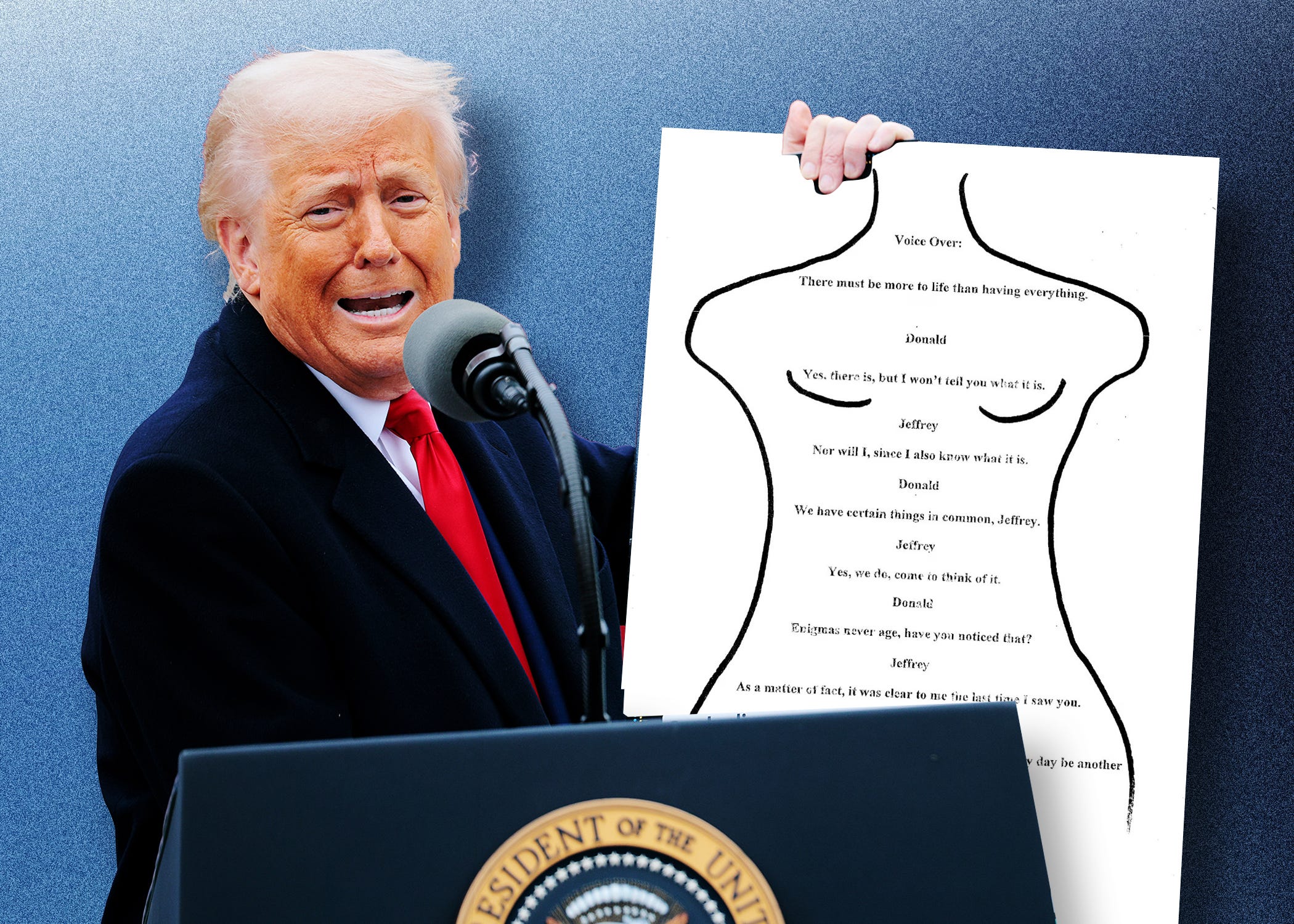
Scrib-ghazi
Minutes after the Wall Street Journal published a letter signed by Donald Trump and addressed to Jeffrey Epstein for his fiftieth birthday, I ran into Sen. Bernie Moreno (R-Ohio) in the basement of the U.S. Senate.1
Moreno is a freshman member. But that doesn’t mean he’s not savvy in the ways of evasion. And when I asked him about Trump’s Epstein card—in which the president’s signature is scribbled in the pubic region of a silhouette of a youngish-looking girl, which encloses a cryptic but very dirty-sounding imagined dialogue between the two men—the senator deflected using the same wording Trump did when trying to shut down a reporter’s question about Epstein a couple months ago: “Are you guys still talking about that stuff? I haven’t seen it, no.”
I handed him a printout of the letter so he could take a look.
“Oh, that’s not his signature,” Moreno said immediately.
I was surprised by how rapidly Moreno switched from professing ignorance of the card to claiming it was a forgery. But I saw it as an indication of how quickly talking points for defending the president were circulated on the Hill. Of course, those talking points don’t make any sense: As JVL noted in his newsletter today, believing the card is a forgery requires believing someone manufactured it and placed it in Epstein’s estate more than two decades ago when the birthday book was compiled, which was more than two years before he was first investigated. Also, claiming the signature doesn’t match goes against the vast evidence of comparable notes and writings from Trump back then that show a nearly identical autograph.
But Republicans I spoke with nevertheless seemed set on insisting that this was all just one more hoax meant to damage the president—Scrib-ghazi or QAhancock, if you will.
“Have you ever seen Donald Trump’s signature?” Moreno asked me, almost laughing. He pointed right at Trump’s name. “Does that look like his signature?”
Yes, I affirmed, it did.
“No it does not!” Moreno blithely interjected, sounding almost playful. “Stop it.”
I asked if he thought the signature had been forged. “Looks like it,” he said. “Also, could you imagine President Trump drawing a drawing like that? That’s not his style.” Moreno then popped into the elevator. I didn’t get to ask whether he thinks the president might have rendered a woman’s figure differently.
Moreno’s response to the latest Epstein revelation was not exactly a surprise. Congressional Republicans have perfected the art of denying reality or disclaiming knowledge of it to better protect Donald Trump. They have become so resolutely evasive that Capitol Hill reporters have for years been printing out physical copies of Donald Trump’s tweets to prevent them from getting out of addressing a particularly gross insult or unexpected policy announcement by claiming they haven’t seen it.
The practice declined a bit when Trump started making his insults and announcements primarily through official press releases and on-camera comments. But when the House Oversight Committee released the documents it obtained from Jeffrey Epstein’s estate yesterday afternoon, Capitol Hill reporters knew that some members would try to avoid offering any comment about the drawing of a naked woman and cryptic poem that Trump sent to the now-deceased child trafficker and rapist. So it felt like a good moment to bring back the printout practice.
But the Trump operation moves quickly. And by the time I had grabbed my warm copy off the printer tray and began holding it out to lawmakers in the halls of Congress, the Republican strategy had already started to take shape. Trump and his allies went all in on claiming the Wall Street Journal’s story was a hoax. Trump doesn’t draw pictures, they said. (Except when he does, of course—but, you know: not those kinds of pictures.) The signature didn’t look like his. Trump doesn’t even know how to read. How could he have written the card?2
But most of the lawmakers I approached with the card printout didn’t go so far as to deny everything outright. Instead, they begged off when I asked if they wanted to see it.
“I’m not gonna get sucked into that vortex,” said Sen. John Cornyn (R-Texas). Asked if he had seen it or wanted to, Cornyn added, “No. I don’t care.”
“I’ve got four minutes before I have to be in the chair [to preside over the Senate],” Sen. Jon Husted (R-Ohio) said while staring at the ceiling. “So I gotta run.”
“No, I haven’t seen it,” said Sen. Rick Scott (R-Fla.) while I held the drawing in front of him. “I mean, I’ll get a copy—I haven’t seen it, though.” I guess my showing it to him didn’t count.
As Scott walked away, one of his staffers asked me to send him a copy. I didn’t have the time to explain that google would suffice. I look forward to hearing back from him once he’s given himself the time to have a look, though.
That’s how Republican senators generally responded to the sight of Trump’s Epstein card—by scampering away. Meanwhile, the House GOP seemed more willing to embrace Trump’s preferred strategy of pure denialism.
Rep. Wesley Hunt (R-Texas) posted a photo of his family signed by Trump and he cited differences between Trump’s signature on his photo and on the Epstein card as evidence of fraud in the latter case. “For the record: This is what President Trump’s signature actually looks like,” Hunt wrote triumphantly.
Rep. Tim Burchett (R-Tenn.) previously cosponsored the bipartisan resolution to require the release of all Epstein files but has yet to attach his name to the discharge petition forcing a vote on it. After the Epstein card was published, he claimed it is just “so easy” to forge Trump’s signature—perhaps by using an autopen, like Biden did for all those pardons!
“I’ve never known Trump to be much of an artist, either, so I kinda draw that into question,” Burchett told reporters. “The thing is it’s been there for four years and now it’s just come out? I just don’t buy it.” Twenty-two years, actually, but who’s counting? Not Burchett.
“I just don’t buy any of it right now, because it’s—we have a prior administration that’s had a history of dishonesty, and they bring something like this out now,” he added. “Why wouldn’t they bring it out during the campaign?”
It sounds like the idea of a presidential administration refusing to use the Justice Department’s closely held investigative information for a political purpose is too outlandish for Burchett to comprehend it. I wonder why he feels that way?
Gun for hire
Rep. Cory Mills (R-Fla.) has been using taxpayer money to pay the former top lobbyist at the National Rifle Association, according to new congressional office disclosures.
Since July of last year, Mills has paid Caliber Contact $30,831 for printed materials and tele–town hall services. Caliber is helmed by Chris Cox, who served as executive director of the NRA’s Institute for Legislative Action from 2002 to 2019, when he was forced out amid a power struggle at the organization following revelations of the group’s financial mismanagement and internal turmoil.
Mills, who worked as a military contractor, has sold weapons and tools for crowd suppression to both domestic and international clients; his wares have included the tear gas used on Black Lives Matter protesters and rubber bullets used against anti-authoritarian, pro-democracy dissidents in Hong Kong. But since arriving in Congress, Mills has struggled with problems that cannot be addressed with tear gas or rubber bullets.
During a court hearing Friday about her request for a restraining order against the congressman, Mills’s ex-girlfriend Lindsey Langston said that she was “scared” and that she feared Mills, nineteen years her senior, because “he’s powerful, he’s well-connected, he’s wealthy.” Late last month, after Trump’s police takeover of the capital, D.C. police closed their investigation into a domestic-disturbance call an unnamed woman had placed against Mills early in the spring. (That woman later told a local reporter that Mills had not physically harmed her during the “emotionally charged” argument that precipitated her call to police. She also said the bruises on her arm, described in the police report as appearing “fresh,” were the result of a medical condition and activities she had done during a recent trip.)
Press Pass readers might recall an episode I reported on from the Republican National Convention in Milwaukee, Wisconsin last year involving Mills’s short temper. I spotted him berating police for not allowing him into a special access door; he told them specifically that he would “call the chairman of the RNC” if the situation was not remedied. I’m sure the officers were impressed with that, but I don’t know how things resolved: They let me through the door before Mills had finished yelling.
Clankers
When our team at The Bulwark offered our dark-horse predictions for 2025 last December, my colleague Martyn Wendell Jones suggested, citing AI critic Ed Zitron, that the artificial intelligence bubble could soon pop. It was a bold prediction, but we're already starting to see signs he might have been on to something.
Rogé Karma writes in the Atlantic:
If there is any field in which the rise of AI is already said to be rendering humans obsolete—in which the dawn of superintelligence is already upon us—it is coding. This makes the results of a recent study genuinely astonishing.
In the study, published in July, the think tank Model Evaluation & Threat Research randomly assigned a group of experienced software developers to perform coding tasks with or without AI tools. It was the most rigorous test to date of how AI would perform in the real world. Because coding is one of the skills that existing models have largely mastered, just about everyone involved expected AI to generate huge productivity gains. In a pre-experiment survey of experts, the mean prediction was that AI would speed developers’ work by nearly 40 percent. Afterward, the study participants estimated that AI had made them 20 percent faster.
But when the METR team looked at the employees’ actual work output, they found that the developers had completed tasks 20 percent slower when using AI than when working without it. The researchers were stunned. “No one expected that outcome,” Nate Rush, one of the authors of the study, told me. “We didn’t even really consider a slowdown as a possibility.”
No individual experiment should be treated as the final word. But the METR study is, according to many AI experts, the best we have—and it helps make sense of an otherwise paradoxical moment for AI. On the one hand, the United States is undergoing an extraordinary, AI-fueled economic boom: The stock market is soaring thanks to the frothy valuations of AI-associated tech giants, and the real economy is being propelled by hundreds of billions of dollars of spending on data centers and other AI infrastructure. Undergirding all of the investment is the belief that AI will make workers dramatically more productive, which will in turn boost corporate profits to unimaginable levels.
On the other hand, evidence is piling up that AI is failing to deliver in the real world. The tech giants pouring the most money into AI are nowhere close to recouping their investments. Research suggests that the companies trying to incorporate AI have seen virtually no impact on their bottom line. And economists looking for evidence of AI-replaced job displacement have mostly come up empty.
The basement is a small area where the underground pathways to the chamber intersect, forcing senators into a bottleneck full of idling reporters. Unless they’re dropped off by car or particularly creative about physical evasion, it’s the best way to find them for questions.
I obviously made up this last one. But it feels as though some of the people I spoke with would go along with that message if asked to do so.
These GOP denials make me think back to Sgt. Schultz on “Hogans Heroes”, “I know nothing…”, “I see nothing..”.
"Trump doesn’t even know how to read" made me laugh out loud.