How Trumpism Betrays the Declaration of Independence
Cherry-picking Lincoln, the MAGA New Right tries to rewrite—or discard altogether—the promise of human equality.

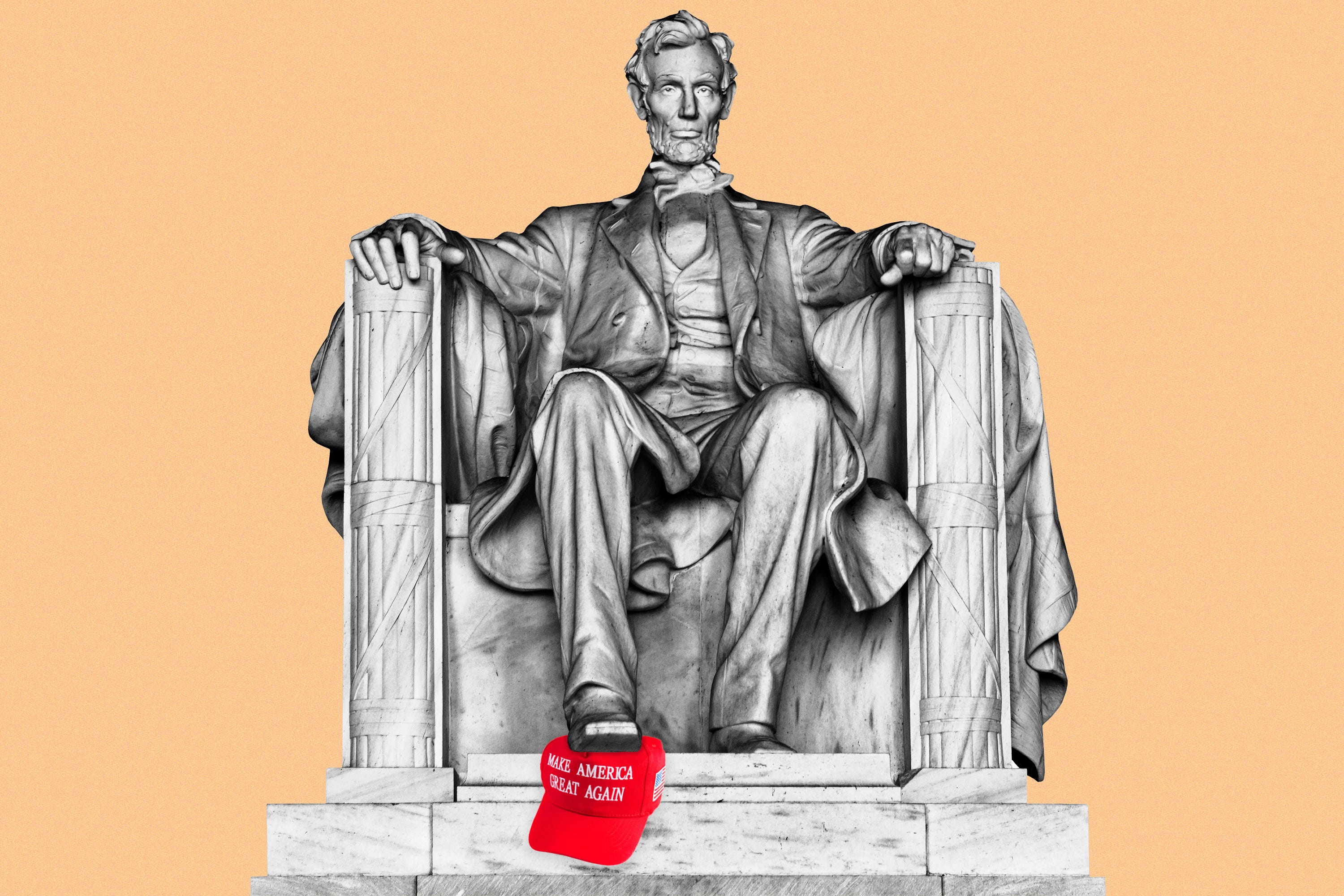
THIS WEEK’S SUPREME COURT RULING in the birthright citizenship case served a major blow to the Trump administration’s most overtly unconstitutional nativist effort. Chief Justice John Roberts, writing for the majority, made his case using expansive, high-minded language affirming the Declaration of Independence and its promise—just days before we celebrate the 250th anniversary of that founding document.
“Citizenship, then and now, was the right to have rights—to freely participate in our political community,” Roberts wrote. “The Framers of the Fourteenth Amendment extended that promise to ‘every free-born person in this land.’ . . . We keep that promise today.”
But for those of us fearing for America’s soul, Tuesday’s decision offers small consolation. The notion that birthright citizenship might be disputed in American law was a decidedly fringe position as recently as a decade ago. The Fourteenth Amendment, ratified in 1868, granted citizenship to formerly enslaved black Americans and all born on American soil, overriding the Supreme Court’s 1857 holding in Dred Scott. Relitigating birthright citizenship meant dredging up this sordid history—and although the high court ultimately ruled against the Trump administration, it is appalling that the matter got as far as it did.
Trump’s opposition to birthright citizenship is just one part of a much larger campaign. He and other MAGA leaders have explicitly defended nativism, rejecting the understanding of Americans as people bound together by the shared beliefs about freedom and human equality spelled out in the Declaration. Nativism unites the MAGA coalition and fuels the Trump administration’s immigration policy, foreign policy, social policy, and economic policy. And it has powerful intellectual supporters who are wedded to a vision of America that turns its back on its highest ideals and principles.
I chronicled the right’s ideological shift toward nativism in my book Furious Minds, about the ideological radicalization of the GOP. I wrote about how the disparate groups that make up the ideological elite of Trumpism have abandoned the idea of America as a creedal nation and minimized the importance of the Declaration in their conception of American identity. From old guard figures like Christopher DeMuth, to the new vanguard led by Kevin Roberts at the Heritage Foundation, and from “national conservatives” like Yoram Hazony to “postliberal Catholics” like Harvard’s Adrian Vermeule, these are the men who set the stage for Vice President JD Vance to declare that “America is not just an idea. It is a group of people with a shared history and a common future. It is, in short, a nation.”
A key figure in this story was the original Trump intellectual: Michael Anton, an early and eager critic of birthright citizenship. In a chapter devoted to him in my book, I explain the ways in which Anton inverts the spirit of the Declaration and betrays the spirit of Abraham Lincoln.
Anton did not like that discussion about himself, nor the rest of my book. He responded with a long review full of fury, misrepresentations, and ad hominem attacks (some of which I have addressed elsewhere). But what is most fascinating about Anton’s response is how he distorts and obscures a specific passage from an important speech by Lincoln. It happens to be the most beautiful passage I know about the true meaning of the Declaration of Independence. Anton is obviously deeply uncomfortable with the inspiring passage, from which he only quotes selectively. All the more reason for us to take a close look at it.
Loathing Lincoln
If you’ve heard of Anton, it is likely because of his “Flight 93 Election” essay, the first major intellectual defense of Trumpism. Originally published under a pseudonym in the Claremont Review of Books in September 2016, the essay made waves when Rush Limbaugh read it in its entirety on his show. The whole thing is based on a grotesque premise: Electing Trump was like the passengers who stormed the cockpit of United Airlines Flight 93 on September 11. There were no guarantees, except this one: “if you don’t try, death is certain.” Anton went on: “To compound the metaphor: a Hillary Clinton presidency is Russian Roulette with a semi-auto. With Trump, at least you can spin the cylinder and take your chances.” His characteristic move is to intellectualize the id of the MAGA movement.
And it has paid off. Anton’s stature has grown thanks to his propagandistic peddling of the idea that the 2020 election was stolen and his longstanding opposition to birthright citizenship. He has held senior positions in both Trump administrations and was one of the lead authors of the current administration’s Security Strategy Report. Today, he is a lecturer at Hillsdale College’s D.C. outpost, in addition to having an endowed fellowship at the Claremont Institute. Just this week he was appointed to the Defense Policy Board, a newly reconstituted committee that advises the secretary of defense.
Anton’s mendacious warping of Lincoln marks a rejection of his intellectual heritage—and reveals the degradation of an entire school of thought. Anton is a product of the Claremont Institute. The California-based think tank was founded in 1979 by four students of Harry V. Jaffa, and its mission—to this day—is to “restore the principles of the American founding to their rightful, preeminent authority in our national life.” Jaffa was a student of Leo Strauss and a scholar of Lincoln who highlighted the importance of the Declaration of Independence in Lincoln’s thinking, a legacy woven deeply into the Claremont Institute and its networks. These “West Coast Straussians” fixate on the philosophical statesmanship of both Lincoln and America’s Founding-era thinkers. Whereas other factions of the New Right speak the language of nationalism, or of Catholic integralism and the “common good,” or of techno-monarchism, the Claremonters speak in terms of the Founding.
The pugnacious Jaffa constantly argued with his fellow conservatives, some of whom saw him as excessively committed to universal, egalitarian principles, and insufficiently attentive to particular cultural attachments, community, tradition, and “states’ rights.” For his part, Jaffa alleged those who refused to embrace the philosophical truths of the Declaration were functionally amoral. Among Jaffa’s primary antagonists was the “paleoconservative” and Southern agrarian writer Mel Bradford, a staunch critic of Lincoln and the principle of equality.
To get a sense of the stakes of this feud, consider: In 1992, the journalist Gary Cartright asked Jaffa “why he thought Bradford was so vehement about Lincoln.” Jaffa reportedly laughed before quipping: “Lincoln stole Mel Bradford’s great-grandfather’s slaves.” Jaffa further explained that “A lot of what Bradford says about Lincoln is simply sour grapes from a disappointed Confederate. . . . Bradford would never come right out and defend slavery. You can’t do that these days. Instead of defending slavery, he attacks Lincoln.” This was standard-issue Jaffa. William F. Buckley once remarked that “the relentless Jaffa logic pries at apparently trifling differences until they open like chasms. What is more, he is able to convey the full gravity of these differences.” Jaffa was in his element defending the Declaration of Independence and the principle of equality that it enshrined.
Selective quotation
Today Anton and other Claremonters are betraying the spirit of Lincoln and the legacy of Jaffa.
Anton’s defenses of Trump and Trumpism reveal just how much he has been marinating in the paleoconservative thought that Jaffa anathematized as nihilism. A decade ago, Anton seemed to immediately recognize candidate Trump’s potential to carry forward paleoconservative ideas. In the “Flight 93” essay, this was most visible in Anton’s praise for the paleoconservative warhorse Pat Buchanan. But in a series of essays Anton wrote (also pseudonymously) beforehand, he demonstrated his private commitment to paleoconservatism more explicitly and comprehensively. These essays were published in the first part of 2016 as part of an insidery blog called the “Journal of American Greatness.”1 There, Anton defended Mel Bradford at length; quoted paleocons-turned-white-nationalists like Sam Francis, Peter Brimelow, and John Derbyshire; and self-identified as a “Paleo-Straussian”—something previously considered a contradiction in terms.
In one of those 2016 essays, “Toward a Sensible, Coherent Trumpism,”2 Anton argued that a Trumpist political order would begin
with regaining control over our borders and dismantling our insane immigration policies, both formal (e.g., the idiotic visa lottery) and informal (the bipartisan consensus not to enforce any law that results in less immigration—at least from non-European sources).
As part of his attack on our “insane” immigration policy, Anton opines on “America’s founding creed”—and in doing so commits an extraordinary apostasy. Typically, for West Coast Straussians, this is the whole ballgame: You either believe in the founding creed of human equality as voiced in the Declaration, or you have abandoned the moral foundations of the American republic. Astonishingly, Anton did the latter.
To build his case against immigration in 2016, Anton cited a speech given by Abraham Lincoln on June 26, 1857, regarding Dred Scott. Desperate to persuade readers that neither the Founders nor Lincoln were serious about human equality, Anton grossly distorts Lincoln’s words. Here is Anton’s full paragraph:
Here I address my neoconservative friends specifically, and also those Trump supporters who are either hostile to or try to wave away America’s founding creed. Yes, it is true that “all men are created equal.” But Lincoln adds the crucial caveat: all men are not “equal in all respects” (emphasis in the original). They are not “equal in color, size, intellect, moral developments or social capacity.” People from different nations with different circumstances, histories, beliefs and traditions will—by definition—hold very different conceptions of good government, some irreconcilably opposed to our own. It has been said that a principal cause of Rome’s fall was that “many men who never knew republican life and did not care for it … became Roman citizens.” Why then do we Americans continue to import millions upon millions who have never known republican life and do not care for it? In doing so, we do not uphold our Founding creed; we hasten and enable its oblivion.
Anton claims that Lincoln saw strict limits to the Founders’ commitment to equality, such that in no way would he imagine the promise of equality to extend beyond national borders.
The notion that America’s founding creed does not apply to those who, according to Anton, have “never known republican life and do not care for it,” has an ugly history. It was precisely this question that was at stake in Dred Scott. In his decision, Chief Justice Roger Taney ruled that black Americans were never intended to be included under the precepts of the Declaration since, he claimed, the Founding generation viewed them as “beings of an inferior order, and altogether unfit to associate with the white race, either in social or political relations; and so far inferior, that they had no rights which the white man was bound to respect.”
Lincoln disagreed. And he used Taney’s decision to expound upon the meaning of the Declaration of Independence. He began by asserting some of the real-world practical limits of the doctrine of equality—those limits that Anton dwells on. But then Lincoln issued an unparalleled, forward-looking pronouncement on the power of the Declaration’s promise. Here is the fuller excerpt:
I think the authors of that notable instrument intended to include all men, but they did not mean to declare all men equal in all respects. They did not mean to say all men were equal in color, size, intellect, moral development or social capacity. They defined with tolerable distinctness in what they did consider all men created equal—equal in certain inalienable rights, among which are life, liberty, and the pursuit of happiness. This they said, and this they meant. They did not mean to assert the obvious untruth, that all were then actually enjoying that equality, or yet, that they were about to confer it immediately upon them. In fact they had no power to confer such a boon. They meant simply to declare the right, so that the enforcement of it might follow as fast as circumstances should permit. They meant to set up a standard maxim for free society which should be familiar to all: constantly looked to, constantly labored for, and even, though never perfectly attained, constantly approximated, and thereby constantly spreading and deepening its influence and augmenting the happiness and value of life to all people, of all colors, everywhere. [Emphasis added.]
In his “Toward a Sensible and Coherent Trumpism” essay, Anton excludes the second half of this paragraph, thereby grossly misrepresenting Lincoln’s meaning. Lincoln described how the Declaration of Independence is an aspirational ideal in an often ugly and brutal world; Anton uses Lincoln’s description of those hard and difficult realities to justify ongoing injustice and cruelty. It’s a staggering inversion of the spirit of Lincoln.
Anton’s cherry-picking makes a mockery of Jaffa, too.
Part of what makes this fuller passage so memorable is that it was quoted at length in the foundational book in the Claremont canon: Jaffa’s The Crisis of the House Divided (1959). Jaffa so appreciated Lincoln’s words that he compared them to Deuteronomy 6:6–7. “We cannot help then perceiving the resemblance,” writes Jaffa, “to the words of the greatest of all lawgivers: ‘And these words, which I command thee this day, shall be in thine heart: And thou shalt teach them diligently unto thy children, and shalt talk of them when thou sittest in thine house, and when thou walkest by the way, and when thou liest down, and when thou risest up.’”
Anton doubles down
I exposed this intellectual malfeasance on Anton’s part in my book. In his review of the book, Anton doubled down on his anti-immigration argument—still refusing to cite the whole passage. Rather than contend honestly with the “standard maxim for free society” that Lincoln sets up for “all people, of all colors, everywhere,” Anton narrows the claim to constitutional forms and then puts words in my mouth: “For Field, the natural equality defended by the founders and Lincoln requires not only perpetual open borders but the electorate’s complete neutrality, even indifference, as to who is admitted and who is not.”
This is an incredible leap. Nowhere in my book will you find a defense of open borders or of state neutrality or indifference concerning immigration—or of the idea that the United States of America is somehow responsible for securing “the equal natural rights of non-Americans,” as Anton at one point claims—because these are not beliefs I hold. My point is more basic. It’s that Anton’s sputtering fearmongering—about “the ceaseless importation of Third World foreigners with no tradition of, taste for, or experience in liberty” or of Americans’ continual “import [of] millions upon millions who have never known republican life and do not care for it” or of Democrats’ supposed desire to “flood the country with endless immigration”—flies in the face of everything Lincoln worked for, including his commitment to the Declaration of Independence.
Look again at the passage from Lincoln that Anton avoids:
[The Founders] meant to set up a standard maxim for free society which should be familiar to all: constantly looked to, constantly labored in for, and even, though never perfectly attained, constantly approximated, and thereby constantly spreading and deepening its influence and augmenting the happiness and value of life to all people, of all colors, everywhere.
How we treat words like this involves nothing less than the aspirations of the American constitutional order. Lincoln says that the Founders actually believed in equality, and the ideals of life, liberty, and the pursuit of happiness: “This they said, and this meant.” Few people have tried harder than Anton to square this vision with the precepts of MAGA. It simply cannot be done, which is why he has had to fudge and deflect so much along the way.
A stumbling block to despots
Abraham Lincoln was not perfect. Some of the statements he made during the course of his political rise and his presidency were racist, and he made hard-headed practical decisions every day. Even in the Dred Scott speech discussed here, Lincoln advocated for “colonization” or the emigration of black Americans to Africa——a policy idea most black leaders rejected from the outset.3
Even so, all Americans can be proud of Lincoln and learn from him. His meditations on the Declaration of Independence deserve to be recovered in their fullness by anyone hoping to celebrate this year’s semiquincentennial. His plainest thoughts outshine the bluster of the MAGA New Right every time.
In the speech I have been dwelling on, Lincoln says the “all men are created equal” clause in the Declaration was added “for future use.” Then he elaborates:
Its authors meant it to be, thank God, it is now proving itself, a stumbling block to those who in after times might seek to turn a free people back into the hateful paths of despotism. They knew the proneness of prosperity to breed tyrants, and they meant when such should re-appear in this fair land and commence their vocation they should find left for them at least one hard nut to crack.
Still more words from Lincoln that we are unlikely to hear in the mouths of MAGA’s ideologues who have labored to, among other things, pervert the Declaration and undermine the Fourteenth Amendment. Thankfully, if the Supreme Court’s decision in Trump v. Barbara, not to mention Trump and Vance’s cratering approval ratings (and other related polling), are any indication, the ‘stumbling block’ and ‘hard-to-crack nut’ of the Declaration of Independence survives in the hearts of many Americans as a shield against despotism.
The increasingly farcical spectacle of Trumpism makes this year’s celebrations of the Declaration’s 250th anniversary bittersweet. From the cage matches on the White House lawn and the algae in the Reflecting Pool, to the Epstein files, ICE, and the debacle in Iran, it’s hard not to have mixed emotions about this July Fourth. Trumpism is a betrayal of the very things that we are meant to be celebrating, and people like Anton are embarrassed by ideals and traditions that should make them proud.
Which is all the more reason for us to reject Trump and his intellectual lackeys in their nativism and their attempts to recast America as just another nation, and to instead join with Lincoln in honoring the Declaration’s promise—our founding commitment to human equality and freedom—that, in all its complexity, defines who we are as Americans.
The blog caught the attention of more mainstream political commentators, at which point the authors got spooked and shut it down. Records of the site remain, however; I write about this at length in Furious Minds.
This Anton essay was also published separately on the right-fringe and antisemitic website Unz.com in March 2016. On the Journal of American Greatness site, the essay was posted with an editors’ note suggesting that Anton had tried to have it published by the Claremont Review of Books, but it was rejected because its arguments regarding immigration showed “thymos but not enough logos”—spiritedness but not enough reason.
Before the Anton types get too excited, note that Lincoln never argued for forcible removal for black people, let alone child separation and mass detention camps; his record vis-à-vis Native Americans is another matter.
 | A guest post by
|