Trump Lost on Birthright Citizenship. But He’s Winning the Immigration Wars.
SCOTUS rejected his brazen constitutional gambit—but cleared the way for potentially the largest revocation of legal immigration status in American history.

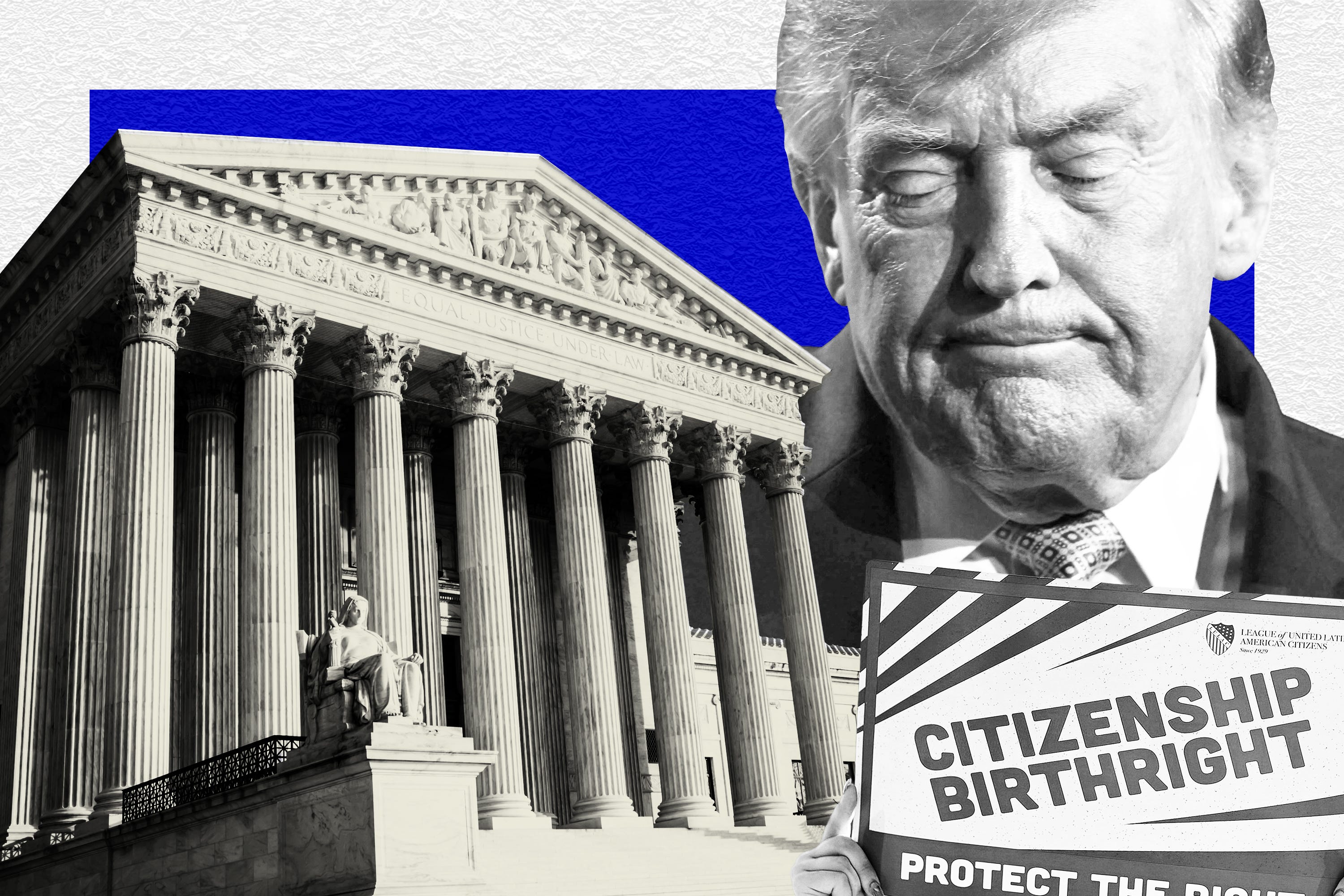
THE U.S. SUPREME COURT DEALT a major blow to Donald Trump’s mass deportation program Tuesday morning in Trump v. Barbara with a 6–3 decision striking down his executive order that purported to end birthright citizenship.
But how much of a blow was it really?
I’ve been grappling with that question ever since the ruling came out on Tuesday morning. And in my various conversations with legal scholars and immigrant advocates, it is clear that the fear they felt coming into decision day has been only partially alleviated.
Yes, the Supreme Court’s decision upheld that children born in the United States to parents unlawfully or temporarily present are “subject to the jurisdiction” of the United States and “are citizens at birth under the Fourteenth Amendment’s Citizenship Clause.”
And yes, Chief Justice John Roberts, who wrote the majority opinion, said “citizenship, then and now, was the right to have rights—to freely participate in our political community. The Framers of the Fourteenth Amendment extended that promise to ‘every free-born person in this land.’ . . . We keep that promise today.”
But step back from the prose and take note of the purpose. Roberts wasn’t making the case just to the public. He was making it to his colleagues.
Justices Clarence Thomas, Samuel Alito, and Neil Gorsuch dissented. (Justice Brett Kavanaugh affirmed the judgment but dissented in part and did not join Roberts’s majority opinion.) In other words, four Supreme Court justices were willing to state that they do not believe birthright citizenship is enshrined in the Constitution—a fact that would have shocked most legal scholars not too long ago.
So yes, the Court’s rejection of Trump’s order reveals the limits of his expansive and often illegal view of executive power that extends to modifying the Constitution via such orders. And yes, more than 250,000 babies born in the United States each year who would have been affected had the executive order been upheld, were not.
But opponents of Trump’s executive order still have future developments to fear. The door remains open to a future Congress restricting birthright citizenship through legislation, with only one justice needed to flip for that goal to be achieved.
THIS ISSUE BECAME the stuff of 72-point headlines when, among the many executive orders Trump approved in the hours after being sworn in for his second term, he signed one attempting to abolish birthright citizenship.
Ratified in 1868 to grant citizenship to formerly enslaved black Americans, the Fourteenth Amendment makes those born on U.S. soil full citizens entitled to all the associated rights and privileges thereof and ensuring “equality under the law, regardless of race, ancestry, or parentage,” as the American Immigration Council puts it. The amendment overrode the Supreme Court’s 1857 Dred Scott decision, which held that black people “are not included, and were not intended to be included, under the word ‘citizens’ in the Constitution.”
Or as John Bingham, author of the amendment, once said, its purpose was to end the “horrid blasphemy . . . that this is a Government of white men.”
But that intention has been contested at times in history since. As Columbia University’s Mae Ngai, a historian specializing in immigration, told me, while the struggle over birthright citizenship is profoundly important, it is not new. She said today’s fight over the issue mirrors past episodes, such as the one in which Frederick Douglass challenged racialist and nativist positions in his famous 1867 lecture, “Our Composite Nation.” At the time, Douglass was speaking in opposition to attempts to restrict Chinese immigration and naturalization. He charged that post-Civil War American democracy must include all races.
This was the singular American identity the Trump administration sought to destroy.
“As the Trump administration lawyer said: We live in a different world today. And [Chief Justice] John Roberts said [during oral argument in April], ‘Yes it’s a different world, but it’s the same Constitution,’” Ngai noted.
WHICH RAISES ANOTHER reason that Tuesday’s ruling from the Court has not been so widely celebrated by immigrant rights activists. There simply has been too much damage done in other areas to celebrate a thin reaffirmation of the Constitution.
This certainly is a rebuke of the Trump administration, Ngai noted, but it is one amid so many large-scale political and legal abdications. “If you look at birthright citizenship as a signature piece in the Trump agenda against people of color, they [Trump supporters] got everything else—mass removals, ‘build the wall,’ no asylum, even green card holders at risk—but they lost big on birthright.”
Todd Schulte, the president of FWD.us, a pro-immigration group that rose out of Silicon Valley, described to me how the anti-birthright citizenship order had acted as a “heat shield” for the administration, helping it rebuff nationwide injunctions and draw media attention away from dozens of other policies that hurt thousands of people. Schulte warned that the fact the Court split over whether to rewrite the Constitution should “be of the deepest concern.”
“Winning is better than losing…” he added, trailing off.
The Trump team “knew everyone would scream the most because it’s so clearly unlawful,” Schulte told me, but “their efforts to rewrite the Constitution as they see fit—even if they end with a ‘loss’ today—have advanced their goals substantially. We should be clear-eyed on where they’re going to continue taking status from millions of people.”
Rep. Analilia Mejia (D-N.J.) has seen the administration’s mass deportation machine up close at the Delaney Hall Detention Center in Newark, New Jersey. Though she has an unfiltered view of the brutality of the administration’s policies in this area, she still sees profound importance in the Court’s rebuke to Trump and Stephen Miller.
“The Thirteenth, Fourteenth, and Fifteenth Amendments are the fruit of the Second Founding of this nation,” she said.
A struggle built in from our inception culminates with a Civil War. You have both black and white abolitionists recognize that we not only have to abolish slavery, one of the most horrific things mankind has done, but we also have to hardwire facets of freedom in perpetuity, with birthright citizenship as a cornerstone. Because freed slaves understood no one is born with less rights than another, which is one of the most important facets of our Constitution—of this Second Founding—and I’m disgusted this administration was willing to challenge it.
Democrats and immigration activists had broadly agreed that while the administration’s assault on birthright citizenship was dangerous—and still is, as mentioned above—its anti-birthright push was always likely to fail at the nation’s highest court.
Despite this reprieve for the hundreds of thousands of new Americans each year whose citizenship was threatened by Trump’s executive order, some of the immigration leaders I spoke with said the most consequential recent decision with immediate consequences for immigrants is the likely fatal blow the Court dealt to Temporary Protected Status late last week. Hundreds of thousands of Haitian refugees are now facing removal despite the program that afforded them their status having been designed to prevent new administrations from destroying it on a whim.
Schulte told me he’d “heard people say TPS wasn’t the major decision”—but in many ways, it was.
“The Largest Delegalization Campaign in History”
WHILE WAITING for Trump v. Barbara, I knew that if the Court overturned the executive order, many would see it as a win for democracy and a rebuke of Trump—both of which are true, as Mejia and others I spoke with affirmed.
But the mood among Democrats and immigrant rights advocates remains dark as they consider the plight of the million-plus people living in the country legally under Temporary Protected Status. TPS grants the Department of Homeland Security the authority to determine whether citizens of specific nations can remain and work in the United States if they’re unable to “return safely to their own country,” whether because of a natural disaster, violence, or some other extreme but temporary situation.
In last week’s ruling in Mullin v. Doe, the Court cleared the way for the Trump administration to cancel temporary protected status for Haitians and Syrians. Like Tuesday’s birthright citizenship decision, this one was also 6–3.
Critics of the Mullin decision characterized it as a rug-pull for those affected: The Trump administration has been given a license to arbitrarily decide who gets to be an immigrant at any given time, reserving for itself the right to take away in an instant the legal status of a person who has followed the rules to get here.
The decision is insidious, and the potential scale of its consequences is enormous.
There are 1.3 million people living in the United States with TPS, Schulte told me.1 As of early 2025, around 100,000 people with TPS had spouses and children with U.S. citizenship, and some 390,000 U.S. citizen children have parents with TPS.
They are our neighbors—the people next to us in grocery store aisles or the pews. In places like Springfield, Ohio, they work in manufacturing and service industries; in places like South Florida, they work predominantly in health care and taking care of our seniors—our grandmothers, as my colleague Jonathan Cohn has powerfully written.
All of these people are now at risk of deportation. If we only account for TPS holders from El Salvador, Honduras, and Haiti, that’s still a “quarter million people who have been here since last century,” Schulte added.
The threat they face is dizzying. For example, TPS for people from El Salvador who had “continuous residence” in the United States since 2001 is set to expire on September 9. Will Trump continue to designate the country of his strongman partner and prison exporter Nayib Bukele as unsafe, which would problematize the return of these TPS holders? Not likely.
“There’s no precedent for the level of revocation of immigration status and people with such longstanding ties to the country,” Schulte said. In frustration, he slammed the Court for dismissing the argument that the administration’s words revealed racist reasons for canceling Haitians’ TPS status. “If there isn’t racial animus towards Haitian TPS holders, then those words have no meaning.”
Andrea Flores, who served as the director of border management on the National Security Council during the Biden administration, said the TPS decision marks a turning point for how seriously the world can take our immigration policies.
“The word of the U.S. no longer matters when it comes to immigration. No immigrant will be able to trust the policy of the U.S. government when they know the next president can delegalize them with the stroke of a pen,” she told me.
THE EFFECTS OF THIS DECISION will reverberate across the globe, but they will be felt with special force in Latin America. In Venezuela, the decision on TPS comes, as CNN’s Priscilla Alvarez writes, “against the backdrop of twin quakes . . . the type of natural disaster that might prompt a review for TPS by DHS.” Horrifyingly, a hundred Venezuelans deported from the United States just hours before the earthquakes were housed in a hotel that collapsed after the shaking started. They are now missing.
The effects on the business community and on eldercare will take time to emerge, but they, too, will be profound.
“We strongly disagree with terminating Haitian TPS,” Rebecca Shi, CEO of the American Business Immigration Coalition, said on a conference call after the decision came down. “It’s economically destructive and morally wrong.”
Senior care providers who were also on the call said the decision was going to devastate the lives of a million American seniors who were going to “lose beloved caretakers who bathed them, fed them, and kept them company for years.” They noted that many vulnerable seniors have memory issues, making turnover in their caretakers particularly harmful.
Rob Liebreich, president and CEO of faith-based nonprofit Goodwin Living, described his feeling of “sadness that more of our older adults who need support in years to come won’t get the care they need.”
And a senior resident at Goodwin House Bailey’s Crossroads in Virginia named Rita Siebenaler told the call it was a “dreadful” day.
“This is not the way a civil society should treat its seniors or humanely treat immigrants to our country,” she said, urging Congress to press for extension of TPS.
Linda Couch, the senior vice president of housing policy at Leading Age, an association of senior care providers, said the United States is staring down a massive shortage of people in the aging care workforce. The advocacy group PHI puts the shortfall at close to 10 million workers.
Couch said there are no replacements lined up for the skilled caretakers being forced out as a result of the decision.
“People can lose their jobs overnight and there is no workforce waiting in the wings that can replace these professionals,” she said.
Hey guys, with these momentous rulings we want you to send in your questions on birthright, TPS, and the asylum ruling and we’ll get into them tomorrow with experts Todd Schulte from FWD.us and Michelle LaPointe from the American Immigration Council. Thank you!
As long as we have one of the two parties being blatantly nativist (and with strong preference for White “heritage” Americans), the war against immigrants will not stop.