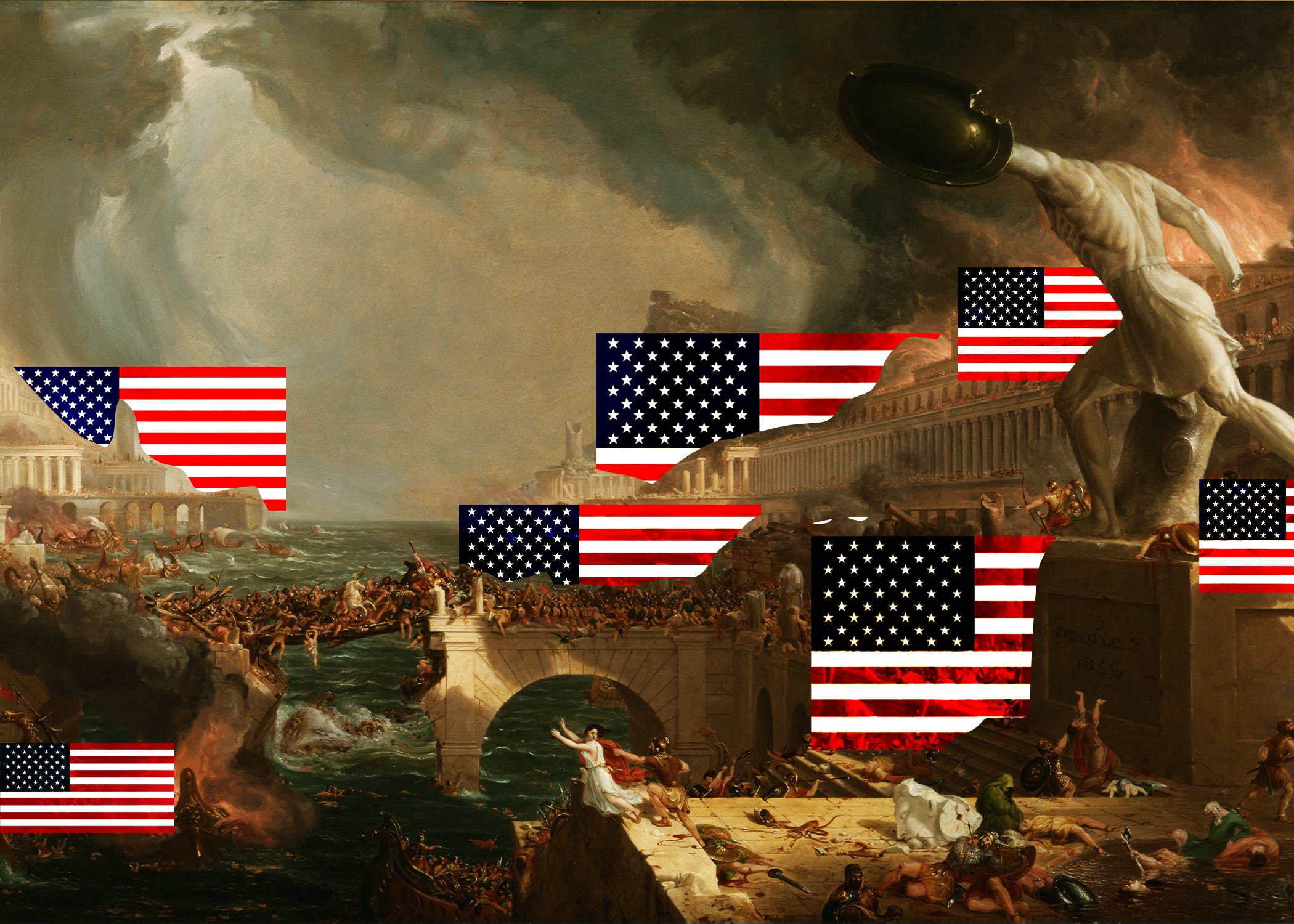
Is This What ‘Late-Stage Democracy’ Looks Like?
What if the Constitution *is* a suicide pact?

Sarah and I did a meatspace Secret pod for you. It’s not emo, exactly, but it’s not a normal show. We just asked each other a bunch of questions and hung out. I hope you’ll get something out of it? For my part, I just enjoyed getting to spend time with my bff.
The show will be up soon; be on the lookout.
1. The Hour Is Late
Yesterday we talked about late-stage capitalism. Today I want to talk about late-stage democracy.
Let’s start with definitions. Late-stage democracy would be the period of democratic decline in a mature democracy that comes before a fall that is the product of internal degradation and not external pressures.1
Can you live with that definition, more or less?
If so, then I’d propose late-stage democracy can manifest in many ways, depending on the specific cultural context. But in the American context, if we are in late-stage democracy, then it involves two changes:
A citizenry no longer primarily responsive to real-world inputs.
Constitutional mechanisms that no longer function as designed.
Bear with me. That’s a lot to unpack.
Let’s start with the first part: a citizenry disconnected from reality.
This is a highly subjective diagnosis and reasonable people will come to different conclusions. So let me make my best case:
The public believing that crime is surging when it is (a) declining and (b) at or near historically low levels.
People reporting that their personal financial situations are good, but that they believe the broader economy is terrible.
People believing that an economic soft landing is a crisis on par with the 2008 global financial crisis / Great Recession.
People blaming Administration B for actions that took place under Administration A.
People abandoning en masse scientific advancements which have saved millions of lives.
Again: This is all highly subjective and “people” and “the public” are not a monolith. Not everyone is disconnected from reality. And historically, I’m sure there has always been a contingent of citizens who were not responsive to real-world inputs. You can likely find antecedents for each of the items listed above.
What I’m suggesting is that there may be some tipping point at which either (1) the percentage of people whose political preferences are disconnected from real-world inputs is so large, or (2) they become so concentrated in one party, that the democratic system begins to stop functioning as a machine to govern the real world.2
Like I said: This is all highly arguable. You might reject the idea in its entirety. Or reject the claim that we are past such a tipping point. And that’s fine. Because what I really want to focus on is the second part: the ossification of our constitutional system.
It turns out that the United States Constitution has one major flaw:
Join Bulwark+ to unlock the rest
Become a paying member of The Bulwark to get access to this post and other subscriber-only content. A subscription gets you:
- Unlimited access to articles and newsletters including The Triad by JVL and Receipts by Catherine Rampell.
- Ad-free editions of our shows (with transcripts) and member-only shows like The Secret Podcast.
- Plus community chats and commenting features. Your support helps keep our work sustainable and available to those who cannot afford a membership. Cancel anytime.