Jack Smith Wants a Spectacle. Will Republicans Play Ball?
The former special counsel says he wants any testimony he gives to be public. In an interview with The Bulwark, Rep. Jamie Raskin outlines why it matters.

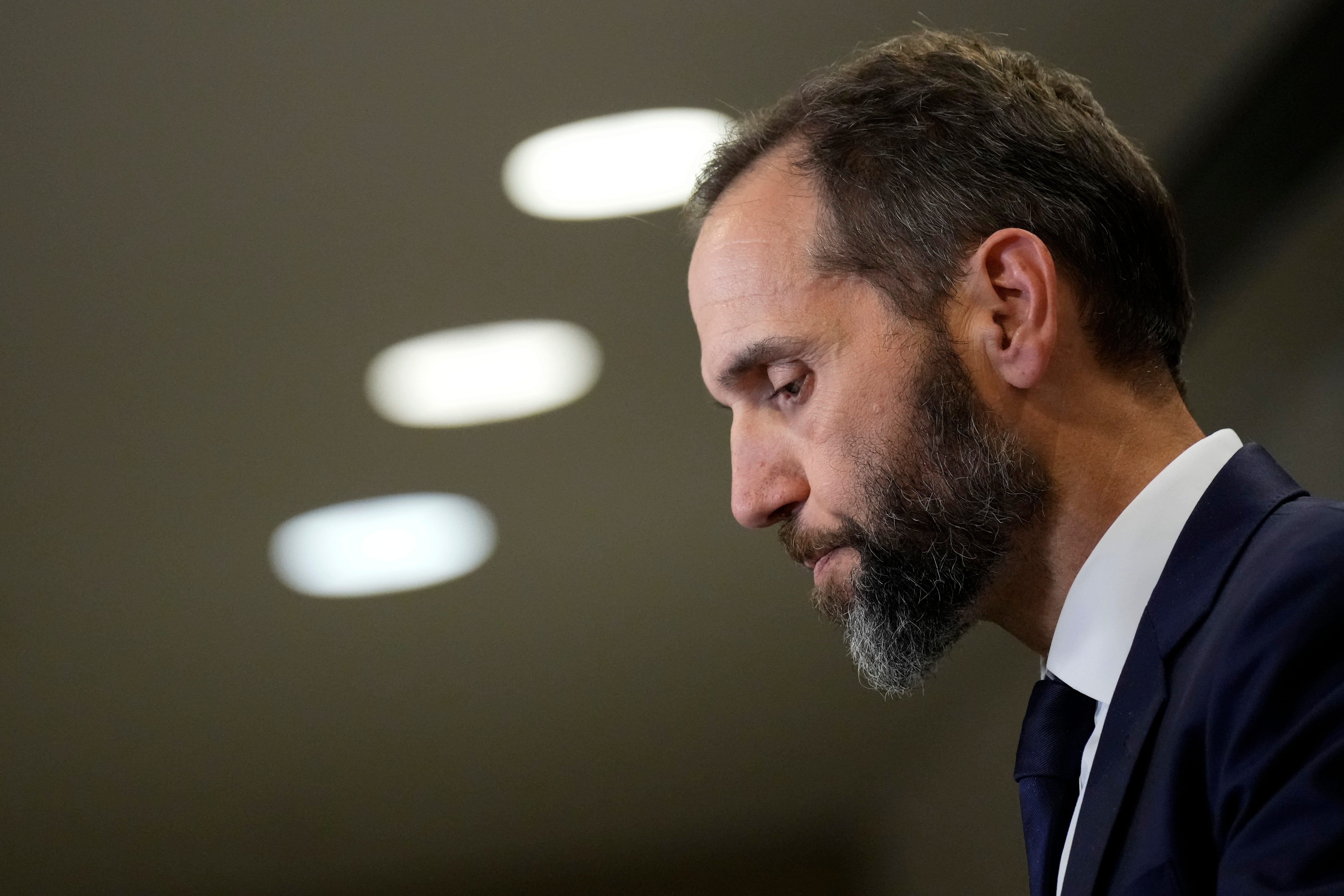
Like many of the individuals who investigated or criticized President Donald Trump during his four-year exile from the White House, Jack Smith is now being subjected to intense political and legal scrutiny.
House and Senate Judiciary Chairmen Jim Jordan (R-Ohio) and Chuck Grassley (R-Iowa) are preparing to bring in the former Justice Department special counsel, who investigated Trump and others for mishandling classified information and attempting to subvert the results of the 2020 election, to testify before their respective committees. Their goals don’t require a special counsel to figure out: They want to berate Smith and lambast the Justice Department for daring to probe Trump’s alleged misuse of classified information while reinforcing their larger narrative about the DOJ being deeply politicized against Trump.
Smith was ready: After receiving his first summons, he started maneuvering to gain a more advantageous position.
“We have received Chairman Jordan’s October 14, 2025, letter and are aware of Chairman Grassley’s interest in testimony from our client, Jack Smith,” attorneys for Smith wrote in a letter to Jordan and Grassley last Thursday. “Given the many mischaracterizations of Mr. Smith’s investigation into President Trump’s alleged mishandling of classified documents and role in attempting to overturn the results of the 2020 election, Mr. Smith respectfully requests the opportunity to testify in open hearings before the House and Senate Judiciary Committees.”
Requesting that a hearing be done out in the open is a classic bit of gamesmanship, designed to portray your critics as the ones having something to hide. And, naturally, some Republicans on the committees were irate.
“I don’t think he’s in any position to bargain,” Sen. John Cornyn (R-Texas), a longtime member of the Judiciary Committee, told me on Monday. “I think there needs to be—typically what happens is there’s some behind-the-scenes vetting by staff before, then public testimony is provided. That’s probably appropriate here.”
But at least one, Sen. Lindsey Graham (R-S.C.), seemed okay with the idea. “It’d be great. I think he should testify,” Graham told me. He deferred to Grassley on the question of which setting and format would be more appropriate.
On the Democratic side, opinion was more uniform, with lawmakers keen on ensuring any Smith hearing is available for public viewing. Sen. Richard Blumenthal (D-Conn.) told me, “It certainly is possible [that Smith will testify in an open hearing], if Republicans will allow it.”
“They control the agenda and all of the committees where he would testify,” Blumenthal added after pausing when I asked if that was likely. “And I think it should be in public. The American people deserve to hear from him.”
The same day that the Smith letter went out, Rep. Jamie Raskin (D-Md.), the ranking Democrat on the House Judiciary Committee, sent his own letter to Jordan calling on him to grant a public hearing.
When I got him on the phone, Raskin elaborated on this for me. “The normal expectation would be that a special counsel investigating a president comes to our committee and testifies publicly,” he said.
“I can’t think of a case where we had a special counsel or independent counsel investigating a president who did not appear in public before a committee to discuss his findings and to answer questions. So that’s the norm,” he added. “It’s just weird to do it in any other way.”
Raskin also noted that “the Republicans don’t want any public questioning or discussion” and that “they would like to serve Trump’s will by getting [Smith] behind closed doors and then, you know, torturing out a few words here or there, which could then be distorted into some kind of media campaign. But that’s, you know—that’s an irresponsible way to go, obviously.”
In theory, Democrats could try to orchestrate a public session for Smith that would take place outside the confines of a formal committee hearing. But that’s still up in the air while the party attempts to secure a public forum.
“We’ve had shadow hearings about different kinds of things, both as House Judiciary Democrats and in conjunction with our Senate colleagues,” Raskin said. “But we have not yet examined that, and I haven’t even begun to think about that, because I think it’s so obvious that he needs to testify in front of the whole country.”
As with the House Oversight Committee’s Epstein investigation, Republicans have wanted to play this probe close to the chest and control how the information gets out. If Smith is intent on counteracting the GOP stratagem by insisting on publicly answering their questions about the particulars of his investigation, it may require a bit of arm-twisting, or perhaps finding an unorthodox forum in which to testify. For now, Smith is eager to stay in the light. Whether lawmakers are willing to let him is an open question.
Deal or no deal?
When the largest federal employees union issued a statement on Monday calling for an end to the now 28-day-long government shutdown, many observers expected Democrats to begin to fold.
“Both political parties have made their point, and still there is no clear end in sight,” American Federation of Government Employees President Everett Kelley said in his statement. “Today I’m making mine: it’s time to pass a clean continuing resolution and end this shutdown today. No half measures, and no gamesmanship. Put every single federal worker back on the job with full back pay—today.”
But instead of acquiescing to union demands, as the party often does, Democrats on Monday and Tuesday appeared to be maintaining their stance that a resolution will only come when Congress has dealt with the expiration of enhanced Affordable Care Act tax credits.
In fact, several members suggested that the AFGE statement wasn’t designed to pressure them at all.
“I had a conversation with the president of AFGE earlier, right after the shutdown [began], and that was their position then,” said Sen. Jeanne Shaheen (D-N.H.). “So this isn’t a new position.”
“Let’s see how the week plays out,” Sen. Mark Warner (D-Va.) told reporters. “I think people want us to fight.”
Senate Minority Whip Dick Durbin (D-Ill.) acknowledged the AFGE statement has “a lot of impact,” but stopped short of announcing a move into the ‘reopen the government’ camp.
“They’ve been our friends, and we’ve worked with them over the years,” Durbin said of the union. “I’ve had a good connection with them and I’ve talked to them. They’re in a terrible mess. So many of their workers are not being paid. I can understand why they did that.”
A wise lobbyist once said there are no winners in a government shutdown; there are only losers and survivors. It appears Senate Democrats still believe they can emerge as winners. But that’s not a real prospect for many others at this point.
What Nick Adams is reading
Nick Adams, the current nominee to serve as U.S. ambassador to Malaysia, has long adored the Hooters restaurant chain. He’s posted about the franchise hundreds of times—certainly more frequently than about U.S. policy in the Asia-Pacific region.
While Adams appeared to be toning down his shtick (and being a bit quieter about Hooters) in advance of a potential confirmation hearing, the chain’s original founders want to revive the Hooters brand as part of a “higher calling.”
Chloe Sorvino writes in Forbes:
Kiefer and the original Hooters crew could easily be enjoying their golden years on golf courses or the beaches of Florida. Instead, they are leading a deal to acquire 111 Hooters locations out of bankruptcy and planning to invest about $40 million into turning around the challenged chain. Kiefer, who was the cofounders’ attorney when Hooters was founded in Clearwater, Florida in 1983, says the group feels an emotional connection to the chain and don’t want to see the brand die.
“We had some soul searching,” says Kiefer. “We don’t want to leave the Hooters world in the condition it is in. We have a moral obligation.”
Last month, a Texas bankruptcy judge gave approval their plan, and final step is expected next week. Kiefer is now embarking on a transformation. That will start, he says, with Hooters returning to a more wholesome image. Nearly half of the 30 highest-volume Hooters restaurants in the U.S. are operated by Kiefer’s Hooters Inc. group. The design hews to the original “Florida themed beach shack” vibe with servers, known as Hooters Girls, in tight white t-shirts and (slightly) longer orange shorts. Kiefer believes the private equity owners of Hooters of America, Nord Bay Capital and TriArtisan Capital Advisor, “oversexualized the concept” by leaning into its reputation as a “breastaurant.” Kiefer’s group will acquire about 54 locations, while an operator called Hoot Owl LLC, which includes some of the first Hooters franchisees, will acquire another 57.
I’m not sure what moral obligation compels one to save the Hooters restaurant chain—perhaps it’s related to a concern over preserving the jobs the company provides—but at least enthusiasts like Adams will be happy, provided he doesn’t get too upset over the “more wholesome” brand direction.
Grab some wings and read the whole piece.
Jack Smith has had all of his hard work go up in smoke, and seen a criminal insurrectionist become president. I think this has all become quite personal for him; he knows he's dealing with liars, and when you're dealing with liars, you testify publicly, not privately.
It’s pretty nervy for Jim Jordan to expect someone to show up for such a committee when he himself ignored a subpoena.