Jack Smith’s Not-So-Subtle Message
In two recent appearances, the former special counsel explained his view of what it means to say ‘No Kings.’


One of those ledes that just pulls you up short, from the Chicago bureau chief of the New York Times:
During a recent run near Lake Michigan, I watched a black S.U.V. make a U-turn and chase down three young men. Two armed immigration agents, their eyes peeking out from behind their balaclavas, jumped out and approached them. One asked what visas they held.
“H-1B,” they responded, looking bewildered. That’s the visa for foreign workers with special expertise.
Nothing that I could see would have attracted the attention of the agents, except for the fact that the men had brown skin. After questioning them, the agents let them go.
This scene is now unfolding across Chicago every day.
Just another day in Stephen Millerland. Happy Thursday.
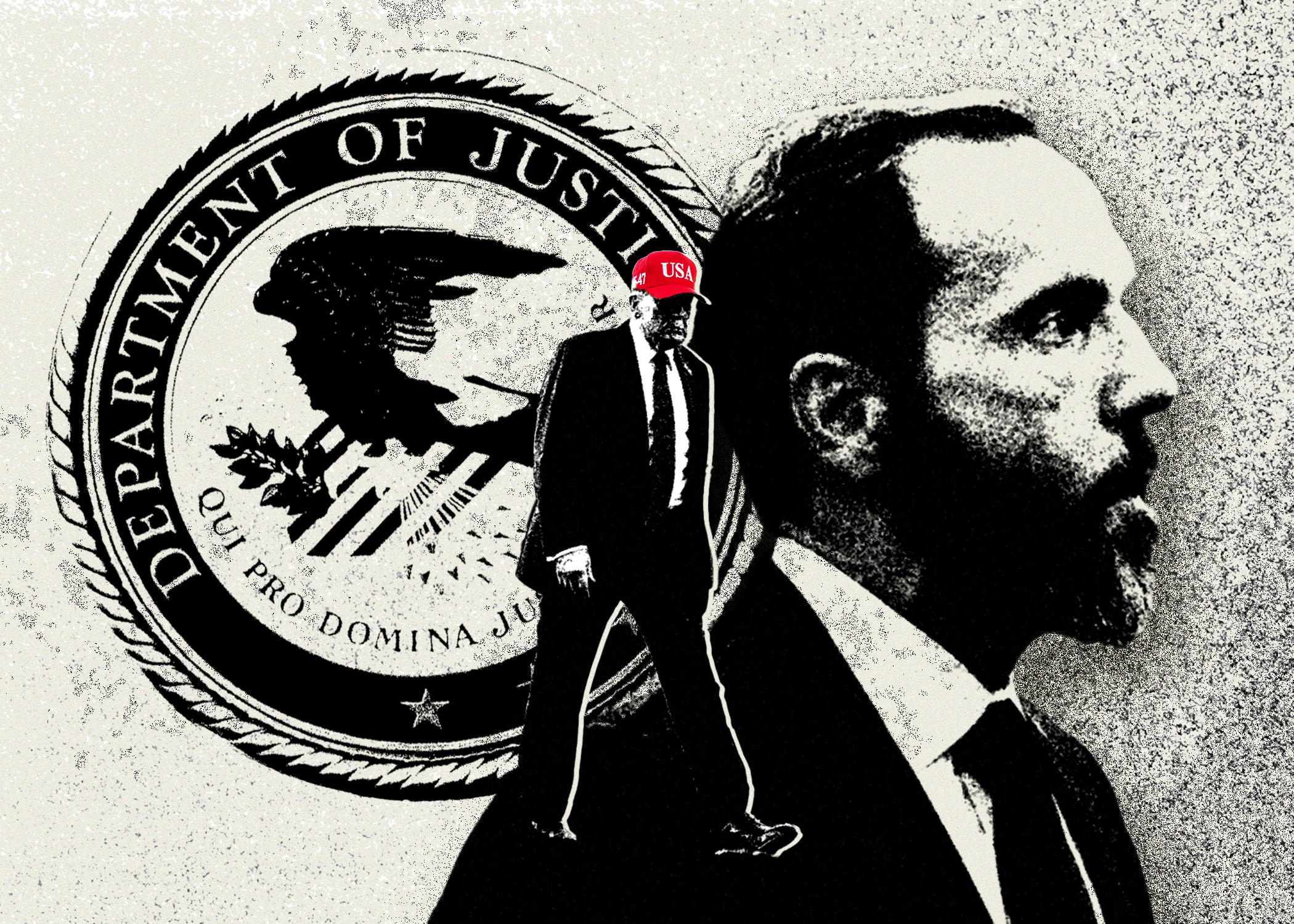
Jack Smith Speaks
by Will Saletan
Jack Smith, the former special counsel who secured indictments of Donald Trump in 2023 and 2024, is reemerging with a call to action. It’s not a call to action against Trump. It’s a call to unite across the political spectrum in defense of the rule of law.
Smith faces a cohort of demagogues who have captured Congress and the White House, taken over the executive branch, ruthlessly abused power, and conned millions of voters into believing that any criticism of this administration’s corruption is partisan.
The demagogues’ strategy was on display last week, when Attorney General Pam Bondi testified before the Senate Judiciary Committee. Senator Josh Hawley called Smith a “hit man” who had led a “witch hunt” against Trump. Senator Eric Schmitt said Smith had been appointed to “get Trump.” Bondi accused Smith of trying to “weaponize the Justice Department against Donald Trump.”
These lies are designed to inflame conservative voters and make them ignore Smith and other critics of the administration.
Smith is trying to puncture that propaganda. And he’s taking his efforts public. In a September 16 speech at George Mason University and an October 8 interview at University College London—the latter was posted to YouTube on Tuesday, the former was recorded in videos obtained on Wednesday by The Bulwark—Smith emphasized the political neutrality of career prosecutors. He noted his own service in administrations of both parties, including Trump’s first term.
Responding to the myth of a partisan double standard in the Justice Department—a myth promoted by Bondi among others—he explained why, for example, Trump had been indicted for his handling of classified documents while Joe Biden hadn’t. The difference, Smith observed, lay in the facts of the two cases, starting with Trump’s obstruction of the government’s efforts to recover its files.
Again and again, Smith emphasized that the current administration has diverged from all previous administrations. “Nothing like what we see now has ever gone on,” he told the audience in London. This divergence, he added, takes two forms: personal loyalty to the president over loyalty to institutions, and a commitment to outcomes instead of rules.
Smith outlined numerous examples:
The pardons and commutations given to everyone convicted of violent crimes on January 6, 2021. Smith put it starkly: “They were pardoned by the president because they committed their crimes in his name and in his interest.”
The terminations of FBI agents and “the January 6th prosecutors and their staffs . . . for doing their jobs.”
The appointment, as a senior adviser to the attorney general, of a man (Jared Wise) who “was at the Capitol on January 6, 2021, telling other rioters to kill police officers.”
The unwarranted “prosecution of the former director of the FBI,” James Comey. Smith pointed out that “the career prosecutors . . . who analyzed this said there wasn’t a case. And so they [apparently alluding to DOJ leaders and the White House] brought somebody in who had never been a criminal prosecutor, on days’ notice, to secure an indictment a day before the statute of limitations ended.”
“Dismissing a criminal case against the current New York City mayor [Eric Adams] in exchange for his cooperation with the president’s political agenda—and then forcing the resignation of prosecutors who wouldn’t go along with that deal.” Smith told the George Mason audience: “I’ve been doing this thirty years. I never heard of such a thing.”
“Refusing to even open a criminal investigation when senior members of this administration broadcast what was clearly classified information over a commercial messaging app, including to a member of the media.” He was alluding here to the infamous chat involving Defense Secretary Pete Hegseth. “Folks,” Smith went on, “there is no Justice Department under any previous administration, Republican or Democrat, that on these facts would not have opened a criminal investigation, where the lives of our service members were put at risk.”
“Deporting people from the United States despite a clear [judicial] order stating that a person can’t be deported.” To this, Smith added: “Leaders at the DOJ [apparently a reference to Emil Bove] allegedly telling prosecutors that they would disregard court orders if they [the court orders] come into conflict with the president’s agenda.”
“In the first week of this administration, seventeen inspector generals from across the government were fired,” Smith reminded the George Mason audience. “If you wanted to deter whistleblowers from coming forward and allow active corruption to happen, one of the first things you’d do is to get rid of those inspector generals.”
“Next thing you’d want to do if you wanted to erode the rule of law is to get rid of nonpartisan, apolitical career prosecutors,” said Smith. “Firing these people is completely unprecedented. No administration has ever tried it.” But this one has.
Trump routinely calls Smith “deranged.” But in his remarks, Smith illustrated what it looks like to follow rules instead of trampling them as Trump and Bondi have. Last year, in a blow to Smith, the Supreme Court granted presidents broad immunity from prosecution. Then, when Trump won the presidential election, the Office of Legal Counsel—operating under Biden—told Smith he couldn’t prosecute Trump as a sitting president. Each time, Smith accepted the judgment and moved on. And while Trump spewed lies about him throughout the investigations, Smith never spoke out against Trump. To do so, Smith observed in London, would “make it hard for the defendant to get a fair trial.”
As Americans of all backgrounds prepare to rally on Saturday against authoritarian government, Smith is now speaking out. He is doing so in a way to underscore all that’s at stake. “No man is above the law, and no man is below it; nor do we ask any man’s permission when we require him to obey it,” he told the students at George Mason, quoting Theodore Roosevelt. And then, in his own voice, Smith added: “When we say we have no kings in this country, that’s what we’re talking about.”
A Conversation With Tim Snyder
by William Kristol
My guest yesterday in the series of discussions that I’ve done for a decade was Timothy Snyder. Tim is a leading historian of central and eastern Europe and the author of several major works, including the magisterial Bloodlands: Europe Between Hitler and Stalin. More recently, he’s been a major participant in contemporary debates through his popular and influential works, On Tyranny: Twenty Lessons from the Twentieth Century (2017), and On Freedom (2024).
I found the conversation both stimulating and very helpful for understanding the current moment. Here are some excerpts, very lightly edited for clarity. You can watch or listen to the whole thing here.
On some features of the Trumpist authoritarian project:
I’ve been thinking about the mechanization of lying. So if you think about Pam Bondi giving testimony or Kash Patel, they don’t prepare for the actual substance of the conversation at all anymore. And also the way that they completely disrespect human ideas of social contract or even ideas about speaking truth because maybe you’re under oath or you have some obligation to do so.
And related to or consistent with that are the giant fantasies, like the Stephen Miller terror memo about how there’s this giant Antifa conspiracy and therefore we have to have effectively a state of emergency. And the whole government has to be turned against the liberals and the Democrats and everybody who tries to organize themselves in the United States. I mean, you can see the resonances of this with Stalinism if you want, or with fascism if you want. But certainly it is a kind of totalitarian politics where you imagine this enemy that has no face and is invisible, and therefore you are allowed to go after them with whatever means necessary.
On the Trumpist takeover of the institutions:
On the institutions, it strikes me that they’re going really quickly. And the thing that they’re trying to establish is something like a party state. So it’s not that the state is going away, it’s that the state is becoming secondary to some other project, which is what of course the fascists and the communists had in common.
They didn’t do away with the state, but the state was secondary to a movement as they called it, or to a party. So the state functioned, but the party was on top of it. The party was beside it. The party ran through it. The worrying thing for me is that today is a little bit different from the prior cases, because those actually went more slowly.
On how Trumpism makes us weaker:
I take an old-fashioned view of this, which is that there really are threats in the world. The Trumpist version of strength isn’t very functional against the actual threats in the world. And so I worry a lot that an FBI with a completely incompetent director, where 50 percent of the agents are directed towards border control, is not an FBI that stops a terrorist attack.
And so I think that will be a real test. When something cracks, does anyone blame them then for that? Of course they will say, ‘Oh, no, that was the left. That was Antifa.’ But subjectively, how does the American population experience it?
On “anticipatory obedience”:
I guess it’s the naivete that bothers me. The people who run law firms or universities or big companies, people who think of themselves as being tough in the world, how naive they can be. I mean, hypocrisy I don’t like, but I can at least understand it. And then, of course, there’s the stuff which is more like collaboration, where people just believe that this is the right way to go. And so why not direct a whole television network that way? There’s that too, which is troubling in a different way.
On protest and ‘No Kings’:
On Saturday, there’s the second big ‘No Kings’ protest. And it’s going to be very big. It’s going to be millions and millions of people in several thousand different places, and I’ll be at one of them. But still, when I’m moving in elite-ish environments, I talk to people who are like, ‘Yeah, this is all terrible, but oh, I didn’t realize there was a protest on Saturday.’ There are other things we can do, but if we’re not protesting, then we’re not doing Politics 101. You do that, and then maybe you do other things too, but you’ve got to do that . . .
I’ve got baseball on my mind at the moment because of the time of year we’re in. And it’s like a lot of people in our—forgive me—class, broadly understood, the way they think about politics is that it’s like a baseball game and there’s an umpire. So there are two teams, and they each have their tactics and their uniforms and their personalities, but at the end of the day, there’s an umpire. There are rules and there’s an umpire.
And the thing is, that’s not actually the way politics works. In moments like this, you’re the umpire. You can’t just sit in the stands and say, ‘Oh, the umpire is not calling balls and strikes. This is weird.’ You’re the umpire. You actually have to get out on the field and be the umpire. And I think we’re stuck at that moment where we’re eating the popcorn and we’re like, ‘Oh, where’s the umpire? I want to watch the game. Where’s the umpire?’ And there isn’t going to be a game unless we get out there and say, ‘Okay, we believe in the rules.’
AROUND THE BULWARK
🚨An Attack on Our System of Government… Republicans in Congress know that what they’re doing is deeply unpopular—on healthcare, supporting troops in the streets, and on redistricting. That’s why they’re basically in hiding, plotting new ways to try to shift the narrative. HEATHER COX RICHARDSON joins TIM MILLER on the flagship pod.
Propaganda With Our Tax Dollars, Sickos in the Chat, and Why the GOP is Scared of #NoKings... On The Next Level, SARAH, TIM, and JVL discuss the GOP’s accelerating moral collapse.
Exclusive: Graham Platner Makes the Case for Doing ‘Something Different’... Maine’s upstart Senate candidate tells LAUREN EGAN why he is a different breed of Democrat than Gov. Janet Mills—but not a progressive.
The Long Road to Peace and Trump’s Short Attention Span... The Israel–Hamas ceasefire is a welcome achievement, writes MONA CHAREN, but the next steps are vague and the president lacks the temperament to get more.
Quick Hits
THIS AUTHORITARIANISM GOES TO 11: Bill wrote yesterday that the Trump authoritarian project is “getting worse.” What he didn’t necessarily predict was how fast it would accelerate in the subsequent 24 hours. Yesterday brought an avalanche of headlines, any one of which would have been a major news event in “normal” times. But this is Trump land, where the shit comes in quick succession.
The Pentagon has officially purged itself of almost all of its reporters, leaving our largest government agency with no in-house coverage. Trump, it was reported, is considering an overhaul of the refugee system that would, in the words of the New York Times’s headline (yes, the headline) “Favor White People.” It was reported that the CIA authorized covert activity in Venezuela, with the option to carry out lethal operations in the country. If it wasn’t surreal enough to see a regime-change operation spooled out in the press, Trump confirmed it in a press conference. And then, for the coup-de-grace, the Wall Street Journal reported last night that “the Trump administration is preparing sweeping changes at the Internal Revenue Service that would allow the agency to pursue criminal inquiries of left-leaning groups more easily.”
This is an avalanche of Watergate-level stuff, all packed into a single day—only the president and his team are shouting it from the rooftops, not covering it up.
A RED HOUSE FOREVER?: “The Supreme Court looks like it’s gearing up to make sure Republicans control the House of Representatives for a generation” reads like a Resistance-porn headline. And yet, it sure looks like that’s exactly what they’re moving toward doing, with justices expressing very real skepticism toward Section 2 of the 1965 Voting Rights Act at oral arguments yesterday.
Section 2, the main provision of the VRA still in operation after parts of it were struck down by the court in 2013, forbids states from passing racially discriminatory election laws—which under prior courts’ interpretations has included drawing congressional maps intended to dilute the power of minority citizens’ votes. In practice, this has led to a number of redistricting practices that function more as quick-and-dirty rules of thumb than actual rules—like drawing at least a few “majority-minority” districts in states with large minority populations. But critics have long argued that these practices, whatever their merits in rooting out institutional racism during the civil rights era, conflict with the Constitution’s basic requirements of race-blind government behavior. As Justice Brett Kavanaugh put it in a 2023 concurrence: “The authority to conduct race-based redistricting cannot extend indefinitely into the future.”
While the legal questions here may be thorny, the political questions are anything but. If SCOTUS puts an end to Section 2, Republicans will be free to take a more aggressive hand in redrawing maps across the South. It’s a development that would shift the balance of power in the House of Representatives by potentially a dozen seats in the GOP’s favor. Until the next mass political realignment arrives, the likely upshot would be a House in which Democrats never hold power except in truly massive blue-wave elections.
THE WATERBOY: One of Vice President JD Vance’s unofficial job responsibilities is arguing that whatever horrible Republican behavior has just been reported in the press isn’t actually so bad. So on the heels of Politico’s Tuesday report of obscene and bigoted texts among state leadership of Young Republican groups, Vance was the first one to the barricades, writing on X that finding such behavior repulsive amounted to “pearl clutching” and that Democrats’ rhetoric was worse. Apparently, however, that first-draft response wasn’t ridiculous enough, because Vance took to Real America’s Voice yesterday to take another crack at it:
By focusing on what kids are saying in a group chat—grow up! I’m sorry. Focus on the real issues. Don’t focus on what kids say in group chats . . . The reality is that kids do stupid things, especially young boys. They tell edgy, offensive jokes. That’s what kids do. And I really don’t want us to grow up in a country where kids telling a stupid joke, telling a very offensive stupid joke, is cause to ruin their lives. And at some point we’re all going to have to say, enough of this BS, we’re not going to allow the worst moment in a 21-year-old’s group chat to ruin a kid’s life for the rest of time. That’s just not okay.
Where do you start with this? The guys yukking it up in the most revolting terms in the Young Republicans chat weren’t “young boys”—they were early-ish career Republican political professionals. Peter Giunta, one of the chat’s worst offenders, is 31. He was recently a candidate for national chair of the organization, which pulls in about a million dollars in donations a year. Vance, meanwhile, wasn’t just saying the chatters shouldn’t have their lives ruined—he was himself heaping contempt on the idea that anyone should even find their chat repugnant. And the “you shouldn’t be defined by the worst thing you’ve ever said on the internet” version of JD Vance seems somehow to have forgotten what he was up to just weeks ago, when he encouraged ratting out people who made tasteless posts about the death of Charlie Kirk to their employers.
Cheap Shots

Jack Smith's "the mechanization of lying" is at once a prophecy and already seeping into historical record, the kind of crystalline observation that future scholars will cite as the moment someone was willing to name the rot devouring the republic from within.
This has never been garden-variety political dishonesty; it's the industrialization of mendacity itself, a savage pivot from artisanal fabrication to mass-produced unreality, each lie distributed through red hat networks optimized for maximum cognitive saturation.
Bondi and Patel aren't politicians in any recognizable sense. They're operating systems, ruthlessly optimized for a singular function. The frictionless generation of contradiction without consequence. They don't prepare because preparation implies an underlying architecture of truth that must be navigated. They've transcended that primitive constraint entirely, their testimonies delivered with the dead-eyed efficiency of chatbots trained on authoritarian prose.
This represents an evolutionary leap in authoritarian technology. Twentieth-century despots required elaborate propaganda ministries, cumbersome apparatus to manufacture and maintain competing realities. The Trumpist innovation is blunt in its brutality. Why construct alternative facts when you can simply render factuality itself obsolete? Why maintain consistency when the very concept of consistency can be deprecated from the governance protocol?
We're watching beta tests of post-truth statecraft, where oaths mean nothing, testimony is performance art, and the machinery hums along powered not by belief but by the sheer momentum of shamelessness. The lie doesn't need to be plausible anymore. It merely needs to be loud, relentless, and algorithmically optimized for repetition.
Truth been made into just another legacy system, quaint and unscalable, awaiting its final decommission. In the smoking ruins of epistemic certainty, where verifiable reality once stood as civilization's load-bearing pillar, we're left with something infinitely more terrifying, a governance model that doesn't deny truth so much as it has evolved beyond any biological need for it whatsoever.
The red hats never craved truth anyway, only the narcotic certainty of being told what to believe, a transactional exchange where critical thought is surrendered for the cold comfort of belonging to something larger than their own abandoned capacity for discernment.
Re the Cheap Shot: I'll forward Ted "Cancun" Cruz the e-mails I've been getting from the No Kings organizers in Houston asking for donations to buy pallets of bottled water and port-a-potties. If there are billionaires secretly funding these protests, why didn't they pay for the water and port-a-potties, Ted?
I also had to buy my own T-shirt and my own poster supplies. Parking downtown is going to cost $18. To which dark money organization should I send my re-imbursement form, Ted?