How the Legacy of Iraq Is Shaping the Dem Response to Venezuela
Members of a younger generation of elected officials—including combat veterans—have the last war on their mind.

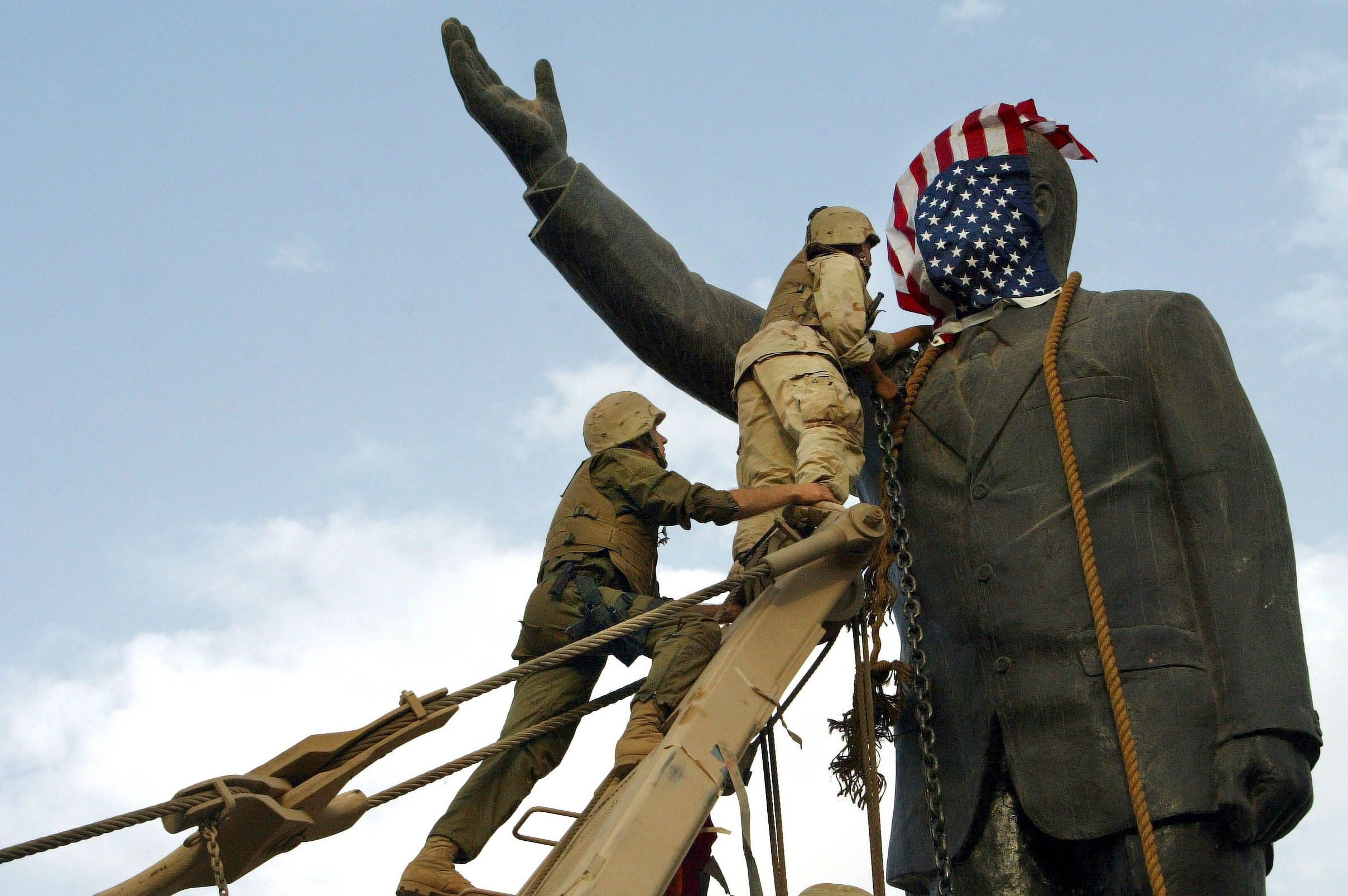
IN 2002, WHEN PRESIDENT GEORGE W. BUSH asked Congress to give him the authority to invade Iraq, the Democratic party, with few exceptions, acquiesced. Many, including all leadership, voted for the war resolution, wary of cementing the party’s image as being weak on national security, especially in light of the attack on 9/11.1
More than two decades later, the party is facing another foreign policy challenge in President Donald Trump’s unauthorized invasion of Venezuela. And while its scope and breadth is obviously different from the Iraq War, there are clear parallels as well. The Trump administration’s use of the term “weapons of mass destruction” to exaggerate the threat of drugs supposedly coming from Venezuela2 echo Bush’s false claims of Iraq’s secret biological weapons program. Oil appears to be a significant motivating factor for intervention. Both invasions were wars of choice, each with tremendous uncertainty about what would come after the initial military triumph.
But unlike in the early 2000s, Democratic leaders aren’t enthusiastically cowing to the Republican president’s war lust. Many, in fact, are aggressively pushing back. And it’s happening in a way that says a lot about the changing composition of the Democratic party.
If you’ve been following the political response to the Caracas operation, you may have noticed that the majority of voices in opposition to it are young—at least by congressional standards. Lawmakers like Massachusetts Rep. Seth Moulton, New York Rep. Pat Ryan, and Arizona Sen. Ruben Gallego have been criticizing both the specific operation and Trump’s newfound appetite for American imperialism more broadly.
In interviews, some of these lawmakers say they see the current moment as a chance to position Democrats as the anti-war party. But they also argue that another factor is at play: They came of age politically during U.S. interventions in the Middle East.
“A big reason I ran for Congress in the first place was to not see our country, which I love, make these same mistakes again,” New York Rep. Pat Ryan, a West Point graduate who served two combat tours in Iraq, told me. “We have an opportunity and an obligation to strongly assert ourselves as the anti-war, anti-intervention, anti–regime change party.”
Such rhetoric would have been unfathomable not so long ago. During the post-Jimmy Carter era, Democrats became terrified of being portrayed as the hippies on college campuses unwilling to go to war to protect Americans. And when the Iraq War authorization was being debated, any Democrat with an eye on running in the 2004 election concluded it would have been political suicidal to vote against the measure.
But as the situation in Iraq worsened, with close to 4,000 U.S. casualties by 2007, and tens of thousands of Iraqi civilian deaths, the party began to reassess. Barack Obama ran for the party nomination in 2007 on his opposition to the war. Donald Trump did the same in 2016 when campaigning against Hillary Clinton.3 Many Democrats who had authorized the war came to regret their votes.
Now, the generation that served in Iraq is filling the ranks of elected officials. They watched their friends die in combat and have dealt with their own PTSD since returning home, all for a war that they largely felt was pointless. They aren’t reluctant to come out in opposition to the use of military force abroad because they’ve lived it.
“Democrats finally are understanding that the American public is not pro-war and we’re not afraid to push back on this administration. I think that’s where this all comes from. And I think we’re seeing the results of also a lot more younger—and I say younger, people around my age, involved in politics and elected officials that grew up during the Afghan and Iraq war,” said Arizona Sen. Ruben Gallego, who served as a marine in Iraq, in an interview with The Bulwark.
“The people that were voting in 2001 were all the men and women that were dealing with the blowback from Democrats being considered soft on Communists from the Vietnam War,” Gallego added. “They were afraid to, I think, actually keep going down that line versus I think now, some of us younger veterans that are elected aren’t afraid to lead in the front when it comes to this kind of issue.”
That last line, in particular, stood out to me. During the run-up to Iraq, there were a handful of Democrats who did oppose the war (21 in the Senate). But they largely deferred to committee chairs and party leadership to set the messaging. In the immediate aftermath of Trump’s Venezuela operation, it’s been different: The younger generation of Democratic veterans has rushed to respond, seemingly bypassing more senior officials in the process.
On Saturday morning, as news of Maduro’s capture broke, Moulton—who was a 24-year-old marine during the 2003 invasion of Iraq and went on to serve four tours in the country—declared in a CNN interview: “This is insane. What the hell are we doing? We’ve got a lot of problems in America today, and invading, occupying, running Venezuela does not solve any of them.”
Colorado Rep. Jason Crow, who served in Iraq and Afghanistan, quickly posted that Americans are “exhausted by endless wars” and “not every problem is ours to fix.” Rep. Chris Deluzio, another Iraq War vet, posted: “If American troops come home with lost limbs and so many other wounds, will you face them and tell them it was worth it? Will you send your kids?”
It’s not just the post-9/11 vets that are speaking unequivocally about Venezuela and Trump’s threats of more military action overseas. Other young Democratic officials who grew up in the aftermath of 9/11 and whose young adulthood was defined by the conflicts in the Middle East have also been quick to criticize Trump’s actions. In an interview with MSNOW, 36-year-old Texas state Rep. James Talarico talked about growing up watching how the Iraq War “robbed this nation of young lives.” He said he was committed to never voting “to send someone’s son or daughter to war to make oil executives richer.”
The challenge for Democrats like Talarico, who is running for U.S. Senate, is not whether they should push back on Trump’s actions in Venezuela. It’s how much emphasis they should place on the issue.
With polls showing that voters don’t vote on foreign policy, and with the party convinced that economics and pocketbook issues will prove more paramount in 2026, critics of Trump’s Venezuela foray have tried to shoehorn it into an affordability argument. Democratic leaders have said that the military operation was a waste of taxpayer resources at a time when voters want the president to be focused on lowering the costs of health care and groceries. They’ve attempted to portray Trump as fixated on an overseas intervention and distracted from the issues that matter back home. And they have pointed to Venezuela as the latest example of Trump’s corruption, arguing that the president intervened as a favor to oil executives who donated money to his presidential campaign.
“These are choices that mean less health care, less ability to lower the cost of housing and food and utilities, and to help people that really need help right now, because we’re going to go fight a regime-change war that we shouldn’t be fighting. I think that’s a really important point and another reason to be really fucking pissed,” said Ryan. “I’ve talked to already a lot of constituents who, even before this, felt like he’s completely taken his eye off the ball on what he promised.”
Although the situation in Venezuela is unpredictable and it’s unclear what role the United States will play on the ground in the weeks to come, most Democratic leaders that I spoke to this week said they did not expect the situation to stabilize anytime soon. Even in the unlikely scenario in which it does, there’s a growing conviction among Democrats that Trump won’t stop there. His longstanding threats to take over Greenland no longer seem so absurd. The president has also threatened military action or intervention in Colombia, Mexico, and Cuba. It’s created tremendous fear and uncertainty across the globe. Back at home, Democrats sense political opportunity.
“There’s going to be a big, big hurt coming for the Republicans because people feel that they’re not paying attention to what they really care about. Most Americans do not care about foreign policy, especially when they’re barely making ends meet,” said Gallego.
My open tabs:
— ‘It’s Going to Change Everything’: A Supreme Court Case Could Rock Campaigns This Year
— The Real Story Behind the Minnesota Welfare Fraud Scandal, by my Bulwark colleague Jonathan Cohn
Many Democrats also wanted to avoid a repeat of the authorization for use of force in the Gulf War, when some in the party, having voted against the resolution and warned of massive casualties, were embarrassed by a quick and overwhelming military victory against Saddam Hussein’s army.
Trump designated fentanyl a weapon of mass destruction, but a) just declaring something a “chemical weapon” doesn’t make it one, and b) fentanyl doesn’t come from Venezuela.
Trump had actually supported the initial invasion but claimed to have always been against it.
“ The challenge for Democrats like Talarico, who is running for U.S. Senate, is not whether they should push back on Trump’s actions in Venezuela. It’s how much emphasis they should place on the issue.”
Is this a serious question? The answer is that nation-building has not worked well, and has landed us in long-running quagmires that cost a lot of lives and a lot of money.
This is even more true now, when this WH neglected to get consent from Congress. And frankly, this administration has obviously not planned for the aftermath.
Getting into a situation like this in another country is beyond foolish. But there is one good thing; if this goes south, then Trump and his staff are on the hook for it.
Still, Congress needs to assert itself. Republicans need to find their spines. Democrats need to keep raising their voices. Most of the nation is very unhappy right now, and someone will be blamed. Let’s make sure that it’s the Republicans.
I do think it's interesting to look at the younger generation of veterans serving in congress and listen to their 2c.