

The MAGAfication of Norman Rockwell
Trump misuses the artist’s work—like other cultural icons—to promote Gestapo tactics and nativist ideas.

Stockbridge, Massachusetts
NOT EVERYONE WHO VENTURES OUT to the Norman Rockwell Museum in Western Massachusetts gets the luxury of a tour from the artist’s own family.
But on a fall day in this—yes—picture-perfect New England town, Daisy Rockwell graciously took me through some of her famous grandfather’s most iconic works.
You’d recognize these masterpieces anywhere, even if you don’t know them by name. The “Four Freedoms” paintings depict the fundamental freedoms that President Franklin Roosevelt once declared all people entitled to: Freedom of Speech (a lone man who resembles young Abe Lincoln rises in dissent at a town hall meeting), Freedom From Want (a happy family awaiting a roast turkey), Freedom of Worship (multiethnic group praying), and Freedom From Fear (parents tucking in their peacefully sleeping children).
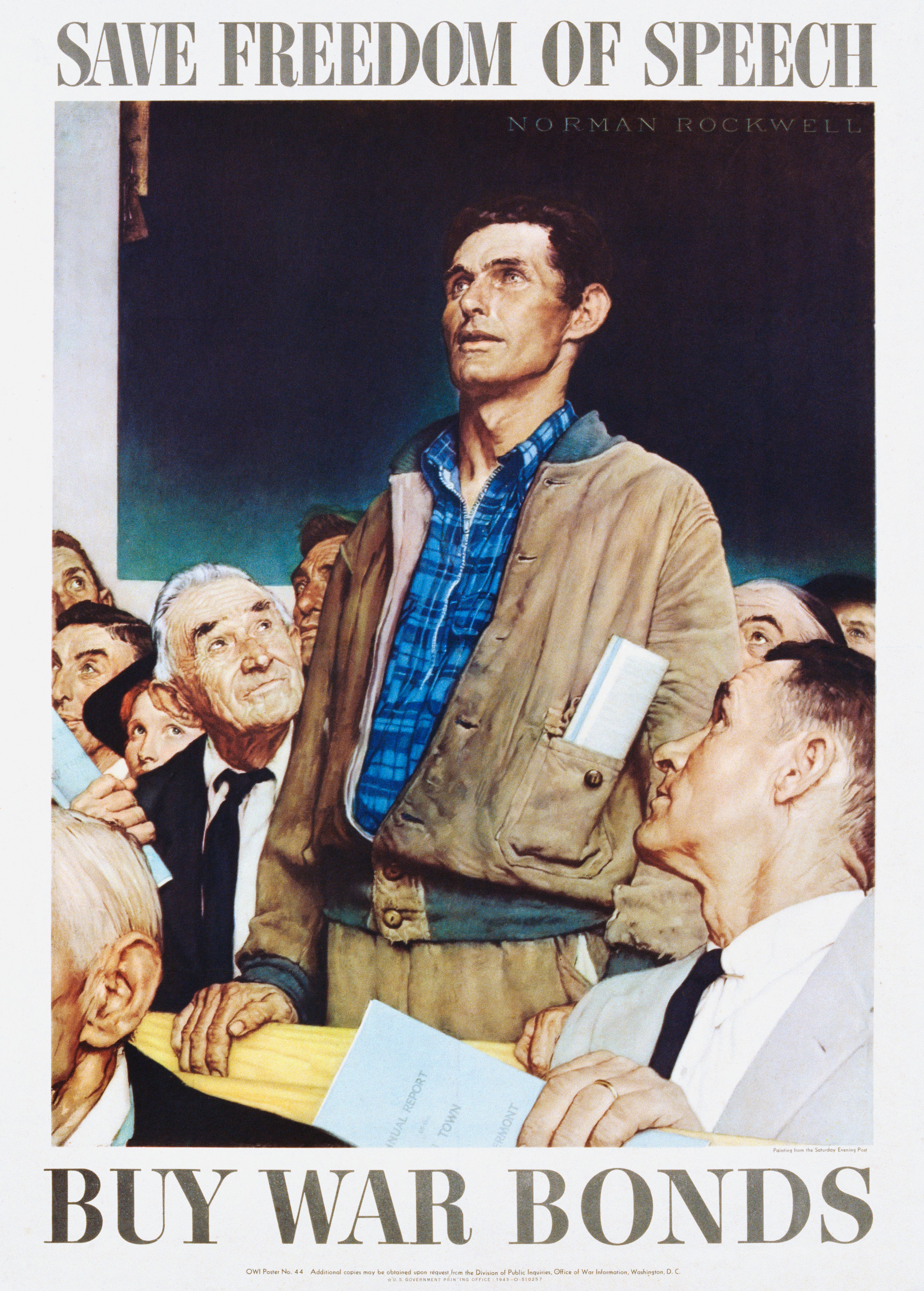
The works have been endlessly parodied since their introduction in 1943. In the internet age, they’ve become ubiquitously memed. (Freedom of Speech, for example, is nowadays widely known as the “unpopular opinion” meme.) But originally, they served as wartime propaganda, meant to help rally support for America and its cause during the years of war against the Nazis.
As Daisy puts it, “Norman Rockwell was antifa”—literally.
So you’ll understand her indignation when President Trump began hijacking her grandfather’s legacy to promote what she considers modern-day fascism.
Over the past several months, the U.S. Department of Homeland Security has been lawlessly appropriating Rockwell’s Leave It to Beaver-esque paintings to promote its Gestapo tactics. In August, the DHS Instagram account posted his 1971 painting of Americans saluting a billowing American flag, alongside the department’s own caption: “Protect our American way of life.”
A month later, the government reproduced his famous 1946 painting of workers cleaning the Statue of Liberty, taking a symbol of welcome for the tired, poor and tempest-tost and superimposing upon it directives to “PROTECT YOUR HOMELAND” and “DEFEND YOUR CULTURE” by joining Trump’s anti-immigrant goons.
Even Rockwell’s Santa was recently enlisted by DHS.
“They used [the paintings] . . . as though his work aligned with their values, i.e., promoting this segregationist vision of America,” said Daisy. “And so of course we were upset by this, because Norman Rockwell was really very clearly anti-segregationist.”
This fall, Daisy decided to take action, organizing a family letter denouncing DHS’s unauthorized use of their patriarch’s oeuvre. (You can watch my conversation with Daisy in the video embedded atop this newsletter, recorded by my Bulwark colleague Hannah Yoest and edited by our video team.)
NORMAN ROCKWELL IS HARDLY the only American cultural treasure unwillingly drafted into the MAGA cause.
It’s not surprising that Trump has slapped his name onto several institutions with some connection to politics or government, such as the U.S. Institute of Peace, now the “Donald J. Trump Institute of Peace,” and the syntactically awkward “The Donald J. Trump and The John F. Kennedy Memorial Center for the Performing Arts.” (The legality of these acts of eponymizing is in dispute.) But some of his most frequent targets are bits of Americana traditionally disconnected from politics.
These include the many pop hits scoring Trump rallies and social media posts against musicians’ wishes. Artists as varied as Sabrina Carpenter, Bruce Springsteen, Olivia Rodrigo, Semisonic, SZA, Village People, and Creedence Clearwater Revival1 have condemned Trump’s unauthorized use of their music.
Some of this is about glomming on to hits to borrow their popularity. Our president would rebrand apple pie if he could. It’s not only about that, though. As with the Rockwell case, many of these artistic abductions are meant to weaponize nostalgia for a simpler, more innocent time—back when America was still “great,” of course.
Classic children’s books feature heavily. For instance, the immigration crackdown in Charlotte, North Carolina, was branded “Operation Charlotte’s Web,” appropriating the title of the 1952 novel by E.B. White. White’s descendants were outraged.
E.B. White “believed in the rule of law and due process,” the author’s granddaughter Martha White said in a statement. “He certainly didn’t believe in masked men, in unmarked cars, raiding people’s homes and workplaces without IDs or summons.”
Both Defense Secretary Pete Hegseth and the Department of Justice likewise arrogated another children’s literary classic, the character Franklin the Turtle, to promote the administration’s extralegal boat strikes and deportation efforts. Once again, the publisher—which happens to be Canadian—condemned the Trump administration’s posts. “Franklin the Turtle is a beloved Canadian icon who has inspired generations of children and stands for kindness, empathy, and inclusivity,” the publisher said in a tweet. “We strongly condemn any denigrating, violent, or unauthorized use of Franklin’s name or image, which directly contradicts these values.”
Even the Rat Pack has been conscripted into the misplaced MAGA nostalgia for a bygone, more nativist era.
“Watched the Dean Martin and Frank Sinatra Family Christmas with my kids,” Stephen Miller tweeted Friday. “Imagine watching that and thinking America needed infinity migrants from the third world.”
As my colleagues have pointed out, this is a strange takeaway about two singers whose parents immigrated from Italy, which would have been considered “third world” at the time.2
It’s not exactly unheard of for an authoritarian regime to try to co-opt cherished cultural darlings from eras past. The Soviets famously exploited Tchaikovsky. The Nazis used Wagner. And both, like Trump, simultaneously cracked down on contemporaneous artists whom they deemed disloyal or degenerate.
But exploiting Rockwell in this way is additionally offensive if you know anything about his artistic trajectory.
ON THE BASEMENT LEVEL of the Norman Rockwell Museum in Stockbridge is a room of Rockwell’s early works, his covers for the Saturday Evening Post.3 It’s cover after cover of sweet, whimsical, slice-of-life scenes of middle-class Americana. There are Boy Scouts and baseball games. Town gossips, soda shops, and returning G.I.’s. And of course all those adorable childhood shenanigans.
It’s no wonder this artist appeals to an administration that pledges to turn back the clock to some prior golden age. Rockwell’s scenes look like a happy, wholesome past that many Americans wish they could return to. But this bucolic past was imagined; Daisy notes that her grandfather created and staged it, using models he cast from his local communities in Vermont and Massachusetts. The artist himself grew up in a boarding house, in a cramped urban environment.
“He loved this idea of this, like, sort of small town idealistic thing,” said Daisy, who is an artist and writer too. “But he made it up himself.”
There’s something else that feels a little off in Rockwell’s depictions of this imagined past: They are overwhelmingly white. In fact, there are scarcely any people of color at all.
For Trumpers, this is presumably a feature, not a bug. You’ll find similarly pale complexions populating the Trump Department of Labor’s current anti-immigrant campaign, which seemed to borrow from that early Rockwell aesthetic when it used AI to generate images of blonde, buff, cleft-chinned male youths powering Trump’s “Blue Collar Boom.”
In Rockwell’s case, the demographics were less an artistic choice than a condition of employment. The Saturday Evening Post barred him from painting people of color in anything other than subservient roles, his granddaughter says, citing interviews he gave later in life.
At the museum, Daisy pointed out places where he sneaked in nonwhite characters anyway, always in ways to emphasize their common humanity. For instance, in that Statue of Liberty painting that DHS stole, the team of workmen cleaning Lady Liberty’s torch is racially integrated.
Then in the 1960s, Rockwell underwent a more radical transformation. He became more concerned by both the social turmoil around him as well as his own legacy. “I was born a White Protestant with some prejudices that I am continuously trying to eradicate,” Rockwell said in 1962. “I am angry at unjust prejudices, in other people and in myself.”
In other words, Norman Rockwell got woke.
Seeking more artistic control, he left the Post for Look magazine. There, he went on to paint some of the most iconic images of the civil rights movement. These have pride of place in the main gallery of the Norman Rockwell Museum.
There you’ll find his famous painting of a black family moving into a white neighborhood, “New Kids in the Neighborhood (Negro in the Suburbs).” Another usually on display—though not on my most recent visit—chillingly depicts slain civil rights workers (“Murder in Mississippi”). And then there is perhaps his best-known work, the 1964 painting that features 6-year-old Ruby Bridges desegregating a white school in New Orleans. She is escorted by U.S. marshals, whose heads are just out of the frame. Also unseen is the angry mob that necessitated the presence of those marshals, and that presumably scrawled the racial slur behind her. The only face we see—and the only one we identify with—is that of a heroic little girl.
The painting was radical for its time. It is called “The Problem We All Live With,” a title that Daisy notes was deliberately present-tense then, and remains present-tense today.
If Rockwell’s early illustrations of pink-cheeked lovebirds and rough-housing kids were meant to comfort audiences, those latter works were meant to challenge them. His tool for achieving both ends, though, was the same: compassion. His works ooze it, whatever the subject and whichever the characters, and regardless of how subsequent opportunists might try to exploit those works.
Compassion of that sort is a virtue obviously absent from Trump’s mass deportation campaign—and arguably from MAGA overall. Which makes the use of Rockwell’s art an especially egregious misappropriation.
I wish I knew what Rockwell might have said about Trump’s theft of his life’s work in service of state-sponsored terror. But even more than that, I wonder what he would have painted.
Ramparts
— Check out The Bulwark’s “12 Days of Griftmas” video if you haven’t already done so. The lyrics all refer to real gifts bestowed upon our leader. (Citations included.) Thanks to the many colleagues I peer-pressured into singing, and to our video team—especially Chris Herbert, Dante DiCicco, and Jamie Abraham—for recording and working overtime to edit this.
— Sometimes I wonder how Commerce Secretary Howard Lutnick managed to run an investment bank.
— Bigots once said this about my ancestors. Miller’s, too.
— The FDA just approved a pill version of Novo Nordisk’s GLP-1 drug Wegovy. This seems like a pretty big deal. I maintain that in the medium term, the economic effects of AI are probably overstated while those of GLP-1’s are massively understated.
— The Department of the Interior suspended leases for five large offshore wind projects under construction off the East Coast. It cited national security concerns though, of course, Trump has long hated these projects. Either way, it’s owning the libs at the expense of “energy independence.”
— Sen. Mike Lee (R-Utah) wants to license Americans to become literal pirates to help Trump’s Caribbean campaign. In ye olden days, a letter of marque allowed privateers to seize, like, a Spanish galleon and sell the gold doubloons. But what do you do with a big oil tanker? Or for that matter a boat full of cocaine? Are privateers supposed to pull up and sell their seized blow in Miami?
— Trump has made Mexico great again.
At rallies Trump often plays CCR’s “Fortunate Son,” a song about wealthy draft-dodgers and those who got plum assignments—including President Dwight D. Eisenhower’s grandson, David Eisenhower. The irony is apparently lost on Trump. We’re probably halfway to hearing “Tomorrow Belongs to Me” next.
It’s just also a weird takeaway, period. What kind of sicko watches a family holiday special about fluffy snow and Santa and immediately starts ranting about the Great Replacement? Some people will commit human rights abuses rather than just go to therapy.
Correction, December 30, 2025, 6:01 p.m. EST: As originally published, this sentence incorrectly identified the publication for which Norman Rockwell created covers as the Saturday Morning Post rather than the Saturday Evening Post.
Thanks for the article and interview, Catherine. So glad you're at the Bulwark.
I knew Norman Rockwell when I was very young. He even gave my oldest sister a few art lessons. My father was rector of St. Paul's Episcopal Church on Main Street in Stockbridge in the early 1950s. Norman Rockwell's wife (2nd wife) often attended our church. We knew many of the people who served as models in the paintings--The doctor giving a boy a shot in his backside as the boy carefully inspects his diploma's on the wall was Dr. Campbell, our GP, whose office was in his house, right near Rockwell's studio. We knew the soda jerk in the painting of a young couple headed to prom, sit sipping a soda. That pharmacy was across an alley from the rectory where we lived. And of course, the chief of police.
I mention this because as idealistic as his paintings are, it was very much like actual life in Stockbridge--a remote, rural Berkshire town. Just to give you an idea of what idealism is like in reality, my parents had been serving the Anglican mission in China when the Communist Revolution occurred. My father stayed to help, until his university students were being harmed by his presence. He escaped to Hong Kong where the rest of the family was, then took the job in Stockbridge. When got there, at Christmas in 1950, with nothing but a few straw suitcases to our name, unbeknownst to us, the entire town had gotten together and furnished the rectory--every stick of matched and mis-matched furniture ours to keep (something I wrote about in a book titled A Stockbridge Homecoming). That was the kind of life, of community, that Rockwell captured in his paintings.
Regarding his focus on Civil Rights later on, it's important to remember Stockbridge, like many towns back then, then was remote. The Mass Pike hadn't even been built yet. The closest we got to other races in town was the tailor, whose shop was next to the famous Red Lion Inn. He was Eastern European. My mother was a Ukrainian immigrant, so that made one other Eastern European in the mix. Even the servants and chauffeurs of the wealth summer people were white. People like my father (who later was a Civil Rights activist in Baltimore) and Rockwell weren't racist in the 1950s. It just that Civil Rights wasn't on the radar in small towns until it was. No one we knew even had a TV. People forget that when Bobby Kennedy went to the South, his own eyes opened to the extremes of poverty and horrors of racism, lynching, white supremacy. He had no idea. It changed him. Changed JFK too. Hence the troops sent to protect black students.
So, although his early paintings captured white people and idealistic images, they weren't racist; they were in many ways true to what he saw in front of him. And, as your interview with his wonderful granddaughter points out, Rockwell left the Saturday Evening Post when they refused to let him depict black people in any but subservient roles. Hence Rockwell's paintings represented not a change of heart, but the values he carried all his life of compassion and kindness and humor and a deep understanding of the best of humanity. The fact that they are being commandeered by this Administration is a horror, just as is Trump's name on the JFK Center.
I hope Norman Rockwell's ghost will haunt the current administration. Going through the Rockwell Museum was a real treat and his work spoke for itself when you observe the whole body of work.