Our Gettysburg Moment
The stakes in Minneapolis are higher than even the participants may realize.

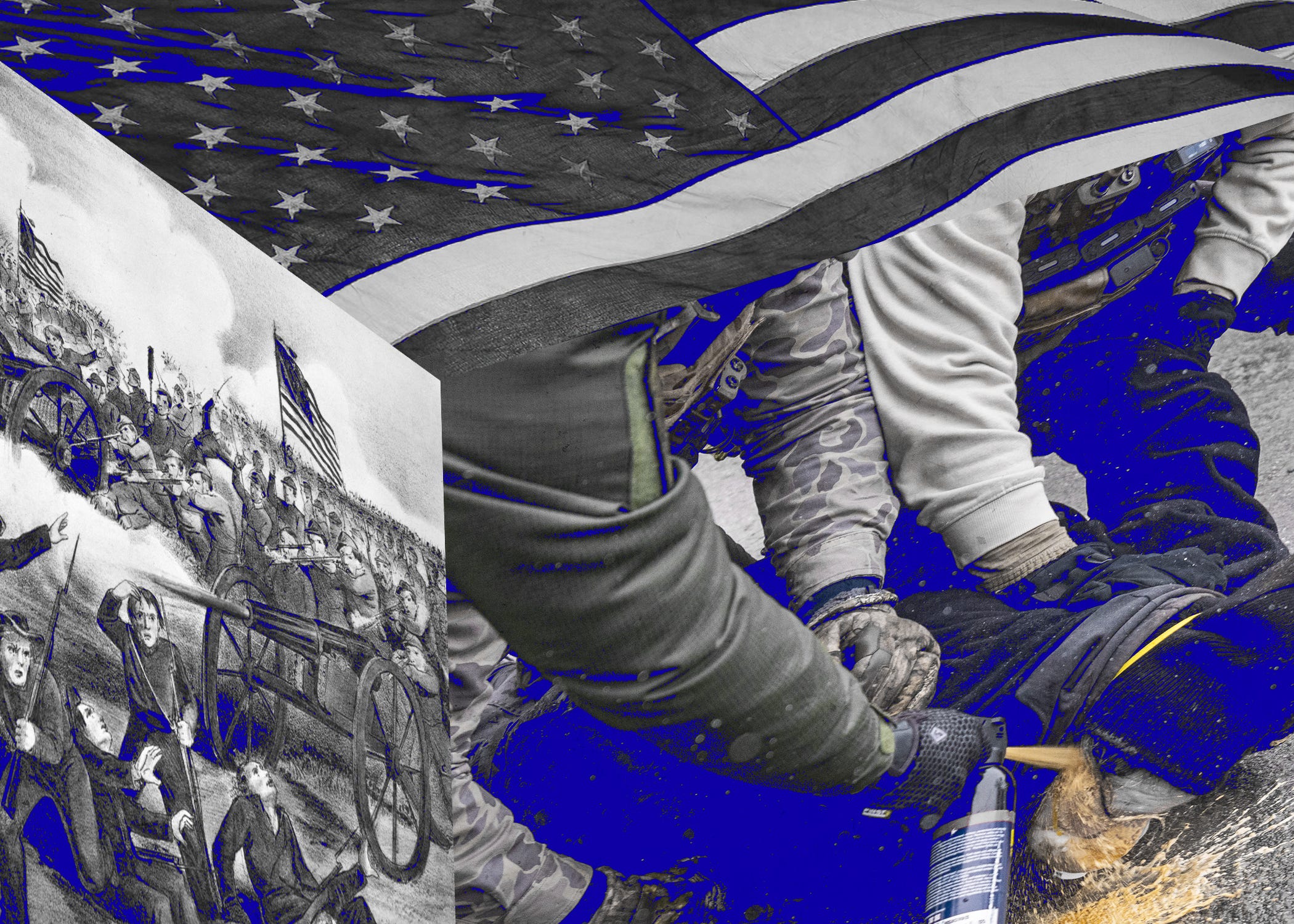
1. Gettysburg
Neither the Union nor the Confederate army planned to engage at Gettysburg.
In June 1863 the Confederate army had moved north toward Pennsylvania. General Robert E. Lee’s plan was to lure the Union forces north and west, and then swing south and east to strike Washington, D.C. The Union army, commanded by General George Meade, was shadowing the Confederate forces at a distance. The armies were spread out, but in the same vicinity on June 30.
The difference was that Meade knew precisely where Lee’s army was, while Lee did not know details about the disposition of the Union forces.
In the early morning hours of July 1, two brigades of Confederate soldiers made their way into the town of Gettysburg to probe, expecting to find a local militia. Instead, they encountered Union cavalry and exchanged fire. At that moment, neither side had any idea what was about to happen.
Caught by surprise, the Confederates pushed more troops forward, moving down the Chambersburg Pike. The Union rushed infantry in to harry the Confederate advance while they awaited reinforcements.
The story of the first day of Gettysburg was two armies, meeting by chance, then pouring forces into the battle until they were both pot-committed to a major engagement.
It’s important to understand that no one understood the stakes at Gettysburg.
Neither army intended to have a major showdown at that time or in that place.
Once begun, the conflict escalated by its own logic until neither side had any choice but to go all-in.
Even after the battle was finished, neither side understood that it had just fought the defining engagement of the war.
This last bit is crucial. The Union understood it had won a victory, but saw the escape of Lee’s army as failure. The Confederates believed they had suffered a setback, but did not understand the strategic implications of what had just happened.
The point is that the people in the battle could not understand its significance. It would take time for everyone to grasp exactly what the events of Gettysburg meant.
Which brings us to Minneapolis.
It’s not clear why the Trump regime chose to invade Minneapolis. Maybe it was animus toward the city’s Somali population. Maybe it was because Gov. Tim Walz had run against Trump and Vance. Maybe it was because they believed the state’s welfare fraud investigations made Minneapolis favorable terrain on which to fight.
But when the regime’s forces occupied the city they were surprised by the resistance they encountered. Not from Democratic politicians, or institutions, or the legal establishment. From ordinary people. The people of Minneapolis organized to protect their neighbors and provide oversight of the regime’s forces that the local government either could not, or would not, perform.
Think about this: State and local law enforcement could do nothing to document the crimes being carried out against the residents of Minneapolis by federal forces. But the people were able to do it themselves. This grassroots army used cell phones and whistles to show the world what was happening.
In return they were menaced, beaten, and arrested. And Renee Good was murdered by the regime’s masked secret police.
Upon encountering this unexpected resistance, the Confederates Trump command poured more forces into the city and adopted even more brutal tactics. At which point the people of Minneapolis organized a general strike. After which the regime’s police executed Alex Pretti on the street, in broad daylight.
Once begun, these engagements have a logic of their own. Maybe Minneapolis will prove to be a hinge point in the battle against American fascism. You can never tell from inside the crucible.
But here is what I want you to understand: The Trump regime, even as it tries to figure out what to do next, continues to pour resources into this fight. The people of Minneapolis have given all they have to give. They need reinforcements from other parts of the resistance.
So where is the opposition party?
In Washington this week, Democrats in the Senate can join the fight by shutting off funding for the regime’s forces in Minneapolis. There is no more important task.
And House Democrats should get themselves to Minneapolis. Immediately. They should be on the street themselves, cameras out and recording, observing and putting their bodies on the line. They should be standing in solidarity with the people of Minneapolis. Demanding the attention of every American to what is happening. Daring the regime to assault them, too.
Minneapolis is not a fight that anyone wanted. But it is here and it has become a major engagement. The people of Minneapolis understand this truth. You and I understand it. The Democratic party must be made to understand it, too.
2. The F Word
We’re to the point where it’s not just hot-heads like me. Here’s Jonathan Rauch in the Atlantic:
Until recently, I resisted using the F-word to describe President Trump. For one thing, there were too many elements of classical fascism that didn’t seem to fit. . . .
Writing a year ago, I argued that Trump’s governing regime is a version of patrimonialism, in which the state is treated as the personal property and family business of the leader. That is still true. But, as I also noted then, patrimonialism is a style of governing, not a formal ideology or system. It can be layered atop all kinds of organizational structures, including not just national governments but also urban political machines such as Tammany Hall, criminal gangs such as the Mafia, and even religious cults. Because its only firm principle is personal loyalty to the boss, it has no specific agenda. Fascism, in contrast, is ideological, aggressive, and, at least in its early stages, revolutionary. It seeks to dominate politics, to crush resistance, and to rewrite the social contract.
Over Trump’s past year, what originally looked like an effort to make the government his personal plaything has drifted distinctly toward doctrinal and operational fascism. Trump’s appetite for lebensraum, his claim of unlimited power, his support for the global far right, his politicization of the justice system, his deployment of performative brutality, his ostentatious violation of rights, his creation of a national paramilitary police—all of those developments bespeak something more purposeful and sinister than run-of-the-mill greed or gangsterism.
When the facts change, I change my mind. Recent events have brought Trump’s governing style into sharper focus. Fascist best describes it, and reluctance to use the term has now become perverse. That is not because of any one or two things he and his administration have done but because of the totality. Fascism is not a territory with clearly marked boundaries but a constellation of characteristics. When you view the stars together, the constellation plainly appears.
Hard agree. Read the whole thing.
And here’s Timothy Snyder, who literally wrote the book on fascism:
People are dying in American concentration camps, unseen. And people are being executed on American streets, seen by all of us.
This is enough. The radical is the pragmatic.
The president should be impeached and convicted, as should everyone responsible for these outrages. ICE should be disbanded. So should the Department of Homeland Security. The other agencies within it should be redistributed across other departments. And the people who have killed should be investigated and brought before judges and juries.
But we have to see the logic of the killings as well as the killings themselves. The horror is a truth in itself. But it is also a sign of a political logic, one known from the totalitarian regimes of the twentieth century, Soviet as well as Nazi, and from attempts to replace the rule of law with personal tyranny.
It is the logic of lies and of lawlessness.
We can all see this. Elected officials in the national Democratic party should be able to see it, too.
And if they can see it, then they should act.
3. The Good Samaritan
From my friend Katie McGrady:
Wictoria and Jozef Ulman had a single word written in the margins of their family Bible, in the Gospel of Luke, right beside the parable of the Good Samaritan, which they had underlined:
Yes!
That tells us almost everything we need to know about the Ulmas, and what legacy they left behind: the Gospel was real to them. . . .
This Polish farm family, with six children and one on the way, knew the Gospel mandate to care for the tossed down, cast aside, and hurt was not just an abstract idea for preachers at the pulpit. They knew they were called to care for the marginalized themselves, in their real life circumstances, and so when the Szali and Goldman families came to find shelter as the Nazis were rounding up the Jews in 1942, the Ulmas opened their home. Their farm became a shelter, and for nearly two years, this Polish Catholic family and these Eastern European Jews lived and worked together, living the parable of the Good Samaritan. . . .
They were eventually sold out by a policeman who knew their whereabouts, bringing the German police to their front door, leading to their brutal execution in the front yard. 17 people total, including the six Ulma children, were shot and killed in a matter of minutes, all so the Nazis could make an example of them. Eyewitness accounts include the horrific details that as the adults were shot and killed, the children stood by screaming and crying. Not knowing what to do with these children in the aftermath, the police decided to shoot and kill them too. When asked about it later, Eilert Dieken, the German commander, responded: So that you would not have any problems with them. . . .
As videos of the shooting of Alex Pretti in Minneapolis on Saturday have circulated, what happened mere moments before his death is notable: he was trying to help a woman tossed down on the ice.
Political commentary and vastly varied opinions about what’s happening with immigration enforcement and protesting aside, it’s evident that a man was killed — after a confusing scrum and in the midst of a tense situation — after his last earthly act was to try and help someone stand back up. . . .
Perhaps the only way to see the image and likeness of God in another is to first and foremost remember we’re all called to be a good samaritan: to help others up when they’ve been pushed down, to offer shelter when we have room, and to see the goodness of God in even the most heartbreaking moments.
This. This. THIS!
"And House Democrats should get themselves to Minneapolis. Immediately. They should be on the street themselves, cameras out and recording, observing and putting their bodies on the line. They should be standing in solidarity with the people of Minneapolis. Demanding the attention of every American to what is happening. Daring the regime to assault them, too."
I have been asking for the elected Dems to get to Minneapolis and I do not understand the LACK of messaging and solidarity from them in this moment.
I implore everyone to call their elected representatives and plead with them to be visible and unified on the front lines of this battle for our democracy.