
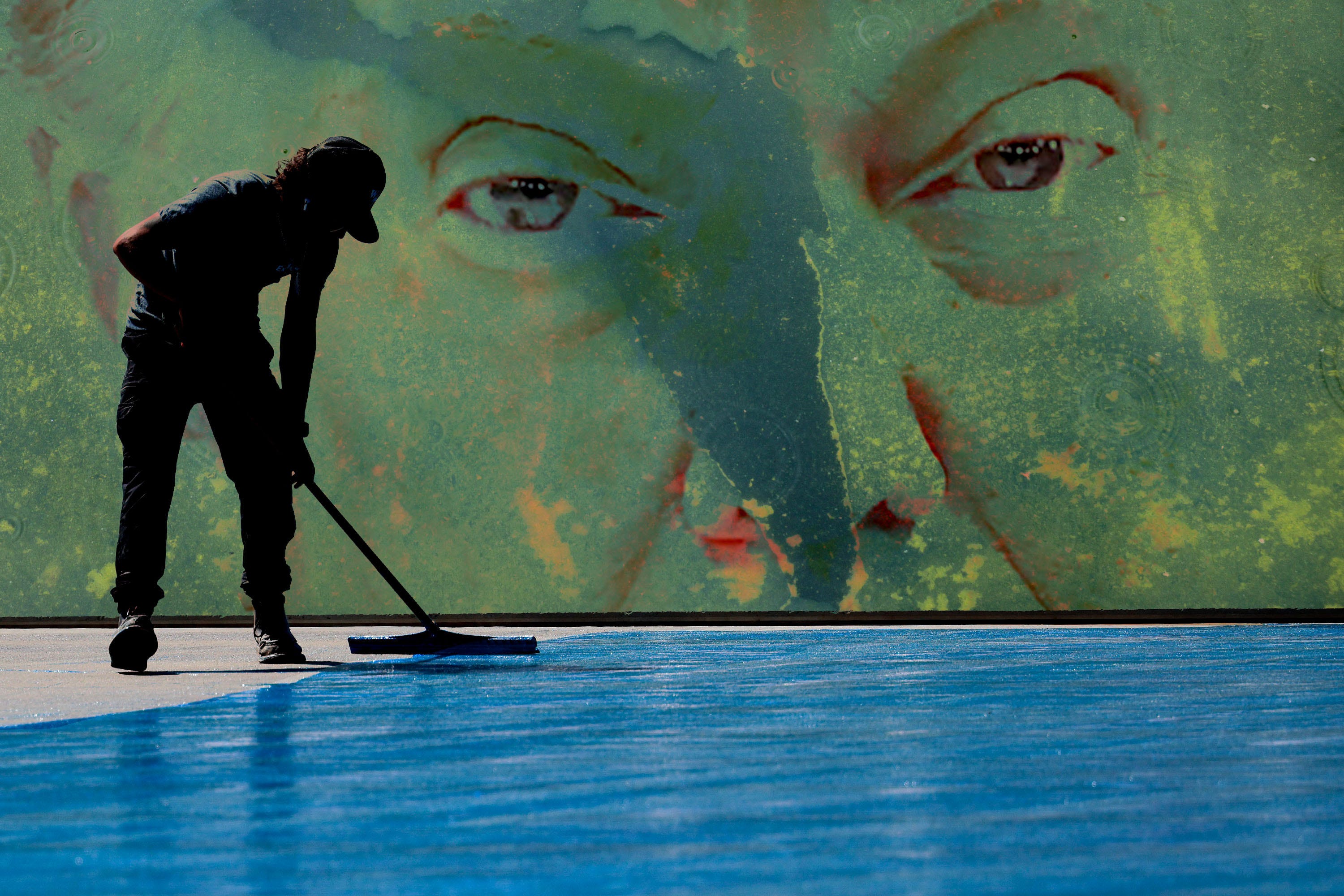
1. Distortion
Once upon a time, we used the word “scandal” to describe any bad story about a politician. Getting caught in adultery or bribery or even mild criminal behavior was “a scandal.”
I stopped using that word about Donald Trump some time around the Charlottesville neo-Nazi march in 2017. It didn’t seem to fit. Calling a white power march that ends in murder a “scandal” isn’t right. It’s confusing venial and mortal sins. Watergate might be a scandal. Kent State is not.
The Trump era has been choc-a-bloc with mortal sins. The killing of Heather Heyer. The deaths of a million Americans from COVID. The attempted coup. The felony convictions. The blood libel against Haitian immigrants in Ohio. The extra-legal rendition of innocent men to a torture prison in El Salvador. The dismantling of USAID. The public executions of Renée Good and Alex Pretti on the streets of Minneapolis. The war with no consultation with Congress and no plan to win. The destruction of the American-led global order.
These are not “scandals.” They are crimes, or depredations, or assaults on democracy.
Which is why I’ve felt a comforting sense of nostalgia about Trump’s ongoing Reflecting Pool debacle. It feels like an incident from the Before Times.
It’s just a scandal.
Trump’s buffoonery beggars belief.
The manager at Trump’s Bedminster golf club seems to have recommended a Mar-a-Lago pal of Trump’s to the National Park Service for the job of cleaning up the Reflecting Pool.
Why is the Park Service soliciting advice from a guy who runs a Trump golf club? Good question!
Having been connected to Trump’s friend, John Cafaro, the Park Service proceeds to give him a no-bid contract. This contract comes with a scandalously high profit margin. Cafaro’s company proceeds to do work so shoddy that the Reflecting Pool is back in crisis just a couple weeks later.
The Trump administration insists that the work done on the project was great, actually, and all of the problems at the Reflecting Pool are the result of vandals, or domestic terrorists. Or antifa. It was probably antifa, right?
Oh, and the Trump buddy who got the no-bid contract and did the no-show job looks like this:
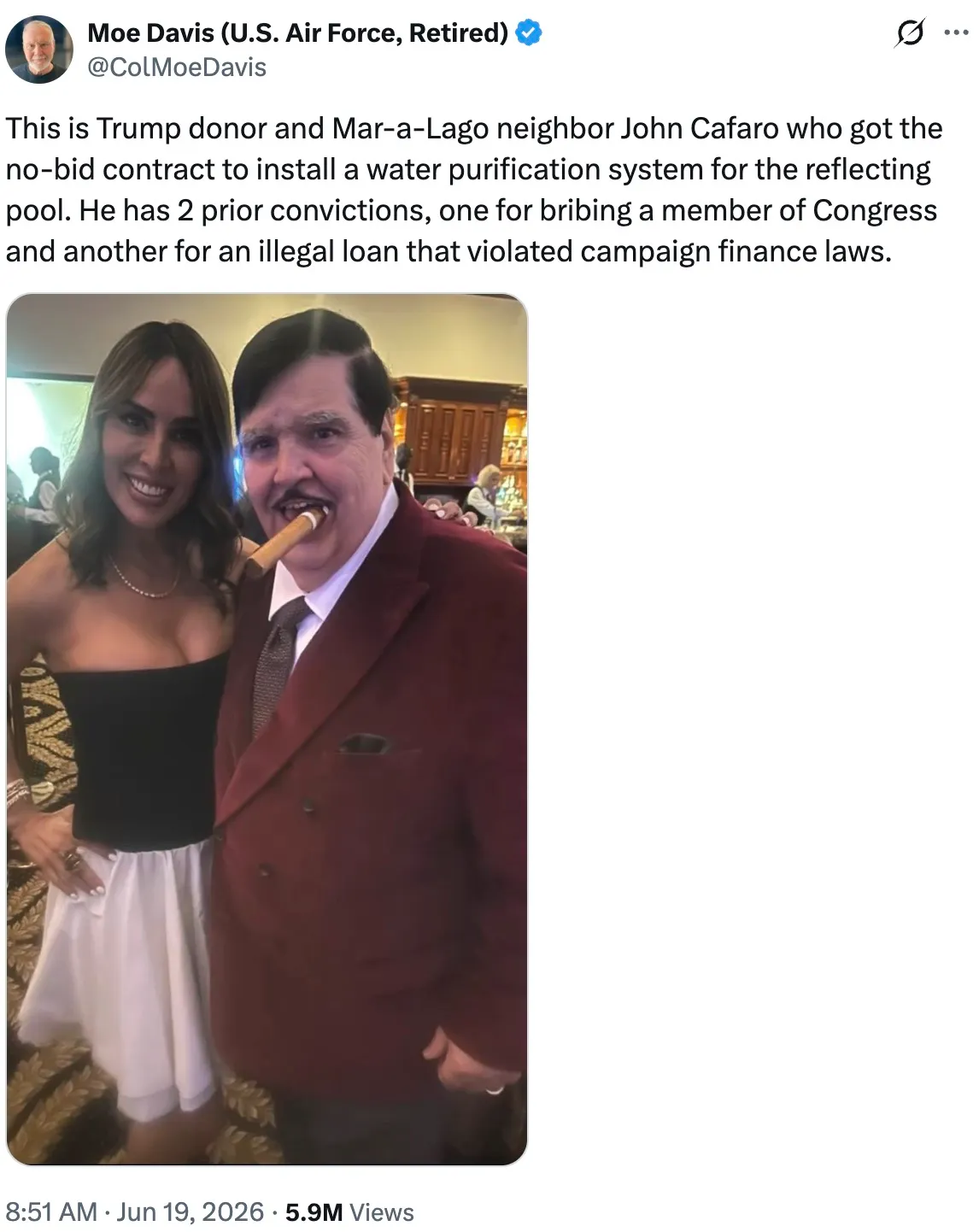
That, my friends, is an old-fashioned scandal. The stakes are low. The graft is small-scale. No one is killed or tortured. The money involved is only eight-digit figures.1
We obsess about Trump’s Reflecting Pool fuck-up because it lets us pretend, for a moment, that we’re back in normal, scandalous territory. It’s a comfort.
It’s also a lie.
We are not in the Before Times. We are at a point, far out there, where the structures are failing us. Not all of them. But more than we ever thought possible.
We are past the era of scandal. We live in an age of democratic backsliding; an age of decline.
Sometimes, authoritarians present themselves as openly evil: Stalin, Pol Pot, Khomeini, Mao.
But most of the time they appear cloaked in buffoonery: Mussolini, Gadaffi, Saddam, Bokassa, Idi Amin, Hugo Chávez, the Kims.
Their silliness tricks people into dismissal. How could someone who dresses like Captain EO and uses a Praetorian guard called “The Revolutionary Nuns” be a real threat?
One of the things Democrats used to say early in the Trump years was, “This is not who we are.”
You don’t hear that line much in the second Trump administration, do you? Because Trump’s second election proved that this is who we are. All of that stuff up top—that list of crimes and depredations—a plurality of Americans affirmatively chose it. It wasn’t an accident of the Electoral College or a case of false advertising. We saw the COVID deaths and the coup. We heard him say he wanted to be a “dictator” who would “terminate” parts of the Constitution. We saw his libel of Haitians and his pledge to deport 20 million immigrants.
Don’t let the Reflecting Pool fool you with its member berries. We don’t have the privilege of living in an age of scandal.2

2. Not Always Right
Correction: Last week Tim and I did a live reading of JD Vance’s second memoir and I made a mistake. I was talking about a Catholic bookstore in Washington, D.C., on K Street and I said it was the “Pauline Book Center.” This is wrong.
The place I was talking about is the Catholic Information Center on K Street. There is another Catholic hub, across the river on King Street in Alexandria called Pauline Books. For many years I worked near the CIC and lived near Pauline Books (K Street and King Street) and while talking my brain mushed them together.
I regret the error.
I don’t make too many factual errors here in the newsletter, but I’m positive that I make lots of them during podcasts. Here’s another for instance: On TNL last week I said that the Iranian regime “just killed, like, 15,000 of their citizens, like, four months ago.”
This is a messy set of facts. The most recent wave of Iranian protests ran from December of 2025 to March of 2026. The Iranian government massacred lots of protestors. How many?
The Iranian government says they killed a little over 3,000 civilians. Various human rights groups put the number anywhere from 6,000 to 36,000 dead.
But most of the massacring seems to have taken place in January 2026, which was six months ago—not four months ago. So how do you even adjudicate this? The most factually correct formulation would have been for me to say:
Between December 2025 and March 2026, the Iranian regime conducted a campaign of mass killings. By their own admission they killed over 3,000 of their own citizens and the real number may be as many as 36,000. The true death toll is disputed and hard to get at because of the repressive nature of the regime.
And I wish I had said that on the podcast, because that’s how I would have written it here, in this newsletter, when I’m able to pause, go find a fact, chase down other facts, then come back to finish writing, then have a team of editors come in after me and make sure I’ve gotten things right—fix my remaining mistakes and add nuance where I’ve been too reductive.
But on a podcast you’re just talking, in real time, with whatever you can recall rattling around in your brain while you’re listening to others and following the conversation.
Which is why I don’t think you can really hold things people say on podcasts and things people write in print to the same standards. Except that it’s more complicated than that.
There are, generally speaking, two types of podcasts. There are full-text shows—where someone has written a script and then they read it. And there are conversation shows, where people talk extemporaneously.
The Bulwark has both. When Will Saletan does one of his direct-to-video takes, it’s almost always full-script and Will has written and edited and fact-checked the same way he would if he was doing an essay for TheBulwark.com. And then there’s TNL or the Secret Pod, where we’re talking and working through ideas and topics in real time.3
So there are different standards for accuracy even within the realm of podcasts.
But maybe we shouldn’t have different standards? Because here I am explaining why I’ll make factual errors conflating the names of two Catholic book stores, while Joe Rogan is interviewing a guy named Chase Hughes, whose entire schtick seems to be a fraud.
This guy Hughes fashions himself as an expert on “psyops” and seems to have invented a not-accurate backstory for himself while making a lot of statements which are—I don’t know how to say this gently—crazy.
Should Rogan and Hughes get to operate on the less rigorous “it’s just a conversational podcast” scale when it comes to saying things that aren’t perfectly factually accurate?
Intuitively, I don’t think so? But I’m not sure how I’d build out a rubric to specify exactly how these things should work.
That’s my question for you today: What are the standards we should demand for factual accuracy across mediums? I think it’s pretty clear for the written word. And it’s pretty clear for scripted-broadcast—for instance, a reported story on 60 Minutes. But what about the other broadcast formats?
I’m interested in hearing your thoughts on all of this in the comments. And also: If you want to support the kind of media that care about getting things right, consider joining Bulwark+.
How’s this for a pitch—Bulwark+: We try to keep the names of Catholic book stores straight.
3. America
I know virtually nothing about soccer, but even I’ve noticed the quality difference between Henry and Lalas on the Fox World Cup studio shows.
We all know someone like Alexi Lalas. He’s the ranter whose rants never actually say anything, the life of the party at the party no one enjoys attending, the “big personality” who’s always misjudging the size of the room. He’s corporate America’s idea of a fun guy, the type of workplace “character” whose business trip hangover never stops him from being first at the hotel breakfast buffet, hair wet, Untuckit shirt untucked. He would absolutely dominate karaoke night at a conference on infrastructure finance. If only this were the limit of Alexi Lalas’s actual impact on the world, our culture would live in blessed ignorance of his existence. But in the real world Alexi Lalas is not a small-time menace working the floor at an infrastructure conference. In the real world Alexi Lalas is American soccer’s brightest media star, and he is everywhere this World Cup.
When Lalas’s Roger Ramjet jaw thrust into frame on Fox at the start of this tournament, it’s fair to assume that many viewers felt a sense of dread similar to that expressed in the Grand Theft Auto meme: “Ah shit, here we go again.” Lalas’s ubiquitousness every World Cup is American TV’s answer to the Iran war: no one wants it, everyone hates it, and as it drags on, it inevitably becomes a face-saving exercise in damage limitation. But there was also a glimmer of hope: for this tournament Fox has enlisted a pair of elite European strikers, Thierry Henry and Zlatan Ibrahimović, to terrorize Lalas and shake proceedings up. Steered by Rebecca Lowe, this new-look panel has promised a slightly more sophisticated approach to covering the tournament than the yahooing belligerence that was Fox’s stock in trade at the last two World Cups. . . .
Zlatan is a dud, the late-career Samir Nasri of pundits – all minimal effort and visible exhaustion. But Henry is magnificent, which is no real surprise for those of us who follow his work through the Champions League season on CBS. And he has already begun to work his blood-twisting magic on the Maga hack at the far-right end of the panel. Brazil v Morocco, Netherlands v Japan, and France v Senegal have all had their admirers, but for sheer drama and eviscerating beauty they have not come close to matching Fox’s on-set title fight. The French aristocrat v the all-American idiot: Henry-Lalas is the real battle of this World Cup.
Henry’s now-viral humiliation of Lalas in the studio kickaround segment the other day – passing the ball with one foot then dragging it away with the other, leaving the defender with 96 caps for the United States to dance with thin air – was absolutely filthy, and in the arena of on-set debate the action has been no less processional. This has been less a battle than a slow-motion scalping, and the good news is it still has weeks left to run.

Correction, June 22, 2026, 1:17 p.m. EDT: As originally published, this sentence said the amount of money involved in the Reflecting Pool scandal was measured in nine-digit figures. The actual amount is about $16 million, which has eight digits.
The funniest part of this whole story: It’s the Reflecting Pool presenting the false image of America as a place where our highest order concerns are scandals.
Some shows—like Robert Evans’s “Behind the Bastards,” are a hybrid: On BtB, Evans works from a full script, but he and his guest talk extemporaneously about the script as they go.
"It's confusing venal and mortal sins.' Great line. Thank you.
I've got a refinement of the Reflecting Pool scandal theory: it was all done intentionally - the inflated no-bid contract , the destruction of the former filtration system, and now the false accusations of vandalism ... Trump ruined the Pool because he wants an excuse to keep the heavy-handed cracking down on public use of the Mall area, for July 4th, and the screw-up with the Pool gives him another excuse to exercise his favorite anti-"antifa" authoritarian action: repressive policing.