

Racist Law From 1882 Is Not That Racist, Trump Says
Buried in the White House’s broadside against the Smithsonian is a bizarre—and revealing—claim about the Chinese Exclusion Act.

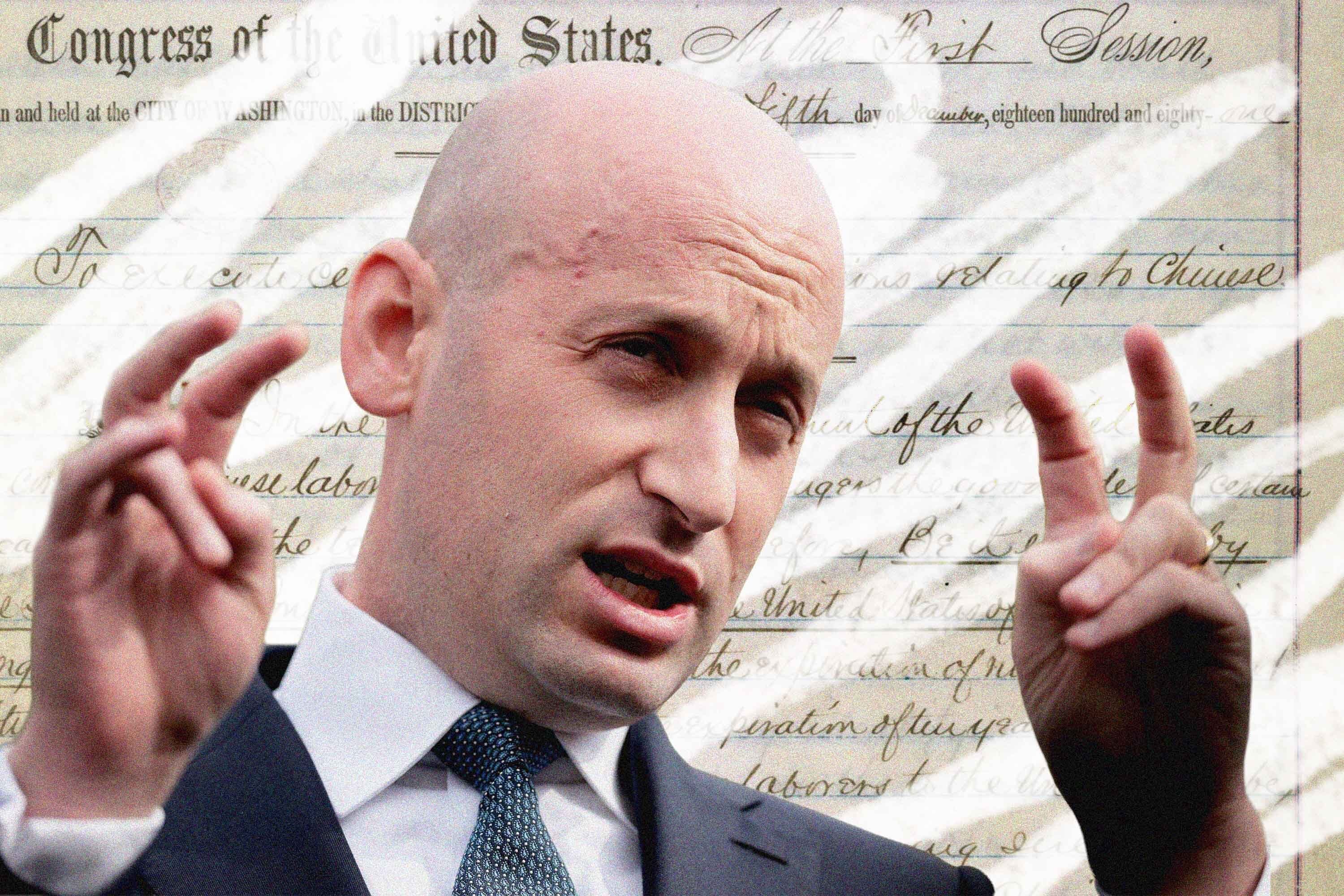
A RACIST LAW THAT INSPIRED MORE RACIST LAWS and was literally named after its racism is definitely not racist. At least according to the Trump administration.
Laser-focused on the midterms, the White House recently released a 162-page report on the most critical issue facing voters: woke museum exhibitions. The report follows a prior Trump executive order complaining about the Smithsonian Institution, which the president said had “come under the influence of a divisive, race-centered ideology.”
This new report, released by the White House Domestic Policy Council, renders in exhaustive, heavily footnoted1 detail all of the Smithsonian’s alleged sins. Among its worst transgressions:
Museum exhibitions acknowledge that some of the nation’s founders were slaveholders.
In a PowerPoint slide in 2022,2 a museum director included an image of a butterfly. This is offensive, the White House report explains, because butterflies are “a well-known symbol in the illegal alien activist community, symbolizing illegal aliens crossing the border from Mexico into the U.S.”
The National Museum of American History refuses to present a single “unified, national narrative,” and instead “asks visitors, ‘How should Americans remember their Revolution and the founding of the nation?’ without providing an answer.” Just as it was taken to pose a threat to the ruling powers in ancient Athens, the Socratic method is apparently an affront to real patriotism today.
But arguably the most telling section of the White House report relates to its defense of the Chinese Exclusion Act of 1882. The report’s authors bristle at any suggestion that this famously racist law may have been motivated by any kind of racial animus. After all, such an acknowledgment might raise uncomfortable questions about the policies of Donald Trump and Stephen Miller—policies that are explicitly modeled on laws like this one.
FOR THOSE UNFAMILIAR: The Chinese Exclusion Act of 1882 was the first major federal law to restrict immigration based on race or nationality. It banned nearly all Chinese laborers from coming to the United States for a decade; it also blocked Chinese immigrants who were already in the United States from ever becoming naturalized citizens. The premise was: If you were of Chinese descent, you were incapable of ever becoming an American, on account of your race.3
The law was born of widespread anti-Chinese sentiment. It was passed amid a decade of growing repression and violence against Chinese immigrants in the Western United States, which resulted in massacres such as those in L.A.’s Chinatown (1871) and at Deep Creek in Oregon (1887), as well as many other acts of violence in the region before and after the bill was made law.
And then as now, economic precarity laid the predicate for virulent nativism. The late nineteenth century was a period of significant economic and technological upheaval owing to industrialization, job displacement, and the country’s evolving geographic footprint (including the completion of the first transcontinental railroad, which relied heavily on Chinese and Irish immigrant labor).
Chinese immigrants were an easy scapegoat for a variety of local troubles, and economic uncertainty and racism became mutually reinforcing.
“The economic part was almost an alibi for the racism,” Columbia University historian and Asian-American studies scholar Mae Ngai tells me. “[White Americans] said they couldn’t compete with Chinese labor because the Chinese could supposedly subsist on just one grain of rice per day. There was something racially inherent about them being cheap.”
If the history (and the name of the law) weren’t clue enough as to the act’s racial framing, in 1889 the Supreme Court explicitly affirmed this as the intention—and offered its blessing:
To preserve its independence, and give security against foreign aggression and encroachment, is the highest duty of every nation. . . . It matters not in what form such aggression and encroachment come, whether from the foreign nation acting in its national character, or from vast hordes of its people crowding in upon us . . . If, therefore, the government of the United States, through its legislative department, considers the presence of foreigners of a different race in this country, who will not assimilate with us, to be dangerous to its peace and security, their exclusion is not to be stayed because at the time there are no actual hostilities with the nation of which the foreigners are subjects. The existence of war would render the necessity of the proceeding only more obvious and pressing. [Emphasis mine.]
In other words, as Ngai put it: “This was a racist law, was openly racist at the time, and the Court upheld its racism under the rubric of national security.”
The White House would prefer to ignore this inconvenient history. In its new report, the administration draws attention to a museum exhibition’s display text about the law, which falsely—the memo claims—portrays “restrictive immigration laws as a tool of white supremacy.” It continues:
[The exhibition] alleges that when “thousands of Chinese journeyed to the American West, encouraged by the promise of gold rush opportunity” in the 1850s, “[t]heir race . . . troubled white Americans,” leading to the 1882 Chinese Exclusion Act, “the first of many restrictive immigration laws.” Another states, “White laborers considered the Chinese competition and responded with hostility.”4 [Emphasis mine.]
How scandalous to characterize totally run-of-the-mill economic anxiety as racist, amiright?
Even if the law had been motivated merely by race-neutral economic objectives—despite all available evidence suggesting otherwise—it still would have failed. Recent research on the economic fallout of the Chinese Exclusion Act found that it slowed overall economic growth in the West, hurt manufacturing output, and even “reduced the labor supply and the quality of jobs held by white and U.S.-born workers, the intended beneficiaries of the Act.”
Support our coverage of economics, policy, and politics, and join our growing pro-democracy community—sign up for a Bulwark+ membership today.
SO YOU CAN IMAGINE why the Trump administration might get a wee bit defensive about anyone offering a critical perspective on this part of our nation’s history, especially since they hope to repeat it.
The 1882 ban on Chinese immigrants was reupped several times over subsequent decades. It became a template for the series of 1920s “national origins” quotas that ratcheted down immigration on racial undesirables from Asia, Africa, and Southern and Eastern Europe.
Trump aide Stephen Miller has frequently held up the era of the racial quota system as the golden age of American history, wherein race-based immigration restrictions were crucial to American global hegemony. (In reality, recent academic research has found that the Quota Acts hurt U.S. economic and scientific development in the mid-twentieth century, and that we benefited from quota repeal in 1965.)
Some of Miller’s rhetoric is spookily reminiscent of rhetoric around the 1882 law, as Stuart Anderson, the executive director of the pro-immigration National Foundation for Economic Policy, has pointed out. Both Miller and politicians who flogged the Exclusion Act in 1882 claimed that people from lowly5 countries could not ever truly become Americans, and were polluting our populace.
“You are not just importing individuals. You are importing societies,” Miller said last year. “No magic transformation occurs when failed states cross borders. At scale, migrants and their descendants recreate the conditions, and terrors, of their broken homelands.”
Miller is also the architect behind Trump’s proclamation last year prohibitively restricting or outright banning immigration from thirty-nine countries (mostly in Asia and Africa, of course). Courts have recently tried to pare it back; the administration, true to form, complains that judges are improperly imputing a racial motive to what is obviously a boring, benign, totally reasonable policy to benefit America First.
Ramparts
— Since Trump’s One Big Beautiful Bill became law last year, about one million fewer kids are enrolled in food stamps. That’s based on available data from seventeen states that break down recipients by age, according to the Center on Budget and Policy Priorities. Can’t blame this economic hardship on immigrants, though I’m sure the Trump administration will try.
— Reconciliation 3.0 is now upon us. While there have been concerns that Republican lawmakers would cut safety-net benefits further to pay for the war, instead they’re just adding to the deficit. But don’t worry, they also have $3.4 trillion in unspecified “government-wide savings.” (Relatedly, I will binge on cookies tonight, but still plan to lose weight through unspecified diet and exercise.)
— Truth Social will sell Wall Street firms earlier access to market-moving posts from Trump. If only we had a functional Securities and Exchange Commission, or a competently run FBI, or really any part of government that still paid attention to things like market manipulation and other white-collar crimes. We don’t.
— Instead, I guess this is what the FBI investigates now.
— The share of job-seekers out of work for six months or longer is also hovering near its highest level in five years.
— The Writers Guild is suing to block the Paramount–Warner Bros. Discovery merger, a day after a group of twelve state attorneys general also sued to block the deal. The guild says that the new entity would control about 35 percent of writing jobs for those working on top-grossing films and 36 percent of television projects.
— It seems we’re about to tariff lamb imports? Why?
— Costs of climate change not always tabulated in the standard numbers: The Guardian reports that recent heatwaves likely killed about 2,700 people in England and Wales. (If only there were some kind of technology that could help avert those deaths. . .)
There are 522 footnotes.
As of this writing, the video of this scandalous PowerPoint has gotten about 150 views on YouTube.
This ultimately led to a court battle over birthright citizenship as well, in a case that also centered on an American of Chinese descent.
The White House was apparently so troubled by the language of this exhibition that the report included this exact paragraph, word-for-word, twice.
What’s nineteenth-century speak for “shithole”?
If Miller likes something, it's a pretty reliable litmus test that it's racist. He's such a caricature of villian that it would be funny if he weren't in the administration.
Stephen Miller is having a hard time integrating into US society. He should take a civics remedial course.